Clodura.ai vs Leadsforge 2026: Which B2B Sales Tool Wins?
Clodura.ai is a full sales-intelligence suite; Leadsforge is an AI list builder. We break down data, pricing, and accuracy so you pick the right stack in 2026.
Clodura.ai vs Leadsforge: The 2026 B2B Prospecting Showdown
This cloduraai vs leadsforge comparison weighs two very different tools. Both promise the same thing: more qualified pipeline, faster. Clodura.ai is an all-in-one sales-intelligence platform. It bundles a contact database, sequencing, and intent signals. Leadsforge takes a simpler path. You describe your ideal customer in plain words, and it builds a list. So the choice is easy to frame. Do you want to own more tooling, or just get a clean list fast?
TL;DR#
- Clodura.ai is a heavyweight suite. You get a large B2B database, intent data, and built-in email sequencing in one place.
- Leadsforge is a light, AI-chat lead generator. You describe your ideal customer, and it returns a list. There is far less to manage.
- Pick Clodura.ai if you want one tool to source, sequence, and track outbound. Pick Leadsforge if you only need fresh lists and already own your outreach stack.
- Neither verifies data first. Bundled databases drift, and AI list builders can invent contacts. Run any export through a dedicated email verifier before you send.
- For accuracy-critical outbound, a focused email finder like Tomba pairs well with either tool. That beats trusting one bundled source alone.
What is Clodura.ai?#
Clodura.ai is a B2B sales-intelligence platform. It targets teams that want sourcing and outreach in one login. Its pitch is breadth. You get a database of hundreds of millions of contacts, direct-dial numbers, org charts, technographics, and buyer-intent signals. An email-sequencing engine and analytics sit on top.
The appeal is clear for a small or mid-size team. You may not want to stitch together five subscriptions. So you search the database, build a list, drop contacts into a cadence, and track replies. You never leave the tool.
The trade-off is simple. Bundled databases are generalists. One vendor maintains contacts across every industry and region. Freshness then varies a lot by segment. You also inherit whatever decay rate that single source carries.
Clodura also leans on intent data. These signals show that an account is researching a category. That can help you prioritize. Just treat intent as a tie-breaker for sequencing order. It is not proof that an email still works.
What is Leadsforge?#
Leadsforge is an AI-first lead-generation tool. It is built around a chat interface. You do not filter a database with dropdowns. Instead, you tell it who you want — "VP of Engineering at Series B fintech companies in the US." It then builds a list for you. The product suits founders and lean teams. Many of them find traditional sales UIs overwhelming.
That simplicity is the whole value. There is almost no learning curve. You can go from idea to list in minutes. But every AI list builder carries one risk. When a model infers contact details, it can produce confident emails that no one checked. A clean-looking CSV is not the same as a deliverable one.
Think of Leadsforge as a sourcing layer, not an outreach platform. You still bring your own sending tool. You bring your own warmup. And, above all, you bring your own verification step.
Cloduraai vs Leadsforge: how do they compare?#
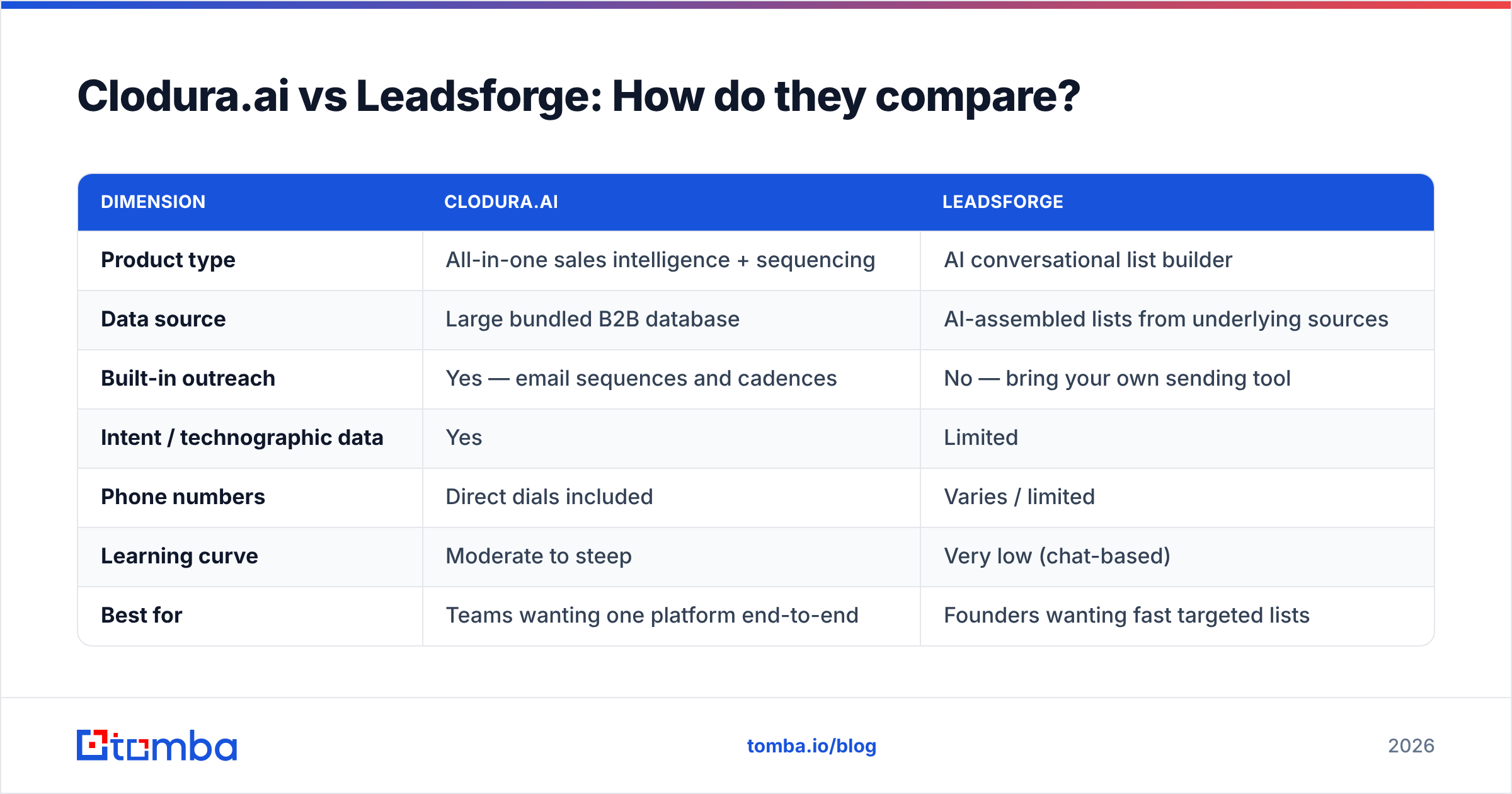
Here is the core breakdown. These are the dimensions that actually change your results.
| Dimension | Clodura.ai | Leadsforge |
|---|---|---|
| Product type | All-in-one sales intelligence + sequencing | AI conversational list builder |
| Data source | Large bundled B2B database | AI-assembled lists from underlying sources |
| Built-in outreach | Yes — email sequences and cadences | No — bring your own sending tool |
| Intent / technographic data | Yes | Limited |
| Phone numbers | Direct dials included | Varies / limited |
| Learning curve | Moderate to steep | Very low (chat-based) |
| Best for | Teams wanting one platform end-to-end | Founders wanting fast targeted lists |
| Verification | Basic, bundled | Minimal — verify externally |
| Typical fit | SMB to mid-market sales teams | Solo founders, lean startups |
The pattern is clear. Clodura.ai gives you more surface area. Leadsforge gives you less friction. Neither is wrong. They solve for different buyers.
Which one fits your motion?#
Use these as quick decision rules:
- You run a structured outbound team with SDRs. Clodura.ai's sequencing and intent layer earns its keep, because you consolidate tools.
- You are a founder doing your own prospecting. Leadsforge removes the UI tax and gets you a list with no training.
- You already own Instantly, Smartlead, or HubSpot for sending. Leadsforge slots in as a pure sourcing layer. Clodura's bundled outreach would overlap.
- Your deliverability is fragile. Neither tool replaces a real verification pass, so budget for one anyway.
- You sell into niche or technical segments. Test both against your exact ICP. Bundled-database accuracy swings hard by vertical.
Is data accuracy the real differentiator?#
Yes. And it is where both tools share the same weakness. Accuracy decides whether your campaign lands in the inbox or the spam folder. Feature count does not. A bundled database is only as fresh as its last refresh. And B2B data decays fast. People change jobs. Companies rebrand domains. Role titles shift every quarter. Industry estimates put B2B contact decay near 2.5% to 3% per month. Over a year, that adds up to a very stale list.
Leadsforge faces a related problem. When an AI assembles a list, it can guess an email format that looks right — first.last@company.com. It may never confirm the mailbox exists. That guess can bounce. A wave of bounces then drags down your sender reputation for every future campaign.
This is why the best 2026 stacks split sourcing from verification. You let Clodura.ai or Leadsforge find the candidate. Then you confirm the address on your own. A catch-all verifier catches domains that accept everything and tell you nothing. A standard verification pass removes dead addresses before they touch your sending domain.
How does pricing compare?#
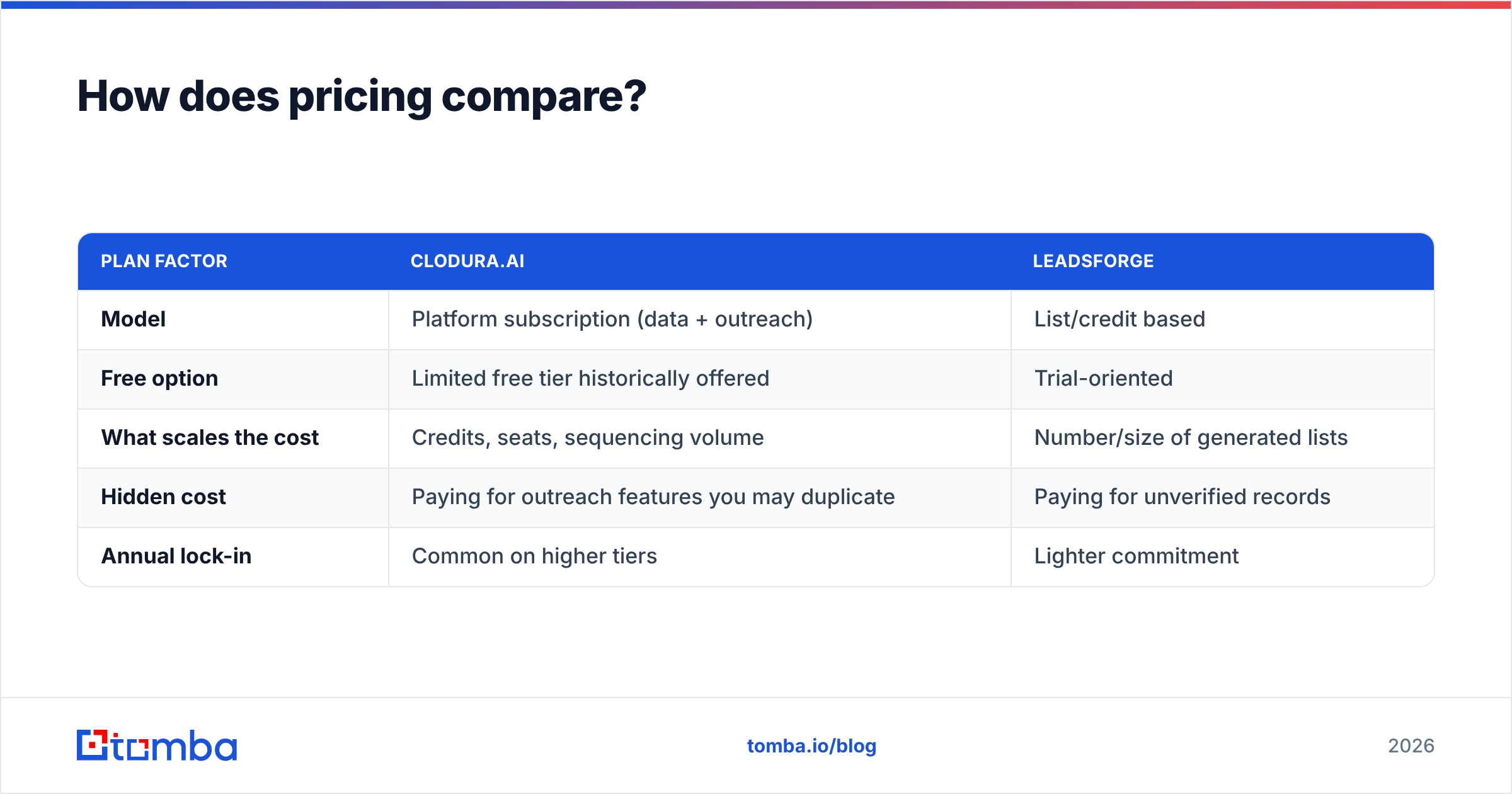
Both tools price by tier. Both gate the things that matter — credit volume, exports, and seats — behind higher plans. Always check current numbers on each vendor's own page, since SaaS pricing moves. But the structure is consistent. Clodura.ai charges for a platform. Leadsforge charges for lists.
| Plan factor | Clodura.ai | Leadsforge |
|---|---|---|
| Model | Platform subscription (data + outreach) | List/credit based |
| Free option | Limited free tier historically offered | Trial-oriented |
| What scales the cost | Credits, seats, sequencing volume | Number/size of generated lists |
| Hidden cost | Paying for outreach features you may duplicate | Paying for unverified records |
| Annual lock-in | Common on higher tiers | Lighter commitment |
The hidden-cost line matters most. With Clodura, you can pay for a sequencing engine you already replaced. With Leadsforge, you can pay per record and still need to verify it. That means paying twice for one usable contact. So factor verification into the true cost of either tool.
For reference, a specialist like Tomba keeps sourcing affordable and predictable. There is a free tier with 25 searches per month. After that, Starter is $49/mo, Growth is $99/mo, and Pro is $249/mo. You do not subsidize bundled features you will not use. See the full Tomba pricing breakdown to compare credit for credit.
Where does a dedicated email finder fit?#
A dedicated finder fills the accuracy gap. Both all-in-one suites and AI list builders leave that gap open. Think of Clodura.ai as a department store and Leadsforge as a personal shopper. Both are convenient. Neither one specializes in confirming that the item in your cart works. A focused tool does one job very well. It returns a verified, deliverable address.
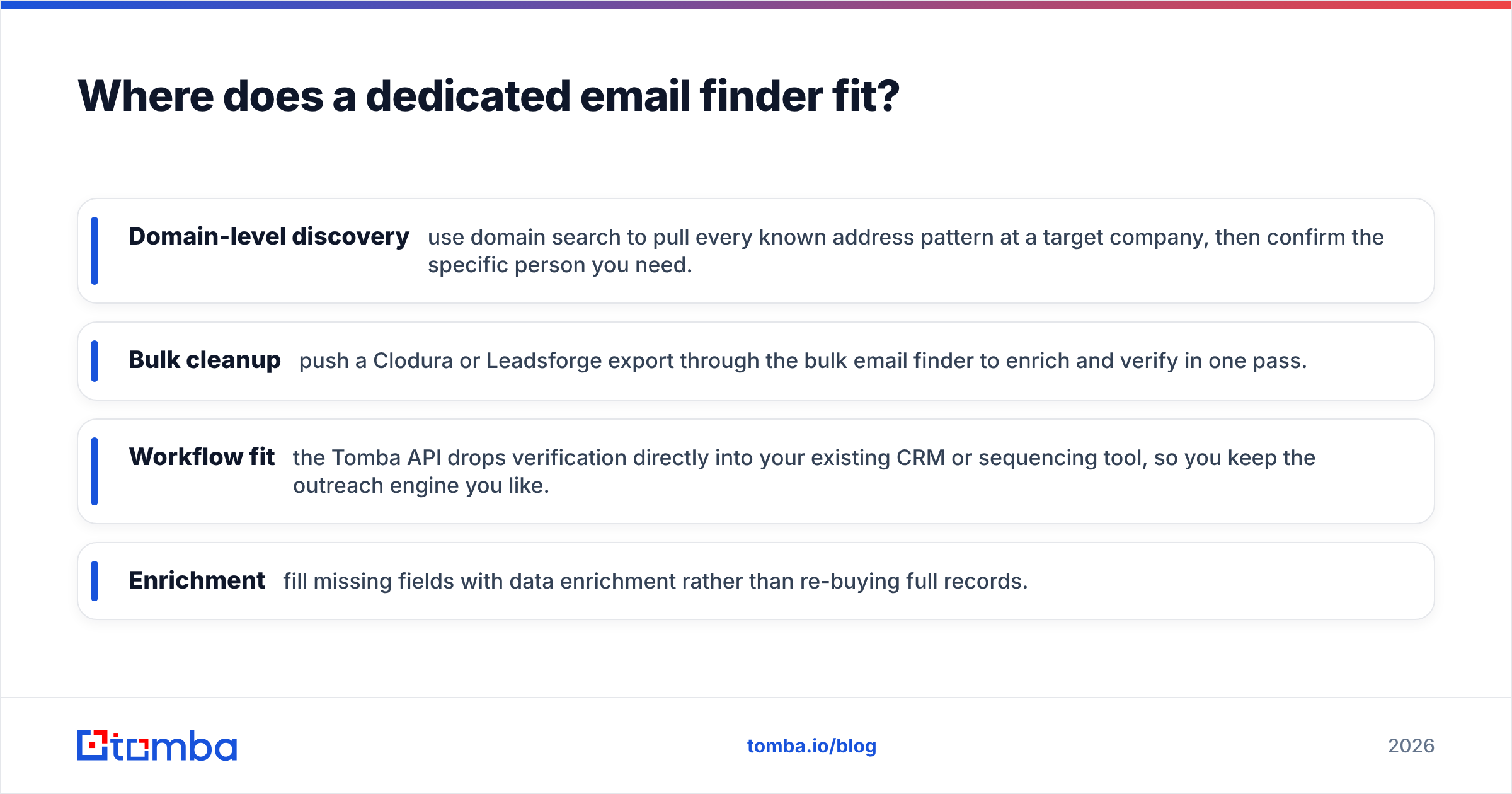
This is the lane Tomba sits in. It does not ask you to trust a single bundled source. Instead, Tomba cross-references multiple data sources and verifies at lookup time. Here are a few ways it complements either platform:
- Domain-level discovery — use domain search to pull every known address pattern at a company. Then confirm the person you need.
- Bulk cleanup — push a Clodura or Leadsforge export through the bulk email finder to enrich and verify in one pass.
- Workflow fit — the Tomba API drops verification into your CRM or sequencing tool. You keep the outreach engine you like.
- Enrichment — fill missing fields with data enrichment instead of re-buying full records.
The point is not to replace Clodura or Leadsforge. It is to stop treating sourcing and verification as one step. They are not the same step.
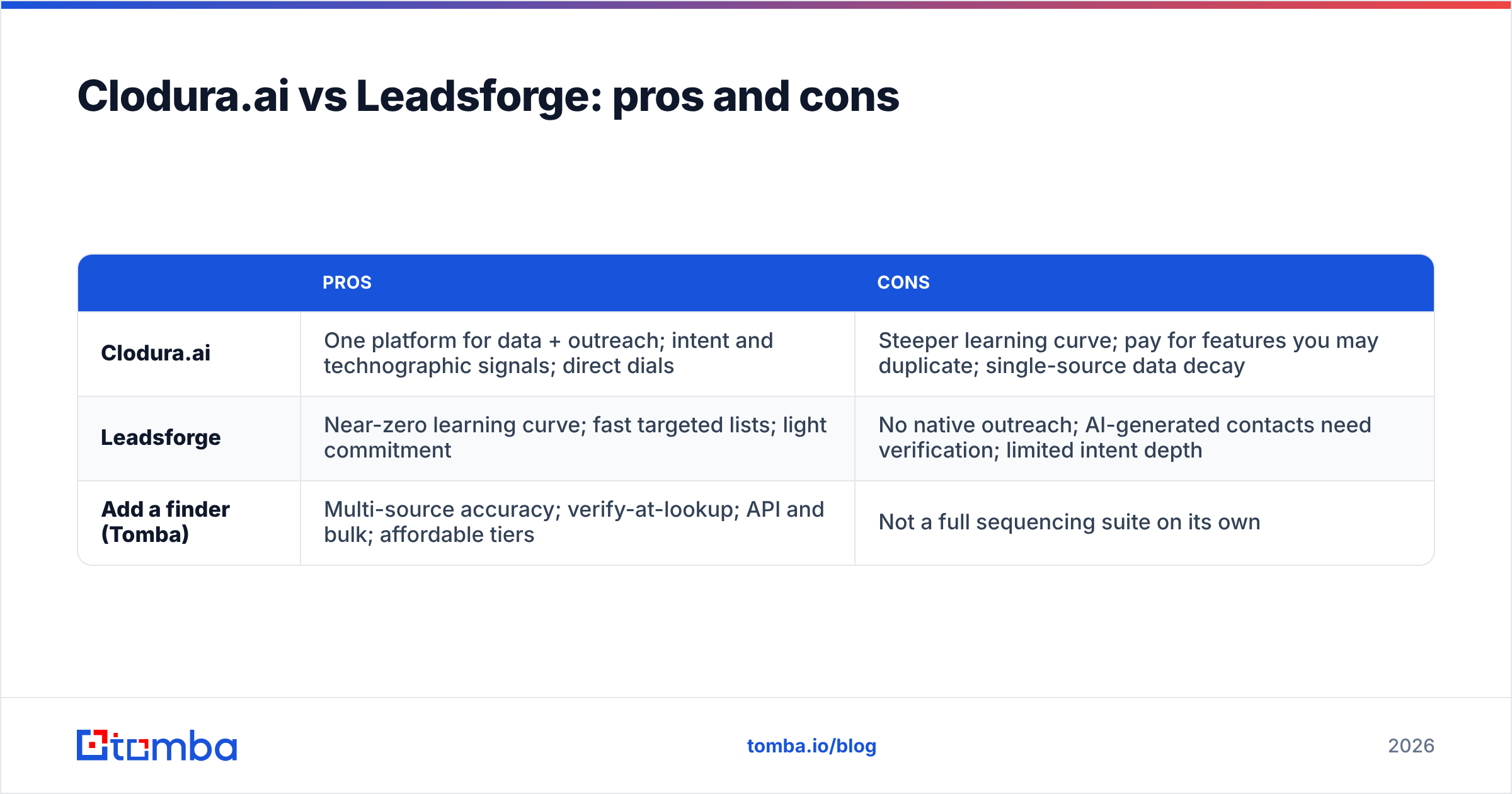
Clodura.ai vs Leadsforge: pros and cons#
| Pros | Cons | |
|---|---|---|
| Clodura.ai | One platform for data + outreach; intent and technographic signals; direct dials | Steeper learning curve; pay for features you may duplicate; single-source data decay |
| Leadsforge | Near-zero learning curve; fast targeted lists; light commitment | No native outreach; AI-generated contacts need verification; limited intent depth |
| Add a finder (Tomba) | Multi-source accuracy; verify-at-lookup; API and bulk; affordable tiers | Not a full sequencing suite on its own |
Which should you choose in 2026?#
Choose by what you are missing, not by feature lists. Say your gap is infrastructure. You have no sequencing, no cadence tracking, and no intent data. Then Clodura.ai folds all of that into one bill and one login. That consolidation is genuinely valuable for a growing team. Say your gap is just targeted names, fast. And you already run a sending stack. Then Leadsforge gets you there with the least friction and the lowest commitment.
But notice what neither tool solves alone. That is trustworthy, verified deliverability at the moment of send. A bundled database drifts. An AI list builder guesses. In both cases, the fix is the same. Split sourcing from verification, and let a specialist confirm the address first. Independent reviews on G2 and Capterra echo this theme. Users love breadth and speed. They consistently flag data freshness as the thing that bites them later. You can also test each vendor's own claims at clodura.ai before you commit budget.
The strongest 2026 setup is rarely one tool. It is a sourcing tool you like — Clodura.ai or Leadsforge — plus a verification-first finder. That finder makes sure the records are real.
Final recommendation#
Start with the platform that matches your gap. Then bolt on accuracy. Want to stop paying for unverified records? Want to send against confirmed, deliverable addresses? Run your lists through the Tomba Email Finder. It cross-checks multiple sources and verifies at lookup. It plugs into whatever outreach engine you already run. So Clodura.ai or Leadsforge handles discovery, and Tomba makes sure every email lands. Spin up the free tier. Push a sample list through it. Measure your bounce rate before and after. The difference is usually the whole argument.
// get started
Find, verify and enrich your first contacts today
Start on the free plan with 25 searches a month, then scale when your team is ready.
Free plan · No credit card required · GDPR & CCPA
// about the author