Clodura.ai vs LeadsGorilla 2026: Which Lead Tool Wins?
Clodura.ai targets B2B SaaS prospecting; LeadsGorilla hunts local agency leads. We compare data, pricing, and accuracy so you pick the right engine for 2026.
Clodura.ai vs LeadsGorilla: Which Lead Tool Actually Fits Your Pipeline in 2026?
Two tools, two completely different jobs. Most "Clodura.ai vs LeadsGorilla" comparisons treat them as rivals, but they barely overlap. Pick the wrong one and you'll pay for features you never touch.
TL;DR#
- Clodura.ai is a B2B sales-intelligence platform: a 600M+ contact database, intent signals, org charts, and sequencing aimed at SaaS and outbound teams.
- LeadsGorilla is a local-business lead generator for agencies: it scrapes Google, Facebook, and Yelp to find SMBs with weak online presence you can pitch services to.
- They are not direct competitors — Clodura sells you decision-makers at tech companies; LeadsGorilla sells you a list of plumbers without a Google Business profile.
- Both struggle with the same bottleneck: email accuracy. Neither is a dedicated verification engine, so bounce rates climb without a second layer.
- If your real goal is clean, deliverable email addresses, pair either tool with a focused email finder and email verifier instead of trusting raw exports.
What is Clodura.ai?#
Clodura.ai is a B2B sales-intelligence and prospecting platform. Think of it as a phone book for the entire tech economy, with a sales sequencer bolted on. You search by company size, industry, technology stack, or buying intent, then export verified-ish contacts directly into an outreach campaign.
Its headline assets:
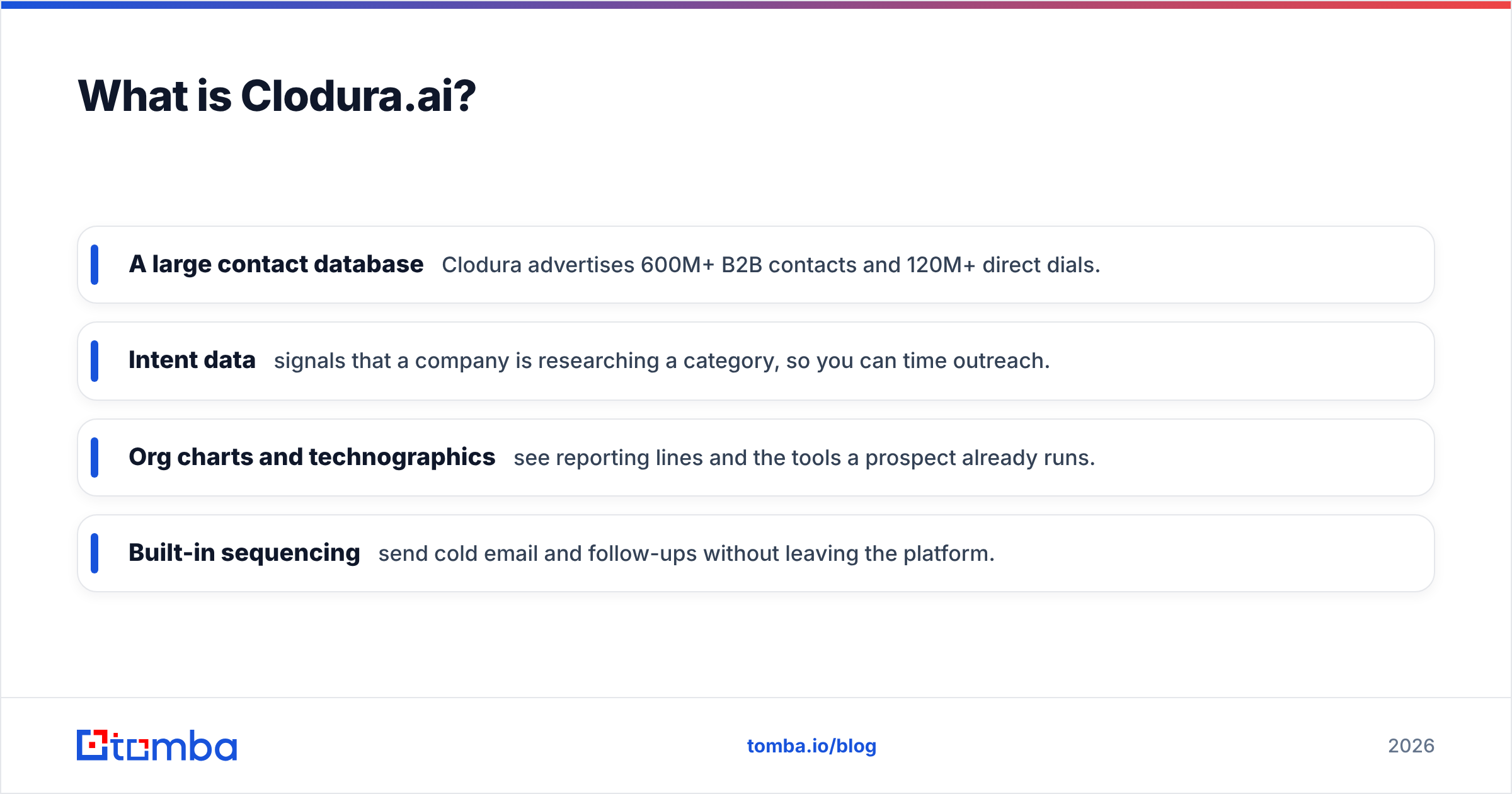
- A large contact database — Clodura advertises 600M+ B2B contacts and 120M+ direct dials.
- Intent data — signals that a company is researching a category, so you can time outreach.
- Org charts and technographics — see reporting lines and the tools a prospect already runs.
- Built-in sequencing — send cold email and follow-ups without leaving the platform.
The target user is an SDR, founder, or RevOps lead running outbound into other businesses, especially software and services companies. You can read more on the Clodura.ai homepage.
What is LeadsGorilla?#
LeadsGorilla is a local-lead-generation tool built for marketing agencies and freelancers. Instead of indexing global B2B databases, it scrapes local directories — Google Maps, Facebook, Yelp — and scores small businesses on how "fixable" their online presence is.
Its core moves:
- Local scraping — pull every dentist, gym, or restaurant in a ZIP code.
- Lead scoring (the "LeadScore") — flag businesses with no website, bad reviews, unclaimed listings, or missing Facebook pixels.
- Report generation — auto-build an audit PDF you hand to the prospect ("here's why your Google ranking is bad").
- Contact capture — grab the business phone, email, and address from the listing.
The target user is an agency owner selling SEO, web design, ads, or reputation management to brick-and-mortar SMBs. See the official LeadsGorilla site for the latest feature set.
Clodura.ai vs LeadsGorilla: How do they compare head-to-head?#
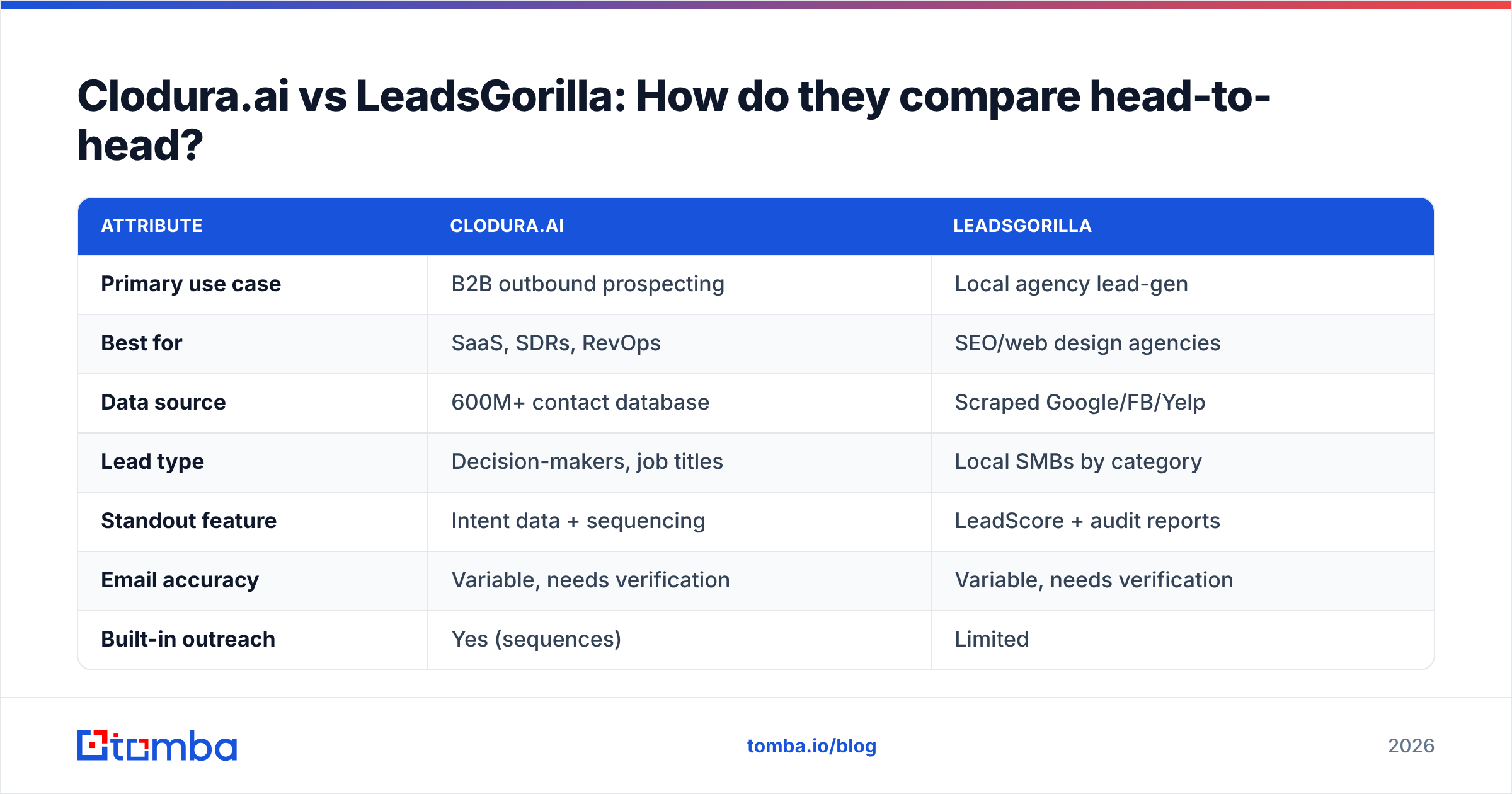
Here's the core split. One sells you who to email at a tech company; the other sells you which local shop needs your agency.
| Attribute | Clodura.ai | LeadsGorilla |
|---|---|---|
| Primary use case | B2B outbound prospecting | Local agency lead-gen |
| Best for | SaaS, SDRs, RevOps | SEO/web design agencies |
| Data source | 600M+ contact database | Scraped Google/FB/Yelp |
| Lead type | Decision-makers, job titles | Local SMBs by category |
| Standout feature | Intent data + sequencing | LeadScore + audit reports |
| Email accuracy | Variable, needs verification | Variable, needs verification |
| Built-in outreach | Yes (sequences) | Limited |
| Entry pricing | ~$33–$83/user/mo (annual) | One-time + plan tiers |
| Free option | Free plan available | Trial-based |
| Phone data | Direct dials included | Listing phone only |
The takeaway: if your buyers sit inside other companies, Clodura is built for you. If your buyers are small companies, LeadsGorilla is the better hunting ground. Comparing them on the same spreadsheet only makes sense if you genuinely run both motions — most teams don't.
Which one has better data quality?#
Neither tool is a verification engine, and that's the part teams underestimate. Both can hand you a record that looks complete and still bounces.
Clodura pulls from a maintained B2B database, so coverage of company-level firmographics is strong. But individual email addresses age fast — people change jobs, domains migrate, and catch-all servers hide invalid mailboxes. Clodura verifies on its side, yet independent reviews on G2 consistently mention stale or missing emails in exports.
LeadsGorilla's data is only as fresh as the directory it scraped this morning. Local listings are notoriously inconsistent: a generic info@ inbox, a personal Gmail, or no email at all. That's fine for a cold call, weaker for a deliverability-sensitive cold-email campaign.
The fix in both cases is the same — treat the export as a starting list, not a finished one. Run every address through a dedicated email verification step, and use a catch-all verifier for the domains that hide behind accept-all servers. A 30% bounce list will torch your sender reputation faster than any tool can rebuild it.
How does pricing compare?#
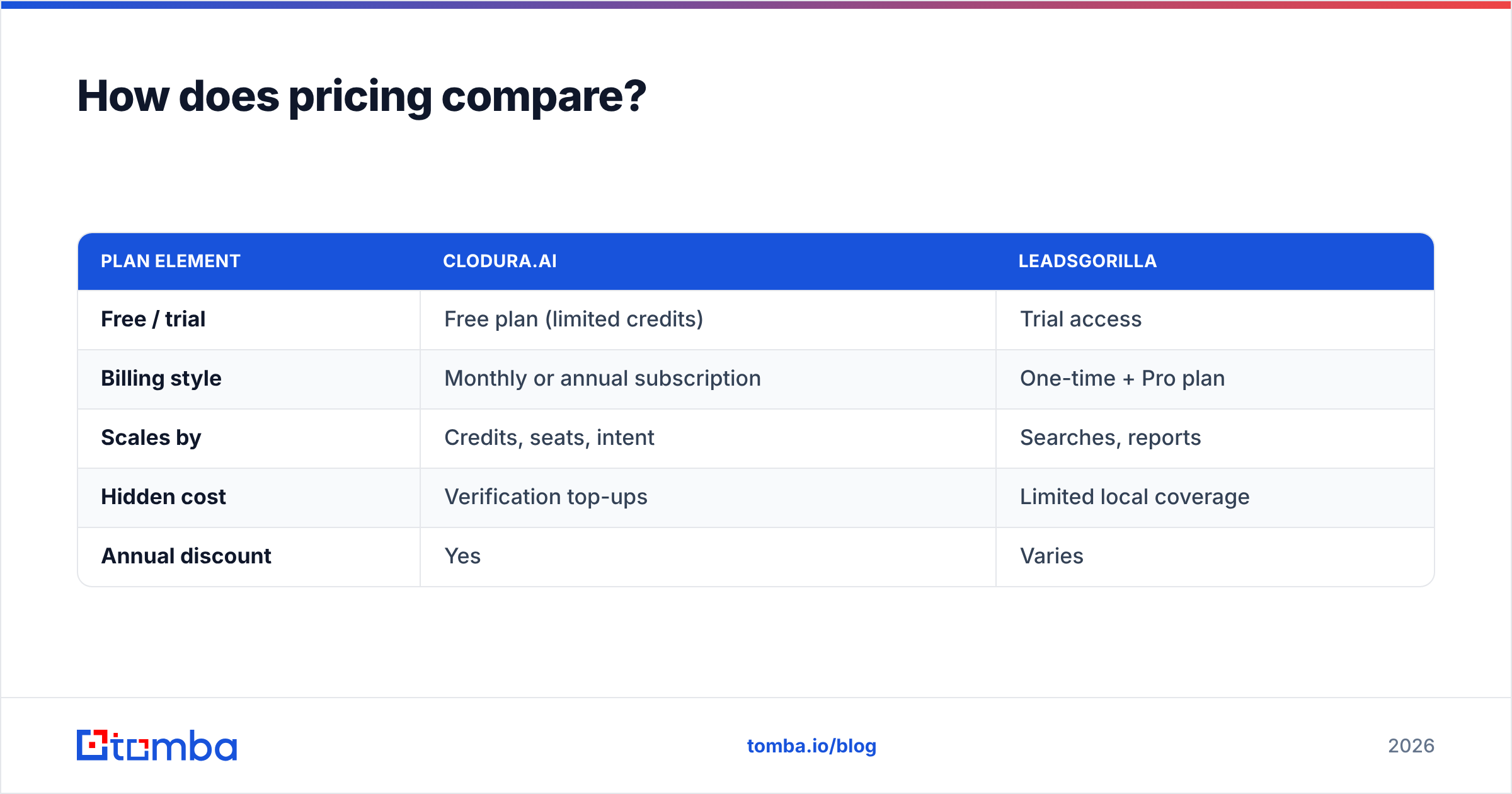
Pricing models are structured differently, which makes a like-for-like number hard.
Clodura.ai runs a per-user SaaS subscription with a free tier (limited credits), then paid plans that scale by credits, intent access, and sequencing seats. Annual billing pushes the effective monthly cost down. You're paying for database access plus the outreach engine.
LeadsGorilla historically used a lifetime/one-time deal plus a Pro subscription, with limits on searches and report generation. Agencies like the one-time entry, but heavy users hit monthly caps and upgrade.
| Plan element | Clodura.ai | LeadsGorilla |
|---|---|---|
| Free / trial | Free plan (limited credits) | Trial access |
| Billing style | Monthly or annual subscription | One-time + Pro plan |
| Scales by | Credits, seats, intent | Searches, reports |
| Hidden cost | Verification top-ups | Limited local coverage |
| Annual discount | Yes | Varies |
Whichever you choose, budget for a separate verification or enrichment layer. That line item is easy to forget and it's the one that protects your deliverability. If you want to model total cost, compare the verification tooling against transparent Tomba pricing before committing.
Is Clodura.ai better than LeadsGorilla?#
It depends entirely on who you sell to — there is no universal winner.
Choose Clodura.ai if:
- You sell B2B, especially software or services, to other companies.
- You need decision-maker contacts — VPs, directors, founders — with job titles and direct dials.
- You want intent signals to prioritize accounts that are actively in-market.
- You run sequences and want prospecting plus outreach in one tab.
Choose LeadsGorilla if:
- You run an agency selling to local SMBs (SEO, web, ads, reputation).
- You prospect by geography and category, not by job title.
- You sell on the audit — the auto-generated report is your foot in the door.
- You prefer a one-time entry cost over a per-seat database subscription.
If you read those two lists and only one describes you, your decision is already made. If both describe you — say, an agency that also sells SaaS — run both for their distinct jobs rather than forcing one to do everything.
What about the missing piece — clean contact data?#
Here's the gap neither tool fully closes: turning a company or a listing into a verified, person-level email you can actually reach.
Clodura gives you a name and a company. LeadsGorilla gives you a business and a listing. In both cases you frequently still need to find the right individual's address and confirm it's live. That's a contact-data problem, not a database or scraping problem.
This is where a focused tool earns its place beside either platform:
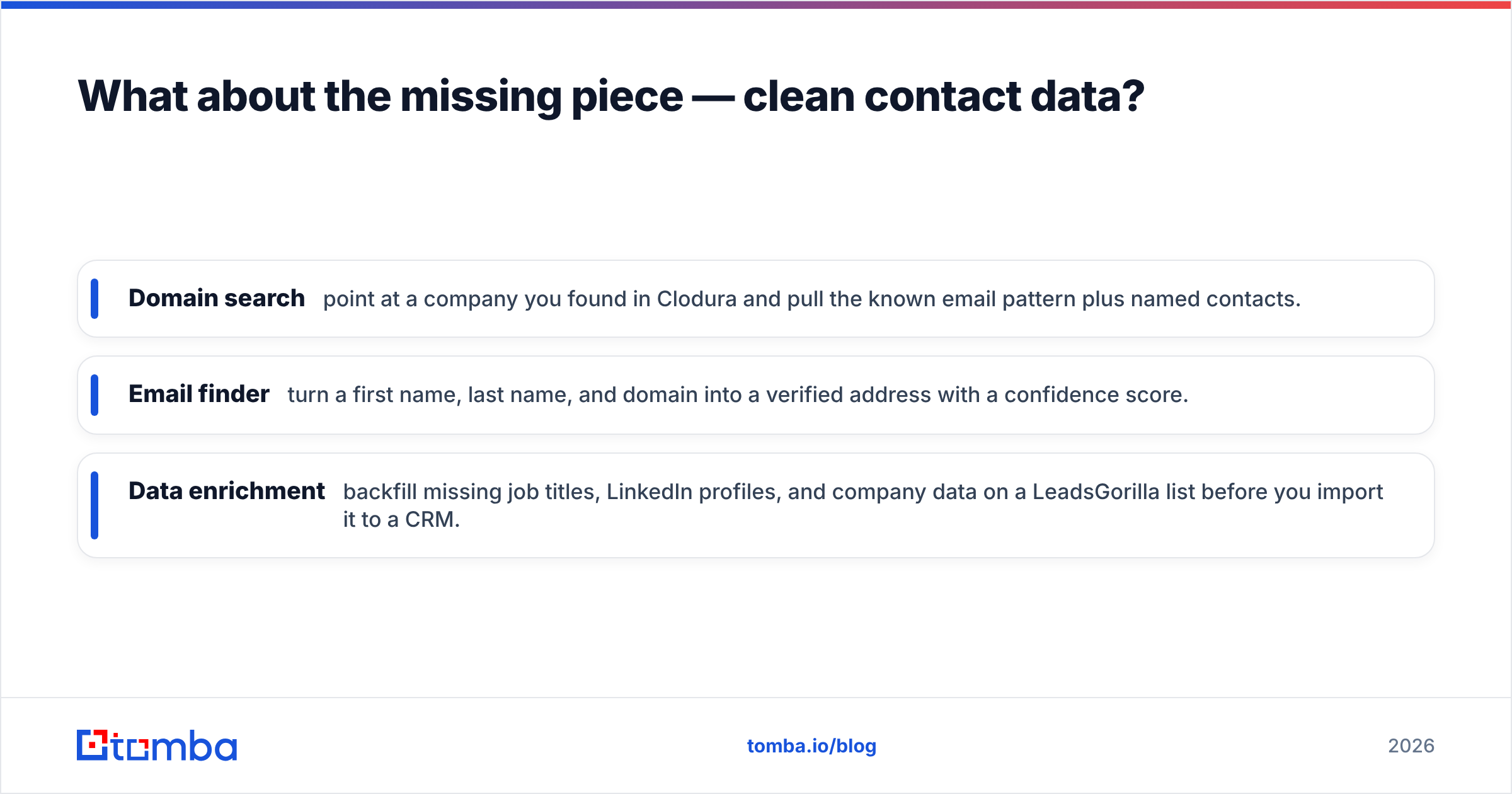
- Domain search — point at a company you found in Clodura and pull the known email pattern plus named contacts.
- Email finder — turn a first name, last name, and domain into a verified address with a confidence score.
- Data enrichment — backfill missing job titles, LinkedIn profiles, and company data on a LeadsGorilla list before you import it to a CRM.
The mental model: let Clodura or LeadsGorilla do discovery, then let a contact-data engine do verification and enrichment. Discovery tools optimize for breadth; verification tools optimize for accuracy. Asking one product to be world-class at both is how bounce rates creep past 10%.
How do they handle outreach and follow-up?#
Clodura wins on built-in outreach. Its sequencer lets you queue cold email, schedule follow-ups, and track replies without exporting anywhere. For a small outbound team that wants one tool, that consolidation is genuinely useful — though dedicated outreach platforms still beat it on deliverability controls and A/B testing.
LeadsGorilla is thinner here. It's a discovery-and-audit tool first; outreach is mostly "export the contact and email or call them yourself." Agencies typically pair it with their own email or calling stack.
For either workflow, the limiting factor is still list hygiene. A great sequence sent to unverified addresses gets throttled by spam filters regardless of how good the copy is. Keep your email deliverability clean by verifying before the first send, and warm the domain properly if you're scaling volume.
Which should you pick in 2026?#
Conclusion first: match the tool to your buyer, then add a verification layer on top of whichever you choose.
- Selling SaaS or B2B services to companies → Clodura.ai for its database, intent data, and sequencing.
- Running an agency selling to local SMBs → LeadsGorilla for its scraping, LeadScore, and audit reports.
- Doing both → run both for their separate jobs; don't expect one to cover the other.
- In every scenario → verify and enrich the contacts before you send, because both tools hand you raw data that ages and bounces.
The honest summary is that "Clodura.ai vs LeadsGorilla" is the wrong fight for most readers. They solve different problems. The shared weakness — contact accuracy — is the thing worth investing in, because it's what determines whether your campaigns land in the inbox or the spam folder.
Get verified, deliverable contacts before you hit send#
Whatever discovery tool you land on, your pipeline lives or dies on whether the emails are real. The Tomba Email Finder turns a name and domain into a verified, confidence-scored address, and the bulk email finder lets you clean an entire Clodura or LeadsGorilla export in one pass. Start free with 25 searches a month, then scale on the $49/mo Starter plan when your outbound is working — no scraped guesswork, just contacts that deliver. Pair discovery with real verification and watch your bounce rate drop where it belongs: near zero.
// get started
Find, verify and enrich your first contacts today
Start on the free plan with 25 searches a month, then scale when your team is ready.
Free plan · No credit card required · GDPR & CCPA
// about the author