Clodura.ai vs Leadzen.ai 2026: B2B Data Tools Compared
Clodura.ai and Leadzen.ai both promise clean B2B contact data and sales intelligence. Here's how they actually compare on accuracy, pricing, and workflow in 2026 — plus where a dedicated finder beats both.
Choosing between Clodura.ai and Leadzen.ai usually comes down to one question your CRM keeps asking: which one gives you contacts your reps can actually reach? Both are pitched as all-in-one B2B sales intelligence platforms, both lean on large contact databases, and both want to live at the top of your outbound funnel. They are not interchangeable.
This breakdown compares the two on the things that decide pipeline — data accuracy, pricing, intent signals, verification, and day-to-day workflow — and is honest about where a focused tool beats a sprawling suite.
TL;DR — Clodura.ai vs Leadzen.ai at a glance#
- Clodura.ai is the more mature sales-intelligence suite: a large contact database, org charts, technographics, intent data, and a built-in sequencer. Best for teams that want prospecting plus light cadence in one login.
- Leadzen.ai leans into real-time lead discovery and an India-heavy dataset with a Chrome extension and search-based prospecting. Best for SMB teams doing high-volume regional outreach.
- Accuracy is the real differentiator. Both ship stale rows; neither verifies aggressively enough on its own. Budget for an independent verification step regardless of which you pick.
- Pricing favors Leadzen for small teams; Clodura scales better for revenue orgs that need intent and org data alongside contacts.
- A dedicated finder + verifier (like Tomba) often beats either suite on cost-per-valid-email when contact data — not cadence — is the bottleneck.
What is Clodura.ai?#
Clodura.ai is a B2B sales prospecting and sales-intelligence platform. It bundles a contact and company database (the vendor cites hundreds of millions of contacts), direct dials, email and cadence tools, org charts, technographic filters, and buyer-intent signals into a single workspace. The pitch is "find, engage, and close" without bolting together five tools.
Where Clodura tends to win is depth of context. You are not just pulling an email; you are pulling the account's tech stack, recent triggers, and a rough map of who reports to whom. For account-based teams that qualify before they reach out, that context shortens research time. You can see more at the official Clodura.ai site.
The trade-off is that breadth dilutes focus. A platform doing ten jobs rarely does any single one at best-in-class quality, and contact verification is usually the job that suffers.
What is Leadzen.ai?#
Leadzen.ai is a lead-generation and prospecting tool built around real-time search and discovery. It offers a database, a Chrome extension for pulling contacts while you browse, and search filters for building lists fast. Its dataset skews toward the Indian and APAC market, which makes it strong for regional SMB outreach and weaker for, say, enterprise North American targeting.
Leadzen's appeal is speed and simplicity. Fewer features, a lighter learning curve, and pricing that small teams can stomach. You can review its current feature set on the Leadzen.ai homepage and cross-check user sentiment on G2 before committing.
The catch mirrors Clodura's: a database-first tool is only as good as how fresh and verified that database is, and real-time discovery does not guarantee a deliverable address.

How do Clodura.ai and Leadzen.ai compare feature by feature?#
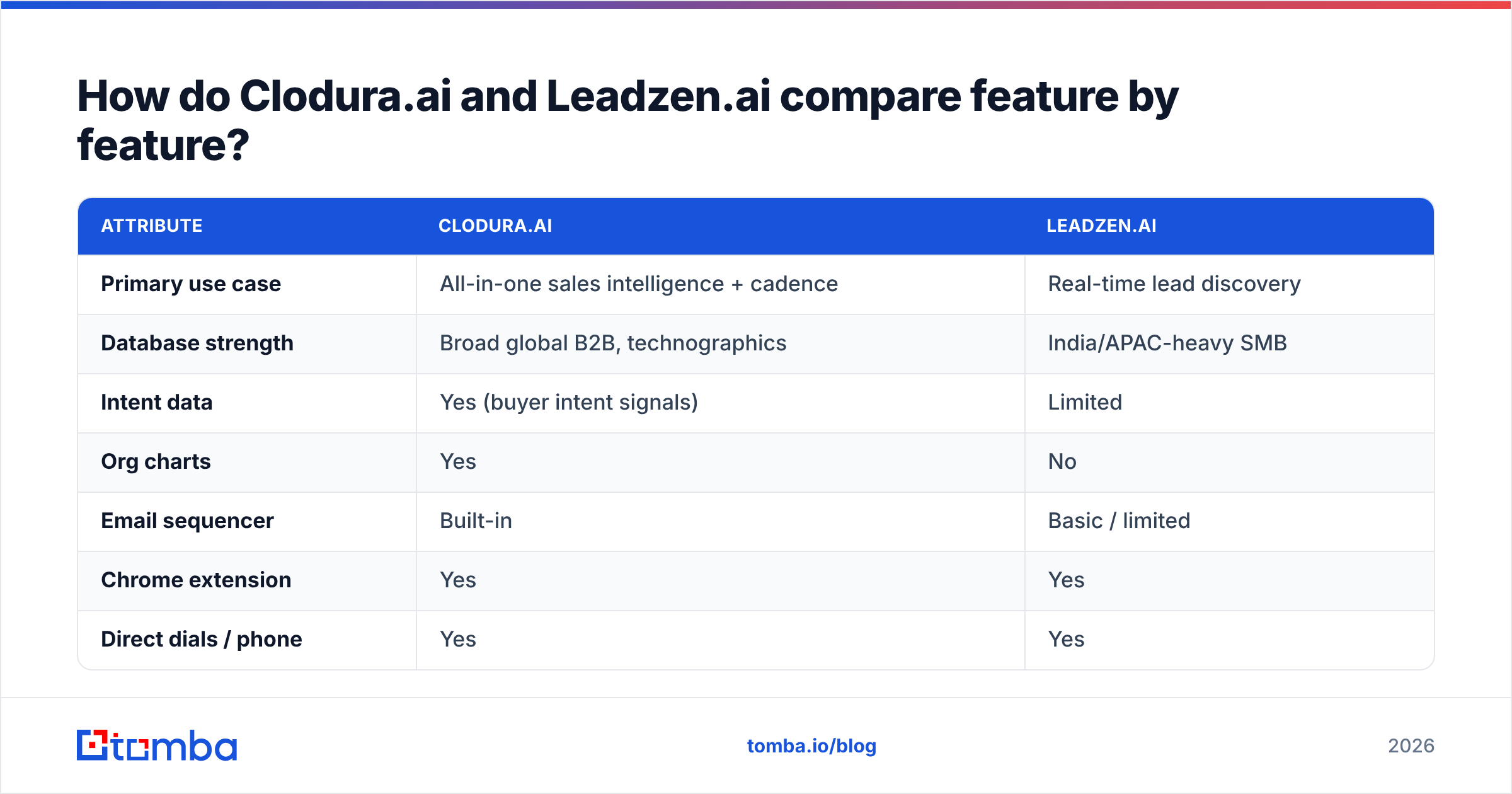
Here is the side-by-side that matters for a buying decision. Treat database sizes as vendor-stated, not independently audited.
| Attribute | Clodura.ai | Leadzen.ai |
|---|---|---|
| Primary use case | All-in-one sales intelligence + cadence | Real-time lead discovery |
| Database strength | Broad global B2B, technographics | India/APAC-heavy SMB |
| Intent data | Yes (buyer intent signals) | Limited |
| Org charts | Yes | No |
| Email sequencer | Built-in | Basic / limited |
| Chrome extension | Yes | Yes |
| Direct dials / phone | Yes | Yes |
| Built-in verification | Light | Light |
| Best fit | Mid-market RevOps teams | SMB regional outreach |
| Free trial | Limited free tier | Limited free tier |
The pattern is clear. Clodura is the heavier platform with intent and org context; Leadzen is the leaner discovery tool with a regional edge. Neither was built to be a verification engine, and that is where teams get burned after the demo.
Which has better data accuracy?#
Accuracy is where both platforms ask you to take their word for it — and where you shouldn't. Vendor-published accuracy rates are marketing numbers measured under ideal conditions, not the bounce rate your reps will see on a Tuesday.
Three realities apply to both tools:
- B2B data decays fast. Roughly 25–30% of contact data goes stale every year as people change roles. A database that was 95% accurate at ingestion is materially worse twelve months later.
- "Found" is not "valid." A row in the database, or a contact pulled by a Chrome extension, is a candidate — not a confirmed mailbox. Catch-all domains hide invalid addresses behind a server that accepts everything.
- Coverage varies by region. Clodura is stronger globally; Leadzen is stronger in India/APAC. Outside its core geography, each tool's hit rate and accuracy both drop.
The practical fix is the same regardless of which suite you choose: run every exported list through an independent email verifier before it touches your sequencer. Verification is cheap; a torched sending domain is not. If you target catch-all-heavy industries, add a catch-all verifier so you aren't flying blind on domains that accept every address.
How do Clodura.ai and Leadzen.ai pricing compare?#
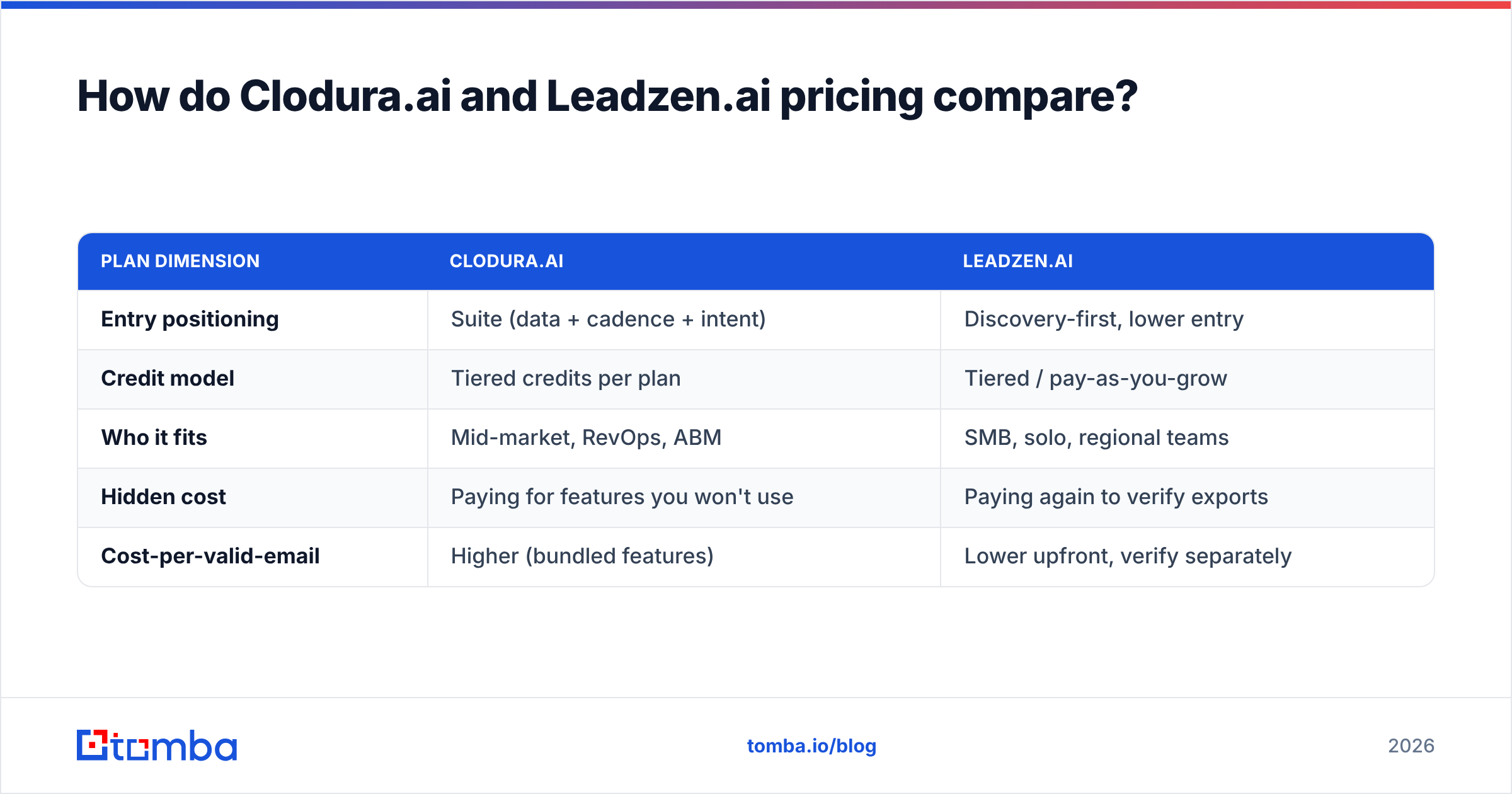
Both vendors gate pricing behind tiers and credit limits, and both publish less than they should, so confirm current numbers directly. The structural difference is what each tier is really selling.
| Plan dimension | Clodura.ai | Leadzen.ai |
|---|---|---|
| Entry positioning | Suite (data + cadence + intent) | Discovery-first, lower entry |
| Credit model | Tiered credits per plan | Tiered / pay-as-you-grow |
| Who it fits | Mid-market, RevOps, ABM | SMB, solo, regional teams |
| Hidden cost | Paying for features you won't use | Paying again to verify exports |
| Cost-per-valid-email | Higher (bundled features) | Lower upfront, verify separately |
The honest read: Leadzen looks cheaper because it does less. Clodura costs more because intent data and org charts are genuinely expensive to maintain — valuable if you use them, dead weight if you don't. For a team whose only real need is reachable contacts, both can be the wrong shape of spend. A usage-based finder with transparent Tomba pricing — Free at 25 searches/mo, Starter at $49/mo, Growth at $99/mo — often beats a seat-plus-credit suite on the metric that counts: dollars per email that actually lands.
When should you pick a dedicated email finder instead?#
Pick a focused email finder over either suite when your bottleneck is contact data, not cadence or research. That is more common than vendors admit.
You likely don't need the full suite if:
- You already own a CRM and a sequencer. Paying Clodura for a second cadence tool is duplicate spend. You need clean inputs, not another sending engine.
- Your lists come from elsewhere — events, LinkedIn exports, scraped firmographics — and you just need the verified email and phone attached. A bulk email finder and enrichment step does exactly that.
- Deliverability is your KPI. When the number you report on is bounce rate and inbox placement, a verifier-first workflow beats a database-first one.
- You build by domain. If you know the company and need the people, domain search turns a website into a list of role-based and named contacts faster than browsing a database UI.
This isn't an argument that suites are useless. Intent data and org charts earn their keep for ABM teams. It's an argument against paying suite prices when a finder-plus-verifier covers 90% of what your outbound actually needs.
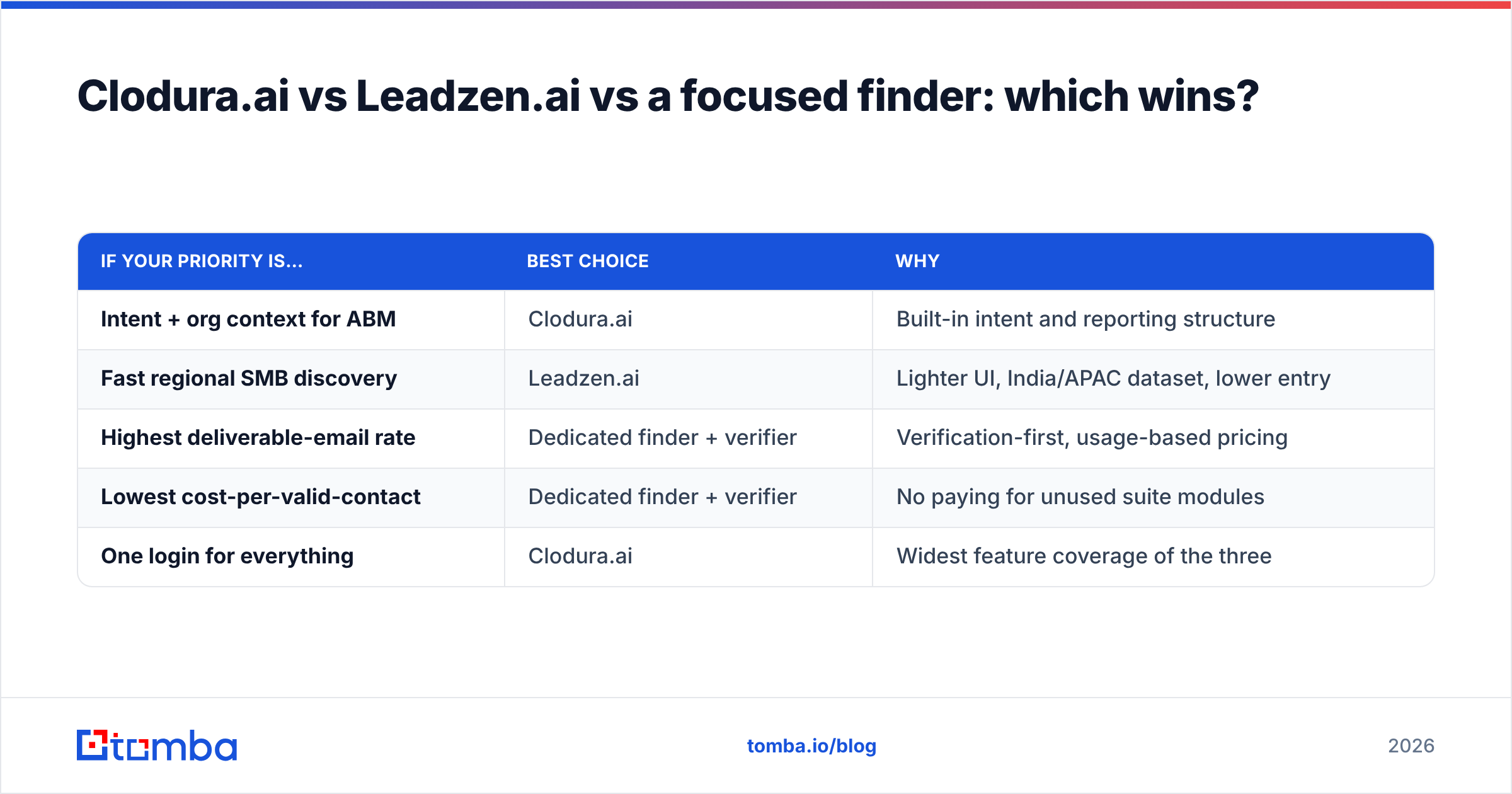
Clodura.ai vs Leadzen.ai vs a focused finder: which wins?#
The right answer depends on what's breaking in your funnel. Map the tool to the bottleneck, not to the longest feature list.
| If your priority is… | Best choice | Why |
|---|---|---|
| Intent + org context for ABM | Clodura.ai | Built-in intent and reporting structure |
| Fast regional SMB discovery | Leadzen.ai | Lighter UI, India/APAC dataset, lower entry |
| Highest deliverable-email rate | Dedicated finder + verifier | Verification-first, usage-based pricing |
| Lowest cost-per-valid-contact | Dedicated finder + verifier | No paying for unused suite modules |
| One login for everything | Clodura.ai | Widest feature coverage of the three |
For most outbound teams in 2026, the smartest stack is a focused finder for clean contacts plus whichever suite you already use for cadence and CRM — rather than betting your deliverability on a single platform's unverified database. Layer in data enrichment to fill firmographic gaps, and you get suite-grade context without suite-grade waste.
How to evaluate either tool before you buy#
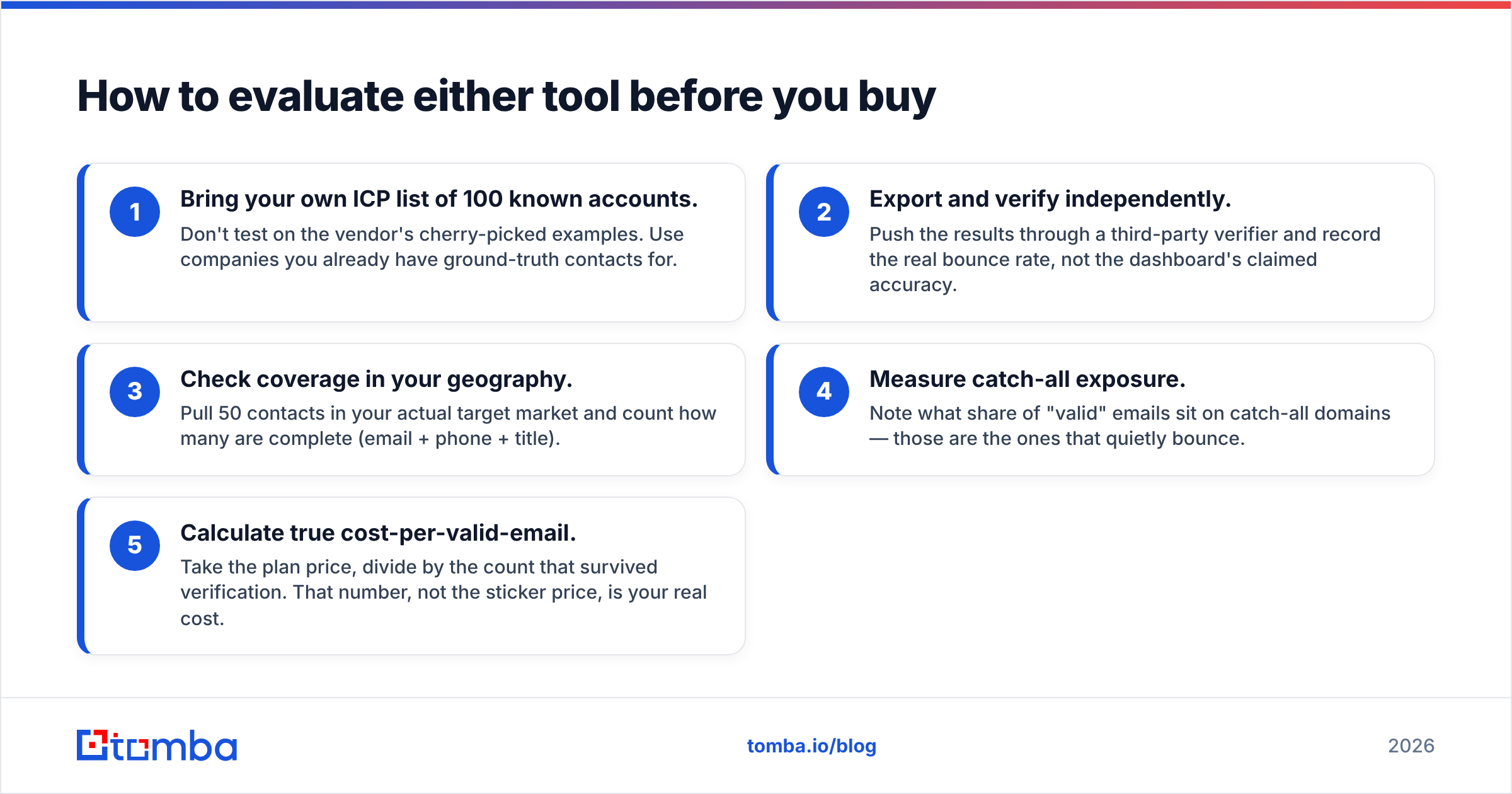
Demos are designed to impress. Run your own test so you compare reality, not slideware. For both Clodura.ai and Leadzen.ai, do this during the trial:
- Bring your own ICP list of 100 known accounts. Don't test on the vendor's cherry-picked examples. Use companies you already have ground-truth contacts for.
- Export and verify independently. Push the results through a third-party verifier and record the real bounce rate, not the dashboard's claimed accuracy.
- Check coverage in your geography. Pull 50 contacts in your actual target market and count how many are complete (email + phone + title).
- Measure catch-all exposure. Note what share of "valid" emails sit on catch-all domains — those are the ones that quietly bounce.
- Calculate true cost-per-valid-email. Take the plan price, divide by the count that survived verification. That number, not the sticker price, is your real cost.
Teams that run this five-step test almost always discover the gap between advertised and deliverable accuracy — and it's usually wide enough to change the decision.
Frequently asked questions#
Is Clodura.ai better than Leadzen.ai? For mid-market and ABM teams that need intent data and org charts, Clodura.ai is the stronger platform. For SMBs doing high-volume regional outreach on a tight budget, Leadzen.ai's lighter, cheaper approach often fits better. Neither is universally "best."
Are Clodura.ai and Leadzen.ai accurate? Both publish optimistic accuracy figures and both ship stale rows, because all B2B data decays. Always verify exports independently before sending. Treat any vendor accuracy claim as a ceiling, not a guarantee.
Do I still need an email verifier if I use these tools? Yes. Built-in verification on both is light. An independent verification pass is the single cheapest insurance against bounces and a damaged sending reputation.
What's the cheapest way to get verified B2B emails? A usage-based finder-and-verifier workflow typically beats seat-plus-credit suites on cost-per-valid-email, because you only pay for contacts you actually need and you verify before you spend on sending.
The bottom line#
Clodura.ai and Leadzen.ai solve overlapping but different problems. Clodura is the richer sales-intelligence suite with intent and org context; Leadzen is the leaner, regionally strong discovery tool. The thing they share is the thing that hurts you most: neither was built to guarantee that the contact you found is a mailbox you can reach.
If your real bottleneck is reachable, verified contacts — and for most outbound teams it is — start with a tool built for exactly that. The Tomba Email Finder finds professional email addresses by domain, name, or company, pairs them with built-in verification, and prices by usage so you never pay for modules you won't touch. Try the Tomba Email Finder on your next ICP list, run the five-step test above, and compare the deliverable-email rate against either suite. Let the bounce rate, not the demo, pick the winner.
// get started
Find, verify and enrich your first contacts today
Start on the free plan with 25 searches a month, then scale when your team is ready.
Free plan · No credit card required · GDPR & CCPA
// about the author