Cloduraai vs Mail Rocket: 2026 B2B Sales Tool Comparison
Cloduraai vs Mail Rocket compared on data, deliverability, pricing, and fit. See which sales tool wins in 2026 — and where a dedicated email finder beats both.
Cloduraai vs Mail Rocket: Which B2B Sales Tool Wins in 2026?
Choosing between Clodura.AI and Mail Rocket comes down to one question: do you need a prospecting database that hands you contacts, or a sending engine that ships your campaigns? They sit on opposite ends of the outbound pipeline, and picking the wrong one means paying for features you'll never touch.
TL;DR
- Clodura.AI is a B2B sales intelligence platform — a contact database, email finder, and sequence builder rolled into one. Best if you start outbound with zero leads.
- Mail Rocket is a cold email sending and automation tool — multi-inbox rotation, warmup, and deliverability tooling. Best if you already have a verified list.
- Pricing favors Mail Rocket for pure sending volume; Clodura.AI costs more because it bundles data.
- Neither is a specialist at email accuracy. Pairing a dedicated email finder with either tool fixes the weakest link: bad data in, bounces out.
- For most teams in 2026, the real stack is data tool + sending tool, not one platform pretending to be both.
What is Clodura.AI?#
Clodura.AI is a sales prospecting platform built around a B2B contact database (the vendor advertises 600M+ contacts and company records). You search by industry, title, technology, or intent signal, pull contacts directly into a list, then run them through built-in email sequences. It also flags buying-intent signals and org charts so reps can prioritize accounts.
Think of Clodura.AI as a grocery store with a kitchen attached. You walk in with nothing, leave with ingredients (contacts) and a few pre-made meals (sequences). The convenience is real, but the produce quality varies — database coverage and freshness are where these platforms live or die, and you pay a premium for the all-in-one shelf.
Where it shines: net-new pipeline. If your team is staring at an empty CRM, Clodura.AI gives you names, titles, and emails to start working today.
What is Mail Rocket?#
Mail Rocket is a cold email automation tool focused on the sending half of outbound. Its core jobs are inbox rotation (spreading volume across many sending addresses), automated email deliverability warmup, and campaign sequencing with reply detection. It does not ship a large prospecting database — you bring your own list.
If Clodura.AI is the grocery store, Mail Rocket is the delivery fleet. It doesn't grow the food; it gets your message to the doorstep without it landing in spam. That makes it a natural fit for agencies and teams running high-volume campaigns who already source leads elsewhere.
Where it shines: throughput and inbox placement. Multi-domain rotation plus warmup keeps sender reputation intact when you scale past a few hundred sends a day.

Cloduraai vs Mail Rocket: How do they compare head-to-head?#
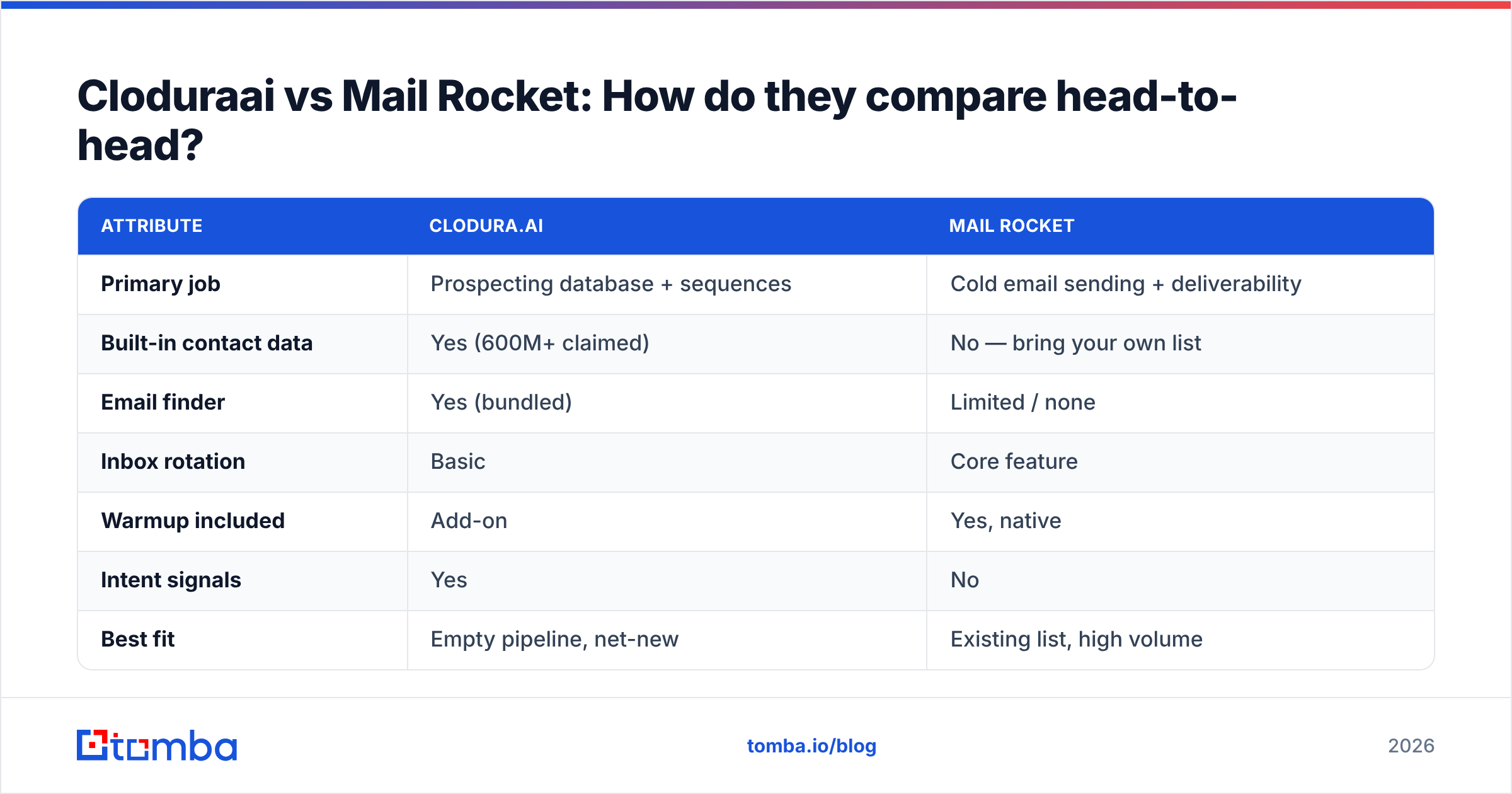
The cleanest way to read this matchup is by pipeline stage. Clodura.AI owns the top (find + qualify); Mail Rocket owns the bottom (send + deliver). Here's the side-by-side.
| Attribute | Clodura.AI | Mail Rocket |
|---|---|---|
| Primary job | Prospecting database + sequences | Cold email sending + deliverability |
| Built-in contact data | Yes (600M+ claimed) | No — bring your own list |
| Email finder | Yes (bundled) | Limited / none |
| Inbox rotation | Basic | Core feature |
| Warmup included | Add-on | Yes, native |
| Intent signals | Yes | No |
| Best fit | Empty pipeline, net-new | Existing list, high volume |
| Learning curve | Moderate (broad UI) | Low (focused) |
| Entry pricing | Higher (data premium) | Lower (sending-only) |
A few things stand out. First, you are not really comparing two versions of the same product — you're comparing a data tool to a delivery tool. Second, the feature both lean on but neither perfects is email accuracy. Clodura.AI's finder is bundled (and bundled finders rarely match standalone tools on hit rate), and Mail Rocket assumes your list is already clean.
That gap matters more than any feature checkbox, because deliverability math is unforgiving.
Which tool has better email deliverability?#
Mail Rocket wins on raw deliverability mechanics — that's its entire reason to exist. Native warmup, domain rotation, and reply-based throttling are first-class, not afterthoughts. If your only question is "will my emails land in the inbox at scale," Mail Rocket is purpose-built for it.
But deliverability isn't just sending mechanics. It starts with list quality. A single sending engine, no matter how good, can't save a list full of invalid addresses. Hard bounces above roughly 2% drag your domain reputation down, and once you're throttled, no amount of rotation recovers placement quickly.
This is where the comparison gets honest:
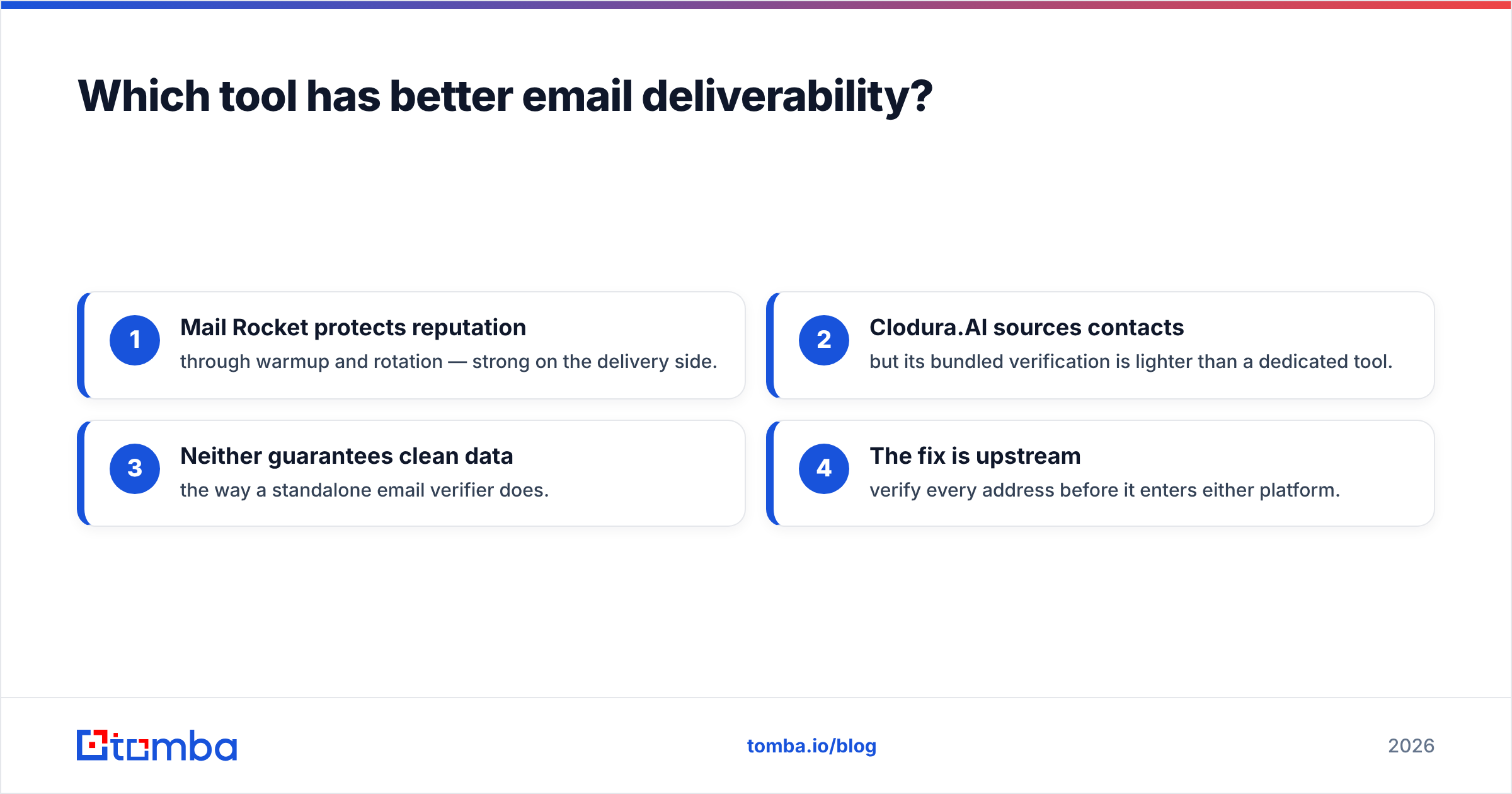
- Mail Rocket protects reputation through warmup and rotation — strong on the delivery side.
- Clodura.AI sources contacts but its bundled verification is lighter than a dedicated tool.
- Neither guarantees clean data the way a standalone email verifier does.
- The fix is upstream: verify every address before it enters either platform.
Run your list through verification first and bounces drop, warmup works as designed, and both tools perform closer to their marketing claims. Skip it, and you're rotating inboxes just to burn them faster.

What does Clodura.AI vs Mail Rocket pricing look like?#
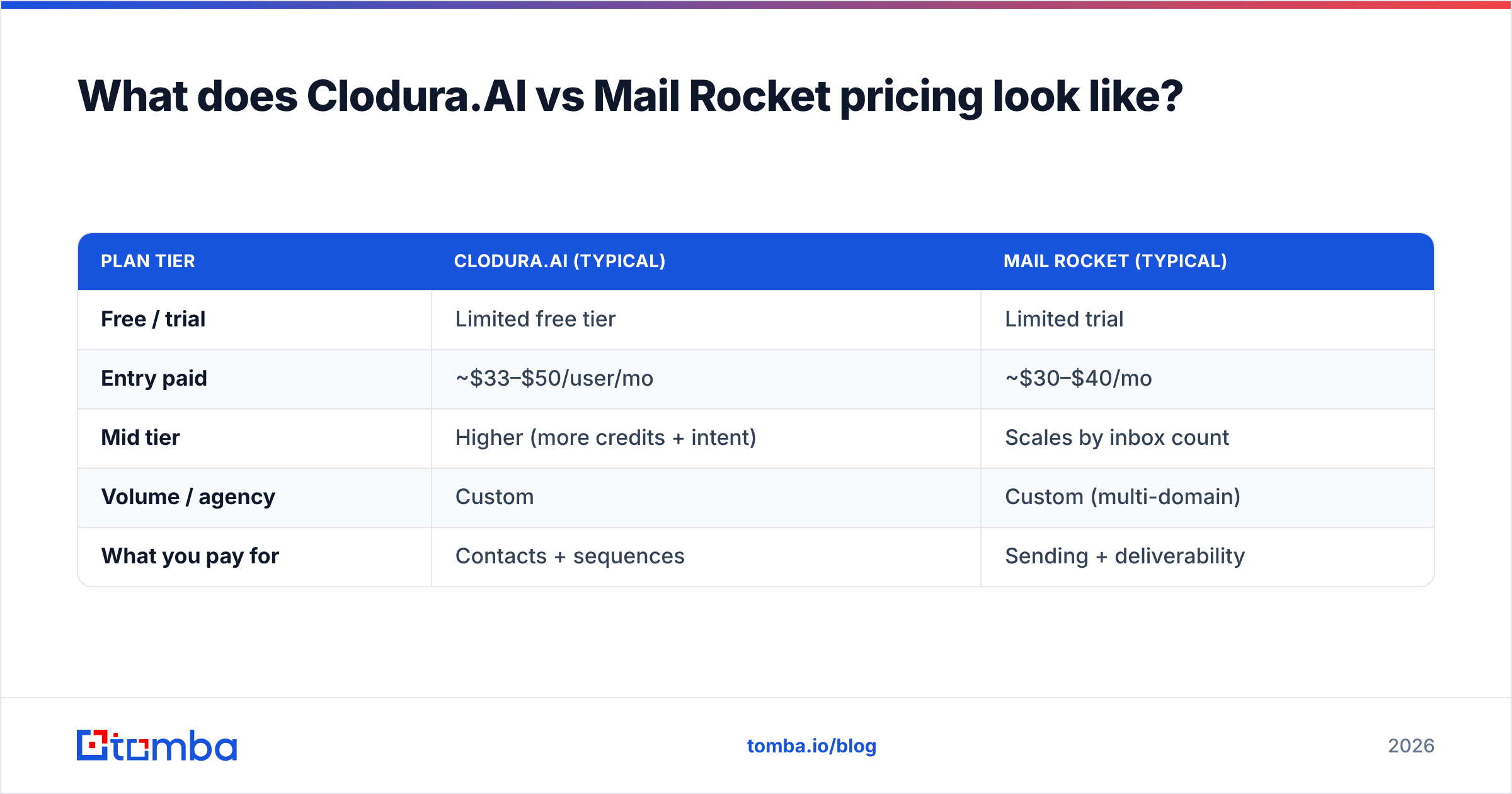
Pricing reflects what each tool bundles. Clodura.AI charges a data premium — you're paying for database access, not just software. Mail Rocket prices on sending capacity (inboxes, contacts, sends), so its entry point is lower if you bring your own leads.
| Plan tier | Clodura.AI (typical) | Mail Rocket (typical) |
|---|---|---|
| Free / trial | Limited free tier | Limited trial |
| Entry paid | ~$33–$50/user/mo | ~$30–$40/mo |
| Mid tier | Higher (more credits + intent) | Scales by inbox count |
| Volume / agency | Custom | Custom (multi-domain) |
| What you pay for | Contacts + sequences | Sending + deliverability |
Pricing for both tools changes often, so confirm current numbers on each vendor's site before you commit. The structural takeaway holds regardless: Clodura.AI's cost includes data you might already have, while Mail Rocket's cost excludes data you'll still need to source. Stack them and you pay twice for prospecting unless you handle data separately.
For comparison, a dedicated email tool like Tomba pricing starts at $49/mo for the Growth-oriented tier with a free tier at 25 searches — and it does one job (accurate contact data) extremely well, instead of bundling a mediocre version into a bigger suite.
Cloduraai vs Mail Rocket: pros and cons#
Clodura.AI pros
- Net-new contacts on demand — no list-building required
- Intent signals and org charts for account prioritization
- One platform from find to first email
Clodura.AI cons
- Higher price reflects the bundled database
- Bundled email finder and verification trail dedicated tools on accuracy
- Broad UI means a steeper ramp for reps who just want to send
Mail Rocket pros
- Best-in-class deliverability mechanics (warmup + rotation)
- Lower entry cost for high-volume senders
- Focused, fast to learn
Mail Rocket cons
- No real prospecting database — you must source leads elsewhere
- Garbage list in, garbage results out: no data safety net
- Less useful for teams starting from zero pipeline
Which should you choose in 2026?#
Pick by where your pipeline breaks. If your CRM is empty and you need contacts, Clodura.AI's database is the faster path to a first campaign. If you already have a list and your problem is inbox placement at volume, Mail Rocket is the sharper, cheaper tool.
But here's the pattern most successful outbound teams land on: they stop forcing one platform to do everything. They run a dedicated data layer for accurate emails and phone numbers, a sending tool for delivery, and let each specialist do its job. According to peer-review sites like G2, the highest-rated outbound stacks are almost always composed, not monolithic.
That's where a focused tool earns its place. Use Tomba's domain search to pull every contact at a target company, verify each address before it touches your sequence, and feed clean data into whichever sending engine you chose. You get Clodura.AI-grade coverage and Mail Rocket-grade delivery — without paying a single vendor to be mediocre at both.
You can also enrich thin records with data enrichment so reps aren't emailing a name with no title, company, or LinkedIn context. Better input data lifts reply rates more than any sequence tweak.
For teams evaluating the broader category, vendor docs and comparison hubs like Clodura.AI's own site and review aggregators such as Capterra are worth a read before you sign an annual contract — feature sets and pricing shift fast in this space.
The verdict#
There's no universal winner between Clodura.AI and Mail Rocket because they solve different problems. Clodura.AI is your answer when you have no leads; Mail Rocket is your answer when you have leads but no deliverability. The mistake is expecting either to cover the full pipeline alone.
What both tools quietly depend on — and neither nails — is email accuracy. Bad addresses inflate Clodura.AI's bounce rates and sabotage Mail Rocket's warmup. Fix that one variable and your entire outbound engine runs cleaner, whichever platform you pick.
That's the cheapest, highest-leverage upgrade you can make in 2026: put a real data tool at the front of the line.
Start with data that doesn't bounce#
Before you commit to Clodura.AI's database or trust Mail Rocket to deliver your list, make sure the emails are real. The Tomba Email Finder finds professional email addresses by name, company, or domain, verifies them against multiple signals, and feeds clean, deliverable contacts into whatever sending stack you run. Start free with 25 searches, scale to the $49/mo Growth plan when you're ready, and stop paying for bounces. Try Tomba today and give your outbound the one thing both of these tools assume you already have — accurate data.
// get started
Find, verify and enrich your first contacts today
Start on the free plan with 25 searches a month, then scale when your team is ready.
Free plan · No credit card required · GDPR & CCPA
// about the author