Clodura.ai vs Mailarrow 2026: Which Cold Email Tool Wins?
Clodura.ai bundles a B2B database with sequencing; Mailarrow is a lean cold email sender. Here's which one fits your outbound stack in 2026 — and where a dedicated data layer beats both.
Choosing between Clodura.ai and Mailarrow comes down to one question: do you need a database bundled with your sender, or do you already have the contacts and just need to ship sequences cleanly? Both tools live in the cold outbound world, but they solve different halves of the problem.
This breakdown is for revenue teams deciding where their next outbound dollar goes. We'll compare data, sequencing, deliverability, pricing, and the gaps each tool leaves open — including the data-accuracy layer that decides whether either platform actually books meetings.
TL;DR — Clodura.ai vs Mailarrow at a glance#
- Clodura.ai is an all-in-one B2B prospecting platform: a built-in contact database, intent signals, email sequencing, and a sales-cadence engine in one subscription.
- Mailarrow is a focused cold email automation tool — multi-inbox sending, warmup, rotation, and reply detection — with no native B2B database of its own.
- Pick Clodura.ai if you want data and sending under one roof and your ICP fits its database coverage.
- Pick Mailarrow if you already source contacts elsewhere and want a lightweight, deliverability-first sender at a lower price.
- Either way, the contacts you load decide your results. A dedicated tool like the Tomba Email Finder plus an email verifier keeps your lists clean enough that whichever sender you pick can actually land in the inbox.
What is Clodura.ai?#
Clodura.ai is a B2B sales prospecting platform that combines a contact database with outbound execution. Think of it as a grocery store that also delivers: you walk the aisles (its database of companies and decision-makers), fill your cart with target accounts, then schedule the delivery (email sequences and cadences) without leaving the building.
Its core pillars are a self-reported database of hundreds of millions of contacts, technographic and intent data, an email-sequencing engine, and a free email verifier built into the workflow. For teams that want to go from "who should I email?" to "send" inside a single login, that bundling is the main draw.
The trade-off with any all-in-one is depth. A platform that does data and sending rarely matches a specialist on either axis. Clodura's database coverage is strong in some segments and thin in others, and its deliverability tooling is competent rather than best-in-class. You can read more about how database coverage varies on the official Clodura.ai site.

What is Mailarrow?#
Mailarrow is a cold email automation tool built around one job: send sequences at scale without torching your sender reputation. If Clodura.ai is the grocery store, Mailarrow is a very good delivery van — it doesn't grow the produce, but it gets the package to the door intact.
Its feature set centers on unlimited email accounts on most plans, automated inbox warmup, sending rotation across mailboxes, AI-assisted personalization, reply detection, and campaign analytics. There's no native B2B database — you bring your own list, whether from a CRM export, a scraping tool, or a dedicated finder.
That focus is a feature, not a bug. Because Mailarrow isn't trying to be a data vendor, it spends its engineering budget on the things that move reply rates: warmup quality, rotation logic, and spam-filter avoidance. The catch is obvious — garbage contacts in, garbage results out. Mailarrow can only protect a domain so far when the list itself is full of invalid addresses.
Clodura.ai vs Mailarrow: the core comparison#
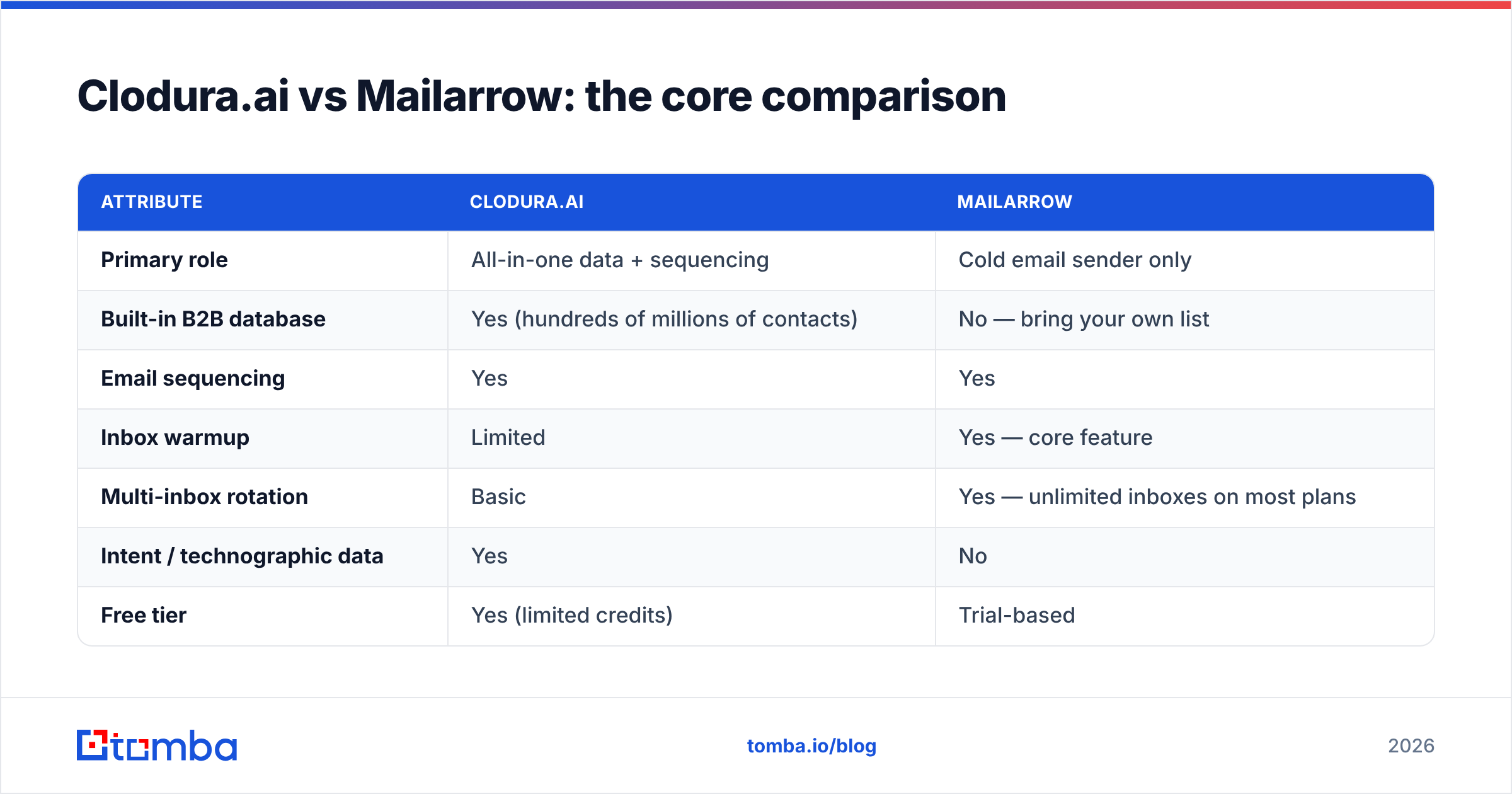
Here's how the two stack up on the attributes that decide an outbound purchase. Prices reflect publicly listed plans as of 2026 and shift with promotions, so confirm on each vendor's pricing page.
| Attribute | Clodura.ai | Mailarrow |
|---|---|---|
| Primary role | All-in-one data + sequencing | Cold email sender only |
| Built-in B2B database | Yes (hundreds of millions of contacts) | No — bring your own list |
| Email sequencing | Yes | Yes |
| Inbox warmup | Limited | Yes — core feature |
| Multi-inbox rotation | Basic | Yes — unlimited inboxes on most plans |
| Intent / technographic data | Yes | No |
| Free tier | Yes (limited credits) | Trial-based |
| Entry paid price | ~$33–$83/user/mo (varies by tier) | ~$39–$49/mo |
| Best for | Teams wanting data + send in one tool | Teams with their own data, deliverability-first |
The pattern is clear. Clodura.ai wins on breadth — you get prospecting data and execution together. Mailarrow wins on sending depth — warmup and rotation are its whole reason to exist. Neither is "better" in the abstract; they're optimized for different starting points.
Is Clodura.ai better than Mailarrow for deliverability?#
Mailarrow is better than Clodura.ai for deliverability, and it's not especially close. Deliverability is Mailarrow's entire pitch: automated warmup that gradually ramps each new mailbox, rotation that spreads volume so no single inbox looks spammy, and reply detection that pauses sequences when a prospect responds. That's the specialist's advantage.
Clodura.ai handles deliverability as one feature among many. It verifies emails before you send and offers sequencing controls, but it doesn't match a dedicated sender's warmup sophistication. If your domain reputation is fragile or you're scaling new mailboxes fast, that gap matters.
But here's the part both vendors gloss over: deliverability starts before either tool touches your campaign. No warmup engine on earth saves you from a list where 30% of addresses bounce. Bounce rate is the single fastest way to wreck sender reputation, and it's a function of list quality, not sender software. Run every address through an email verifier and a catch-all verifier before it enters any sequence, and both platforms perform dramatically better. Skip that step and the most advanced warmup in the world is rearranging deck chairs.
For the mechanics of how reputation, SPF, and bounce thresholds interact, the email deliverability glossary is a useful primer, and independent reviews on G2 show the same pattern across the category: list hygiene predicts inbox placement more than any single sending feature.
Which tool has better B2B data?#
Clodura.ai has data; Mailarrow has none — so on paper Clodura wins by default. But "has a database" and "has accurate data for your ICP" are different claims. Clodura's coverage is genuinely useful in certain verticals and geographies and noticeably thinner in others. Its self-reported counts are large, but the relevant number is match rate and accuracy for your target accounts, not the total row count.
This is where many teams get burned by all-in-one platforms. They assume the bundled database is good enough, load thousands of contacts, and discover months later that their bounce rate and reply rate both suffer because a meaningful slice of the data was stale. A bundled database removes a tool from your stack; it doesn't guarantee the contacts are real.
The reliable move is to treat data sourcing as its own discipline. Use a specialist email finder to locate decision-makers by domain or name, run a domain search to map every reachable contact at a target company, and enrich what you have with data enrichment so each record carries role, seniority, and verified contact details. When you need volume, a bulk email finder processes whole account lists at once. That gives you a clean, verified list to feed into either Clodura.ai or Mailarrow.
How do Clodura.ai and Mailarrow price out?#
Pricing favors Mailarrow for narrow use and Clodura.ai for consolidated use — the right answer depends on how many tools you're replacing.
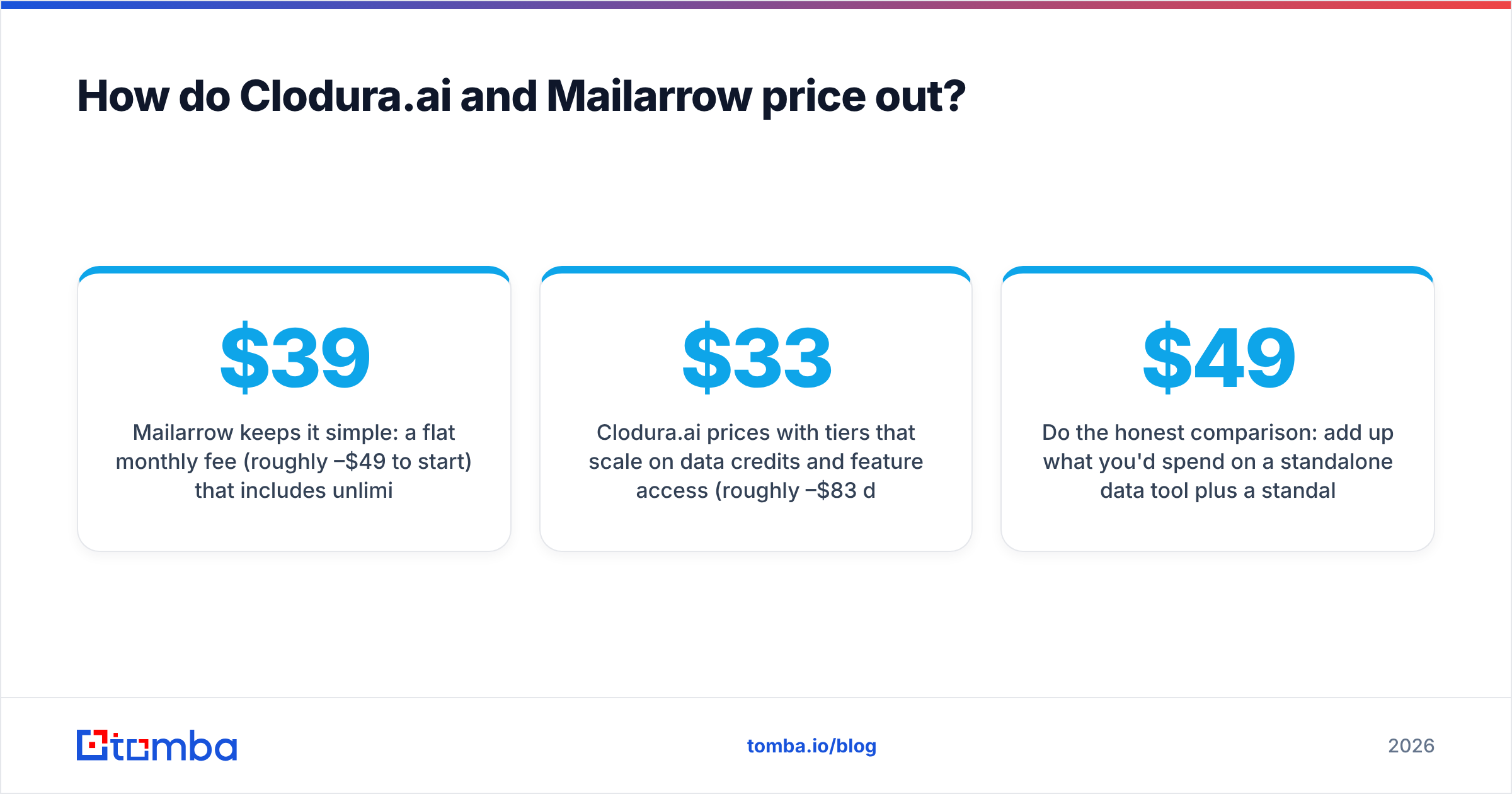
Mailarrow keeps it simple: a flat monthly fee (roughly $39–$49 to start) that includes unlimited or high inbox counts, warmup, and sequencing. Because you bring your own data, there are no per-credit data charges — you pay for sending capacity, full stop. That makes total cost predictable and low if you already have a contact source.
Clodura.ai prices per user with tiers that scale on data credits and feature access (roughly $33–$83 per user per month depending on plan and billing term, with a limited free tier). You're paying for the database and intent data as much as the sequencing, so the per-seat cost reflects the bundled value. If Clodura replaces both a data vendor and a sender for you, the math can work out cheaper than buying two specialists.
Do the honest comparison: add up what you'd spend on a standalone data tool plus a standalone sender, then compare against Clodura's all-in price and against Mailarrow-plus-a-data-tool. For reference, a dedicated finder like Tomba starts at $49/mo on the Starter plan after a free tier of 25 searches — see full Tomba pricing — which means "specialist data + lean sender" is often competitive with, or cheaper than, an all-in-one once you account for data accuracy.
When should you choose Clodura.ai?#
Choose Clodura.ai when consolidation is worth more to you than best-in-class depth. Specifically:
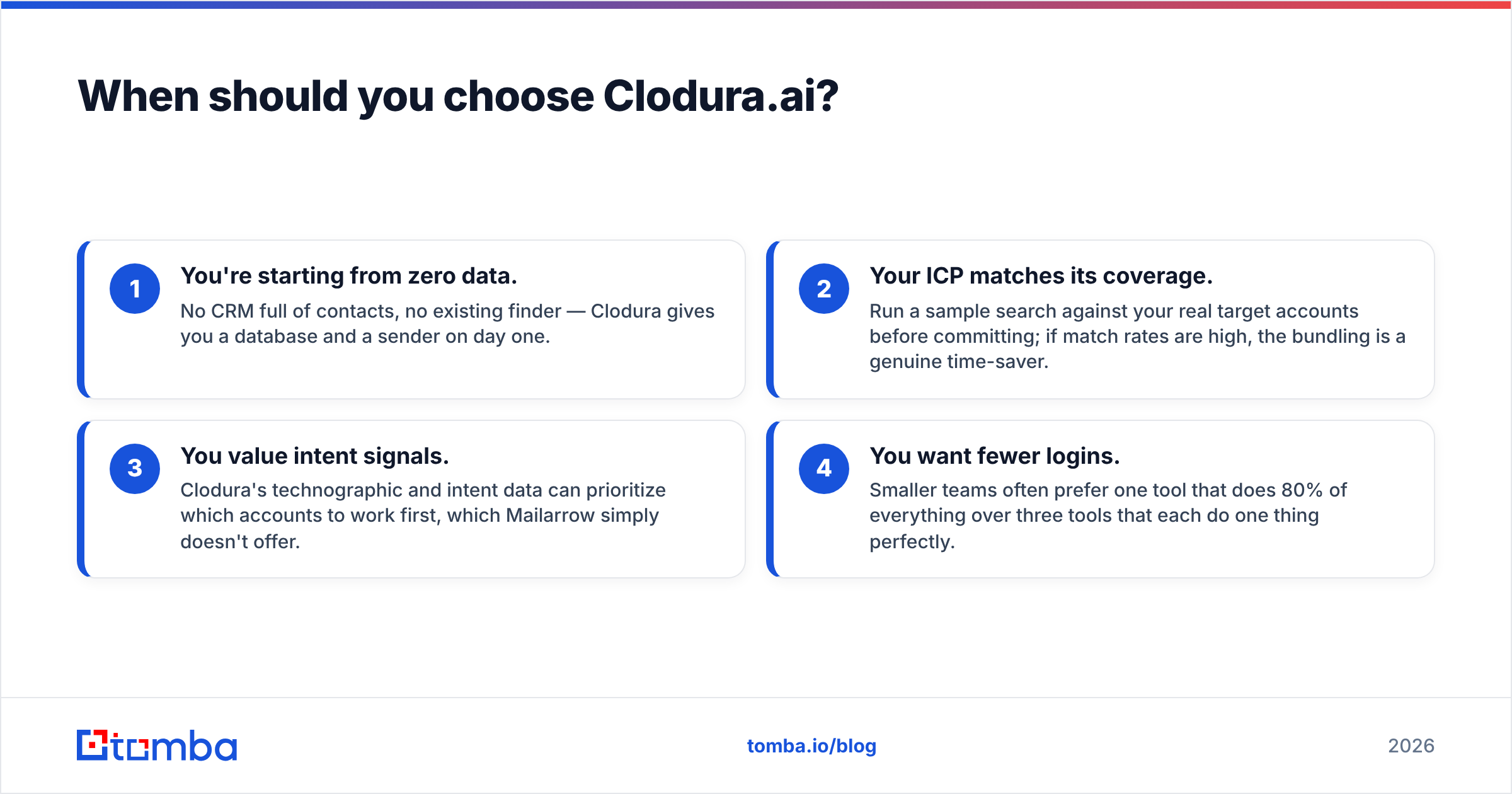
- You're starting from zero data. No CRM full of contacts, no existing finder — Clodura gives you a database and a sender on day one.
- Your ICP matches its coverage. Run a sample search against your real target accounts before committing; if match rates are high, the bundling is a genuine time-saver.
- You value intent signals. Clodura's technographic and intent data can prioritize which accounts to work first, which Mailarrow simply doesn't offer.
- You want fewer logins. Smaller teams often prefer one tool that does 80% of everything over three tools that each do one thing perfectly.
If those describe you, Clodura.ai is a reasonable single-platform bet — just keep an email verifier in the loop to catch the stale records any database accumulates.
When should you choose Mailarrow?#
Choose Mailarrow when you already own your data and deliverability is the bottleneck. Specifically:
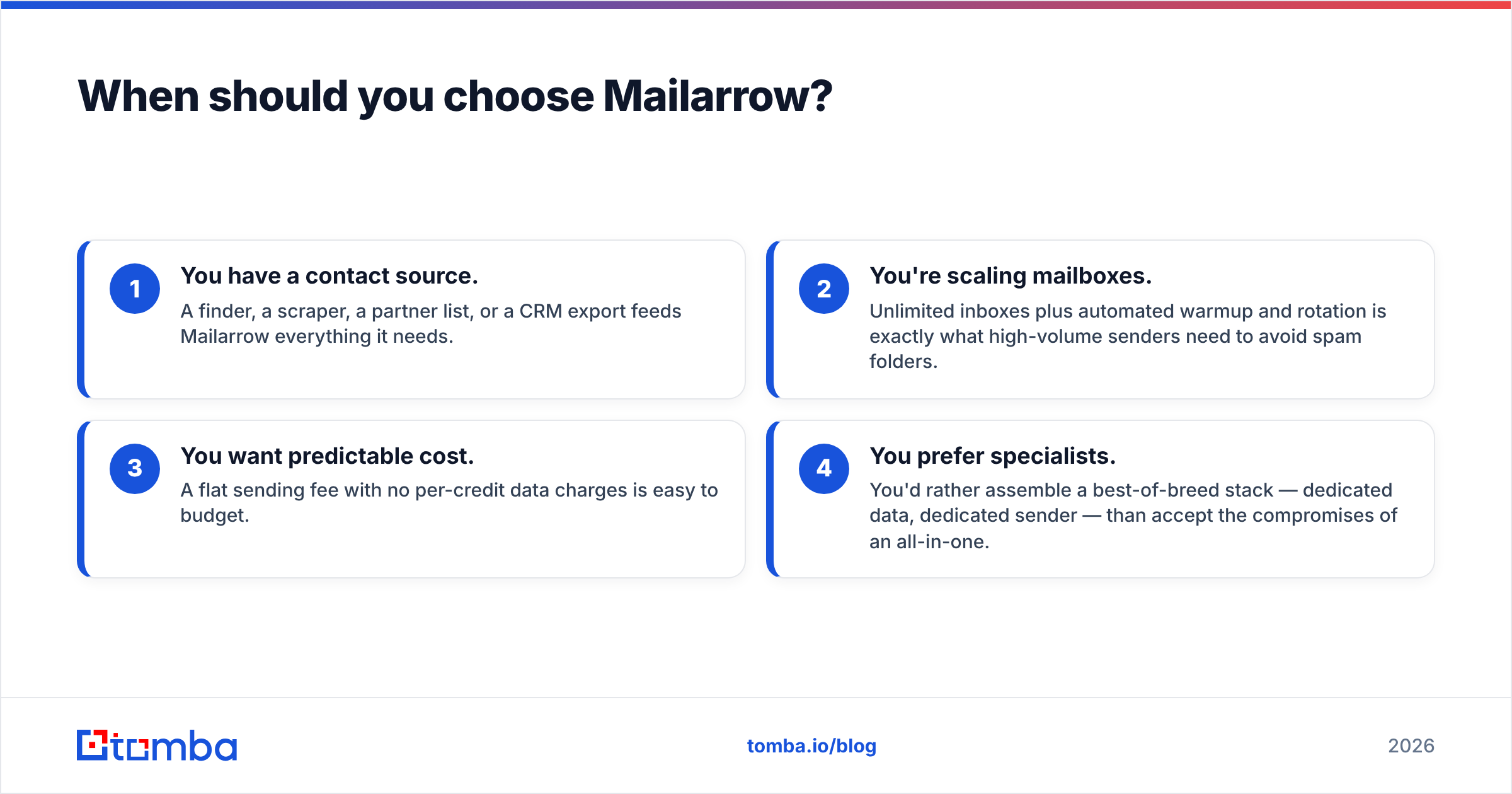
- You have a contact source. A finder, a scraper, a partner list, or a CRM export feeds Mailarrow everything it needs.
- You're scaling mailboxes. Unlimited inboxes plus automated warmup and rotation is exactly what high-volume senders need to avoid spam folders.
- You want predictable cost. A flat sending fee with no per-credit data charges is easy to budget.
- You prefer specialists. You'd rather assemble a best-of-breed stack — dedicated data, dedicated sender — than accept the compromises of an all-in-one.
Mailarrow is the better pick for the deliverability-obsessed operator who treats data sourcing as a separate, deliberate step.
What both tools miss — and how to fix it#
Neither Clodura.ai nor Mailarrow solves the real outbound problem on its own, because the real problem is contact accuracy, and that's a layer above both.
Mailarrow has no data at all. Clodura.ai has data of variable quality that decays the moment people change jobs. In both cases, the team that wins is the one that controls list hygiene independently of the sender. That's why high-performing outbound stacks almost always include a dedicated finder-and-verifier layer:
- Find decision-makers with a purpose-built email finder and domain search.
- Verify every address with an email verifier and catch-all verifier before it sequences.
- Enrich records so personalization tokens (role, company, seniority) are accurate, not guessed.
- Automate the whole flow through the Tomba API so clean data flows straight into Clodura.ai or Mailarrow.
Get that layer right and the Clodura-vs-Mailarrow decision shrinks to a preference question, because both tools start performing closer to their ceiling.
The verdict: Clodura.ai vs Mailarrow#
Clodura.ai is the all-in-one for teams that need data and sending together; Mailarrow is the deliverability specialist for teams that already have their data. There's no universal winner — there's a winner for your situation.
If you're starting cold with no contacts and your ICP fits Clodura's coverage, the bundle saves you time and a second subscription. If you've already solved data and you want the cleanest possible inbox placement at a predictable price, Mailarrow is the sharper tool.
What doesn't change either way is the data layer. Whichever sender you pick, the contacts you feed it determine whether you book meetings or burn your domain. Start by building a verified, enriched list with the Tomba Email Finder — find decision-makers by domain or name, verify every address before it sends, and push clean records straight into your sequencing tool via the API. The free tier gives you 25 searches to test match rates against your real ICP before you spend a cent, and Tomba pricing scales from $49/mo when you're ready to run volume. Fix the data first, and Clodura.ai or Mailarrow will finally perform the way the demo promised.
// get started
Find, verify and enrich your first contacts today
Start on the free plan with 25 searches a month, then scale when your team is ready.
Free plan · No credit card required · GDPR & CCPA
// about the author