Clodura.ai vs Mailtact 2026: Which Sales Tool Wins?
Clodura.ai is a data-first sales intelligence platform; Mailtact is a cold-email automation tool. Here's how they compare in 2026 — and where a dedicated data layer beats both.
Clodura.ai vs Mailtact: The 2026 Buyer's Breakdown
Choosing between Clodura.ai and Mailtact feels harder than it should, because the two tools are not actually solving the same problem. One is a sales-intelligence database that hands you contacts. The other is an outreach engine that sends to contacts you already have. Picking the "winner" without understanding that split is how teams end up paying for two platforms that overlap by 20% and leave the other 80% uncovered.
This breakdown cuts through it: what each does well, where each leaks money, and which combination actually produces booked meetings in 2026.
TL;DR#
- Clodura.ai is a B2B data + intent platform: contact database, org charts, technographics, and basic sequencing bolted on top.
- Mailtact is a cold-email automation tool: inboxes, sequences, deliverability controls, and reporting — but you bring your own data.
- They are complements, not substitutes. Using one to do the other's job is where accuracy and deliverability both suffer.
- The weak link in either stack is data freshness. Stale emails tank deliverability no matter how good your sequencer is.
- Best 2026 setup: a dedicated, verified data source feeding whichever outreach engine you prefer — which is exactly the gap a tool like the Tomba Email Finder fills.
What is Clodura.ai?#
Clodura.ai is a sales-intelligence platform built around a proprietary B2B database. Its core pitch is discovery: you search by industry, title, geography, or technology stack, and it returns company and contact records, often with direct dials and org-chart context. It layers in buyer-intent signals and a light sequencing module so reps can move from "found a lead" to "sent an email" without leaving the tool.
The strength is breadth at the top of the funnel. If your problem is "I don't know who to contact," Clodura.ai is designed for that. The trade-off is depth on the sending side — its automation and deliverability tooling is functional but secondary to the data product. You can read user impressions on G2 and the vendor's own positioning on clodura.ai to see how heavily the messaging leans on database size.
What is Mailtact?#
Mailtact is a cold-email and outreach automation tool. Its job starts after you have a list: connect your sending mailboxes, build multi-step sequences with conditional logic, rotate inboxes to protect your domain, and track opens, clicks, and replies. Think of it as the engine room rather than the map.
Mailtact does not try to be a contact database. That is a deliberate scope choice, and it's the right mental model: a sequencer is only as good as the addresses you load into it. Send to a list full of dead or guessed emails and even a great automation tool will torch your sender reputation. That is why the data layer underneath matters more than the sequencer's feature list.
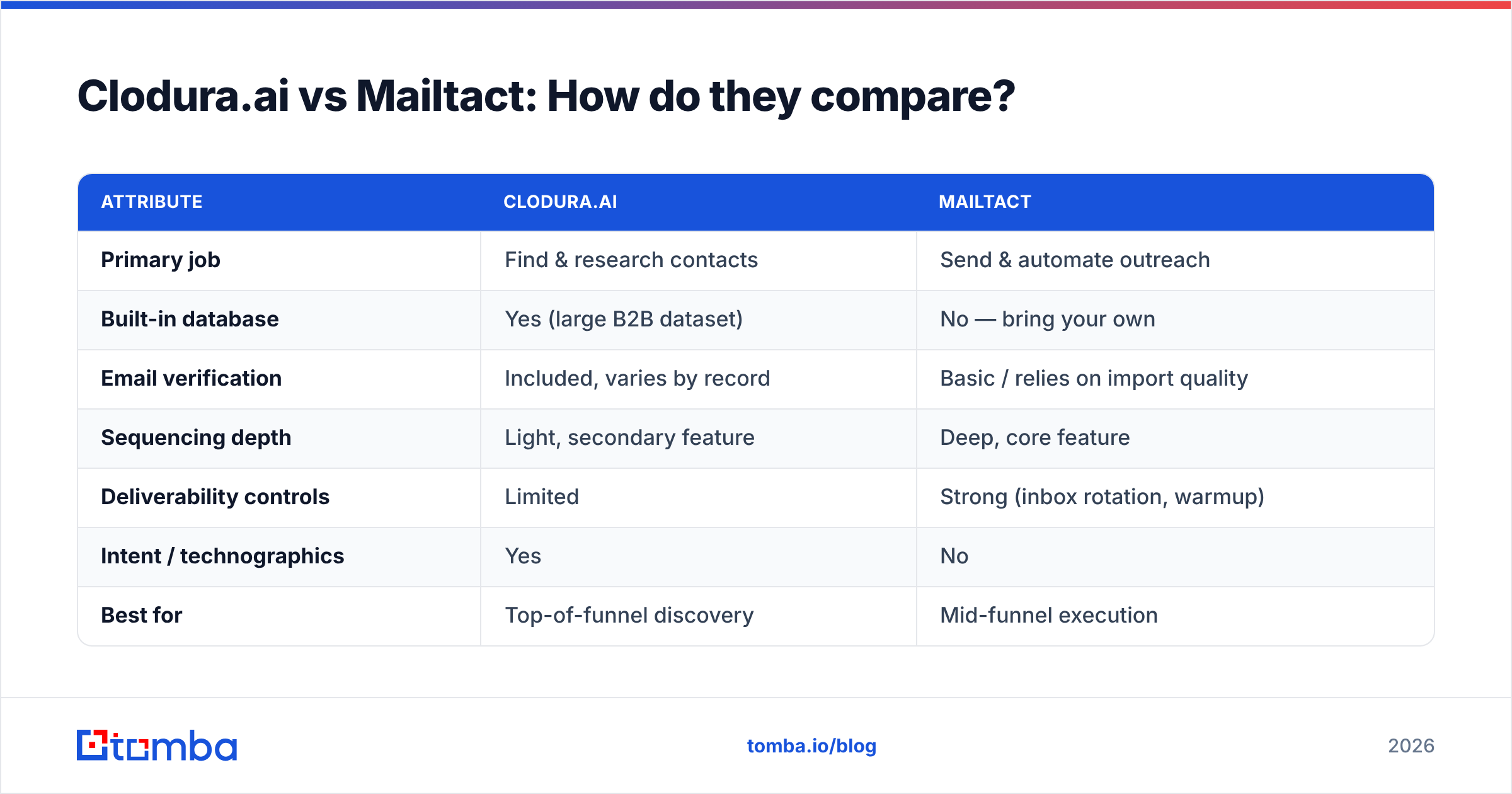
Clodura.ai vs Mailtact: How do they compare?#
Here's the head-to-head on the attributes that actually change outcomes. Treat the data-quality and automation rows as the two that matter most for your use case.
| Attribute | Clodura.ai | Mailtact |
|---|---|---|
| Primary job | Find & research contacts | Send & automate outreach |
| Built-in database | Yes (large B2B dataset) | No — bring your own |
| Email verification | Included, varies by record | Basic / relies on import quality |
| Sequencing depth | Light, secondary feature | Deep, core feature |
| Deliverability controls | Limited | Strong (inbox rotation, warmup) |
| Intent / technographics | Yes | No |
| Best for | Top-of-funnel discovery | Mid-funnel execution |
| Weakness | Sending sophistication | Data sourcing |
The pattern is obvious once it's laid out: their strengths sit on opposite ends of the same workflow. Clodura.ai owns "who and why," Mailtact owns "how and when."
Which one should you choose?#
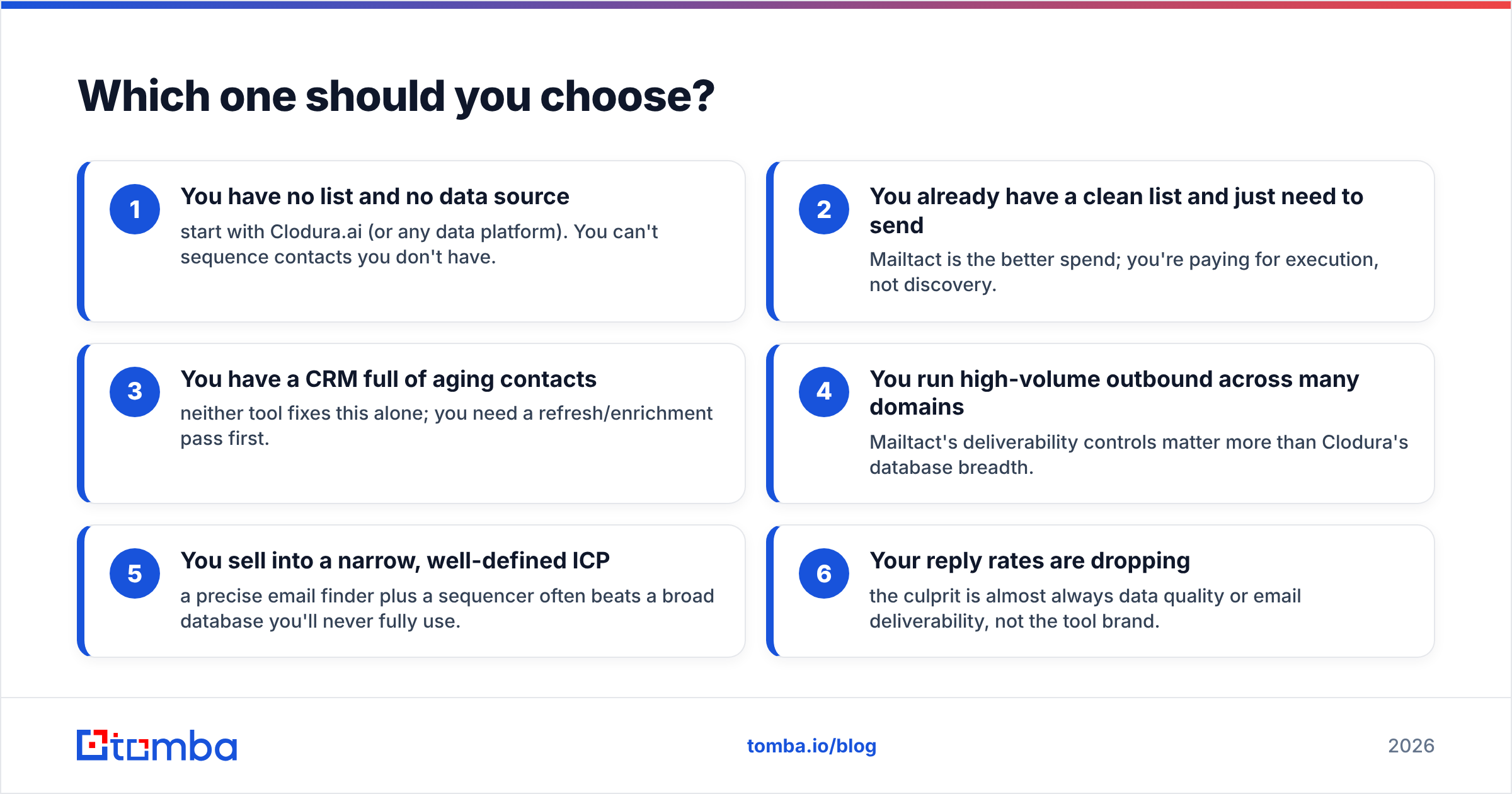
The honest answer is that the question is usually wrong. Use this quick decision guide instead of forcing a binary.
- You have no list and no data source — start with Clodura.ai (or any data platform). You can't sequence contacts you don't have.
- You already have a clean list and just need to send — Mailtact is the better spend; you're paying for execution, not discovery.
- You have a CRM full of aging contacts — neither tool fixes this alone; you need a refresh/enrichment pass first.
- You run high-volume outbound across many domains — Mailtact's deliverability controls matter more than Clodura's database breadth.
- You sell into a narrow, well-defined ICP — a precise email finder plus a sequencer often beats a broad database you'll never fully use.
- Your reply rates are dropping — the culprit is almost always data quality or email deliverability, not the tool brand.
Where do both tools actually leak money?#
Data decay. B2B contact data degrades fast — people change jobs, companies rebrand, and catch-all domains hide invalid mailboxes. A bundled database refreshes on the vendor's schedule, not yours, and a sequencer trusts whatever you import. Either way, the failure mode is the same: you send to addresses that bounce, your domain reputation drops, and your good emails start landing in spam.
This is the quiet tax on both platforms. Clodura.ai gives you volume but you can't control its refresh cadence. Mailtact gives you control but assumes your input is clean. Neither is built to be your verification backstop.
That's the case for treating contact data as its own layer in the stack. Before a single email enters a sequence, every address should be checked against a current source and a real email verifier. The difference between a 2% bounce rate and a 12% bounce rate is rarely the sequencer — it's whether the list was verified the day you sent it, not the day the database last synced.

How does a dedicated data layer change the math?#
A focused data tool sits upstream of both Clodura.ai and Mailtact and makes each one better. Instead of trusting a bundled dataset's age or an imported CSV's accuracy, you generate verified contacts on demand and only then feed your outreach engine.
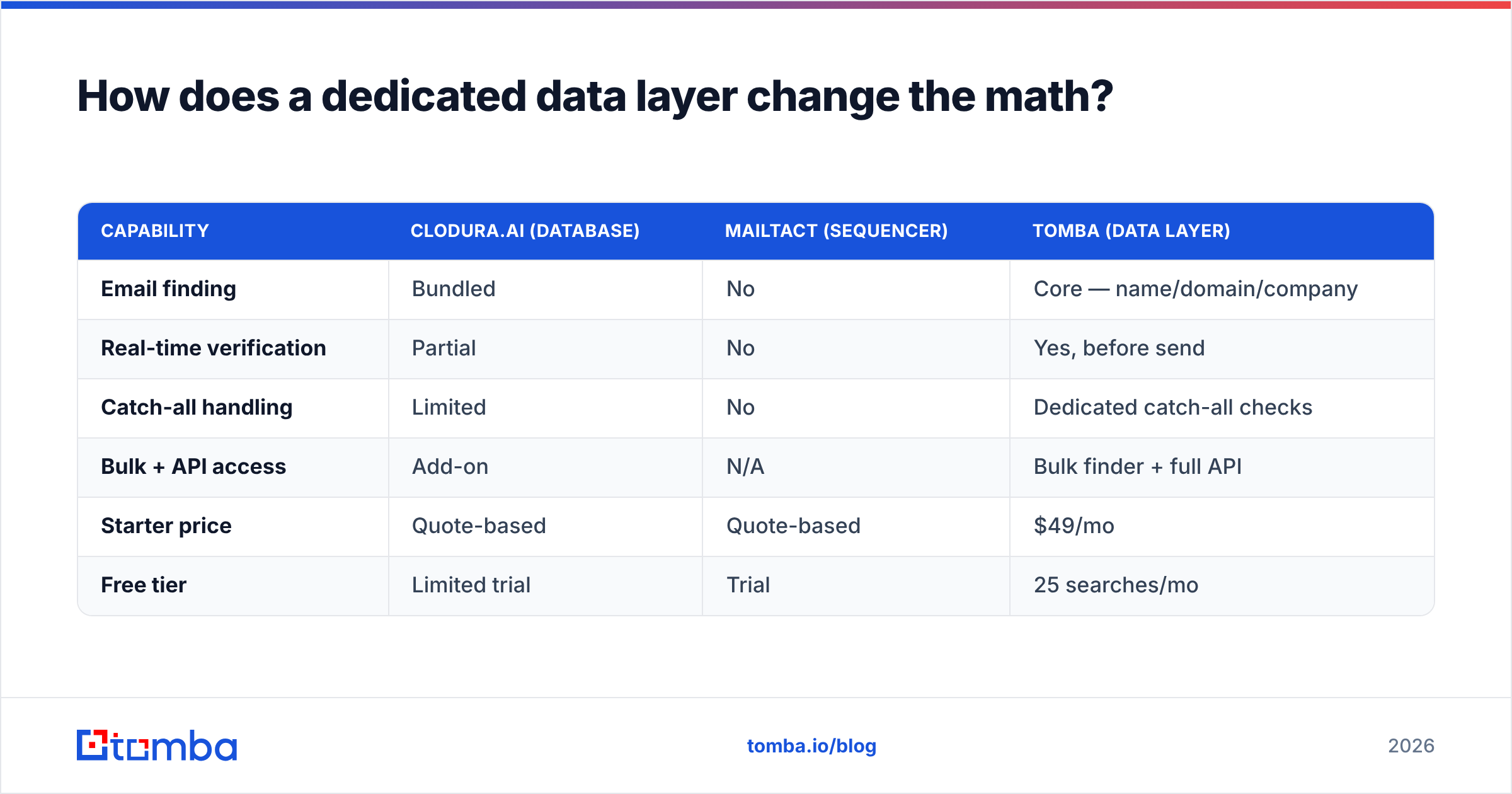
Here's how the three approaches stack up on the metrics that decide whether outbound works.
| Capability | Clodura.ai (database) | Mailtact (sequencer) | Tomba (data layer) |
|---|---|---|---|
| Email finding | Bundled | No | Core — name/domain/company |
| Real-time verification | Partial | No | Yes, before send |
| Catch-all handling | Limited | No | Dedicated catch-all checks |
| Bulk + API access | Add-on | N/A | Bulk finder + full API |
| Starter price | Quote-based | Quote-based | $49/mo |
| Free tier | Limited trial | Trial | 25 searches/mo |
The point isn't that a data layer replaces a sequencer or a database — it's that verified input is the single biggest lever on reply rate, and it's the thing both categories treat as someone else's problem. Tools like the domain search and bulk workflows let you build a target list, verify it, and hand a clean file to whichever engine you've standardized on. If pricing is a deciding factor, the transparent Tomba pricing tiers make the data layer the cheapest insurance in the stack.
What does the ideal 2026 outbound stack look like?#
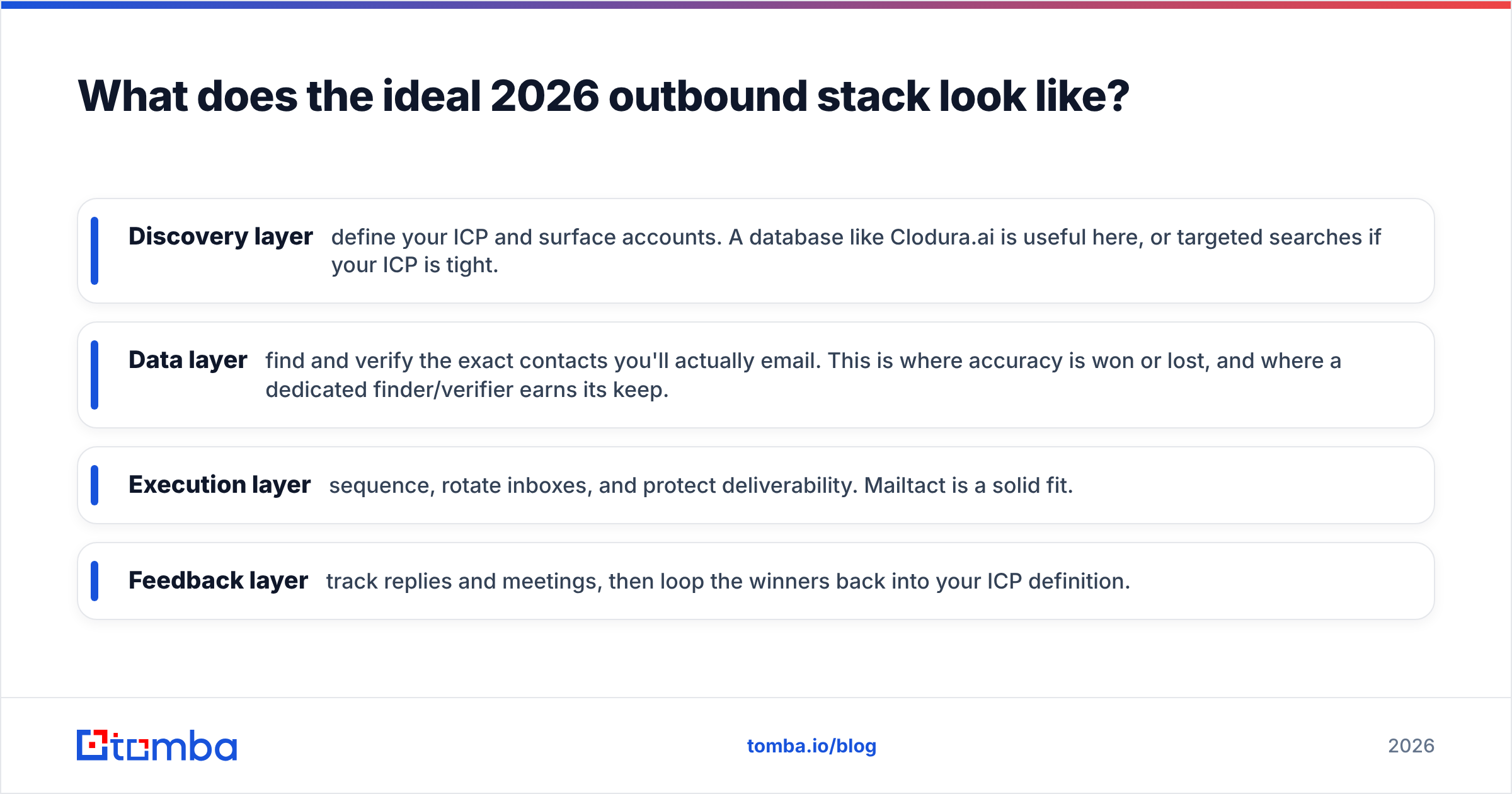
Stop thinking "Clodura.ai or Mailtact" and start thinking in layers:
- Discovery layer — define your ICP and surface accounts. A database like Clodura.ai is useful here, or targeted searches if your ICP is tight.
- Data layer — find and verify the exact contacts you'll actually email. This is where accuracy is won or lost, and where a dedicated finder/verifier earns its keep.
- Execution layer — sequence, rotate inboxes, and protect deliverability. Mailtact is a solid fit.
- Feedback layer — track replies and meetings, then loop the winners back into your ICP definition.
When the layers are separated, you can swap any one of them without rebuilding the whole motion. Lock yourself into a single all-in-one and you inherit its weakest component permanently. For most teams, the weakest component of an all-in-one is the data — which is exactly why pulling that piece out into a specialized tool produces the biggest jump in performance.
If you want to wire this together without manual CSV shuffling, Tomba's integrations and API push verified contacts straight into your CRM or sequencer, so the data layer runs automatically instead of as a weekly chore. And because cold outreach still lives or dies on fundamentals like SPF, warmup, and copy, pair your clean data with the deliverability basics every guide from HubSpot onward keeps repeating.
Frequently asked questions#
Is Clodura.ai better than Mailtact? Neither is strictly "better" — they do different jobs. Clodura.ai is a data and discovery platform; Mailtact is an outreach automation tool. If you must pick one, choose based on whether your bottleneck is finding contacts or sending to them.
Can I use Mailtact without Clodura.ai? Yes, and many teams do. Mailtact needs a contact list, not Clodura specifically. You can source that list from any verified data provider, which often gives you fresher, cheaper data than a bundled database.
Why do my cold emails still bounce with these tools? Almost always stale or unverified data. Run every address through a verifier the day you send, handle catch-all domains explicitly, and keep your sending volume warmed up.
What's the cheapest way to improve reply rates? Fix the data first. Verified contacts cut bounces, protect sender reputation, and lift deliverability more reliably than any sequencer tweak — and a data layer starts at $49/mo, far below most platform contracts.
The bottom line#
Clodura.ai and Mailtact aren't rivals — they're two halves of an outbound motion, and both quietly depend on something neither one specializes in: accurate, freshly verified contact data. Whichever platform you standardize on, the fastest path to more replies is to stop trusting aging databases and unverified imports.
Start by fixing the layer that everything else rests on. Run your prospects through the Tomba Email Finder to pull verified, current email addresses on demand, then feed them into Clodura.ai, Mailtact, or whatever engine you already love. Clean data in, booked meetings out — that's the part no all-in-one will solve for you.
// get started
Find, verify and enrich your first contacts today
Start on the free plan with 25 searches a month, then scale when your team is ready.
Free plan · No credit card required · GDPR & CCPA
// about the author