Cognism vs Harmonic (2026): Which B2B Data Tool Wins?
Cognism sells verified contact data for outbound; Harmonic tracks emerging startups for sourcing. Here's how they differ on coverage, pricing, and fit—plus a leaner way to get contact data.
Cognism and Harmonic get lumped together as "B2B data" tools, but they solve almost opposite problems. Pick the wrong one and you either overpay for coverage you don't need or miss the exact companies you were trying to find.
TL;DR: Cognism vs Harmonic in 30 seconds#
- Cognism is a sales-intelligence platform built for outbound teams. Its strength is verified contact data—mobile numbers, work emails, and compliant records for calling and emailing decision-makers at scale.
- Harmonic is a startup-intelligence and company-sourcing platform. Its strength is finding and tracking emerging private companies early, using signals like headcount growth, funding, and founder activity.
- They rarely compete head-to-head. Cognism answers "how do I reach these people?" Harmonic answers "which companies should I be watching?"
- Pricing is opaque for both—annual contracts, sales-led quotes, and seat minimums. Neither publishes a self-serve tier.
- If your real need is accurate contact data on demand without a five-figure contract, a usage-based tool like Tomba's email finder covers the outbound side for a fraction of the cost.
What is Cognism?#
Cognism is a sales-intelligence platform focused on contact data quality and compliance. Teams use it to build calling and emailing lists of B2B decision-makers, with a heavy emphasis on phone-verified mobile numbers (its "Diamond Data" product) and GDPR/CCPA-aware records.
The core use case is outbound execution. A sales development rep opens Cognism, filters by job title, company size, industry, and tech stack, then exports verified contacts into a CRM or sequencer. Its European coverage is a genuine differentiator—many US-first tools thin out badly outside North America, and Cognism built its reputation partly on filling that gap.
Where Cognism is strong:
- Phone-verified mobile numbers for cold calling, checked by a human team.
- Compliance tooling—do-not-call list screening and notified-jurisdiction flags.
- International coverage, especially EMEA and DACH markets.
- Intent data through a Bombora partnership, so you can prioritize accounts already researching your category.
You can read more about its positioning on the Cognism site, and its user reviews on G2 give a realistic read on data accuracy by region.
What is Harmonic?#
Harmonic is a company-data and startup-intelligence platform. Instead of optimizing for "here is a verified phone number," it optimizes for "here is a company worth knowing about before anyone else does."
Its primary users are venture investors, corporate development teams, and founder-led sourcing motions. Harmonic ingests signals across millions of private companies—headcount trends, funding rounds, founder LinkedIn activity, website launches, hiring spikes—and lets you build watchlists and alerts around emerging players. If you want to catch a company at seed stage before it hits everyone's radar, that is the job Harmonic is built for.
Where Harmonic is strong:
- Early-stage company discovery, including stealth and pre-funding startups.
- Growth signals—team expansion, momentum scores, and trigger events.
- Founder and people graphs that map who is starting what.
- API and enrichment feeds for embedding company data into your own product or CRM.
You can see its focus on the Harmonic homepage. Note the framing: it sells discovery and monitoring, not sales dials. That difference drives everything below.
Cognism vs Harmonic: the core difference#
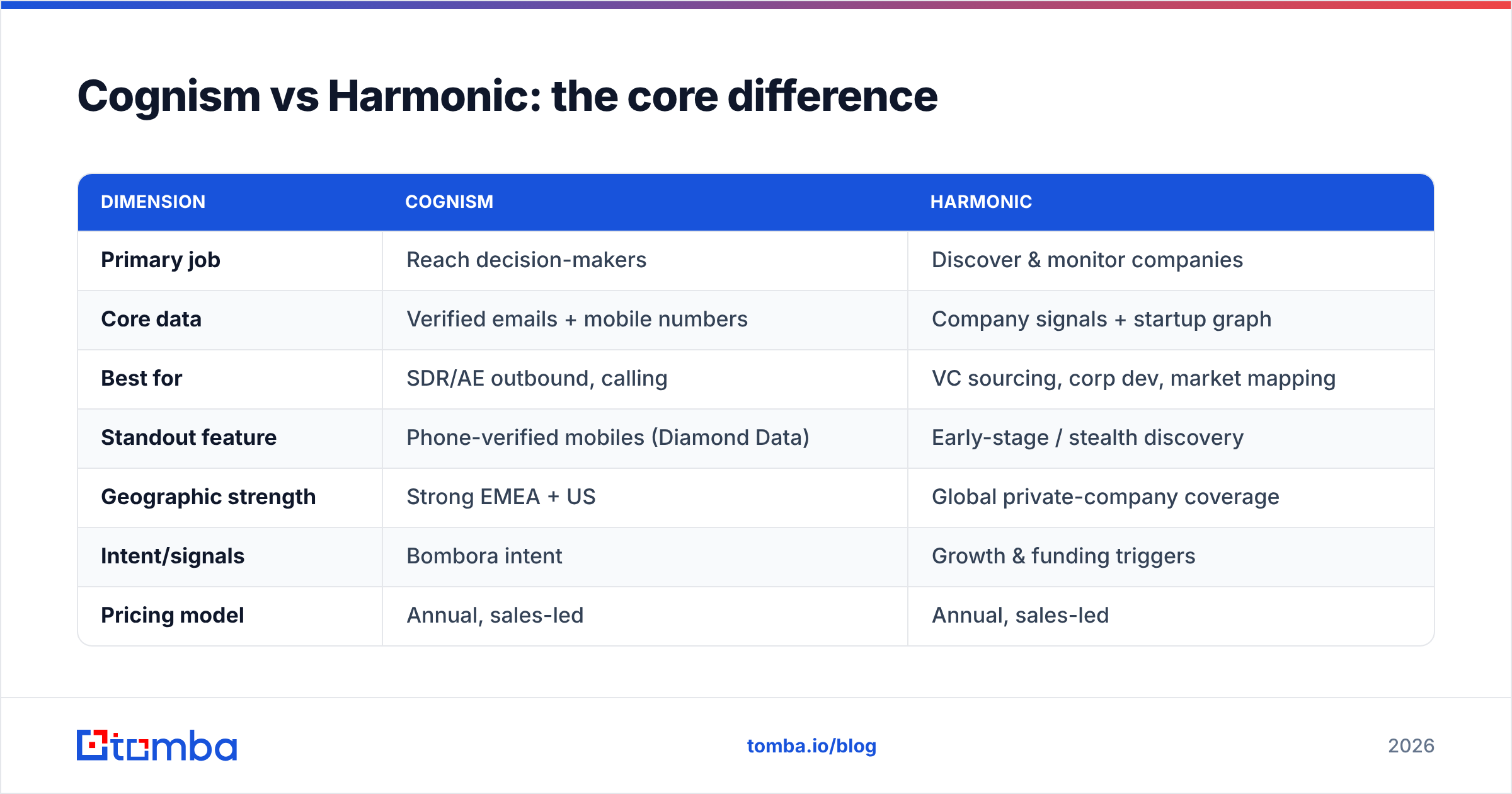
Here is the one-line version: Cognism helps you contact known audiences; Harmonic helps you discover unknown companies.
If you already know the profile of who you want to sell to and you need clean records to reach them, that is Cognism's lane. If you are trying to identify which companies deserve your attention in the first place—especially early-stage ones—that is Harmonic's lane.
Most confusion between the two comes from treating "B2B data" as one category. It isn't. Contact data (people you can email and call) and company intelligence (firms you should track) are different products with different buyers, different refresh cadences, and different success metrics.
| Dimension | Cognism | Harmonic |
|---|---|---|
| Primary job | Reach decision-makers | Discover & monitor companies |
| Core data | Verified emails + mobile numbers | Company signals + startup graph |
| Best for | SDR/AE outbound, calling | VC sourcing, corp dev, market mapping |
| Standout feature | Phone-verified mobiles (Diamond Data) | Early-stage / stealth discovery |
| Geographic strength | Strong EMEA + US | Global private-company coverage |
| Intent/signals | Bombora intent | Growth & funding triggers |
| Pricing model | Annual, sales-led | Annual, sales-led |
| Self-serve tier | No | No |
Which one is right for your use case?#
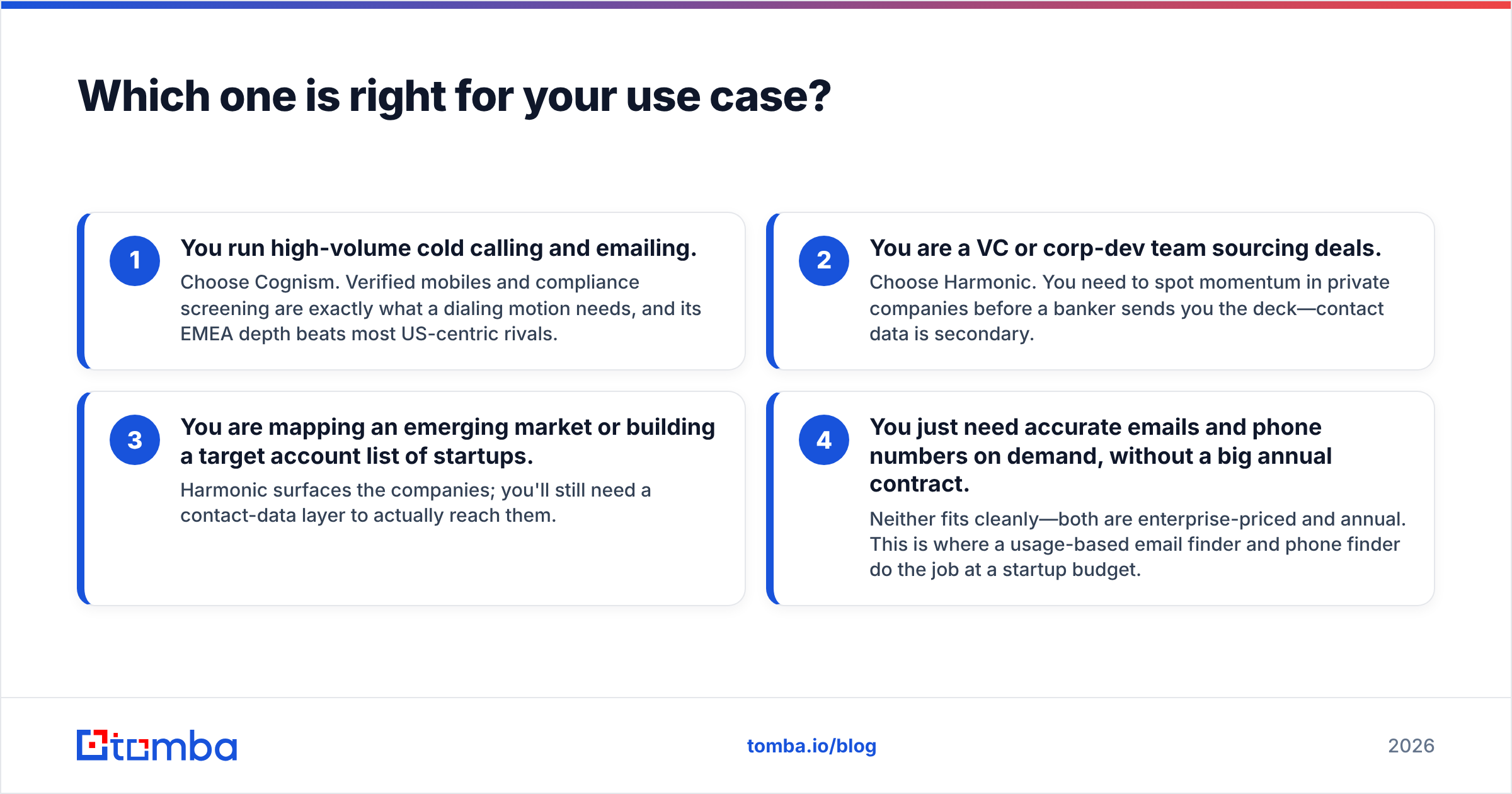
Rather than "which is better," ask "which job am I hiring a tool to do?" These four scenarios cover most teams:
- You run high-volume cold calling and emailing. Choose Cognism. Verified mobiles and compliance screening are exactly what a dialing motion needs, and its EMEA depth beats most US-centric rivals.
- You are a VC or corp-dev team sourcing deals. Choose Harmonic. You need to spot momentum in private companies before a banker sends you the deck—contact data is secondary.
- You are mapping an emerging market or building a target account list of startups. Harmonic surfaces the companies; you'll still need a contact-data layer to actually reach them.
- You just need accurate emails and phone numbers on demand, without a big annual contract. Neither fits cleanly—both are enterprise-priced and annual. This is where a usage-based email finder and phone finder do the job at a startup budget.
Notice how often the honest answer is "you need discovery and contact data." Harmonic finds the company; something else has to find the buyer's email. That layered reality is why plenty of teams pair a sourcing tool with a lean, pay-for-what-you-use contact tool instead of buying one giant suite.

How do Cognism and Harmonic compare on pricing?#
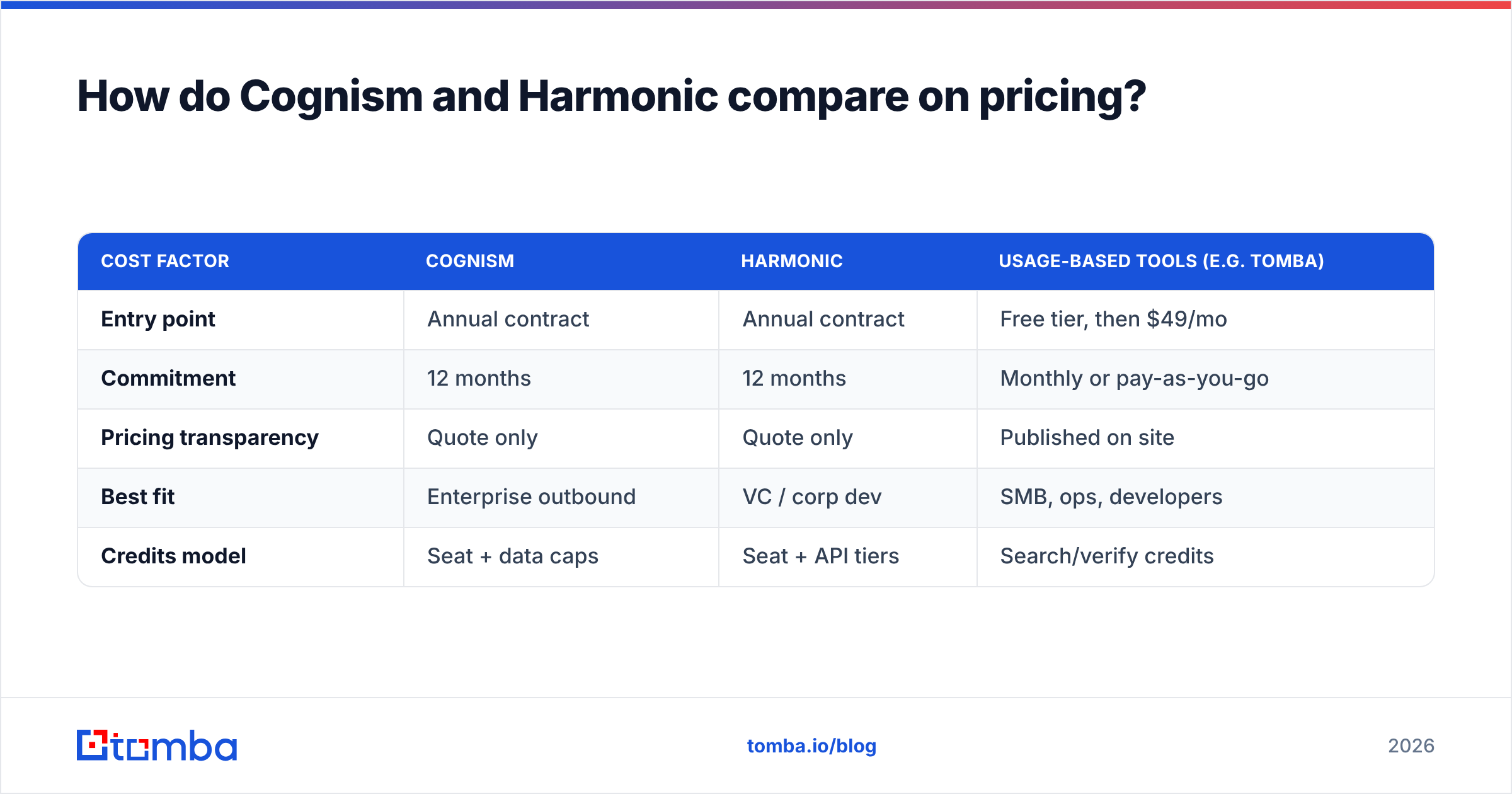
Both are sales-led and opaque, which is the most important practical fact for a buyer. Neither publishes prices, and both typically require annual commitments with seat minimums. Reported figures from review sites put Cognism contracts commonly in the low-to-mid five figures per year depending on seats and data volume; Harmonic is similarly quote-based and scales with users and API access.
That model works if you have budget approval and a team large enough to amortize the seats. It works poorly if you are a small team, a solo founder, or an ops person who needs contact data intermittently and hates being locked into a year.
| Cost factor | Cognism | Harmonic | Usage-based tools (e.g. Tomba) |
|---|---|---|---|
| Entry point | Annual contract | Annual contract | Free tier, then $49/mo |
| Commitment | 12 months | 12 months | Monthly or pay-as-you-go |
| Pricing transparency | Quote only | Quote only | Published on site |
| Best fit | Enterprise outbound | VC / corp dev | SMB, ops, developers |
| Credits model | Seat + data caps | Seat + API tiers | Search/verify credits |
For reference, Tomba's pricing starts with a free tier of 25 searches per month, then Starter at $49/mo, Growth at $99/mo, and Pro at $249/mo—no annual lock-in required. That is a different category of commitment than a Cognism or Harmonic contract, and for many teams the deciding factor.
Where does a lightweight contact tool fit in?#
Both Cognism and Harmonic are heavyweight platforms. Sometimes the job is smaller: you have a list of target domains and you need the right person's verified email, or you're enriching a CRM export, or you're building a workflow that needs data programmatically.
For those jobs, a focused contact-data tool is faster and cheaper than a full platform:
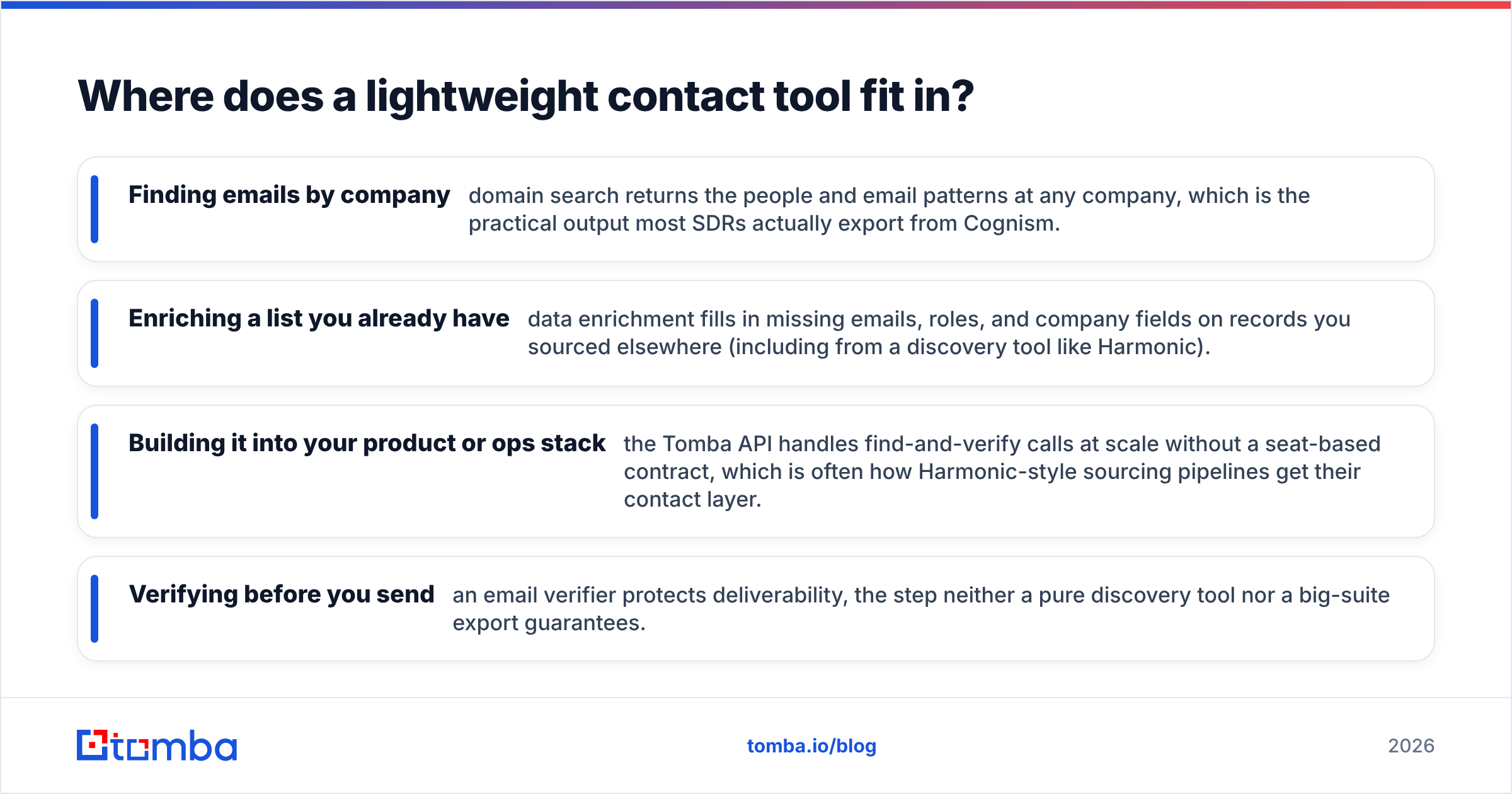
- Finding emails by company — domain search returns the people and email patterns at any company, which is the practical output most SDRs actually export from Cognism.
- Enriching a list you already have — data enrichment fills in missing emails, roles, and company fields on records you sourced elsewhere (including from a discovery tool like Harmonic).
- Building it into your product or ops stack — the Tomba API handles find-and-verify calls at scale without a seat-based contract, which is often how Harmonic-style sourcing pipelines get their contact layer.
- Verifying before you send — an email verifier protects deliverability, the step neither a pure discovery tool nor a big-suite export guarantees.
This is not an argument that Tomba replaces Cognism's compliance tooling or Harmonic's startup graph. It's that a large share of "we bought a data platform" spend is really just "we needed emails and phone numbers," and that specific need has a leaner solution.
Cognism vs Harmonic: pros and cons#
Cognism — pros
- Human-verified mobile numbers built for calling.
- Strong compliance features for regulated outbound.
- Deep EMEA/DACH coverage.
Cognism — cons
- Opaque, enterprise-level annual pricing.
- Overkill if you only need occasional email lookups.
- US data quality varies by segment (check region-specific reviews).
Harmonic — pros
- Best-in-class early-stage and stealth company discovery.
- Rich growth and funding signals for sourcing.
- Solid API for embedding company data.
Harmonic — cons
- Not a contact-execution tool—you still need emails and dials elsewhere.
- Sales-led pricing, not built for small teams.
- Overlaps little with traditional SDR workflows.
Frequently asked questions#
Is Cognism a competitor to Harmonic? Not really. Cognism sells verified contact data for outbound; Harmonic sells startup and company intelligence for sourcing. They can sit in the same stack—Harmonic finds the companies, a contact tool finds the people.
Which has better data accuracy? For phone and email contact data, Cognism is the stronger of the two by design. For private-company and startup signals, Harmonic leads. They're measuring different things, so a single "accuracy" score doesn't transfer between them.
Do either offer a free plan? No. Both are quote-based with annual commitments. If you want a free entry point, usage-based contact tools like Tomba offer a free tier and published pricing.
What if I only need emails and phone numbers? Then a full platform is probably more than you need. A dedicated finder-and-verifier stack does that specific job for far less. See the B2B database and finder tools for the pay-as-you-go route.
The bottom line#
Choose Cognism if your priority is reaching known audiences at scale with compliant, phone-verified data—especially in Europe. Choose Harmonic if your priority is discovering and monitoring emerging private companies before your competitors do. They're complements more often than rivals.
But if you strip either decision down to what most teams actually export—verified emails and phone numbers—you don't need a five-figure annual contract to get them. Start free with the Tomba Email Finder: search by domain, name, or company, verify before you send, and pay only for what you use. Point your sourcing tools at discovery, and let a lean, transparent contact layer handle the outreach data—no lock-in required.
Related guides#
// get started
Find, verify and enrich your first contacts today
Start on the free plan with 25 searches a month, then scale when your team is ready.
Free plan · No credit card required · GDPR & CCPA
// about the author