Cold Email vs Cold Call in 2026: Which One Actually Works
Cold email scales cheap but replies are slow. Cold calling converts fast but burns hours. Here's the honest math on cost per meeting, reply rates, and when each channel actually wins.
TL;DR
- Cold email wins on cost per touch and scale; cold calling wins on speed to feedback and conversion per conversation.
- A realistic cold email sequence returns 3-8% reply rates on clean data. A cold call day of 60 dials returns 3-6 real conversations and 1-2 meetings for a good rep.
- Cost per booked meeting lands in a similar range for both once you price in rep salary — email is cheaper per touch, calling is cheaper per qualified touch.
- Data quality decides both. A bad email guess bounces; a bad phone number burns 90 seconds and a rep's morale.
- The teams that beat both numbers don't pick one. They call the people who opened, and email the people who didn't answer.
What is the real difference between cold email and cold call?#
Cold email is asynchronous and cheap. Cold calling is synchronous and expensive. Everything else follows from that.
Think of it like fishing. Cold email is setting fifty lines across a lake and checking them tomorrow — low cost per line, low yield per line, and you find out slowly. Cold calling is standing in one spot with a spear — most throws miss, but when you connect you know instantly, and you can adjust your aim on the next throw.
That asymmetry is why the two channels break down completely differently on a spreadsheet:
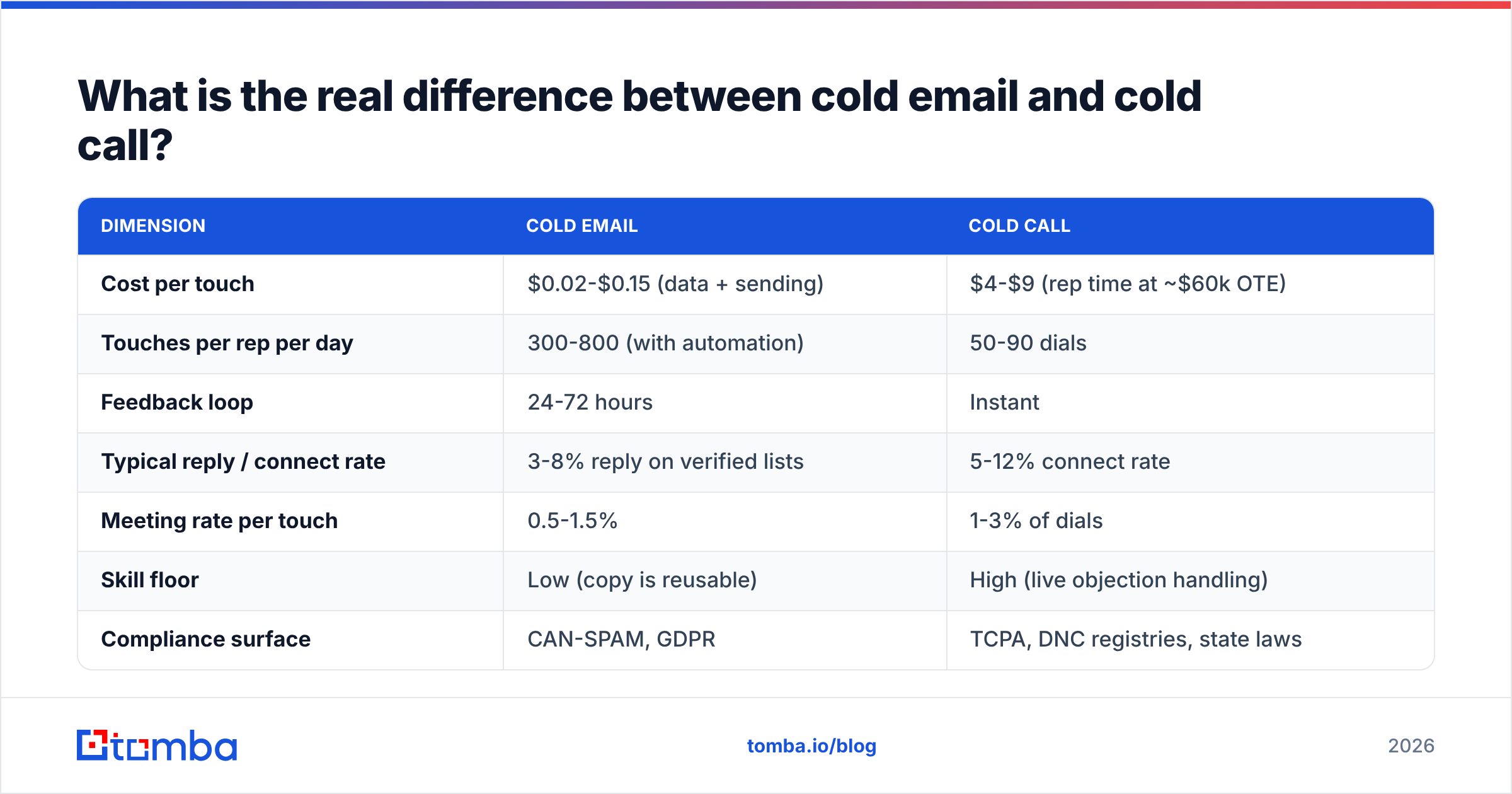
| Dimension | Cold Email | Cold Call |
|---|---|---|
| Cost per touch | $0.02-$0.15 (data + sending) | $4-$9 (rep time at ~$60k OTE) |
| Touches per rep per day | 300-800 (with automation) | 50-90 dials |
| Feedback loop | 24-72 hours | Instant |
| Typical reply / connect rate | 3-8% reply on verified lists | 5-12% connect rate |
| Meeting rate per touch | 0.5-1.5% | 1-3% of dials |
| Skill floor | Low (copy is reusable) | High (live objection handling) |
| Compliance surface | CAN-SPAM, GDPR | TCPA, DNC registries, state laws |
| Scales by | Adding data + domains | Adding humans |
Neither column is "the winner." They're different machines. The mistake most teams make is comparing the reply rate of email to the connect rate of calling, which is like comparing a rifle's magazine size to its muzzle velocity.
Which channel has better response rates in 2026?#
Cold calling has better per-conversation conversion. Cold email has better total output.
Run the arithmetic on one rep, one day:
Cold call day
- 80 dials attempted in ~5.5 hours of talk time and dialer overhead.
- 8 connects (10% connect rate — generous, and only reachable with verified direct dials).
- 3 real conversations past the first 15 seconds.
- 1 meeting booked, occasionally 2 on a good day.
Cold email day
- 400 emails sent across warmed inboxes (or 2,000 queued across a week).
- ~380 delivered after a 5% bounce on clean data.
- 19 replies at a 5% reply rate — including 8 "no thanks" and 3 out-of-office.
- 4-6 positive replies, of which 2-3 become meetings.
Email produces more meetings per rep-day. Calling produces better meetings — a prospect who agreed on the phone is 2-3x more likely to actually show up than one who typed "sure, send a time." HubSpot's sales statistics roundup has consistently found that live conversation dramatically compresses the deal cycle, and every RevOps leader who has tracked no-show rate by source has seen the same thing.
There's a caveat nobody puts in the deck: those email numbers assume your list is real. A 5% bounce rate is the outcome of verification, not luck. Send to a scraped list of pattern-guessed addresses and you'll see 20-25% bounces, a wrecked sender reputation, and reply rates under 1% because most of your sends landed in spam.
What does each channel actually cost per meeting?#
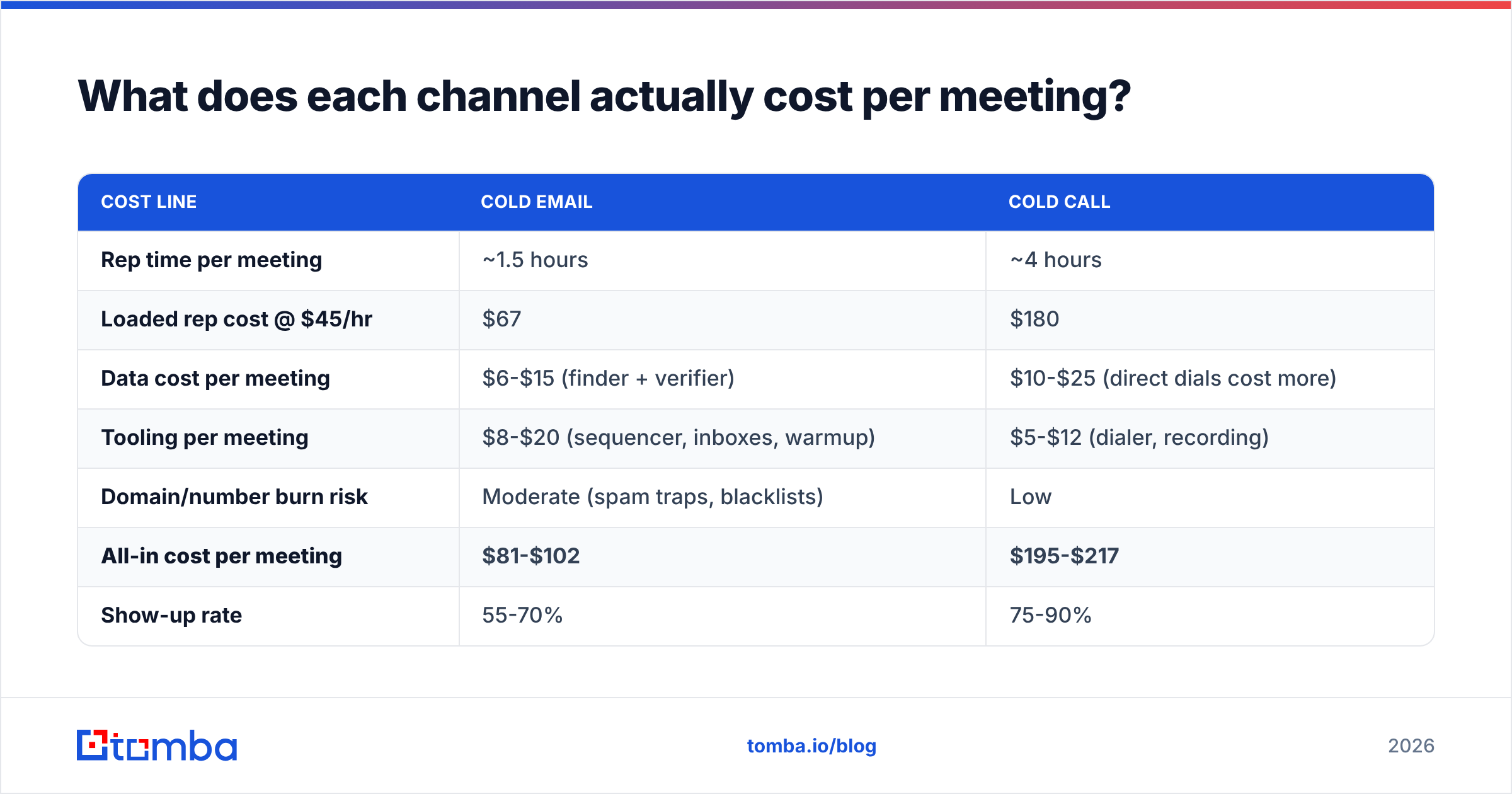
This is where intuition fails. People assume email is 10x cheaper. It isn't — once a human is involved, the human dominates the cost line.
| Cost line | Cold Email | Cold Call |
|---|---|---|
| Rep time per meeting | ~1.5 hours | ~4 hours |
| Loaded rep cost @ $45/hr | $67 | $180 |
| Data cost per meeting | $6-$15 (finder + verifier) | $10-$25 (direct dials cost more) |
| Tooling per meeting | $8-$20 (sequencer, inboxes, warmup) | $5-$12 (dialer, recording) |
| Domain/number burn risk | Moderate (spam traps, blacklists) | Low |
| All-in cost per meeting | $81-$102 | $195-$217 |
| Show-up rate | 55-70% | 75-90% |
| Cost per held meeting | $125-$180 | $230-$275 |
Cold email is roughly 1.5-2x cheaper per held meeting. That gap is real but it's much narrower than the "$0.02 per email!" framing suggests. And the gap closes fast in three situations:
- Six-figure ACV. When one deal is worth $120k, a $275 meeting is free.
- Tiny TAM. If there are 400 accounts on earth that can buy your product, you can't scale email — you'd exhaust the list in a month. Call them.
- Saturated inboxes. Some segments (VP Eng at Series B startups, agency owners) get 40+ cold emails a week. Their phone rings twice.
Cost per meeting is also the metric most often gamed. If your SDR books meetings by promising "just 10 minutes to share a case study," you'll get a cheap meeting and an expensive pipeline problem.
Is cold calling dead in 2026?#
No — but the unqualified cold call is. What died is dialing a switchboard and asking for the decision maker.
What replaced it:
- Direct dials or nothing. Mainline numbers reach a gatekeeper or a voicemail nobody checks. Connect rates on direct mobile numbers run 3-5x higher. This is why a phone finder that returns validated mobile numbers is now table stakes, not a nice-to-have.
- Warm-ish calling. Rep calls a contact who opened the last two emails, visited pricing, or engaged on LinkedIn. Connect rate holds, but conversation quality jumps.
- Compliance-first dialing. The Telephone Consumer Protection Act and state-level DNC rules have real teeth, and 2024-2025 enforcement made "we bought the list, so it's fine" an expensive position. Scrub against DNC, keep consent records for anything auto-dialed, and don't touch a predictive dialer without legal sign-off.
- Fewer, better dials. Best-performing teams have cut daily dial targets from 100+ to 50-70 and doubled research time per account. Activity metrics went down. Meetings went up.
The rep who researches ten accounts and makes twenty thoughtful calls outperforms the rep who blasts eighty. That is the opposite of what the activity dashboard rewards, which is why it keeps not happening.
Is cold email dead in 2026?#
Also no — but the volume game is over.
Google and Yahoo's 2024 bulk sender requirements, plus Microsoft's 2025 tightening, moved the deliverability floor. If you send more than 5,000 messages a day to a single provider you need authenticated domains, a complaint rate under 0.3%, and one-click unsubscribe. That killed the 10,000-sends-a-day agency model.
What survives:
- Lower volume, verified lists. Bouncing a message costs you far more than the credit you spent finding it. Run every address through an email verifier before it enters a sequence.
- Multiple sending domains, warmed properly. Not to dodge filters — to spread risk when one domain gets flagged.
- Real personalization above the fold. Not
{{first_name}}and a merge-tagged company. One specific, verifiable observation about their business in line one. - Sequences of 3-4 touches, not 9. Touches 5-9 generate almost no replies and generate almost all of the complaints.
The teams complaining that "cold email doesn't work anymore" are almost always describing a data problem. Their email deliverability collapsed because their bounce rate told mailbox providers they were guessing.
When should you choose cold email over cold call?#
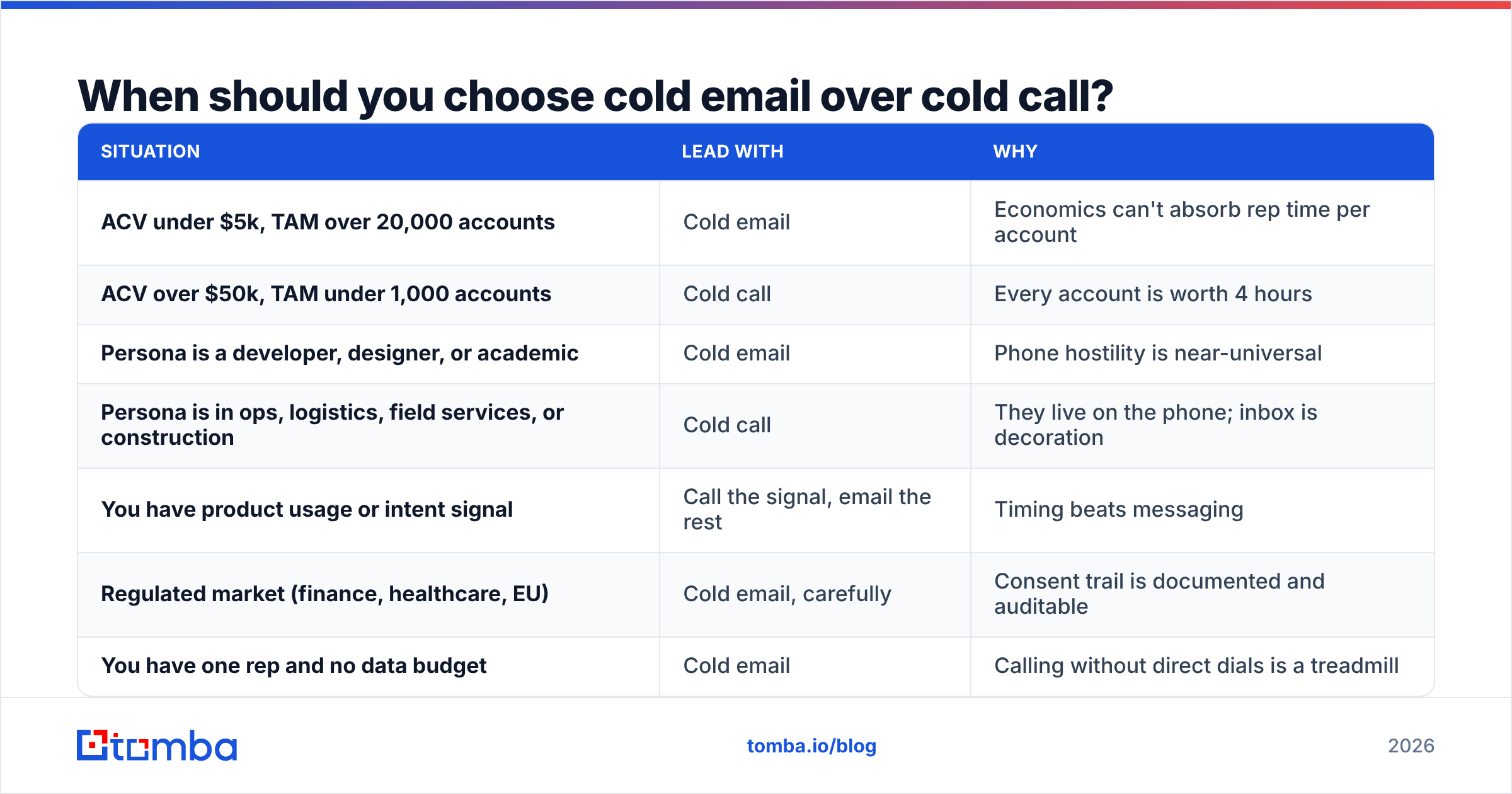
Use this decision matrix rather than a philosophy.
| Situation | Lead with | Why |
|---|---|---|
| ACV under $5k, TAM over 20,000 accounts | Cold email | Economics can't absorb rep time per account |
| ACV over $50k, TAM under 1,000 accounts | Cold call | Every account is worth 4 hours |
| Persona is a developer, designer, or academic | Cold email | Phone hostility is near-universal |
| Persona is in ops, logistics, field services, or construction | Cold call | They live on the phone; inbox is decoration |
| You have product usage or intent signal | Call the signal, email the rest | Timing beats messaging |
| Regulated market (finance, healthcare, EU) | Cold email, carefully | Consent trail is documented and auditable |
| You have one rep and no data budget | Cold email | Calling without direct dials is a treadmill |
| Your last three deals came from referrals | Neither, yet | Fix the ICP before scaling any channel |
Two failure modes worth naming. The first: teams that pick calling because a VP "believes in the phones," then hand reps a list of mainline numbers and watch them quit in six weeks. The second: teams that pick email because it's cheap, buy 50,000 unverified contacts, torch a domain, and conclude the channel is saturated.
Both failures are data failures wearing a channel costume.
How do cold email and cold call work together?#
The honest answer to "cold email vs cold call" is that the comparison is a false binary for any team past its first two reps. Sequenced together, the channels compound.
A working multi-channel cadence over ten business days:
- Day 1 — Email. Short, specific, one question. No attachment, no calendar link.
- Day 3 — Call. Only if the email was opened twice or clicked. Reference nothing about tracking; open with the reason you're calling.
- Day 4 — LinkedIn view + connect. No pitch in the note. Familiarity, not conversion.
- Day 6 — Email reply-in-thread. New angle, not a "just bumping this."
- Day 8 — Call + voicemail. Voicemail names the specific problem and says you'll email the details.
- Day 9 — Email referencing the voicemail. This pair reliably outperforms either touch alone, because the voicemail makes the email familiar rather than cold.
- Day 10 — Breakup email. One sentence. Ask if you should close the file.
Multi-touch, multi-channel cadences run roughly 2-3x the meeting rate of email-only at the same contact count. Gartner's ongoing research on B2B buyer behavior points at the same mechanism: buyers now touch six or more channels before a first conversation, so a single-channel sequence is competing against silence rather than presence.
The operational requirement is that every contact carries both a verified email and a validated direct dial. A cadence that calls a wrong number on day 3 has quietly become an email-only cadence with extra steps.
What data do you need before either channel works?#
Both channels rest on the same foundation, and it's the part teams skip because it isn't fun.
- Verified work email. Not a permutation guess. Not
first.last@company.cominferred from one sample. A syntactically valid, MX-checked, SMTP-confirmed address. Tools like an email finder that returns a confidence score let you route low-confidence hits to a call instead of burning a send. - Validated mobile or direct dial. Line type matters. A landline at an office nobody occupies is worse than no number, because it consumes a dial slot.
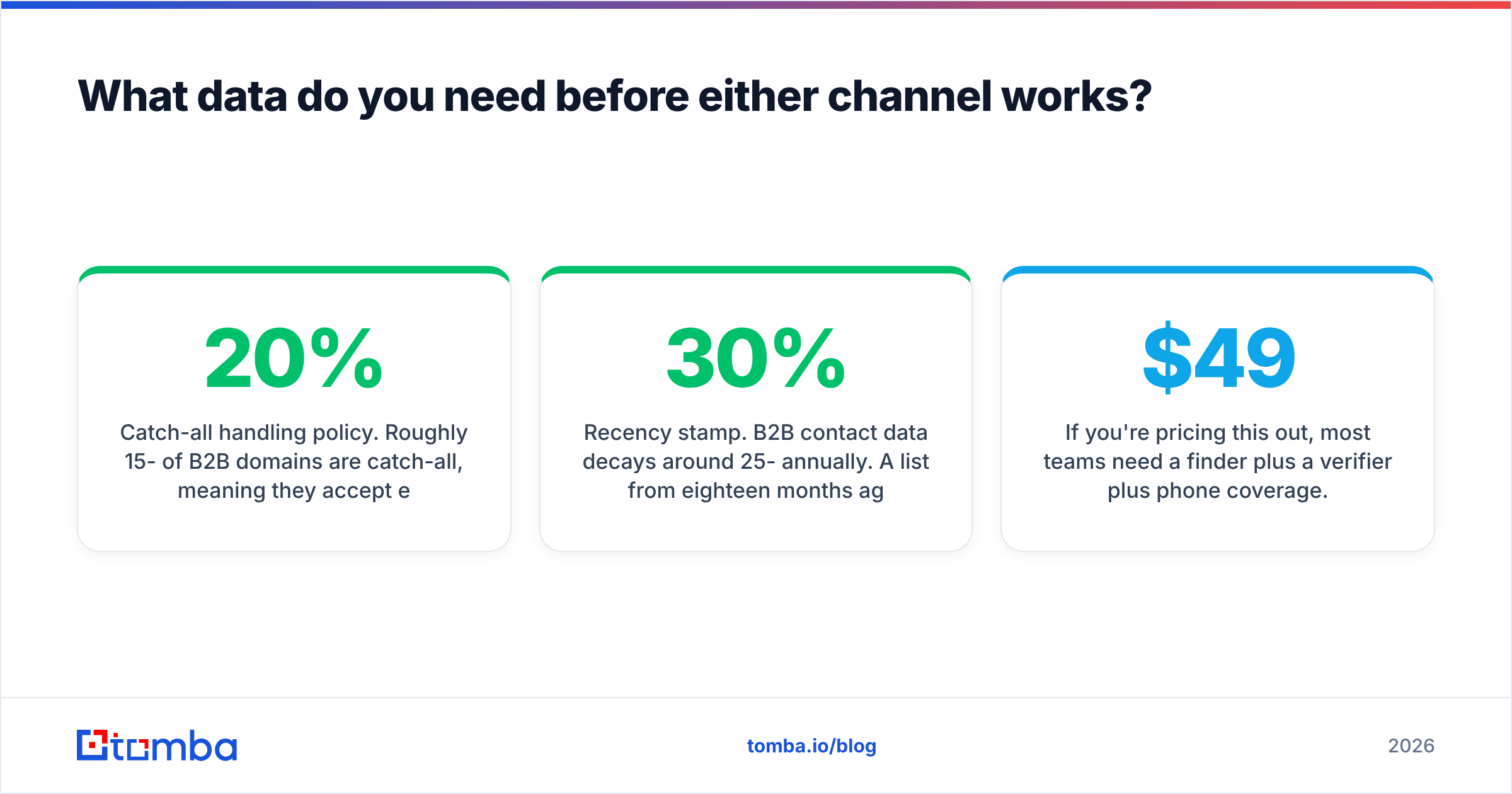
- Catch-all handling policy. Roughly 15-20% of B2B domains are catch-all, meaning they accept everything and verify nothing. Decide upfront: send anyway at a lower confidence tier, or route to phone. Don't let this decision happen by accident in a spreadsheet.
- Deduplication across the account. Emailing three people at the same 40-person company in the same week is how you get reported.
- Recency stamp. B2B contact data decays around 25-30% annually. A list from eighteen months ago is half fiction.
You can compare vendors on this dimension the same way you'd compare anything else — G2's data-provider category has enough verified reviews to separate the accuracy claims from the accuracy. Look at reported bounce rate in reviews, not at the vendor's own accuracy percentage, which is always measured on whatever subset makes it look best.
If you're pricing this out, most teams need a finder plus a verifier plus phone coverage. Tomba pricing starts free at 25 searches per month for testing a segment, then $49/mo on Starter and $99/mo on Growth once a sequence is actually running. That's meaningfully below the per-seat platforms, though those bundle a sequencer you'd otherwise buy separately — worth doing the arithmetic on your own stack rather than trusting anyone's comparison chart, including this one.
So which one should you actually run first?#
Start with cold email if you're validating a message. Start with cold calling if you're validating a market.
That's the cleanest heuristic available. Email gives you statistically usable data on messaging — you can A/B two subject lines across 400 sends and learn something real in a week. Calling gives you qualitative data on whether the problem you think exists actually exists — twenty conversations will tell you more about positioning than 2,000 emails ever will.
Then run both. The debate about cold email vs cold call is mostly a debate about which constraint you hit first: money or attention. Email runs out of attention. Calling runs out of money. A cadence that alternates between them runs out of neither for a lot longer.
Whichever you pick, the failure point is upstream of the channel. A wrong email address bounces. A wrong phone number wastes ninety seconds and a little of a rep's will to live. Fix the data, and both channels start behaving like the case studies said they would.
Get the contact data right before you pick a channel. Tomba Email Finder returns verified, confidence-scored work emails by domain, name, or company — so your sequence starts with addresses that exist and your dial list starts with people who are actually there. The free tier covers 25 searches a month, enough to test a segment before you commit a budget to either channel.
Related guides#
Ready to find emails that actually work?
Join 150,000+ professionals who stopped guessing and started sending. Free credits on signup — no credit card required.
Get the Tomba newsletter
Practical outbound tactics and product updates — once every two weeks.
About the author