Jet Leads Pro vs Vocusio: Which B2B Lead Tool Wins in 2026?
Jet Leads Pro and Vocusio both promise clean B2B contact data, but they are built for different buyers. Here is an honest breakdown of accuracy, pricing transparency, verification depth, and when a third option makes more sense.
Jet Leads Pro vs Vocusio comes down to one question: which tool hands you more verified, deliverable contacts in your niche? Neither vendor publishes enough to answer that from the outside. So here is the short version, then the week-long test that settles it.
TL;DR
- Jet Leads Pro and Vocusio sit in the same bucket: small, fast-moving B2B contact-data tools that sell volume and simplicity. Neither one publishes the accuracy methodology that larger buyers expect.
- Neither vendor keeps a deep public pricing page or a documented verification pipeline. That means you decide with a paid test, not a feature matrix.
- The single metric that matters is verified deliverable rate on your ICP, not total database size. A 200M-record claim means nothing if your niche is 4% covered.
- Do you need documented data sources, a real SMTP-level verifier, and an API you can build on? Then an established finder like Tomba or a compliant list vendor such as BookYourData is the safer default.
- Run the 7-day bake-off in the last section before you commit to any annual contract.
What are Jet Leads Pro and Vocusio?#
Both are B2B contact-acquisition tools aimed at the same person. That person is a founder, SDR, or agency operator who needs email addresses for a defined list of companies. They also do not want to pay enterprise sales-intelligence pricing.
Jet Leads Pro positions itself around speed and bulk output — upload a list of domains or companies, get contacts back. The pitch is throughput. That framing is common among newer lead tools. They aggregate from public sources and partner feeds, apply pattern matching, and return a large result set fast.
Vocusio leans toward the workflow side — finding contacts and pushing them into an outbound motion. Tools in this lane usually bundle light sequencing or CRM export next to the lookup.
Here is the honest part, and it matters more than any feature list. Neither brand has the public footprint of an Apollo, a Clearbit, or a ZoomInfo. There is no published data-sourcing methodology and no audited accuracy benchmark. Third-party review volume is thin on G2's sales intelligence category and Capterra. That is not disqualifying — plenty of good tools start small. But it shifts the burden of proof onto you. You have to run the test yourself.

How do you actually evaluate a low-profile lead tool?#
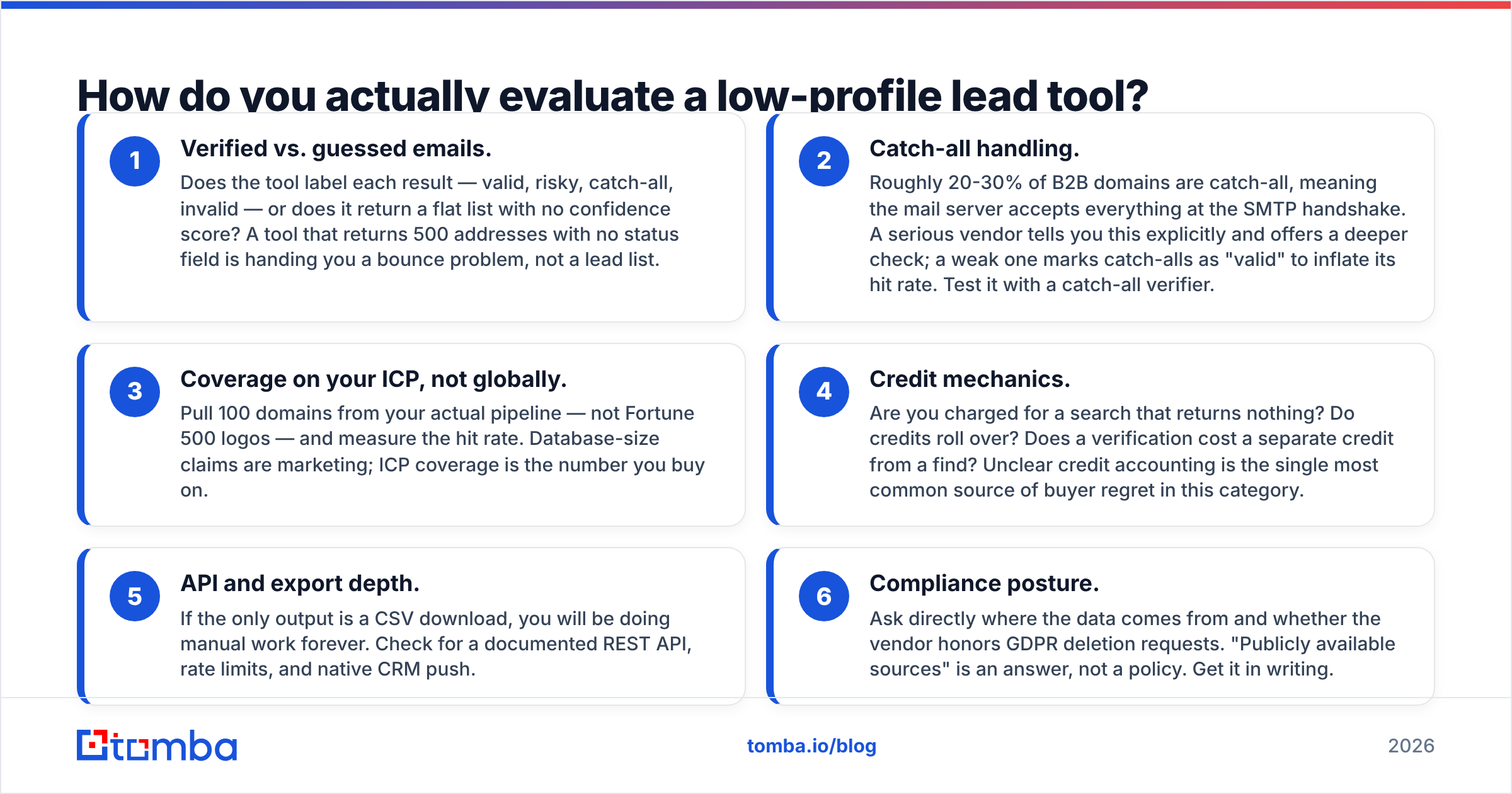
When a vendor's public documentation is thin, stop reading marketing copy. Grade on six concrete signals instead. This is the checklist I would hand any RevOps lead evaluating either product.
Start with the three signals that decide data quality:
- Verified vs. guessed emails. Does the tool label each result — valid, risky, catch-all, invalid? Or does it return a flat list with no confidence score? A tool that hands you 500 addresses with no status field is handing you a bounce problem, not a lead list.
- Catch-all handling. Roughly 20-30% of B2B domains are catch-all. The mail server accepts everything at the SMTP handshake. A serious vendor tells you this outright and offers a deeper check. A weak one marks catch-alls as "valid" to inflate its hit rate. Test it with a catch-all verifier.
- Coverage on your ICP, not globally. Pull 100 domains from your actual pipeline — not Fortune 500 logos — and measure the hit rate. Database-size claims are marketing. ICP coverage is the number you buy on.
The next three decide what the tool really costs and how far it scales:
- Credit mechanics. Are you charged for a search that returns nothing? Do credits roll over? Does a verification cost a separate credit from a find? Unclear credit accounting is the most common source of buyer regret in this category.
- API and export depth. If the only output is a CSV download, you will be doing manual work forever. Check for a documented REST API, rate limits, and native CRM push.
- Compliance posture. Ask where the data comes from. Ask whether the vendor honors GDPR deletion requests. "Publicly available sources" is an answer, not a policy. Get it in writing.
Every one of these is testable in under an hour with a trial account. None of them appear on a feature grid.
Jet Leads Pro vs Vocusio: how do they compare head-to-head?#
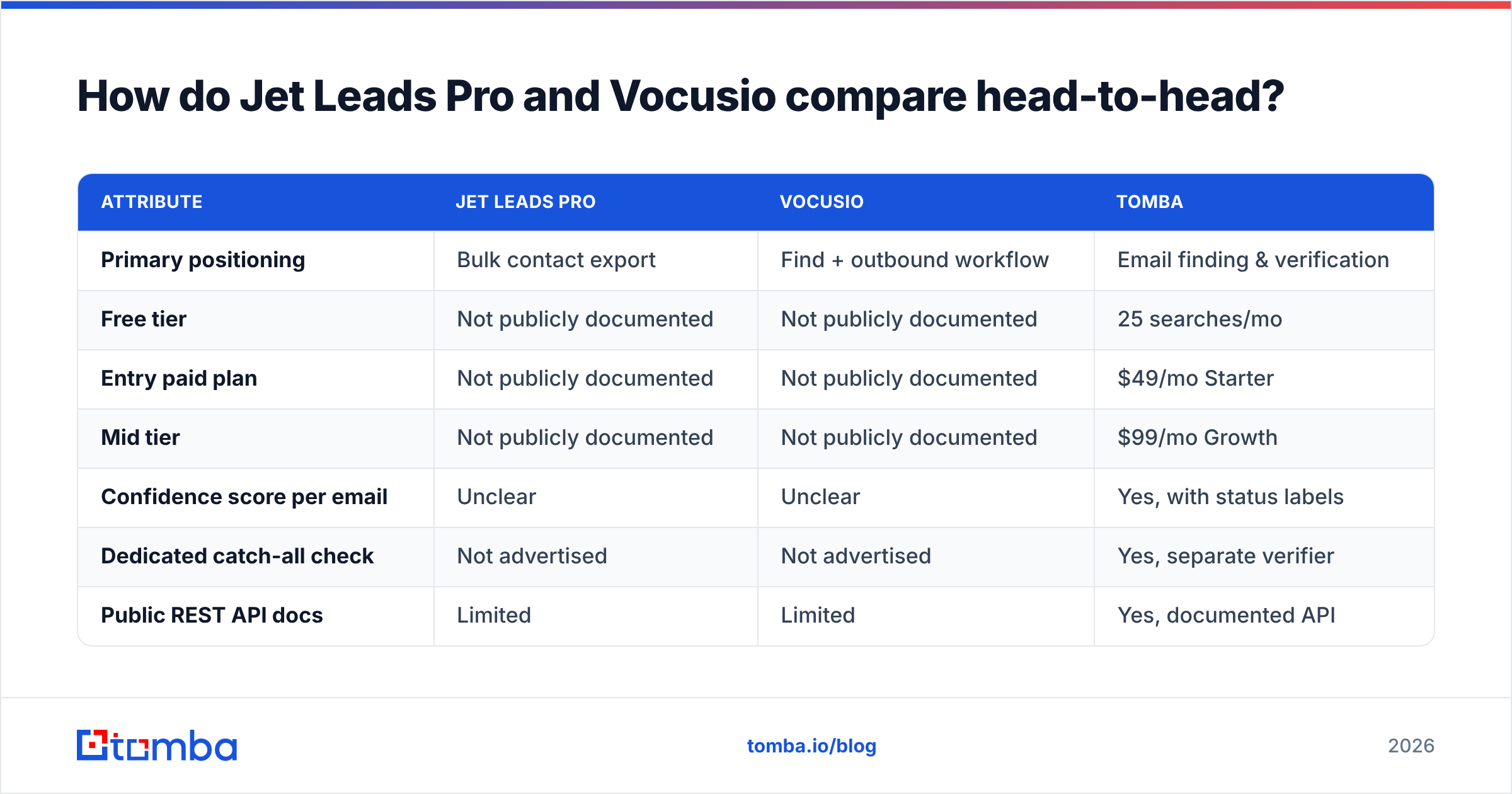
Neither vendor publishes a full specification sheet. So the table below marks unverifiable claims as Not publicly documented rather than guessing. Tomba is included as a reference column with published, checkable numbers, so you have a calibration point.
| Attribute | Jet Leads Pro | Vocusio | Tomba |
|---|---|---|---|
| Primary positioning | Bulk contact export | Find + outbound workflow | Email finding & verification |
| Free tier | Not publicly documented | Not publicly documented | 25 searches/mo |
| Entry paid plan | Not publicly documented | Not publicly documented | $49/mo Starter |
| Mid tier | Not publicly documented | Not publicly documented | $99/mo Growth |
| Confidence score per email | Unclear | Unclear | Yes, with status labels |
| Dedicated catch-all check | Not advertised | Not advertised | Yes, separate verifier |
| Public REST API docs | Limited | Limited | Yes, documented API |
| Bulk processing | Advertised | Advertised | Yes, bulk finder + verifier |
| Published data sources | No | No | Yes, data sources page |
| Native CRM integrations | Unclear | Unclear | HubSpot, Salesforce, Pipedrive, Zapier |
The pattern is clear. On raw feature intent, all three tools promise similar outcomes. On verifiability they diverge sharply. Can you check the claim before you pay? That gap is the actual decision.
Which one has better data accuracy?#
Nobody can answer this from the outside. Any blog post that gives you a precise accuracy percentage for these two tools is inventing it. What you can do is learn what separates a 95%-deliverable list from a 70%-deliverable one, then test for it.

Accuracy in this category comes from three layers stacked on top of each other:
Layer one — pattern inference. The tool knows that acme.com uses first.last@, so it generates jane.doe@acme.com. Cheap, fast, and wrong often enough to hurt. Every tool does this. A company email pattern checker shows you the format a domain actually uses. That format is the input to this step.
Layer two — corroboration. The generated address is cross-checked against sightings in public sources, historical sends, and partner data. This is where real vendors separate themselves. It is also where the "where does your data come from" question earns its keep.
Layer three — live validation. The address is checked against the receiving mail server over an SMTP conversation. Add MX record checks, syntax validation, disposable-domain detection, and role-account flagging. Without this layer you are guessing.
A tool that only runs layers one and two will report high "found" rates and deliver mediocre inbox rates. If neither vendor can tell you which layers they run, assume layer three is missing or shallow. Budget for a separate email verifier on top. That is not a knock on either product. It is standard practice, even among teams running Apollo or Lusha.

What does the pricing actually work out to?#
Sticker price is the wrong unit. The right unit is cost per verified, deliverable contact in your ICP.
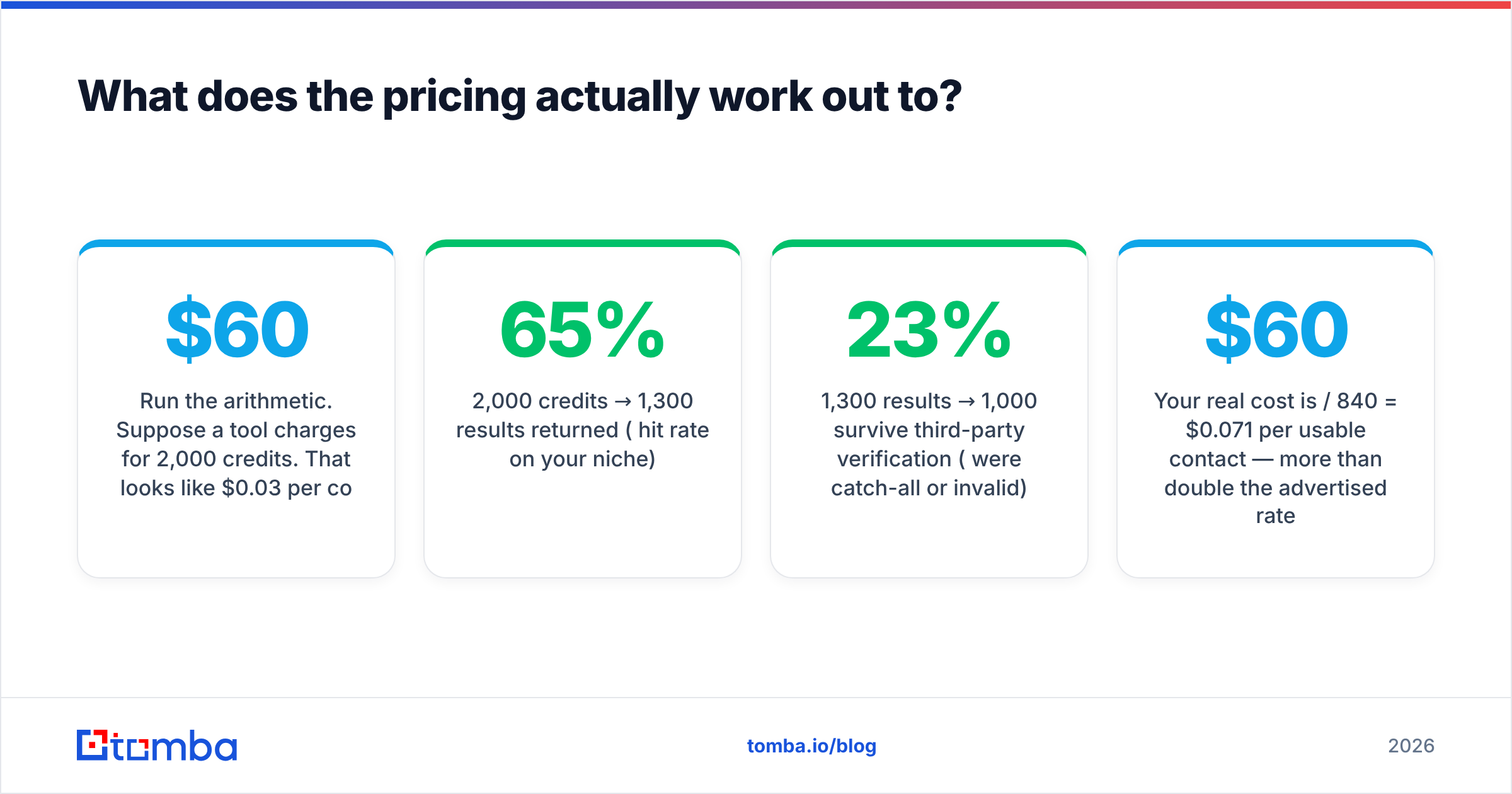
Run the arithmetic. Suppose a tool charges $60/month for 2,000 credits. That looks like $0.03 per contact. Now apply reality:
- 2,000 credits → 1,300 results returned (65% hit rate on your niche)
- 1,300 results → 1,000 survive third-party verification (23% were catch-all or invalid)
- 1,000 verified → 840 are actually in-title and in-ICP
Your real cost is $60 / 840 = $0.071 per usable contact — more than double the advertised rate. Then add the verification spend you needed to get there.
This is why credit mechanics matter more than headline price. Ask both vendors, in writing:
| Pricing question | Why it matters |
|---|---|
| Are empty searches charged? | Can silently double effective cost on niche ICPs |
| Do unused credits roll over? | Seasonal outbound teams waste 30-40% otherwise |
| Is verification a separate credit? | Turns a $49 plan into a $90 plan |
| Is annual billing refundable? | Small vendors, high churn risk |
| What is the overage rate? | Surprise invoices kill trust fast |
For calibration: Tomba's pricing runs a free tier at 25 searches/month, Starter at $49/mo, Growth at $99/mo, and Pro at $249/mo, with Enterprise custom. Published, fixed, checkable. Cannot get equivalent clarity from a vendor before signing? That opacity is itself a data point.

Who should pick Jet Leads Pro, and who should pick Vocusio?#
Based on how each product positions itself:
Lean toward Jet Leads Pro if your bottleneck is volume and your ICP is mainstream — SaaS, agencies, e-commerce in North America and Western Europe. It also assumes you already run a separate verification step before sending. You are buying raw throughput and cleaning it downstream.
Lean toward Vocusio if you want fewer tools in the stack. You accept a smaller, less flexible data layer in exchange for an integrated find-to-send motion. This suits a one-person outbound operation more than a team with a defined RevOps process.
Lean toward neither if any of these apply:
- You need an API contract you can build product features on
- Your ICP is outside the vendors' likely coverage strength (APAC, LATAM, non-English SMB, regulated industries)
- Legal requires documented data provenance
- You are sending at a volume where a 15% bounce rate would torch sender reputation
In that third case, look at established finders with published methodology, or at a compliant list vendor. BookYourData takes the opposite approach: pre-verified, purchasable lists with a stated accuracy guarantee. That is a genuinely different and legitimate model when you want volume without running the verification yourself.
How do you run a 7-day bake-off between them?#
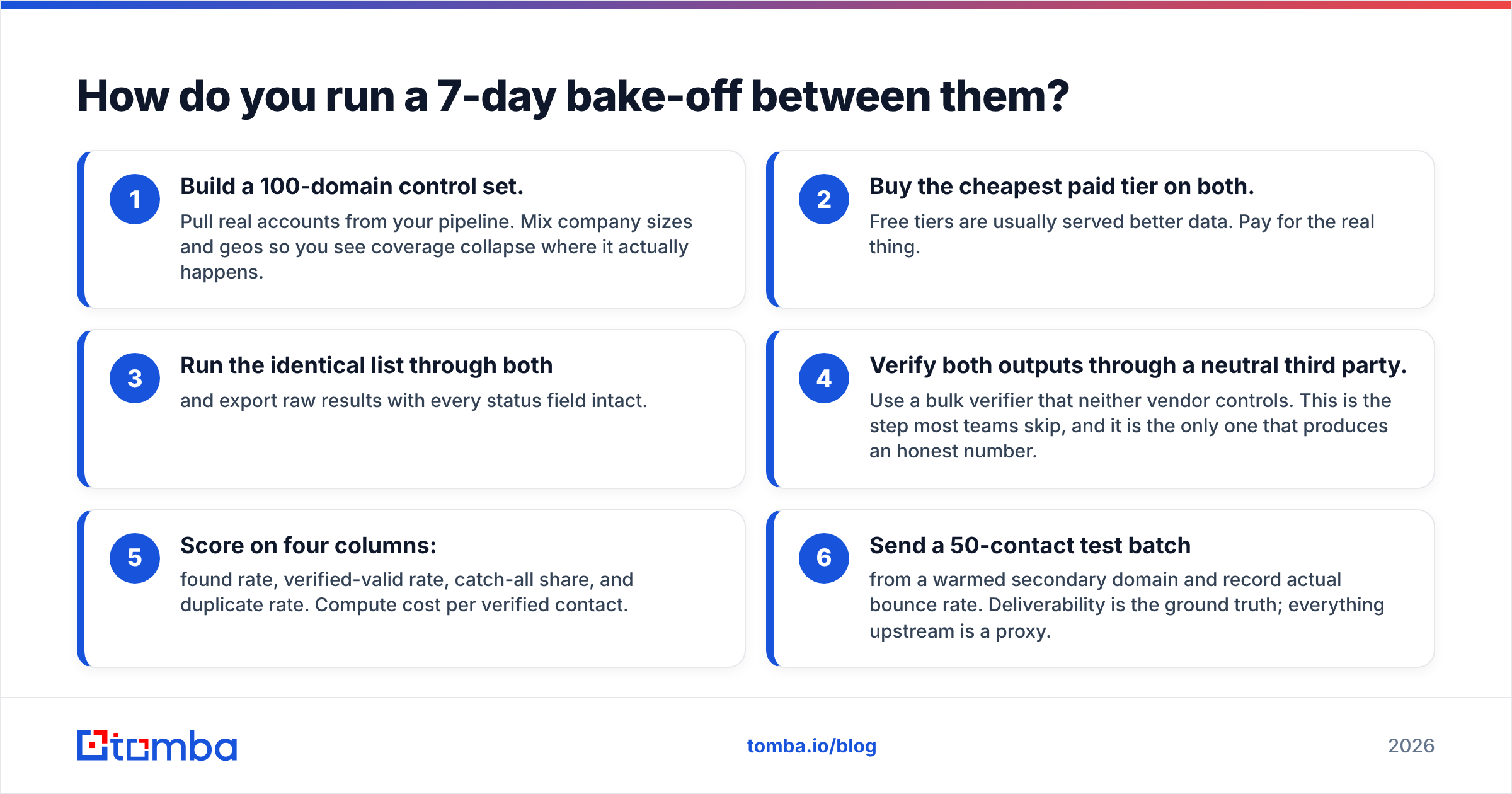
Do not decide from marketing pages. Run this:
- Build a 100-domain control set. Pull real accounts from your pipeline. Mix company sizes and geos so you see coverage collapse where it actually happens.
- Buy the cheapest paid tier on both. Free tiers are usually served better data. Pay for the real thing.
- Run the identical list through both and export raw results with every status field intact.
- Verify both outputs through a neutral third party. Use a bulk verifier that neither vendor controls. Most teams skip this step. It is the only one that produces an honest number.
- Score on four columns: found rate, verified-valid rate, catch-all share, and duplicate rate. Compute cost per verified contact.
- Send a 50-contact test batch from a warmed secondary domain and record actual bounce rate. Deliverability is the ground truth; everything upstream is a proxy.
Seven days, maybe $120 total, and you get a defensible answer instead of a vibe. Teams that skip this step find the problem three months into an annual contract. By then the email deliverability damage is already done.
What is the honest verdict?#
Jet Leads Pro vs Vocusio has no winner you can declare from the outside. Any comparison that claims one is guessing. Both are plausible tools for a small outbound operation. Both carry the same risk profile: limited public documentation, unclear verification depth, and thin third-party validation.
What you can be certain about is the shape of the decision. Volume claims are cheap. Verified deliverability is expensive to produce and easy to test. Whichever tool you pick, budget for an independent verification layer before anything hits a mailbox. A bounced send costs far more than a wasted credit. It burns domain reputation that takes weeks to rebuild.
Want the finding and the verifying handled in one place, with published pricing, documented data sources, and an API you can build against? Start with the Tomba Email Finder. The free tier gives you 25 searches a month. That is enough to run the control-set test above against whichever vendor you are weighing, and to check the cost-per-verified-contact math yourself before you sign anything.
Related guides#
// get started
Find, verify and enrich your first contacts today
Start on the free plan with 25 searches a month, then scale when your team is ready.
Free plan · No credit card required · GDPR & CCPA
// about the author