LeadEngineAI vs Seamless.AI: Data, Pricing, and Accuracy
Seamless.AI sells a database plus a sales team. LeadEngineAI sells AI automation on top of aggregated data. Here is how they compare on accuracy, credits, contracts, and what a cheaper verified-email stack looks like.
LeadEngineAI vs Seamless.AI comes down to three things: data accuracy, real pricing, and export limits. One sells a big database plus a sales rep. The other sells AI automation on top of brokered data. Here is how they compare, and what a cheaper verified-email stack looks like.
TL;DR
- Seamless.AI is the older, heavier product. You get a large aggregated B2B contact database, a Chrome extension, buyer intent, and an annual per-seat contract you negotiate with a rep. Pricing is not published.
- LeadEngineAI is the newer, AI-first entrant. It leans on automated list building, AI research, and workflow generation rather than raw database size. Plans and limits change often, so check the vendor's own site before you buy.
- Neither tool is honest about the one number that matters: what percentage of exported emails actually land. Both count a "found" contact as a credit whether or not it bounces.
- If your bottleneck is contracts and seat fees rather than features, a focused email finder plus verifier usually costs 60-80% less for the same list. Tomba starts at $49/mo, with a free tier of 25 searches.
- Best split: Seamless.AI for teams that want one big database with intent baked in. LeadEngineAI for small teams that want automation over headcount. A dedicated finder and verifier for anyone who just needs clean, exportable, verified addresses.
What are LeadEngineAI and Seamless.AI?#
They solve the same job: get a name, a company, and a working email into your sequence. But they were built in different eras, and it shows.
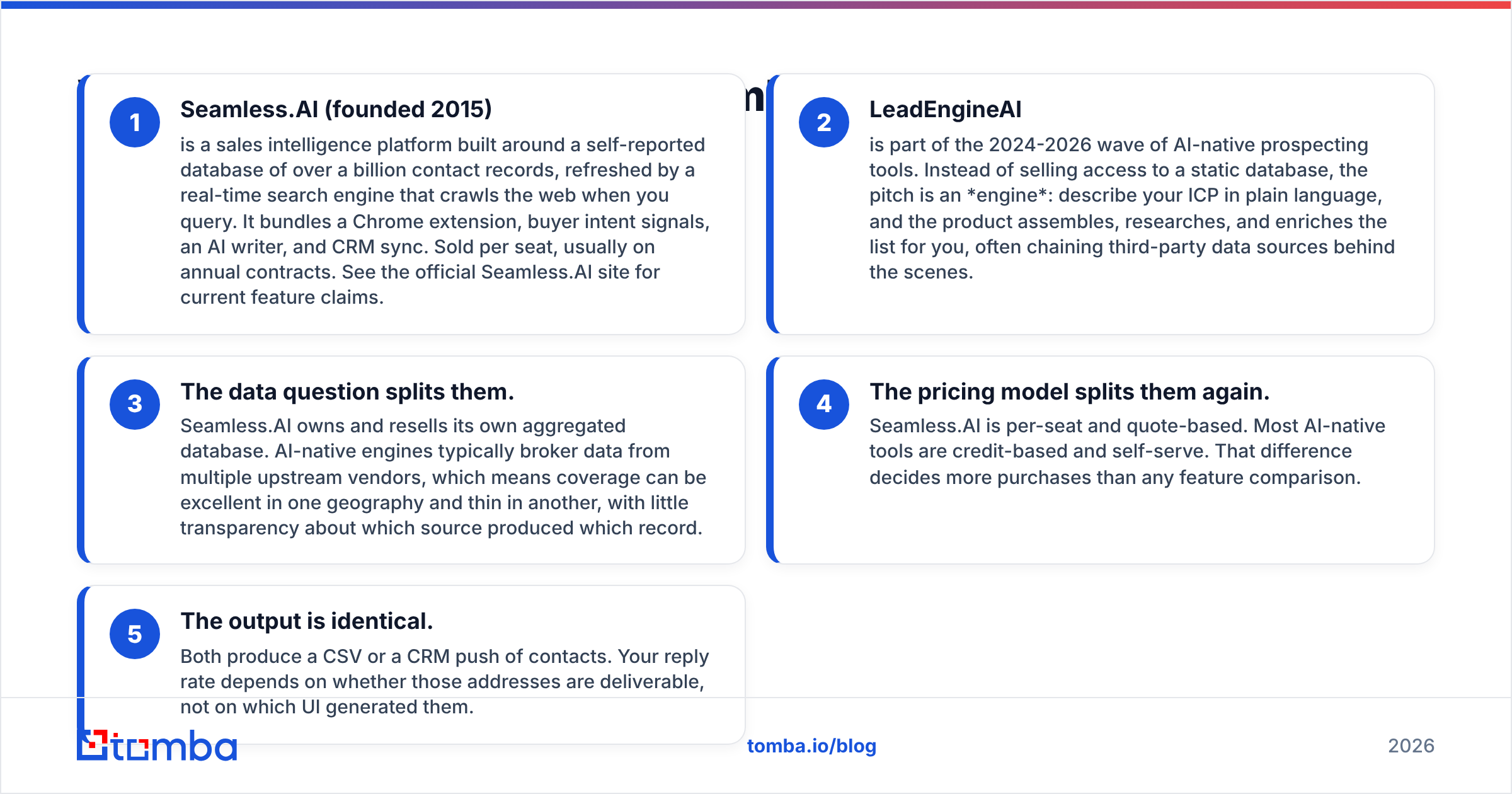
Seamless.AI (founded 2015) is a sales intelligence platform. It is built around a self-reported database of over a billion contact records. A real-time search engine crawls the web when you query. It bundles a Chrome extension, buyer intent signals, an AI writer, and CRM sync. It sells per seat, usually on annual contracts. See the official Seamless.AI site for current feature claims.
LeadEngineAI is part of the 2024-2026 wave of AI-native prospecting tools. It does not sell access to a static database. The pitch is an engine: describe your ICP in plain language, and the product assembles, researches, and enriches the list for you. Third-party data sources are usually chained behind the scenes.
The data question splits them. Seamless.AI owns and resells its own aggregated database. AI-native engines broker data from several upstream vendors. Coverage can be excellent in one country and thin in another. You rarely learn which source produced which record.
The pricing model splits them again. Seamless.AI is per-seat and quote-based. Most AI-native tools are credit-based and self-serve. That one difference decides more purchases than any feature comparison.
The output is identical. Both hand you a CSV or a CRM push. Your reply rate depends on whether those addresses are deliverable, not on which UI generated them.
Strip away the branding and you are buying three things: coverage, accuracy, and export freedom. Everything else is packaging.

LeadEngineAI vs Seamless.AI: how they compare head-to-head#
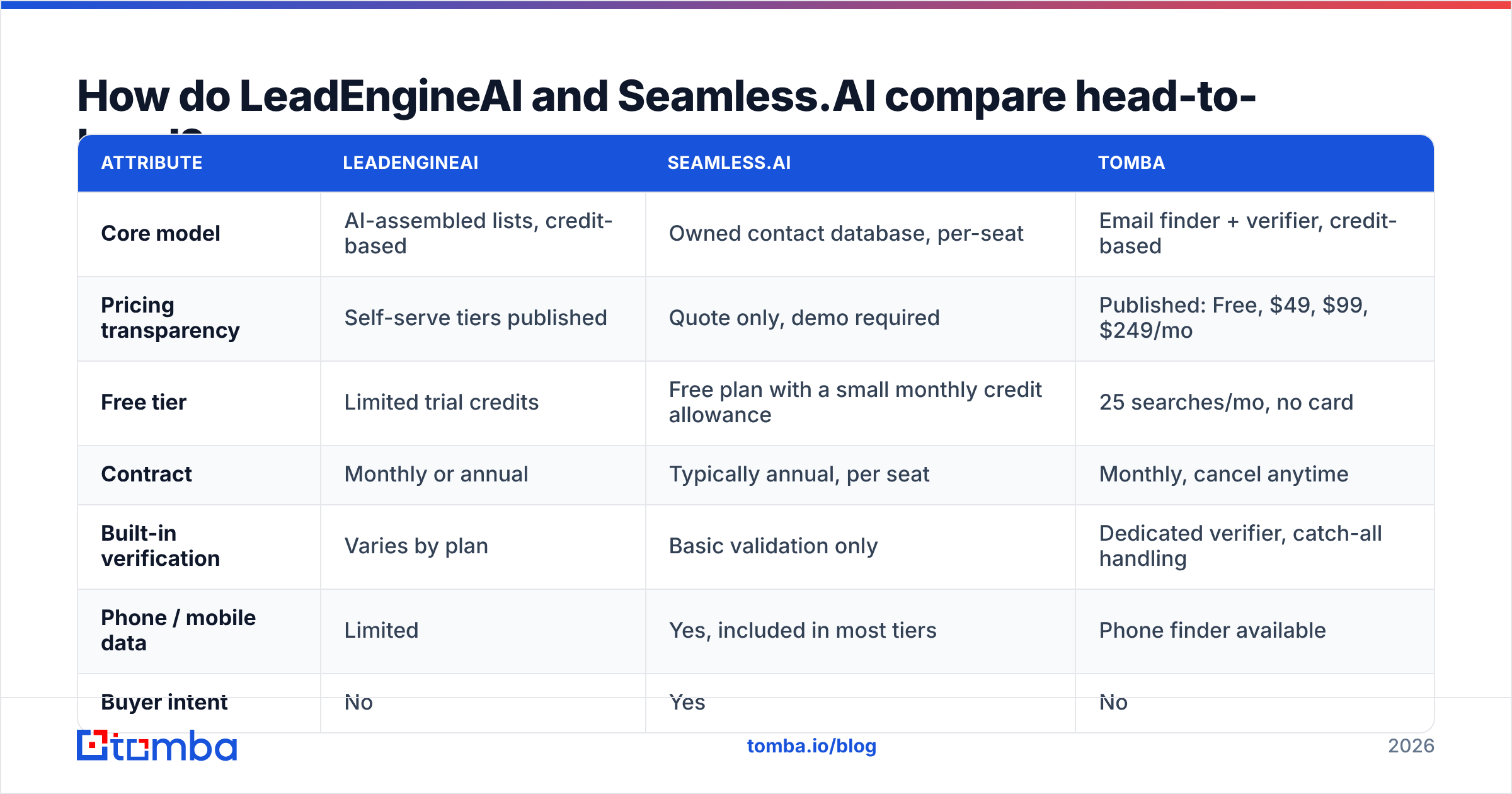
Here is the practical breakdown. Where a vendor does not publish a number, this table says so rather than inventing one. Check the vendor site before you sign.
| Attribute | LeadEngineAI | Seamless.AI | Tomba |
|---|---|---|---|
| Core model | AI-assembled lists, credit-based | Owned contact database, per-seat | Email finder + verifier, credit-based |
| Pricing transparency | Self-serve tiers published | Quote only, demo required | Published: Free, $49, $99, $249/mo |
| Free tier | Limited trial credits | Free plan with a small monthly credit allowance | 25 searches/mo, no card |
| Contract | Monthly or annual | Typically annual, per seat | Monthly, cancel anytime |
| Built-in verification | Varies by plan | Basic validation only | Dedicated verifier, catch-all handling |
| Phone / mobile data | Limited | Yes, included in most tiers | Phone finder available |
| Buyer intent | No | Yes | No |
| Chrome extension | Yes | Yes | Yes |
| API access | Yes, credit-metered | Available on higher tiers | Yes, on all paid plans |
| Bulk enrichment | Yes | Yes | Yes, CSV in / CSV out |
| Export limits | Credit-capped | Credit-capped per seat, per day | Credit-capped, no seat multiplier |
| Best for | Small teams automating list building | Mid-market teams wanting intent + data in one seat | Teams that need verified addresses cheaply |
The row that creates the most support tickets is export limits. Seamless.AI meters credits per user. Several G2 reviewers flag daily caps and renewal friction, so read the Seamless.AI reviews on G2 before you commit to an annual term.
AI-native engines like LeadEngineAI usually skip the seat multiplier. But they burn credits on enrichment steps you never asked for. You get the same end-of-month surprise from a different direction.
Which one has better data accuracy?#
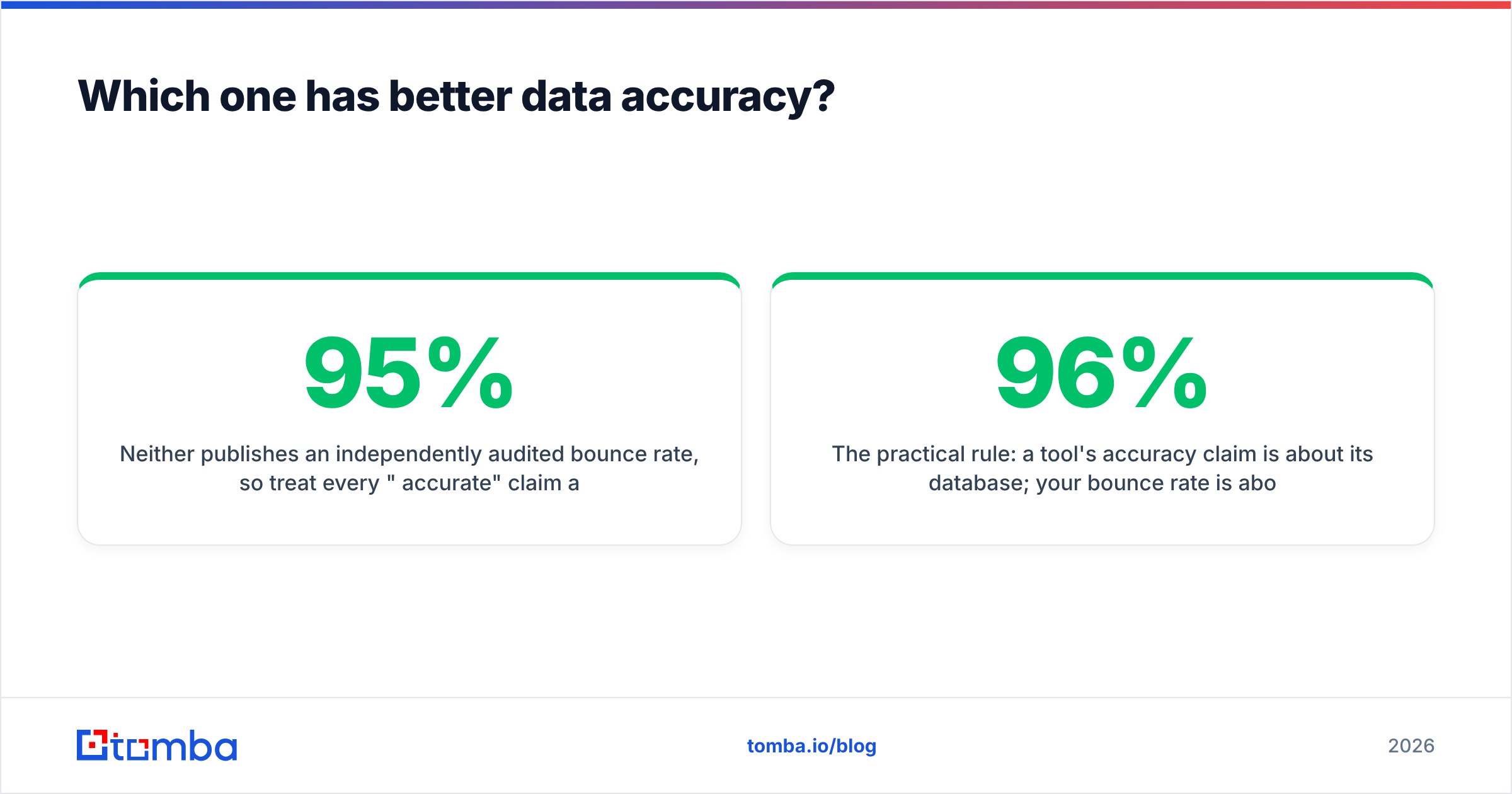
Neither publishes an audited bounce rate. Treat every "95% accurate" claim as marketing until you test it.
Run this test before you buy, on both tools, with the same list:
- Build a 200-row control list from a segment you know well: 50 accounts you already sell into, 150 you do not.
- Export from each tool and record how many credits each burned to produce 200 rows.
- Run both exports through an independent email verifier — not the vendor's own checker, which has an obvious incentive to pass its own data.
- Count three buckets: valid, catch-all, and invalid. Catch-all is not a win. It is a coin flip you pay for.
- Send a 50-contact test batch and measure hard bounces at 72 hours.

Here is the usual pattern. Database-first tools like Seamless.AI cover US mid-market and enterprise contacts well. They get thinner on EMEA, APAC, and companies under 50 people.
AI-native engines stay more even across regions because they broker several sources. In exchange, they return more catch-all and role-based addresses: info@, sales@, contact@. Those inflate the "found" number without giving you a human to talk to.
The practical rule: a tool's accuracy claim is about its database. Your bounce rate is about your segment. A 96% accurate database can still hand you a 12% bounce rate if your ICP is 20-person agencies in Portugal.
Catch-all domains deserve their own paragraph. Roughly a fifth of B2B domains accept every address at the SMTP layer. A naive verifier marks them "valid," and your ESP later marks them "bounced." If your list skews toward Microsoft 365 tenants, run a catch-all verifier as a separate step. Do not trust a single green checkmark.
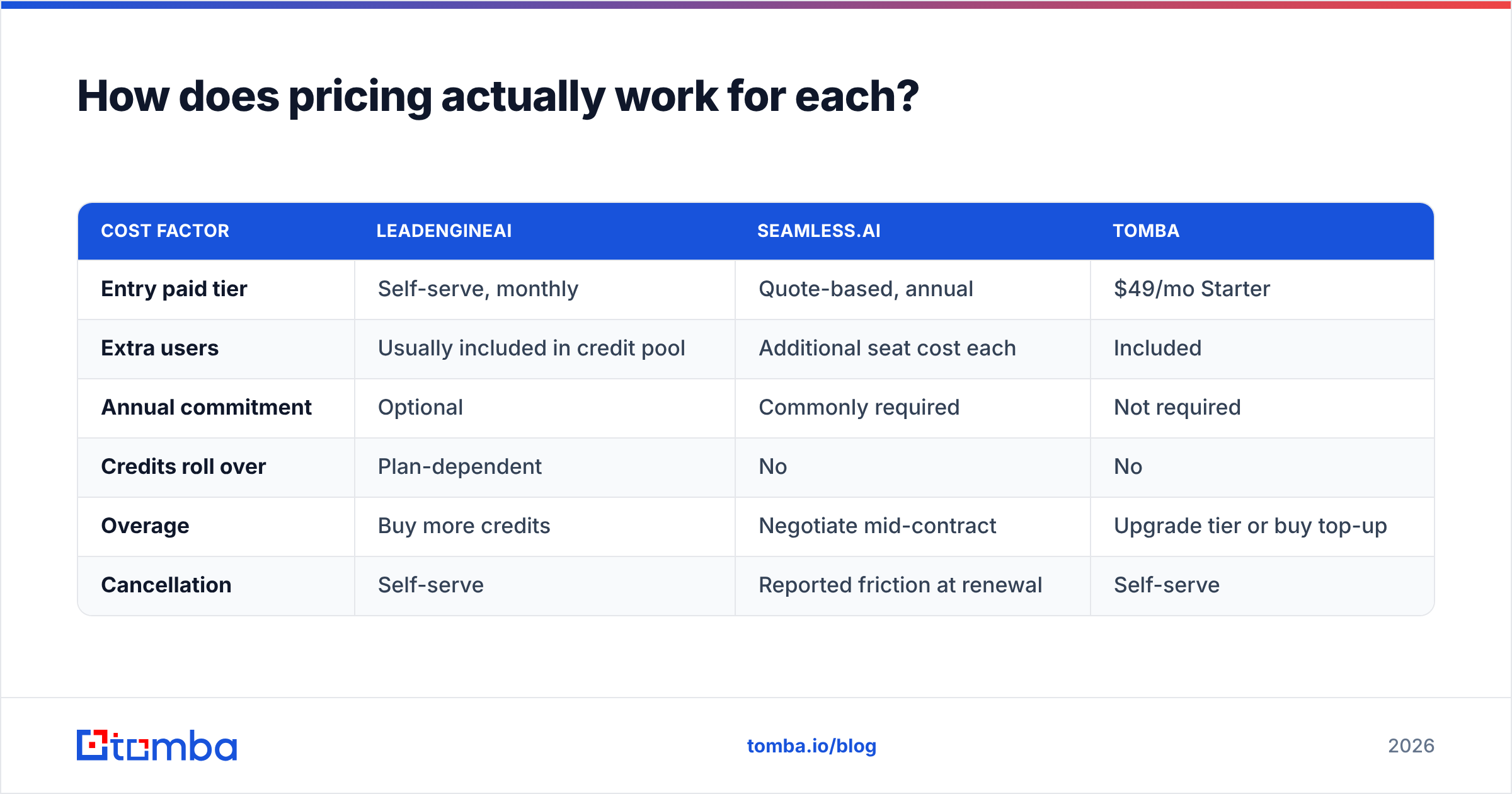
How does pricing actually work for each?#
This is where the comparison stops being close.
| Cost factor | LeadEngineAI | Seamless.AI | Tomba |
|---|---|---|---|
| Entry paid tier | Self-serve, monthly | Quote-based, annual | $49/mo Starter |
| Extra users | Usually included in credit pool | Additional seat cost each | Included |
| Annual commitment | Optional | Commonly required | Not required |
| Credits roll over | Plan-dependent | No | No |
| Overage | Buy more credits | Negotiate mid-contract | Upgrade tier or buy top-up |
| Cancellation | Self-serve | Reported friction at renewal | Self-serve |
Three cost traps to watch, whichever logo you pick:
- Seat math. A $150/seat/month tool with five reps is $9,000 a year before anyone sends an email. A credit-pooled tool with one admin account and shared exports costs a fraction of that for the same output.
- Wasted credits on bad records. If 15% of your exports bounce, you paid for 15% of nothing. You also paid twice, because bounces damage sender reputation and suppress the good 85%.
- Renewal asymmetry. Annual contracts renew quietly. Review sites document cancellation friction with database vendors generally. Put the notice date in your calendar the day you sign.
For a sense of how the wider category prices itself, HubSpot's sales software pricing is a useful anchor. Modern GTM buyers expect published numbers and a self-serve entry point. Vendors that still hide pricing behind a demo are optimizing for their sales team, not your evaluation.
LeadEngineAI vs Seamless.AI: which is better for your team?#
Pick by constraint, not by feature list.
Choose Seamless.AI if:
- You need buyer intent and contact data in one login, and will actually use both.
- Your ICP is US-centric mid-market or enterprise, where its database is strongest.
- You have budget approval for an annual per-seat contract and a procurement process that prefers established vendors.
- Mobile numbers matter as much as emails for your motion.
Choose LeadEngineAI if:
- You are a two-to-ten person team and want the tool to do the list-building thinking for you.
- Your ICP changes often and you would rather describe it in a prompt than rebuild filters.
- You want self-serve pricing and month-to-month flexibility.
- You are happy to verify the output yourself before it hits a sequence.
Choose a dedicated finder + verifier if:
- You already have a source of company targets — a list, a scraper, a B2B database, an ABM list from marketing — and only need the contact layer.
- You send at volume and bounce rate is the metric your whole program lives on.
- You want cost to scale with usage, not headcount.
There is a fourth option worth naming. If you want static, pre-built lists at a flat per-record price instead of a subscription, providers like BookYourData serve that model well. It is a different shape of purchase for the same underlying need.

What do real users complain about?#
Across public reviews in this category, the same four complaints recur for every vendor:
- Credit burn on failed searches. Many tools deduct a credit for a "found" record even when the address is a guess or a role account. Ask whether unverified results are billable.
- Export caps that appear after purchase. Daily and per-seat limits are rarely in the marketing copy. Get them in writing during the trial.
- Data staleness on job changes. B2B contact data decays roughly 25-30% per year. A record found in January is much weaker by October. That is why re-verification before each campaign beats the vendor's original accuracy figure.
- Contract exit friction. The most common one-star theme in sales intelligence is not data quality. It is the renewal.
None of these are unique to LeadEngineAI or Seamless.AI. They are structural to a market that sells access rather than outcomes.
How does the comparison look against a focused email finder?#
If your honest requirement is "give me deliverable email addresses for a defined list of people and companies," a full sales-intelligence suite is an expensive way to buy a narrow capability.

The stack most lean teams end up with looks like this:
- Source of targets: LinkedIn Sales Navigator, an ABM list, conference attendee lists, or website visitor data.
- Contact layer: a domain-and-name email finder that returns a pattern-confirmed address plus a confidence score.
- Verification layer: SMTP and catch-all checks before any address enters a sequence.
- Bulk layer: CSV upload for the monthly refresh, using a bulk email finder instead of seat-by-seat lookups.
- Automation layer: an API call from your CRM so enrichment happens on record creation, not in a quarterly panic.
Now price it at 5,000 contacts a month, one admin, three reps consuming the output. A per-seat suite runs four to five figures a year. A credit-based finder and verifier on Tomba's $99/mo Growth plan covers the same volume with room to spare. The free tier lets you check coverage on 25 searches before you spend anything. If you are shopping the incumbent, the Seamless.AI alternative breakdown lays out the feature-by-feature swap.
This is not an argument that Seamless.AI is bad software. It has real strengths, and intent data and phone coverage lead that list. A pure email finder does not attempt either. The argument is simpler: most teams buy the suite and use 20% of it.
What should you do next?#
Run the 200-row test. It costs you an afternoon, and it settles the LeadEngineAI vs Seamless.AI argument with data from your own ICP instead of a landing page. Whichever tool wins on valid addresses per credit spent is right for your segment. That answer will differ from your competitor's.
If the test shows what it usually shows — that your bottleneck is deliverable addresses, not database breadth — start with Tomba's Email Finder. The free tier gives you 25 searches with no card. Starter is $49/mo. Every plan includes API access, so enrichment runs inside your workflow instead of a rep's browser tab. Test it against your current export, compare bounce rates after one send, and let the numbers decide.
Related guides#
// get started
Find, verify and enrich your first contacts today
Start on the free plan with 25 searches a month, then scale when your team is ready.
Free plan · No credit card required · GDPR & CCPA
// about the author