AI Sales Technology in 2026: The Complete Buyer's Guide
A practical, vendor-neutral guide to AI sales technology in 2026 — what each layer does, how to build a stack that compounds, and where the ROI actually lives.
TL;DR
- AI sales technology isn't one product — it's five layers (data, enrichment, engagement, intelligence, and forecasting) that only pay off when they share clean data.
- The biggest ROI killer is bad inputs: an AI sequencer firing at unverified emails burns your domain reputation faster than any algorithm can fix.
- Most teams overbuy on engagement tools and underinvest in the data layer that feeds them. Reverse that.
- Use the buying framework below to score any tool on data quality, workflow fit, and measurable lift — not demo polish.
- Start with accurate contact data, then layer automation on top. The order matters more than the brand names.
What is AI sales technology?#
AI sales technology is the set of tools that use machine learning to find, qualify, contact, and forecast revenue against buyers — replacing manual research and guesswork with probabilistic prediction.
Think of it like a modern kitchen versus a campfire. A campfire (manual prospecting) cooks, but you tend every flame yourself. A professional kitchen (an AI sales stack) still needs a chef, but the prep, timing, and temperature control are automated so the chef spends time on the dish, not the fire. The catch: a fancy oven can't save bad ingredients. That's the whole game with AI sales technology — the model is only as good as the data you feed it.
In practice, "AI sales technology" gets used as a catch-all for very different jobs:
- Finding people — predicting which accounts and contacts fit your ICP.
- Reaching people — generating and sequencing outbound at scale.
- Understanding deals — call recording, sentiment analysis, and next-step suggestions.
- Predicting revenue — forecasting which deals close and when.
Lumping these together is why so many stacks feel bloated. Each layer solves a different problem, and you rarely need the flagship product in every category.
What are the layers of an AI sales tech stack?#
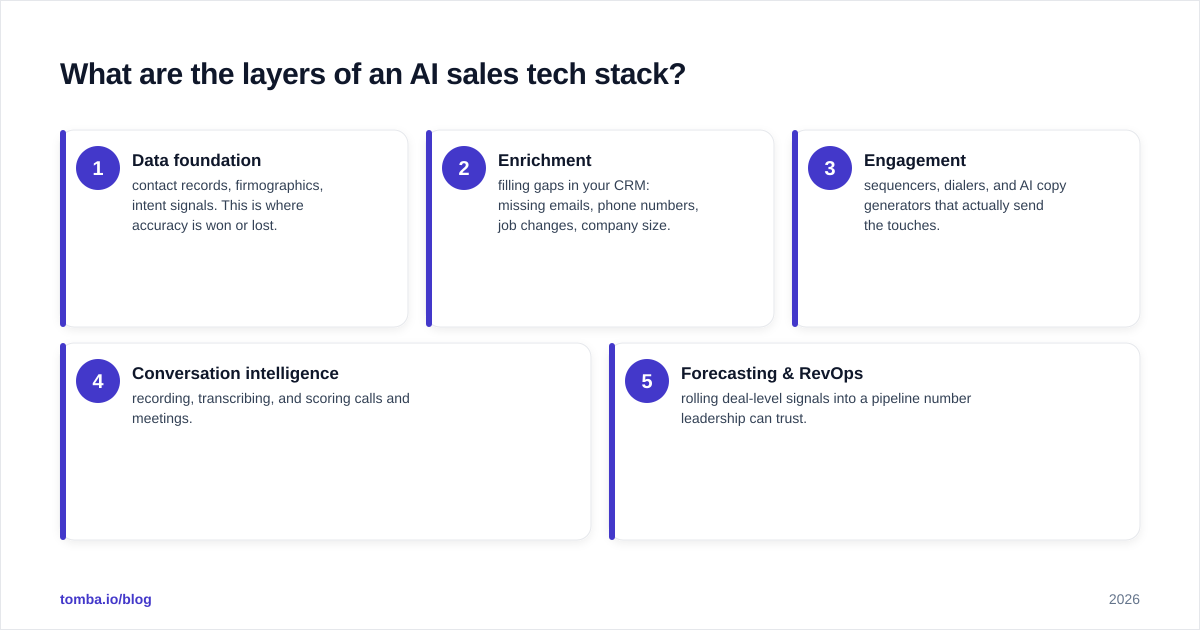
The stack has a natural order, bottom to top. Each layer feeds the one above it, which is why skipping the foundation breaks everything downstream.
- Data foundation — contact records, firmographics, intent signals. This is where accuracy is won or lost.
- Enrichment — filling gaps in your CRM: missing emails, phone numbers, job changes, company size.
- Engagement — sequencers, dialers, and AI copy generators that actually send the touches.
- Conversation intelligence — recording, transcribing, and scoring calls and meetings.
- Forecasting & RevOps — rolling deal-level signals into a pipeline number leadership can trust.
A quick gut check: if your engagement layer is sending mail to addresses your data layer never verified, you're automating waste. Verified contact data and clean data enrichment aren't glamorous, but they're the difference between a sequencer that books meetings and one that gets you blocklisted. Run new contacts through an email verifier before a single AI-written email goes out.
Which AI sales tools should you actually buy?#
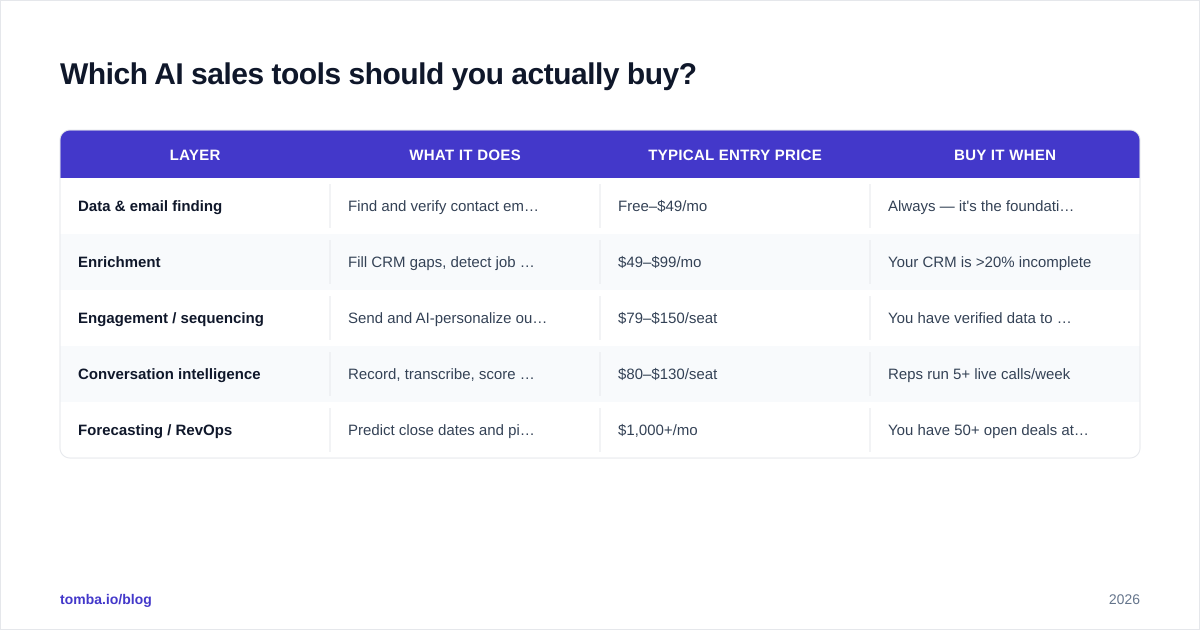
Below is a neutral comparison of the main categories — not brands, categories — so you can see where budget belongs. Prices are representative entry tiers as of 2026; always confirm current vendor pricing.
| Layer | What it does | Typical entry price | Buy it when |
|---|---|---|---|
| Data & email finding | Find and verify contact emails/phones | Free–$49/mo | Always — it's the foundation |
| Enrichment | Fill CRM gaps, detect job changes | $49–$99/mo | Your CRM is >20% incomplete |
| Engagement / sequencing | Send and AI-personalize outbound | $79–$150/seat | You have verified data to send to |
| Conversation intelligence | Record, transcribe, score calls | $80–$130/seat | Reps run 5+ live calls/week |
| Forecasting / RevOps | Predict close dates and pipeline | $1,000+/mo | You have 50+ open deals at once |
Notice the pattern: the cheapest layer (data) is the one you should never skimp on, and the most expensive (forecasting) only earns its cost at scale. Teams routinely invert this — buying a premium forecasting suite while feeding it pipeline built on stale contacts.
For the data layer specifically, Tomba pricing starts with a free tier of 25 searches per month, then Starter at $49/mo and Growth at $99/mo — which means you can validate the foundation before committing to expensive engagement seats on top.
Is AI sales technology worth the cost?#
Yes — but only on the layers where prediction beats a human, and only when fed clean data. The ROI is real and uneven.
Where AI clearly wins:
- Research time. AI cuts pre-call research from 15 minutes to under two. According to HubSpot's research on sales productivity, reps spend a large share of their week on non-selling tasks; automating research returns that time directly to selling.
- Personalization at scale. Generating a relevant first line for 500 prospects is a job humans can't do well manually but models do consistently.
- Deal risk detection. Conversation intelligence flags stalled deals earlier than a rep's gut, as analyst firms like Gartner have documented in sales-tech adoption studies.
Where AI underdelivers:
- Anything built on bad data. A perfectly written AI email to a wrong address is worse than no email — it costs deliverability.
- Over-automated outreach. Buyers detect template spam instantly. AI volume without targeting just accelerates the unsubscribe rate.
The honest framing: AI sales technology is a multiplier, not a generator. It multiplies whatever you give it. Give it verified contacts and a sharp ICP, and the lift is significant. Give it a junk list, and it multiplies the junk.
How do you choose AI sales technology without overbuying?#
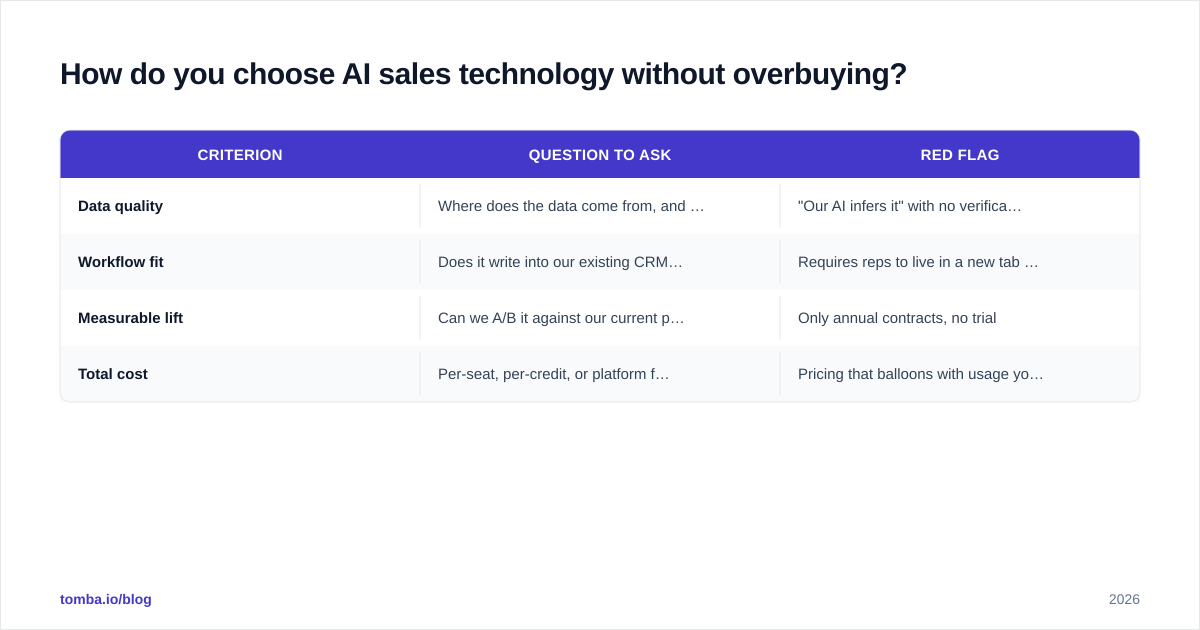
Score every tool on three axes before the demo dazzles you. Most buying regret comes from optimizing for features instead of fit.
| Criterion | Question to ask | Red flag |
|---|---|---|
| Data quality | Where does the data come from, and what's the verified accuracy rate? | "Our AI infers it" with no verification step |
| Workflow fit | Does it write into our existing CRM, or create a second system of record? | Requires reps to live in a new tab all day |
| Measurable lift | Can we A/B it against our current process in 30 days? | Only annual contracts, no trial |
| Total cost | Per-seat, per-credit, or platform fee — and what scales? | Pricing that balloons with usage you can't predict |
A simple rule: if a vendor can't show you the verification or sourcing behind their data, treat the AI layer on top as decoration. The model is downstream of the data every time. This is exactly why teams pair a sequencer with a dedicated bulk email finder and verifier rather than trusting whatever contacts the all-in-one platform scraped.
How do you build an AI sales stack that compounds?#
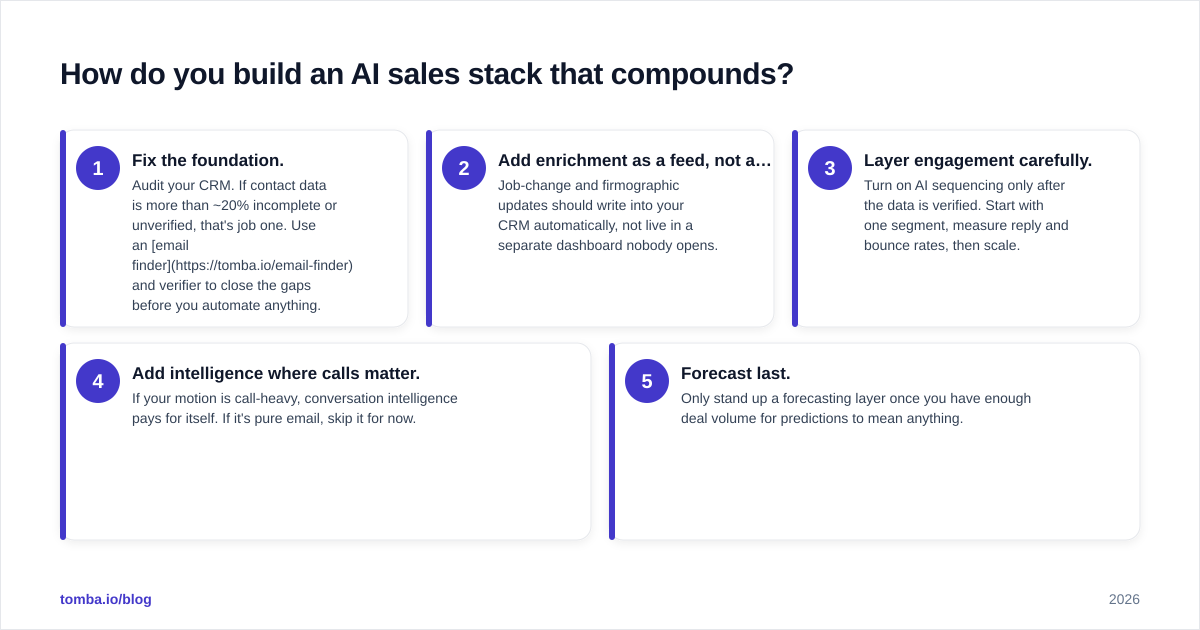
Build bottom-up, prove each layer, then add the next. A stack compounds when every tool shares the same clean record — and degrades when each tool maintains its own conflicting copy.
A pragmatic 2026 rollout:
- Fix the foundation. Audit your CRM. If contact data is more than ~20% incomplete or unverified, that's job one. Use an email finder and verifier to close the gaps before you automate anything.
- Add enrichment as a feed, not a silo. Job-change and firmographic updates should write into your CRM automatically, not live in a separate dashboard nobody opens.
- Layer engagement carefully. Turn on AI sequencing only after the data is verified. Start with one segment, measure reply and bounce rates, then scale.
- Add intelligence where calls matter. If your motion is call-heavy, conversation intelligence pays for itself. If it's pure email, skip it for now.
- Forecast last. Only stand up a forecasting layer once you have enough deal volume for predictions to mean anything.
The compounding effect comes from shared data. When your finder, enrichment, sequencer, and CRM all reference one verified record, every new tool gets smarter. When they don't, you're paying five vendors to disagree about the same contact. Platforms with native integrations — see how Tomba connects through its HubSpot integration and Salesforce integration — keep that single record clean across the stack.
What's next for AI sales technology?#
Three shifts are reshaping the category in 2026, and they all point the same direction: data quality becomes the moat.
- Agentic workflows. AI "agents" that chain research → enrichment → drafting → CRM update without a human clicking between tools. These are powerful and ruthlessly dependent on accurate inputs — an agent acting on bad data does damage at machine speed.
- Consolidation pressure. Buyers are tired of 12-tool stacks. Expect platforms that own the data layer plus one adjacent layer to win, while point solutions get squeezed.
- Deliverability as a gating metric. As inbox providers tighten filtering, verified-only sending stops being best practice and becomes survival. Stacks that verify before they send will simply land more mail.
The throughline across all three: the teams that win with AI sales technology in 2026 aren't the ones with the most tools. They're the ones whose tools all run on the same verified, current data.
The bottom line#
AI sales technology is a multiplier on your data, not a substitute for it. Buy the foundation first, prove each layer before adding the next, and judge every vendor on data quality before features. Do that, and the stack compounds. Skip it, and you've automated your worst inputs.
Start where the ROI is most reliable: accurate contact data. The Tomba Email Finder finds and verifies professional emails by domain, name, or company — so the AI layers you build on top are firing at real people, not bouncing off dead addresses. Try the free tier (25 searches/month), confirm the accuracy against your own list, and build up from a foundation you can trust.
// get started
Find, verify and enrich your first contacts today
Start on the free plan with 25 searches a month, then scale when your team is ready.
Free plan · No credit card required · GDPR & CCPA
// about the author