AI Calling and Meetings: The 2026 Sales Tech Playbook
AI now dials your prospects, runs the call, and books the next meeting. Here is how AI calling and meeting tools actually work in 2026 — and where they quietly break.
TL;DR
- "AI calling and meetings" is shorthand for three distinct tool layers: AI dialers (more conversations per hour), AI meeting assistants (record, transcribe, summarize), and AI voice agents (autonomous calls that book meetings).
- The biggest ROI today is the boring middle layer — meeting assistants that auto-log call notes to your CRM — not fully autonomous robocallers.
- AI voice agents work for simple, high-volume qualification, but still struggle with objection handling, compliance, and trust on cold calls.
- None of this matters if your contact data is wrong. A dialer that auto-calls dead numbers just burns time faster.
- Start with one layer, measure connect rate and meeting-set rate, then expand. Don't buy the whole stack at once.
What does "AI calling and meetings" actually mean in 2026?#
AI calling and meetings is not one product — it's a stack of three jobs that used to be fully manual.
Think of a sales call the way you'd think of a restaurant service. There's getting people in the door (dialing and connecting), the meal itself (the conversation), and the cleanup and reservations for next time (notes, follow-up, booking). AI has crept into all three, but at very different speeds.
Here's the honest breakdown:
- AI dialers — software that calls multiple numbers at once, drops voicemails, detects answering machines, and routes live humans to a rep. The AI part is mostly answering-machine detection and local-presence routing.
- AI meeting assistants — tools that join your call, record it, transcribe it, and produce a summary plus action items. This is where conversation intelligence lives (think Gong and its competitors).
- AI voice agents — synthetic voices that hold an entire conversation, qualify a lead, and book a meeting without a human on the line. This is the newest and most oversold category.
Most "AI calling" pitches blur these three together. They are not interchangeable, and they fail in different ways.
Why are sales teams adopting AI calling tools now?#
The short answer: connect rates collapsed, and reps spend more time on admin than selling.
Cold-call connect rates have been sliding for years, and reps now burn a large share of their day on after-call data entry instead of conversations. AI calling and meeting tools attack both problems at once — more dials per hour on the front end, zero manual note-taking on the back end.
The second driver is data. Conversation intelligence turns every call into structured, searchable data: who said what, which objections came up, which talk-track closed. That feeds coaching and forecasting in a way a manager listening to random recordings never could. If you want the formal definition of the broader trend, see this primer on sales automation.
The catch is that every one of these gains assumes you're reaching real people at real numbers. We'll come back to that.
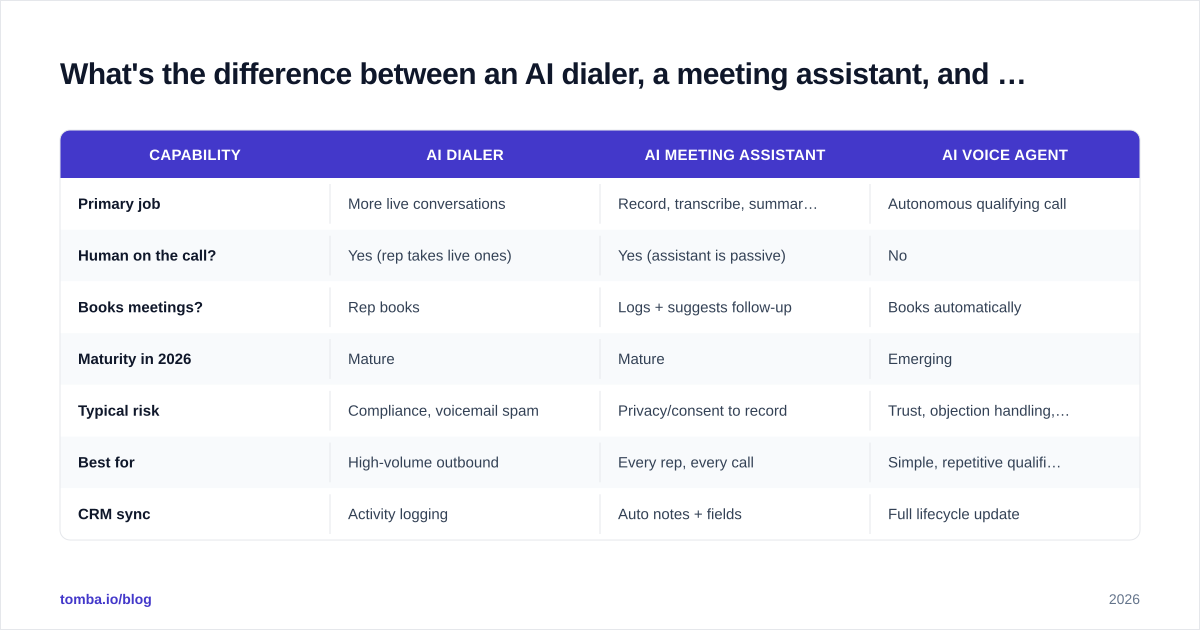
What's the difference between an AI dialer, a meeting assistant, and a voice agent?#
This is the table to screenshot before your next vendor call.
| Capability | AI Dialer | AI Meeting Assistant | AI Voice Agent |
|---|---|---|---|
| Primary job | More live conversations | Record, transcribe, summarize | Autonomous qualifying call |
| Human on the call? | Yes (rep takes live ones) | Yes (assistant is passive) | No |
| Books meetings? | Rep books | Logs + suggests follow-up | Books automatically |
| Maturity in 2026 | Mature | Mature | Emerging |
| Typical risk | Compliance, voicemail spam | Privacy/consent to record | Trust, objection handling, regulation |
| Best for | High-volume outbound | Every rep, every call | Simple, repetitive qualification |
| CRM sync | Activity logging | Auto notes + fields | Full lifecycle update |
The pattern is clear: the further right you go, the more you remove the human — and the more the technology has to earn trust it hasn't fully earned yet.
A useful rule of thumb: if the call requires judgment, keep a human on it and let AI handle the cleanup. If the call is a scripted yes/no qualification at volume, a voice agent can be worth testing.
Do AI meeting assistants actually save time?#
Yes — and this is the layer with the clearest, most defensible ROI.
An AI meeting assistant is like having a court stenographer who also writes the meeting minutes and emails them out before you've left the room. The rep stays fully present on the call instead of scribbling notes, and the CRM gets updated automatically afterward.
What a good meeting assistant does in 2026:
- Joins Zoom, Google Meet, Teams, or a dialer call automatically.
- Produces a clean transcript with speaker labels.
- Generates a summary, next steps, and detected objections.
- Pushes structured fields back to the CRM — deal stage hints, competitor mentions, budget signals.
- Surfaces coaching metrics like talk-to-listen ratio and monologue length.
The productivity win isn't the transcript. It's the elimination of post-call admin and the fact that managers can finally coach from data instead of vibes. HubSpot's own research on sales productivity repeatedly lands on the same theme: reps want less manual logging and more selling time. Their sales statistics roundup is a reasonable place to sanity-check the numbers a vendor quotes you.
One adoption tip: turn off the parts you won't use. Teams that enable every AI summary, score, and nudge at once tend to ignore all of them. Start with auto-transcription and CRM logging, then layer in coaching analytics.
Can AI voice agents replace SDRs on cold calls?#
Not for most B2B motions — not yet, and maybe not ever for complex deals.
AI voice agents have genuinely improved. Latency is low enough that interruptions feel natural, and the synthetic voices no longer sound like a 2018 IVR menu. For inbound qualification, appointment reminders, and simple "are you still interested?" follow-ups, they can carry real weight.
Where they break:
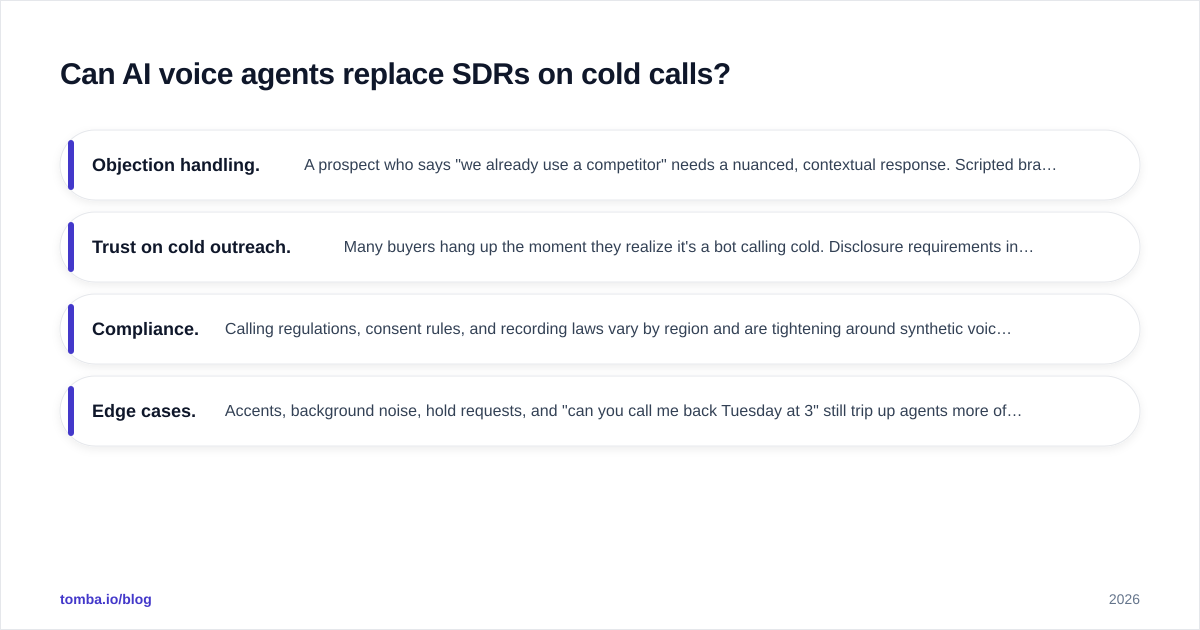
- Objection handling. A prospect who says "we already use a competitor" needs a nuanced, contextual response. Scripted branching only goes so far.
- Trust on cold outreach. Many buyers hang up the moment they realize it's a bot calling cold. Disclosure requirements in several regions also force you to announce the AI, which kills the illusion.
- Compliance. Calling regulations, consent rules, and recording laws vary by region and are tightening around synthetic voices specifically. Read the Telephone Consumer Protection Act overview before you point a robocaller at a list.
- Edge cases. Accents, background noise, hold requests, and "can you call me back Tuesday at 3" still trip up agents more often than demos suggest.
The realistic 2026 role for voice agents is narrow and valuable: reactivating old leads, confirming booked meetings, and running first-pass qualification on inbound forms — freeing human SDRs for the conversations that actually need a human.
How do you build an AI calling and meetings stack without overbuying?#
Buy one layer, prove it, then add the next. The most common mistake is purchasing a full "AI revenue" suite and using 10% of it.
A sane rollout sequence:
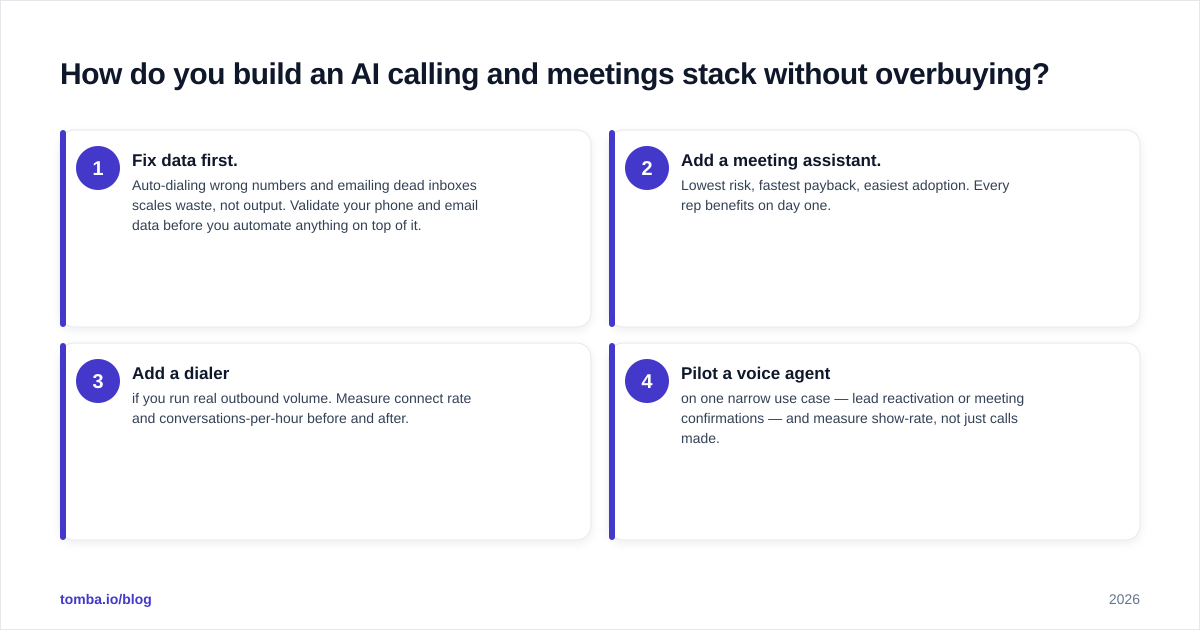
- Fix data first. Auto-dialing wrong numbers and emailing dead inboxes scales waste, not output. Validate your phone and email data before you automate anything on top of it.
- Add a meeting assistant. Lowest risk, fastest payback, easiest adoption. Every rep benefits on day one.
- Add a dialer if you run real outbound volume. Measure connect rate and conversations-per-hour before and after.
- Pilot a voice agent on one narrow use case — lead reactivation or meeting confirmations — and measure show-rate, not just calls made.
For step one, the unglamorous truth is that contact accuracy is the ceiling on everything else. A dialer with a 40% bad-number rate doesn't have an AI problem; it has a data problem. Tools like a dedicated phone finder and ongoing data enrichment keep your call lists clean enough that the AI layer has something real to work with.
It's also worth checking independent reviews rather than vendor decks. Category pages on G2 will show you where each tool actually wins and where the one-star reviews cluster.
What metrics tell you the AI calling stack is working?#
Track outcomes, not activity. "Calls made" goes up the day you install a dialer; that proves nothing.
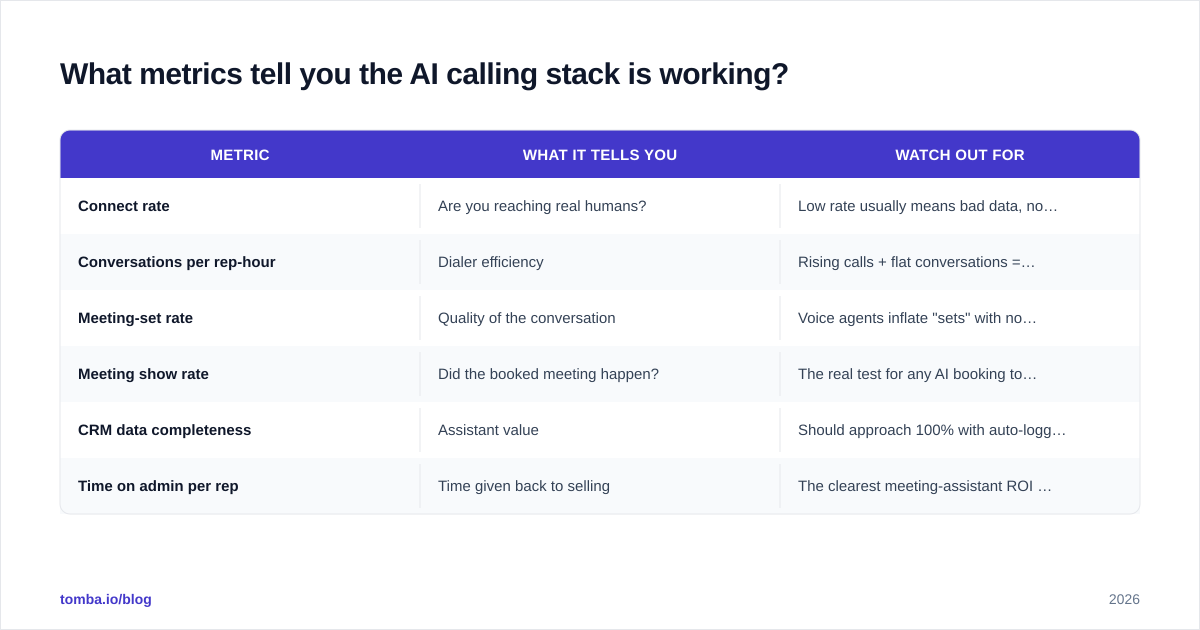
| Metric | What it tells you | Watch out for |
|---|---|---|
| Connect rate | Are you reaching real humans? | Low rate usually means bad data, not bad scripts |
| Conversations per rep-hour | Dialer efficiency | Rising calls + flat conversations = spam dialing |
| Meeting-set rate | Quality of the conversation | Voice agents inflate "sets" with no-shows |
| Meeting show rate | Did the booked meeting happen? | The real test for any AI booking tool |
| CRM data completeness | Assistant value | Should approach 100% with auto-logging |
| Time on admin per rep | Time given back to selling | The clearest meeting-assistant ROI signal |
If meeting-set rate climbs but show rate falls, your AI is booking junk. That single comparison catches most "great demo, useless in production" tools.
For pipeline-level health, pair these with classic measures like win rate so you can see whether more conversations are actually turning into revenue rather than just noise in the funnel.
Where does AI calling and meetings go next?#
The near-term trajectory is convergence and tighter CRM coupling, not full autonomy.
Expect the three layers to merge into single workflows: a voice agent qualifies an inbound lead, the meeting assistant joins the booked call, and the same system writes everything to the CRM and drafts the follow-up email — all without a rep touching a keyboard. The human moves up the stack to handle the high-value, high-judgment conversations.
Two things will gate how fast this happens:
- Regulation around synthetic voices and consent, which is tightening, not loosening.
- Data quality, which remains the silent failure point. The most sophisticated AI agent is only as good as the number and email it's handed.
That second point is why the smartest teams are investing in clean contact data before they invest in autonomous calling. The order matters.
The bottom line#
AI calling and meetings in 2026 is best understood as three layers, not one buzzword. The meeting-assistant layer is mature and pays for itself almost immediately. AI dialers are proven for high-volume outbound. Autonomous voice agents are promising but still narrow — deploy them on simple, repetitive calls and keep humans on anything that needs judgment.
Above all, fix your data before you automate your calling. Every layer of this stack multiplies whatever data you feed it — including the bad data.
That's where Tomba fits. Before your dialer makes a single call or your AI agent books a single meeting, you need the right person, the right company, and a verified way to reach them. Use the Tomba Email Finder to source accurate, verified contact details by name or domain — and pair it with the phone finder so your AI calling stack is dialing real people, not dead numbers. Check the Tomba pricing plans (a free tier covers 25 searches a month, with paid plans starting at $49/mo) and feed your AI calling workflow the clean data it needs to actually perform.
Ready to find emails that actually work?
Join 150,000+ professionals who stopped guessing and started sending. Free credits on signup — no credit card required.
Get the Tomba newsletter
Practical outbound tactics and product updates — once every two weeks.
About the author