AI Prospecting in 2026: Automate B2B Lead Generation
AI prospecting turns hours of manual list-building into minutes. Here's how AI lead generation works in 2026, the tools that matter, and how to build a pipeline that actually converts.
TL;DR
- AI prospecting uses machine learning to find, score, enrich, and prioritize leads automatically — replacing the manual list-building that eats 21% of a rep's week.
- The biggest 2026 shift is from more data to better timing: intent signals and AI scoring decide who to contact and when, not just who exists.
- A working AI lead generation stack has four layers: sourcing, enrichment, scoring, and orchestration. Most teams already own pieces of it.
- Accuracy still decides everything. AI that fills your sequences with stale or guessed contacts just helps you burn your domain faster.
- You don't need a six-tool stack to start. A verified data source plus one scoring layer beats a bloated pipeline of unverified leads.
What is AI prospecting?#
AI prospecting is the use of machine learning to automate the front end of B2B sales: finding accounts that fit your ICP, surfacing the right contacts inside them, enriching those contacts with accurate data, and ranking them by likelihood to buy. Instead of a rep manually scrolling LinkedIn and copy-pasting into a spreadsheet, software does the sourcing and the human spends time on conversations.
Think of it like the difference between fishing with a single line and fishing with sonar. The old way, you cast where you think fish are and wait. AI prospecting reads the water first — who's hiring, who's funded, who visited your pricing page twice this week — and tells you where to cast. You still have to reel them in, but you stop wasting hours over empty water.
The category matured fast. In 2023 most "AI" prospecting was a glorified database filter. By 2026 the useful systems do three things a database can't: they infer intent from behavioral signals, they predict fit from patterns in your closed-won deals, and they keep contact data fresh instead of letting it rot at the industry-standard 22–30% annual decay rate.
Why does manual prospecting break at scale?#
Because the math doesn't work. A rep can research maybe 25–40 quality accounts a day if they're doing it properly — verifying the contact, checking recent triggers, personalizing the angle. Push them to hit 100 and quality collapses into copy-paste spam. Push the team to grow pipeline 3x and you either hire three more SDRs or you change the method.
Manual prospecting also fails silently. Reps quietly skip the accounts that are hard to research, default to the same easy personas, and let CRM data go stale because updating it isn't their job. The pipeline looks full while half of it is unreachable or mis-targeted.
AI prospecting attacks all three failure modes: it doesn't get bored, it doesn't play favorites with personas, and it can re-verify a list on a schedule instead of letting it decay. That's the real argument — not that AI is smarter than your best rep, but that it's tireless and consistent where humans aren't.
How does AI lead generation actually work?#
Strip away the marketing and an AI lead generation pipeline is four layers stacked on top of each other. You can buy them as one suite or assemble them from focused tools.
1. Sourcing. The system pulls candidate accounts and contacts from databases, the open web, LinkedIn, and your own site traffic. Modern sourcing includes website visitor reveal — identifying the companies behind anonymous traffic so you can prospect people who already showed interest.
2. Enrichment. Raw names become usable records: verified work email, role, seniority, company size, tech stack, funding. This is where an accurate email finder and data enrichment matter most — garbage in, garbage sequences out.
3. Scoring. A model ranks each lead on fit (do they look like your customers?) and intent (are they showing buying behavior right now?). Good scoring is trained on your closed-won data, not a generic template.
4. Orchestration. The prioritized list flows into sequences, sales engagement tools, or an AI SDR that drafts the first touch. Triggers fire automatically — a new hire in the buying role, a funding round, a return site visit.
The trap teams fall into is buying layer 4 (a shiny AI sequencer) while feeding it layer-2 garbage. The output looks automated and professional and bounces at 28%. Fix the data layer first.
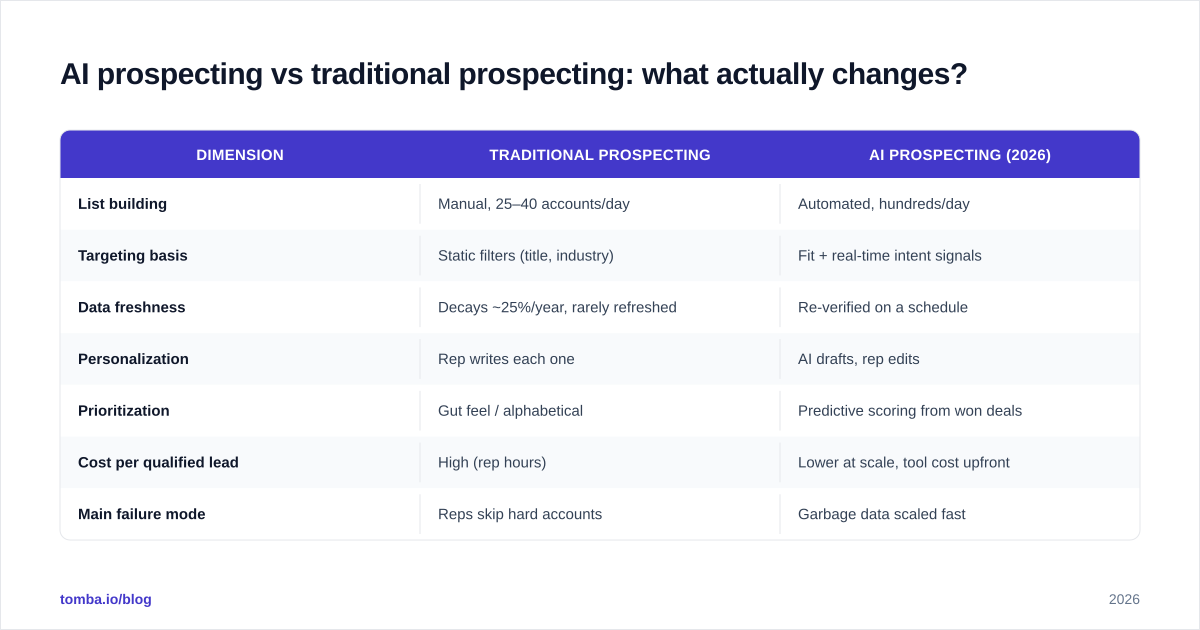
AI prospecting vs traditional prospecting: what actually changes?#
| Dimension | Traditional prospecting | AI prospecting (2026) |
|---|---|---|
| List building | Manual, 25–40 accounts/day | Automated, hundreds/day |
| Targeting basis | Static filters (title, industry) | Fit + real-time intent signals |
| Data freshness | Decays ~25%/year, rarely refreshed | Re-verified on a schedule |
| Personalization | Rep writes each one | AI drafts, rep edits |
| Prioritization | Gut feel / alphabetical | Predictive scoring from won deals |
| Cost per qualified lead | High (rep hours) | Lower at scale, tool cost upfront |
| Main failure mode | Reps skip hard accounts | Garbage data scaled fast |
The headline isn't "AI replaces SDRs." It's that the unit of work changes. Reps stop being researchers and list-builders and become editors and closers — reviewing AI-surfaced accounts, approving the angle, and spending saved hours on live conversations. According to HubSpot's sales research, reps spend roughly a third of their time actually selling; AI prospecting is mostly an attack on the other two-thirds.
What does AI prospecting cost in 2026?#
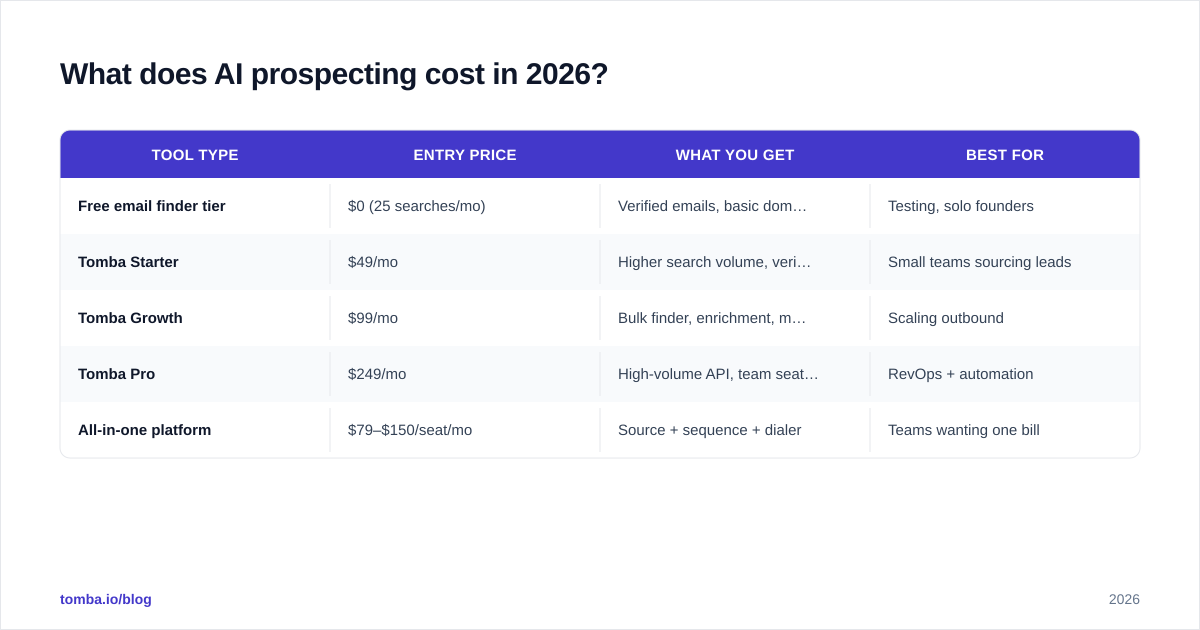
Pricing splits into two camps: focused data tools you pay for by credits or seats, and all-in-one platforms that bundle sourcing, sequencing, and a CRM. Here's how a representative slice looks, including Tomba pricing for the data layer.
| Tool type | Entry price | What you get | Best for |
|---|---|---|---|
| Free email finder tier | $0 (25 searches/mo) | Verified emails, basic domain search | Testing, solo founders |
| Tomba Starter | $49/mo | Higher search volume, verifier, domain search | Small teams sourcing leads |
| Tomba Growth | $99/mo | Bulk finder, enrichment, more credits | Scaling outbound |
| Tomba Pro | $249/mo | High-volume API, team seats, enrichment | RevOps + automation |
| All-in-one platform | $79–$150/seat/mo | Source + sequence + dialer | Teams wanting one bill |
A note on the obvious objection: bundled platforms look cheaper because it's "one tool," but you're often paying premium seat prices for a mediocre data layer you can't swap out. Buying an accurate data source separately — even at $49/mo — and piping it into a sequencer you already own is frequently the better-value path. Don't pay all-in-one prices for half-accurate data.
Which AI prospecting tools matter, and how do you choose?#
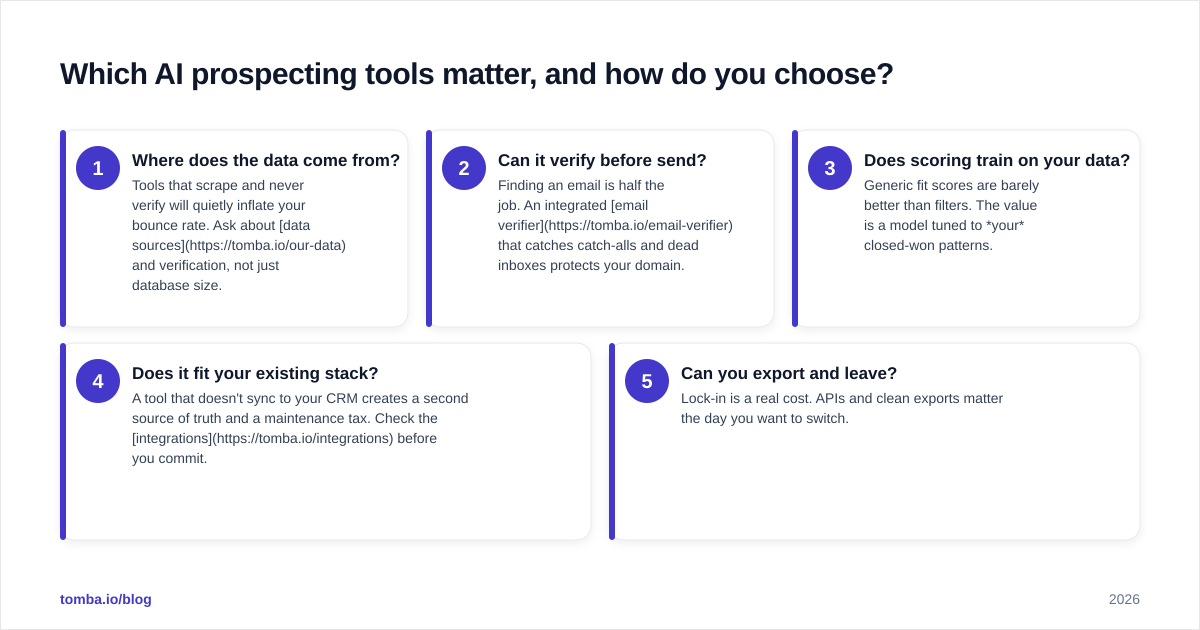
Ignore the logo soup. Evaluate any AI prospecting tool against five questions:
- Where does the data come from? Tools that scrape and never verify will quietly inflate your bounce rate. Ask about data sources and verification, not just database size.
- Can it verify before send? Finding an email is half the job. An integrated email verifier that catches catch-alls and dead inboxes protects your domain.
- Does scoring train on your data? Generic fit scores are barely better than filters. The value is a model tuned to your closed-won patterns.
- Does it fit your existing stack? A tool that doesn't sync to your CRM creates a second source of truth and a maintenance tax. Check the integrations before you commit.
- Can you export and leave? Lock-in is a real cost. APIs and clean exports matter the day you want to switch.
Cross-check vendor claims against third-party reviews on G2 before you trust a single benchmark a vendor publishes about itself — including ours.

How do you build an AI prospecting pipeline that converts?#
Here's a concrete five-step build that won't blow up your domain reputation.
Step 1 — Define ICP from won deals, not opinions. Pull your last 50 closed-won accounts and find the patterns: size, industry, trigger that started the deal. That pattern is your scoring target. Skip this and you'll automate the wrong audience faster.
Step 2 — Source against triggers, not just titles. Layer intent on top of fit. "VP of Sales at a 200-person SaaS company" is a filter; "VP of Sales who just got hired at a 200-person SaaS company that raised a Series B" is a reason to reach out today.
Step 3 — Enrich and verify before anything enters a sequence. This is the non-negotiable step. Run every contact through verification. Use the bulk email finder for volume, and treat any unverifiable or catch-all address as a separate, lower-priority track — don't blast it.
Step 4 — Let AI draft, let humans approve. Use AI to write the first-touch draft based on the trigger, then have the rep edit for voice and accuracy. Fully automated first touches read like fully automated first touches. This is also where sales automation earns its keep — automate the assembly, keep judgment human.
Step 5 — Measure reply and bounce, not just sends. Volume is a vanity metric. Track positive reply rate and bounce rate weekly. If bounces climb above 3%, your data layer is failing — stop and fix it before you scale.
The single biggest mistake is running steps 1–5 backward: buying the sequencer first (step 4), scaling volume (step 5), and bolting on ICP and verification later once the domain is already smoking. Build the data foundation first.
What are the risks and limits of AI prospecting?#
AI prospecting is a force multiplier, which means it multiplies bad inputs too. Three honest limits:
Deliverability is your responsibility, not the tool's. An AI that sources 5,000 contacts a day makes it trivially easy to torch your sending domain. Verification, warmup, and volume discipline still matter — more, not less, when sending is automated.
Intent data is probabilistic. A "surge" signal is a hint, not a guarantee someone's in-market. Treat scores as prioritization, not as gospel, and keep a human in the loop for high-value accounts.
Personalization at scale is still detectable. Buyers in 2026 have seen thousands of "I noticed you raised a Series B" openers. AI lowers the cost of personalization, which means everyone does it, which means the bar for genuinely relevant outreach is higher than ever. The tool gets you to the door faster; it doesn't write the conversation for you.
The teams winning with AI prospecting treat it as leverage on a sound process, not a replacement for one. Per Gartner's sales technology research, the gap between teams that see ROI from sales AI and those that don't is rarely the tool — it's the data hygiene and process discipline underneath it.
How do you get started this week?#
Start small and prove the data layer before you buy the orchestration layer. Pick 50 target accounts that match your best closed-won deals. Find and verify the right contact at each one. Send 50 genuinely relevant, human-edited touches. Measure reply and bounce. If that 50 converts, you have a model worth automating — scale it. If it doesn't, no amount of AI volume would have saved it, and you just learned that cheaply.
The foundation of every step above is accurate contact data. If the email bounces, the smartest scoring model in the world just helped you fail faster. Start with a data source that verifies before it hands you an address.
Ready to build your AI prospecting pipeline on data that actually lands? The Tomba Email Finder finds and verifies professional email addresses by name, domain, or company — so the contacts entering your sequences are real before you spend a single send on them. Start free with 25 searches a month, then scale to Growth at $99/mo when your pipeline is ready to grow. Build the foundation first; let AI do the rest.
Ready to find emails that actually work?
Join 150,000+ professionals who stopped guessing and started sending. Free credits on signup — no credit card required.
Get the Tomba newsletter
Practical outbound tactics and product updates — once every two weeks.
About the author