B2B Data Platforms in 2026: How to Pick the Right Vendor
Most B2B data platforms sell you the same database with a different login. Here's how to compare vendors on accuracy, coverage, freshness, and price before you sign.
You signed a five-figure contract for a "premium" contact database, loaded 50,000 records into your CRM, and three months later half the emails bounce and the job titles are two roles out of date. That is the default experience with B2B data platforms — not because the vendors are scams, but because almost every buyer evaluates them on the wrong things: logo count, total record claims, and the demo that was rigged with the vendor's best accounts.
This guide gives you a vendor evaluation framework that survives contact with reality. You will learn what actually separates one data platform from another, the questions that expose a weak vendor in ten minutes, and a scorecard you can run before money changes hands.
TL;DR#
- B2B data platforms mostly resell overlapping sources. "300 million contacts" is a vanity number — coverage of your ICP and freshness are what move pipeline.
- Score vendors on five axes: accuracy, coverage depth, data freshness, compliance, and true cost per usable record — not headline price.
- Always run a blind accuracy test on 200–500 of your own target accounts before signing. Vendor-supplied samples are cherry-picked.
- Waterfall enrichment beats single-vendor lock-in. Combining a verifier with one or two finders usually outperforms any single "complete" platform.
- Tomba fits teams that want verified emails, domain search, and data enrichment via API without an enterprise minimum — starting at $49/mo.
What is a B2B data platform?#
A B2B data platform is a vendor that sells access to structured information about companies and the people who work at them — names, job titles, work emails, phone numbers, firmographics (industry, headcount, revenue), and increasingly intent and technographic signals. You consume it through a CRM sync, a Chrome extension, a bulk CSV export, or an API.
Think of it like a produce market. Dozens of stalls sell tomatoes, but most buy from the same three farms overnight. The differences that matter are which stall got today's delivery (freshness), which one actually stocks the heirloom variety you need (coverage of your niche), and which one quietly mixes in last week's bruised stock (accuracy). The signage out front — "10 MILLION TOMATOES" — tells you nothing useful.
The category spans three rough tiers:
- Sales intelligence suites (Apollo, ZoomInfo, Cognism) — large databases bundled with sequencing, intent, and dialers.
- Enrichment and finder APIs (Tomba, Clearbit, People Data Labs) — focused data delivery you pipe into your own stack.
- Verification specialists (ZeroBounce, NeverBounce) — they don't find data, they tell you whether the data you have is still good.
Most mature teams end up using one from each tier rather than betting everything on a single "all-in-one" platform.
Why do most B2B data platforms feel the same?#
Because under the hood, many of them are. The raw data comes from a shared set of upstream sources: public web crawls, business registries, email-pattern inference, opt-in user contributions (often a "give us your contacts to unlock credits" model), and licensed third-party feeds. When four vendors all license the same firmographic provider, their company records are near-identical.
What you are actually paying for is the processing layer: how aggressively the vendor verifies records, how often it re-checks them, how it handles catch-all domains, and how honestly it labels confidence. Two platforms with the same source data can post a 30-point accuracy gap purely on processing discipline.
This is why headline record counts are noise. A vendor claiming 700 million contacts with no freshness guarantee is selling you a warehouse where 40% of the boxes are empty. According to repeated industry analysis, B2B contact data decays at roughly 30% per year as people change jobs — so a database's age matters more than its size. You can read peer-reported accuracy on sites like G2 before you ever talk to a rep.
How do you evaluate B2B data platforms?#
Score every vendor on five axes. Weight them for your use case — an outbound team weights accuracy and freshness; a TAM-sizing analyst weights coverage.
1. Accuracy#
The percentage of records that are correct and currently valid. For emails, that means deliverable, not catch-all-guessed. Demand the vendor's methodology: do they SMTP-verify at query time, or serve a cached guess? A real email verifier checks the mailbox; a pattern generator just assembles first.last@domain and hopes.
2. Coverage depth#
Not total records — coverage of your segment. A platform with 500M global contacts may have thin data on, say, German mid-market manufacturing or US healthcare IT. Test against your actual target list, not the total addressable universe.
3. Data freshness#
How often records are re-verified. Ask for the median record age and the re-crawl cadence. "Real-time verification on request" beats "refreshed quarterly" by a wide margin for outbound.
4. Compliance#
GDPR and CCPA exposure is real. Confirm the lawful basis for processing, the data-subject deletion workflow, and whether they suppress against opt-out registries. A vendor that can't answer this clearly is a liability you're inheriting.
5. True cost per usable record#
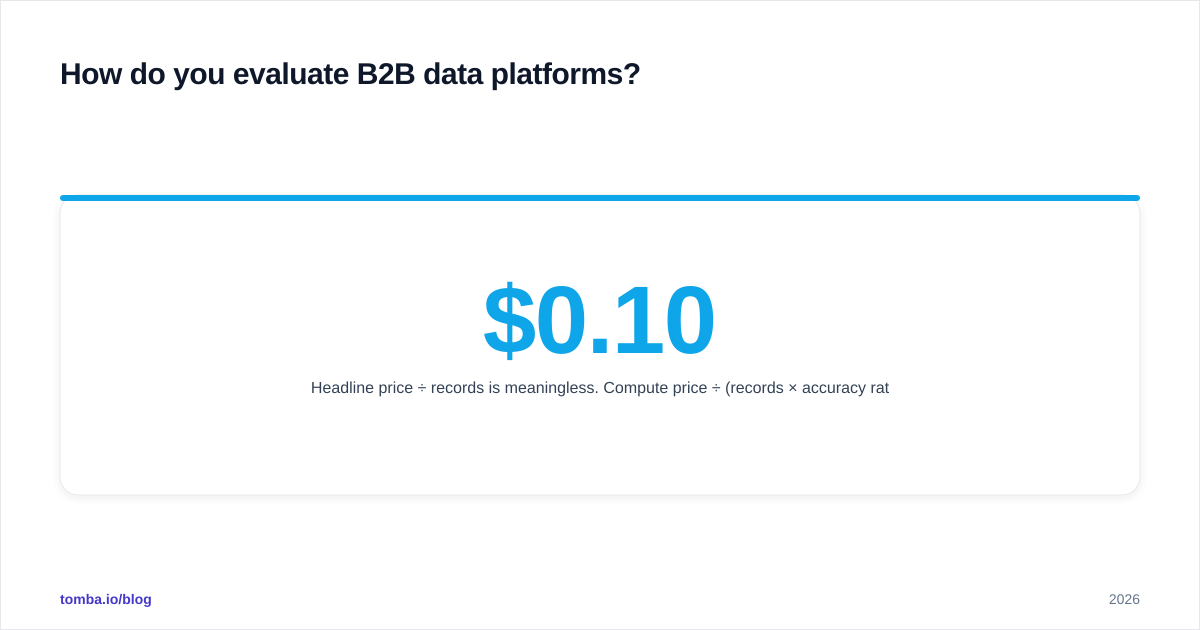
Headline price ÷ records is meaningless. Compute price ÷ (records × accuracy rate). A $0.10 record at 95% accuracy ($0.105 usable) beats a $0.04 record at 55% accuracy ($0.073... wait — run the math on your test, not theirs). Credits that expire monthly, overage fees, and forced annual contracts all inflate the real number.
Which B2B data platforms compare best in 2026?#
Here is a side-by-side on the attributes that actually drive a buying decision. Pricing reflects published entry tiers as of 2026; confirm current numbers directly, since vendors revise often.
| Attribute | Tomba | Apollo.io | ZoomInfo | Clearbit |
|---|---|---|---|---|
| Entry price | $49/mo | $49/mo (paid) | Custom (4-5 figs/yr) | Bundled w/ HubSpot |
| Free tier | 25 searches/mo | 5 credits/mo | No | Limited |
| Core strength | Verified email + domain search | All-in-one + sequencing | Deepest US firmographics | Enrichment in HubSpot |
| Email verification | Built-in, SMTP-level | Included | Included | Included |
| API-first | Yes | Yes | Yes (enterprise) | Yes |
| Catch-all handling | Dedicated verifier | Basic | Basic | Basic |
| Best for | Lean teams wanting clean emails via API | SMBs wanting one tool | Enterprise TAM + intent | Existing HubSpot shops |
| Annual lock-in | No | Optional | Usually required | Tied to HubSpot |
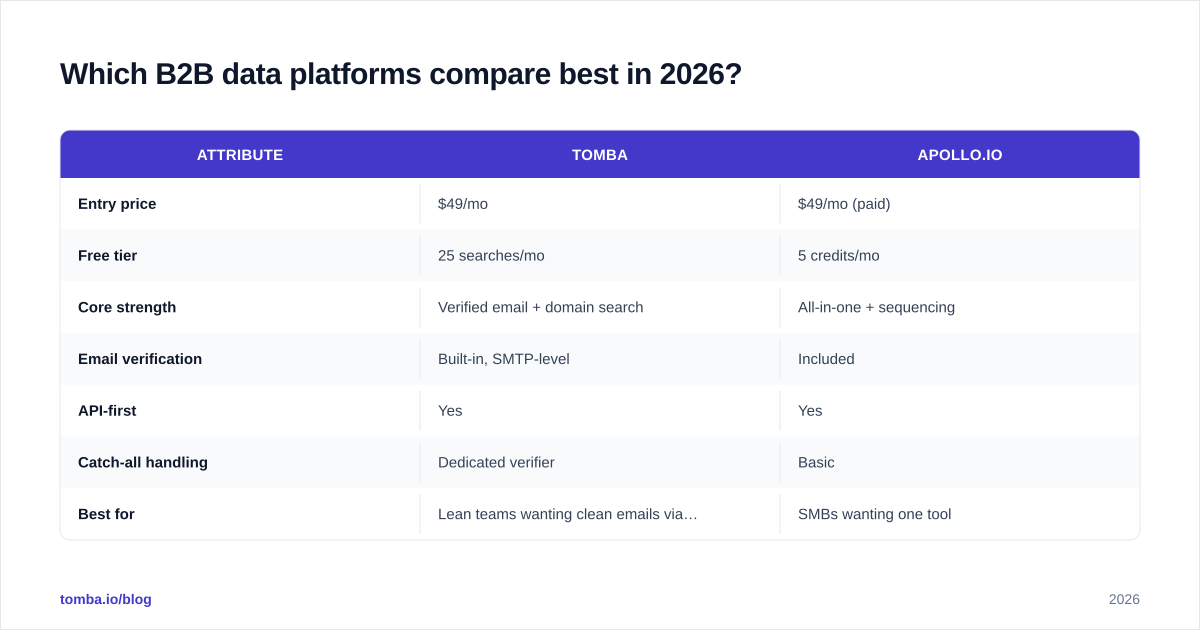
No row is "the winner" universally. ZoomInfo's US firmographic depth is genuinely hard to match if you're an enterprise sizing a market — and you'll pay for it. Apollo wins when you want database plus sending in one seat. Tomba wins when you already have a sending stack and just need accurate, verified contacts delivered through an email finder API without an enterprise floor. Clearbit makes sense almost exclusively if your gravity is already in HubSpot.
How do you run a blind accuracy test?#
This is the single highest-leverage step, and almost nobody does it. Vendors send polished sample files; you need a test they can't game.
- Pull 200–500 contacts you already know are correct — your closed-won accounts, where you have the real verified email and current title.
- Strip the answers. Send each vendor only the name + company (or domain).
- Have each vendor enrich the blind list through a trial or paid pilot.
- Score against your known-good answers: exact email match, deliverability, title accuracy, phone validity.
- Compute true cost per usable record from the pilot, not the rate card.
Run a bulk email finder export across the same list so you're comparing identical inputs. If a vendor refuses a paid pilot or insists you evaluate only their sample file, that refusal is your answer.
For the deliverability side of the test, push every returned email through an independent email verifier rather than trusting the vendor's own "valid" flag — self-graded homework inflates every time.
Should you use one platform or a waterfall?#
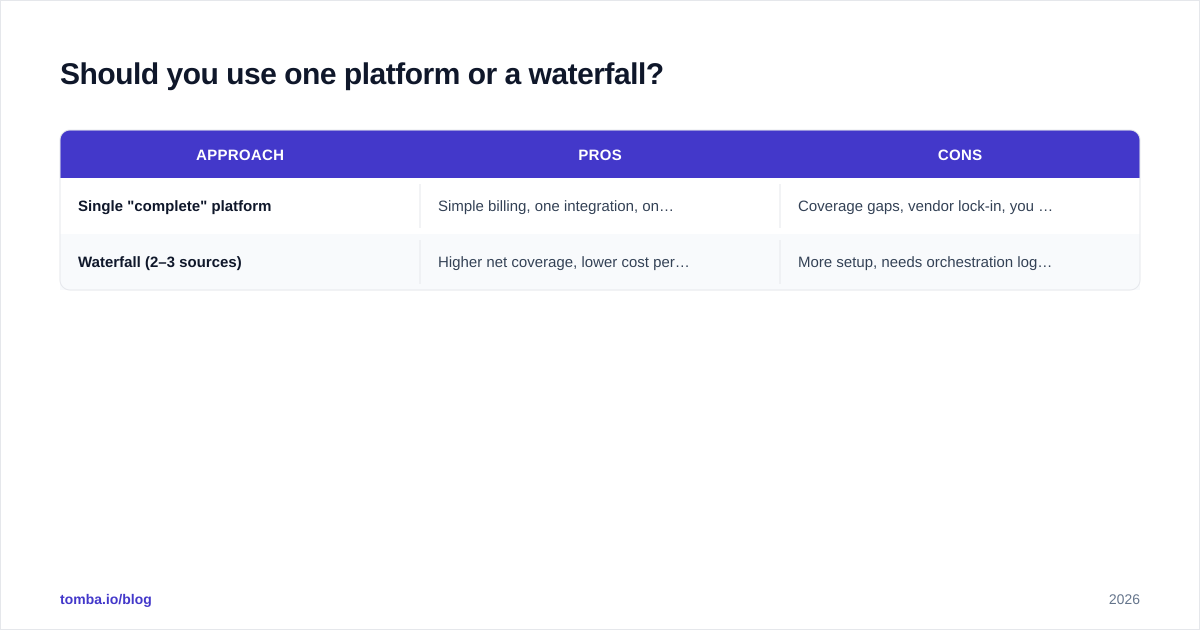
Use a waterfall. A waterfall (or cascade) enrichment setup queries multiple data sources in priority order and stops when it gets a verified hit — so you pay for the cheapest source that works and fall back to pricier ones only when needed.
| Approach | Pros | Cons |
|---|---|---|
| Single "complete" platform | Simple billing, one integration, one support line | Coverage gaps, vendor lock-in, you pay for accuracy you don't get |
| Waterfall (2–3 sources) | Higher net coverage, lower cost per record, no single point of failure | More setup, needs orchestration logic or a tool that does it |
The waterfall almost always wins on net coverage and cost once you're past a few thousand records a month. A typical stack: a primary finder for the bulk of hits, a verifier to catch decayed records, and a fallback finder for the long tail your primary misses. You can wire this with a Tomba API call as one stage and route the misses to a secondary source. Tools like HubSpot's own data enrichment sit comfortably as the CRM-side destination for the cleaned output.
The trap is treating "all-in-one" as a feature. It's a billing convenience, not a quality guarantee. Bundling sequencing, dialing, and data under one login does nothing to make the data more accurate — and it makes switching the data layer painful by design.
What questions expose a weak vendor fast?#
Ask these on the first call. Vague answers are disqualifying.
- "How do you verify emails — SMTP at query time, or cached?" If they dodge, accuracy is theater.
- "What's the median age of a record in my segment?" Watch for "we don't track that."
- "Show me catch-all handling." Many platforms mark catch-all domains as "valid" — they aren't. A dedicated catch-all verifier is the honest approach.
- "What's your lawful basis under GDPR, and how does deletion work?" Silence here is legal risk you absorb.
- "Can I run a blind paid pilot on my own list?" A confident vendor says yes immediately.
- "Where does the data come from?" Vendors proud of their sourcing publish it — Tomba documents where its data comes from openly.
How does pricing actually work?#
Most B2B data platforms price on one of three models, and the model matters as much as the number:
- Credit-based (per record revealed) — predictable, good for spiky usage. Watch expiry: monthly credits that don't roll over are a stealth price hike.
- Seat-based — flat per user, often with "fair use" caps that throttle heavy users.
- Volume/API — per-call pricing that rewards efficiency and punishes sloppy queries.
Tomba runs a transparent ladder — Free (25 searches), Starter $49/mo, Growth $99/mo, Pro $249/mo, then Enterprise — with no forced annual lock-in. Compare that against any vendor quoting "custom" only: opacity is usually a sign the price floor is high and negotiable, which means small teams overpay. See full Tomba pricing for the per-tier search and verification limits, and check independent reviews on Capterra to sanity-check vendor claims against real users.
Final scorecard: how to decide#
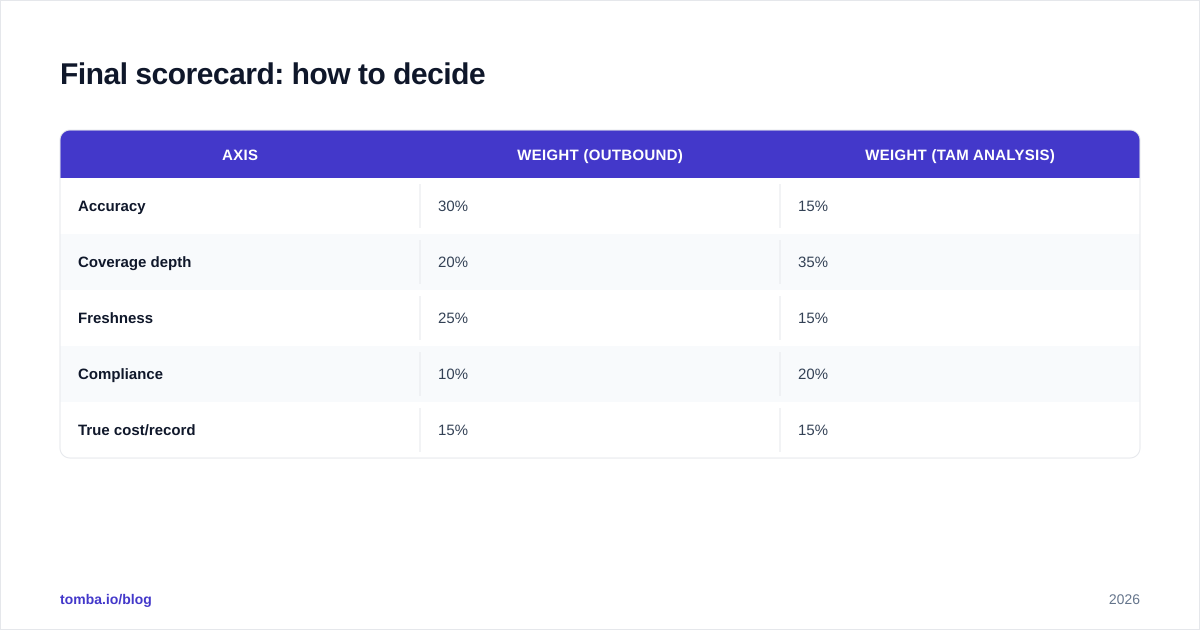
Build a simple weighted sheet. Score each vendor 1–5 on the five axes, multiply by your weights, and total it:
| Axis | Weight (outbound) | Weight (TAM analysis) |
|---|---|---|
| Accuracy | 30% | 15% |
| Coverage depth | 20% | 35% |
| Freshness | 25% | 15% |
| Compliance | 10% | 20% |
| True cost/record | 15% | 15% |
Run the blind test first so the accuracy and cost scores are yours, not the vendor's. The platform that wins your sheet — not the one with the loudest record count — is the right buy.
Get verified B2B contact data without the enterprise minimum#
If your blind test keeps surfacing the same problem — plenty of records, too many bounces — start with the data layer, not another all-in-one suite. The Tomba Email Finder finds professional emails by name, company, or domain and verifies them at the SMTP level before they reach your sequence, with domain search for whole-company sweeps and an API that drops cleanly into a waterfall. Spin up the free tier with 25 searches, run it head-to-head against your current vendor on your own list, and let the deliverability numbers pick the winner. Clean data in, fewer bounces out — that's the whole job.
// get started
Find, verify and enrich your first contacts today
Start on the free plan with 25 searches a month, then scale when your team is ready.
Free plan · No credit card required · GDPR & CCPA
// about the author