Conversation Intelligence Software: 2026 B2B Buyer's Guide
Conversation intelligence turns every sales call into searchable, coachable data. Here's how the tech works, what to look for, and how to pick a platform in 2026.
TL;DR
- Conversation intelligence software records, transcribes, and analyzes sales calls and meetings, then surfaces coaching insights, deal risks, and market signals automatically.
- The category is now a core part of the revenue tech stack — sitting between your dialer, CRM, and forecasting tools.
- Gong, Chorus (ZoomInfo), Salesloft, Clari Copilot, and Fireflies dominate, but they differ sharply on price, depth, and whether they're built for coaching or revenue intelligence.
- Expect $1,200–$1,600 per user per year at the high end; lighter note-takers start free.
- A conversation intelligence tool is only as good as the contact data feeding your pipeline — clean inputs in, useful signals out.
What is conversation intelligence?#
Conversation intelligence is software that captures your sales conversations — calls, video meetings, sometimes emails — transcribes them, and uses AI to analyze what happened. Think of it as a flight recorder for your revenue team: every conversation is logged, searchable, and graded, so nothing depends on a rep's memory or hurried CRM note.
In practice, the software joins your Zoom, Teams, or Google Meet call as a bot (or taps your dialer), records the audio, runs speech-to-text, and then layers analysis on top: who talked how much, which competitors were named, whether next steps were set, and how the deal sentiment is trending. The output lands in dashboards, Slack alerts, and your CRM.
The category grew out of a simple problem. Managers used to coach by riding along on calls or skimming the one deal a rep flagged. That covers maybe 2% of conversations. Conversation intelligence covers 100% of them and makes the patterns visible — which is why it's become a default line item in modern B2B sales tools budgets.
How does conversation intelligence software actually work?#
There are four layers under the hood, and understanding them helps you judge any vendor's demo.
1. Capture. The tool ingests the conversation. For video, a recorder bot joins the meeting. For phone, it integrates with your dialer or VoIP provider. Better platforms also pull in the email and calendar thread around the deal so the transcript has context.
2. Transcription. Speech-to-text converts audio into text, with speaker separation (diarization) so you know who said what. Accuracy on accents, crosstalk, and industry jargon is where cheap tools fall apart.
3. Analysis. This is the real product. Natural language processing detects topics, competitor mentions, pricing talk, questions asked, talk-to-listen ratio, monologue length, and sentiment. Newer platforms run large language models to summarize the call, extract action items, and answer free-text questions like "what objections came up in deals we lost last quarter?"
4. Activation. Insights flow somewhere useful: a coaching scorecard, a deal-risk alert, an auto-written CRM summary, or a forecast adjustment. A tool that analyzes brilliantly but strands the data in its own dashboard creates work instead of removing it.
What problems does conversation intelligence solve?#
Conclusion first: it replaces guesswork with evidence across coaching, forecasting, and go-to-market.
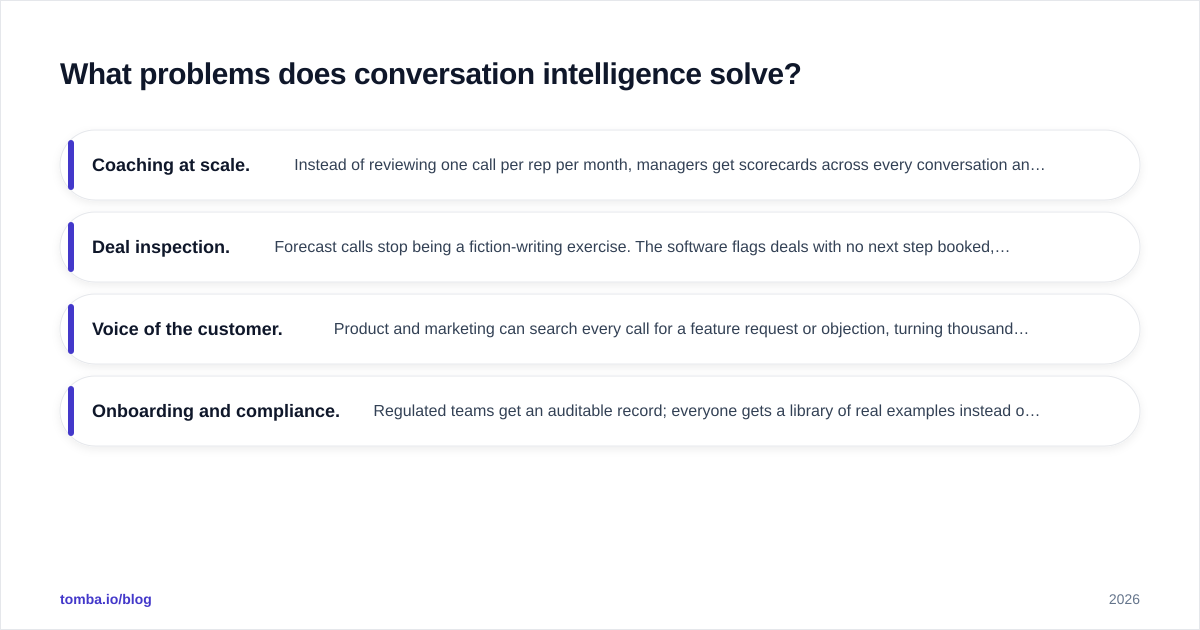
- Coaching at scale. Instead of reviewing one call per rep per month, managers get scorecards across every conversation and can drop time-stamped comments. New reps ramp faster by watching tagged "great discovery" calls.
- Deal inspection. Forecast calls stop being a fiction-writing exercise. The software flags deals with no next step booked, single-threaded contacts, or a competitor mentioned late in the cycle.
- Voice of the customer. Product and marketing can search every call for a feature request or objection, turning thousands of conversations into a searchable research panel.
- Onboarding and compliance. Regulated teams get an auditable record; everyone gets a library of real examples instead of role-play scripts.
The thread tying these together is that conversations are your richest first-party data source, and most of it used to evaporate the second the call ended.
Conversation intelligence vs. AI note-takers: what's the difference?#
People conflate the two, and vendors are happy to let them. An AI note-taker (Fireflies, Otter, the meeting summary built into Zoom) records and summarizes. That's the capture and transcription layers. A conversation intelligence platform adds the analysis and activation layers built specifically for revenue: coaching workflows, deal scoring, CRM enrichment, and forecasting.
If you just want clean recaps emailed after a call, a note-taker is fine and often free. If you want to coach a team, inspect a pipeline, and feed your forecast, you need the heavier category. Buying a note-taker and expecting revenue intelligence is the most common — and expensive — mismatch in this market.
Which conversation intelligence platforms lead in 2026?#
The market splits into three camps: coaching-first platforms, revenue-intelligence suites, and lightweight note-takers that are climbing upmarket. Here's how the main players compare.
| Platform | Best for | Starting price (per user/yr) | Native CRM sync | Standout strength |
|---|---|---|---|---|
| Gong | Revenue intelligence at scale | ~$1,440 + platform fee | Salesforce, HubSpot | Deepest deal & market analytics |
| Chorus (ZoomInfo) | Teams already in ZoomInfo | Bundled / ~$1,200 | Salesforce, HubSpot | Tight contact-data tie-in |
| Salesloft (Conversations) | Full sales-engagement stack | Add-on to Salesloft seat | Salesforce | Cadence + calls in one tool |
| Clari Copilot | Forecasting-led orgs | ~$1,080 | Salesforce | Links calls to revenue forecast |
| Fireflies.ai | SMB / note-taking first | Free tier; ~$120 paid | Via Zapier/native | Low cost, fast setup |
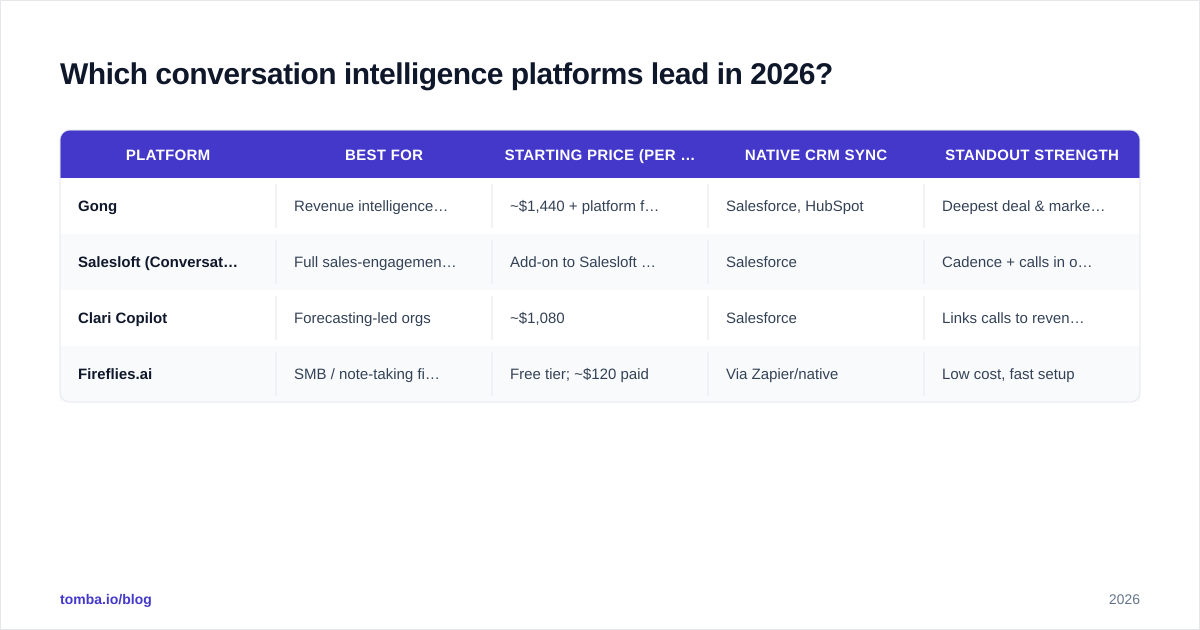
A few honest caveats. Published pricing in this category is slippery — most enterprise vendors quote per seat plus a platform fee and rarely list numbers publicly, so treat the table as directional and confirm on a quote. You can read independent buyer reviews on G2 before you shortlist. And "best" is workload-dependent: a 12-person startup and a 400-rep enterprise should not land on the same tool.
How do you choose the right conversation intelligence tool?#
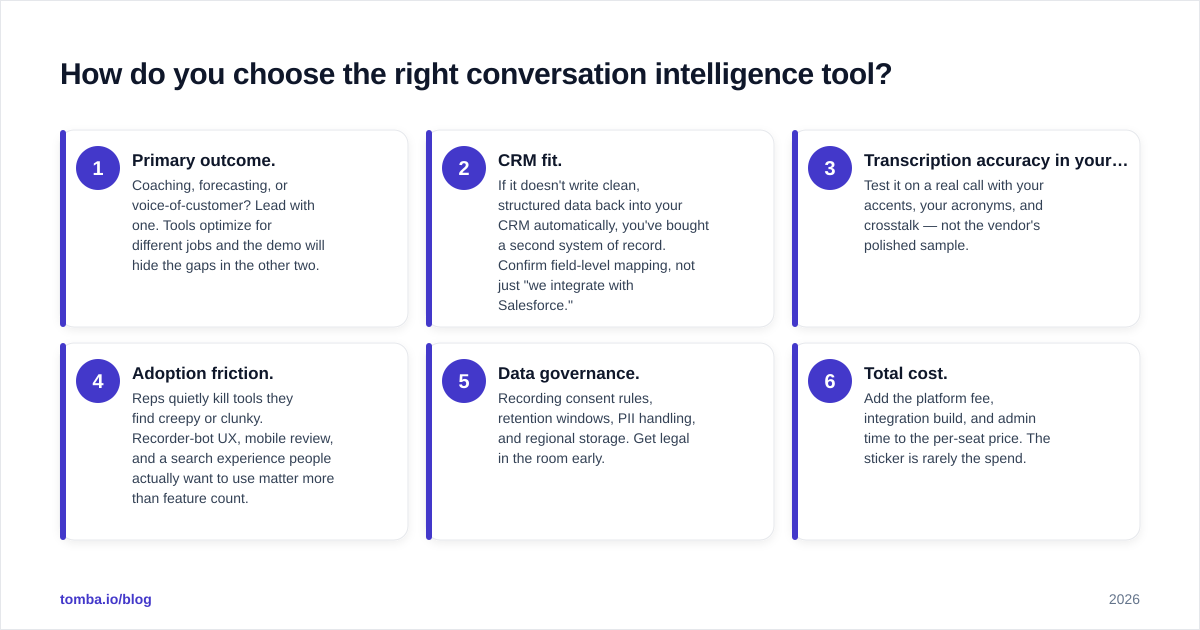
Match the tool to the job, not the logo. Run candidates through this checklist.
- Primary outcome. Coaching, forecasting, or voice-of-customer? Lead with one. Tools optimize for different jobs and the demo will hide the gaps in the other two.
- CRM fit. If it doesn't write clean, structured data back into your CRM automatically, you've bought a second system of record. Confirm field-level mapping, not just "we integrate with Salesforce."
- Transcription accuracy in your reality. Test it on a real call with your accents, your acronyms, and crosstalk — not the vendor's polished sample.
- Adoption friction. Reps quietly kill tools they find creepy or clunky. Recorder-bot UX, mobile review, and a search experience people actually want to use matter more than feature count.
- Data governance. Recording consent rules, retention windows, PII handling, and regional storage. Get legal in the room early.
- Total cost. Add the platform fee, integration build, and admin time to the per-seat price. The sticker is rarely the spend.
A reasonable rollout sequence: pilot with one team for a quarter, define two or three metrics you'll actually watch (next-step-set rate, talk-to-listen ratio, ramp time), and only expand once a manager is using it weekly. Tools that get bought top-down and never adopted are the category's quiet graveyard.

Where does conversation intelligence fit in the wider stack?#
It's the analysis hub, but it sits downstream of two things: how you reach buyers and how clean your data is.
Upstream, you need contacts to call in the first place — that's prospecting and data enrichment. A dialer or sequencer drives the conversations. Conversation intelligence then captures and grades them. The graded output feeds forecasting and revenue operations.
This is why data hygiene matters so much. If reps are dialing wrong numbers and emailing dead inboxes, your conversation intelligence tool faithfully records a pipeline of noise. Garbage conversations in, garbage insights out. Teams that pair call analytics with verified contact data — accurate emails, current titles, working direct dials — get a signal worth coaching on. A phone finder and verified email layer aren't competitors to conversation intelligence; they're the fuel.
It also connects to your CRM as the connective tissue. Most platforms push summaries and call fields into HubSpot or Salesforce, so the conversation record lives next to the deal record. If you run a leaner stack, lightweight options and integrations via tools like Zapier can bridge the gap.
What does conversation intelligence cost — and is it worth it?#
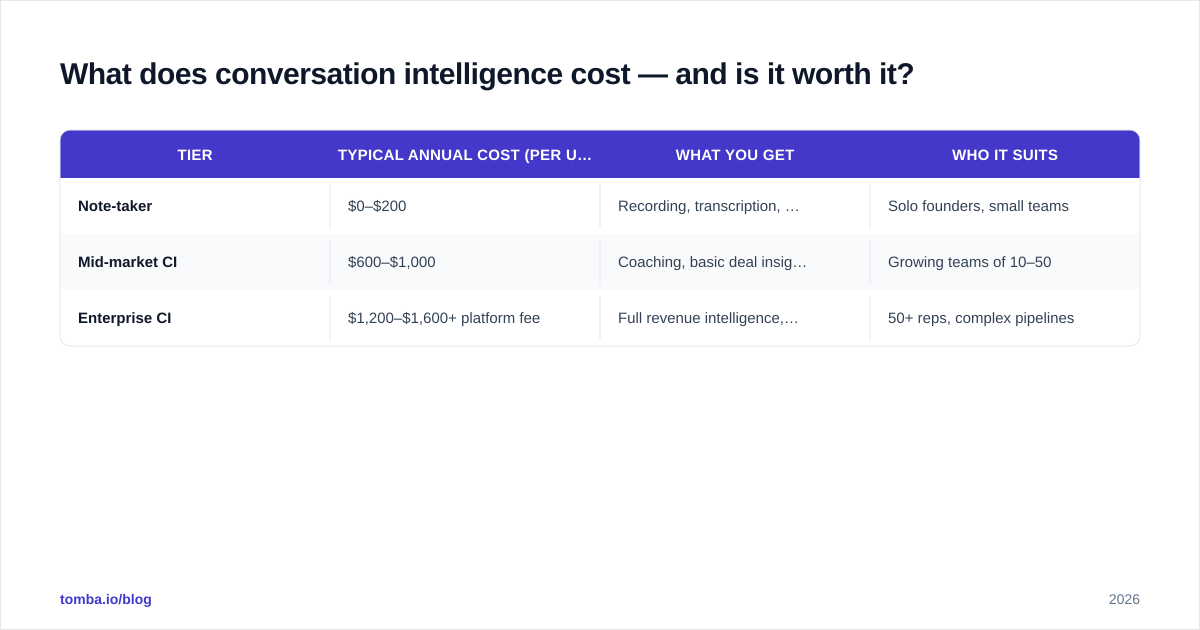
Pricing clusters into three tiers, and the right question isn't "what's cheapest" but "what's the cost of the conversations I'm currently losing?"
| Tier | Typical annual cost (per user) | What you get | Who it suits |
|---|---|---|---|
| Note-taker | $0–$200 | Recording, transcription, summaries | Solo founders, small teams |
| Mid-market CI | $600–$1,000 | Coaching, basic deal insights, CRM sync | Growing teams of 10–50 |
| Enterprise CI | $1,200–$1,600+ platform fee | Full revenue intelligence, forecasting, market analytics | 50+ reps, complex pipelines |
The ROI case is concrete when you tie it to a number you already track. If conversation intelligence shortens new-rep ramp by a month, or lifts win rate by flagging single-threaded deals before they stall, the per-seat cost is rounding error against quota. If you buy it as a recording archive nobody opens, it's pure overhead. The deciding variable is adoption, not the feature list.
Common pitfalls to avoid#
- Treating it as surveillance. Frame it as coaching and self-review, or reps will sabotage adoption. The teams that win make the call library a shared resource, not a manager's panopticon.
- Skipping consent and governance. Recording laws vary by region and even by US state. Build consent into the workflow before you flip it on.
- Over-indexing on transcription demos. Every vendor's sample call is clean. Yours won't be. Test on messy reality.
- Ignoring the data inputs. As above — the tool can't fix conversations you never had because the contact data was wrong. Sort your prospecting data first.
- No owner. A platform with no internal champion who reviews calls weekly will decay into shelfware within two quarters.
Frequently asked questions#
Is conversation intelligence the same as call recording? No. Call recording is one layer. Conversation intelligence adds transcription, AI analysis, and activation into coaching and forecasting workflows.
Do reps need to consent to being recorded? Consent rules apply to participants on the call (which varies by jurisdiction), and internally you should be transparent with your team. Always confirm requirements with legal.
Can small teams benefit, or is this enterprise-only? Small teams can start with a free or low-cost note-taker and graduate to a full platform as headcount and pipeline complexity grow.
Does it integrate with my CRM? The major platforms sync natively with Salesforce and HubSpot; lighter tools rely on Zapier or native connectors. Verify field-level mapping before buying.
The bottom line#
Conversation intelligence has moved from nice-to-have to default infrastructure for B2B revenue teams, because it converts your most valuable, most perishable data — what was actually said — into something you can coach, forecast, and search. Pick the tier that matches your primary outcome, demand real CRM write-back, and protect adoption like it's the whole investment, because it is.
But remember where the signal starts. The best call analytics in the world can't rescue a pipeline built on bad contact data. Before you spend $1,400 a seat grading conversations, make sure your reps are reaching the right people. Tomba's Email Finder gives you verified, accurate professional emails by name, company, or domain — and you can pair it with the phone finder and data enrichment so every conversation your intelligence tool records is one worth analyzing. Start on the free plan and feed your sales stack clean data from the first call.
// get started
Find, verify and enrich your first contacts today
Start on the free plan with 25 searches a month, then scale when your team is ready.
Free plan · No credit card required · GDPR & CCPA
// about the author