Sales Enablement in 2026: Tools, Strategy & Framework
Sales enablement is more than a content library. Here's the framework, the tool categories, and how to build a stack that actually lifts win rates in 2026.
TL;DR
- Sales enablement is the system of content, training, coaching, and tools that helps reps have better buyer conversations and close more deals — not a single platform you buy.
- The teams that win treat enablement as a repeatable operating function with owners, metrics, and a feedback loop, not a shared drive full of stale decks.
- Your stack usually spans four layers: content management, training/coaching, conversation intelligence, and clean contact data feeding the CRM.
- Measure enablement by ramp time, win rate, quota attainment, and content usage — not by how many assets you produced.
- Even the best playbook fails if reps reach the wrong people. Accurate prospecting data is the unglamorous foundation that makes everything downstream work.
What is sales enablement?#
Sales enablement is the ongoing process of giving your revenue team the content, training, coaching, and technology they need to sell more effectively. Think of it like a pit crew in motorsport: the driver (your rep) gets the attention, but the race is won by the team that keeps the car fueled, tuned, and supplied with the right tires at the right moment. Enablement is that crew.
In practical terms, it answers three questions for every rep, on every deal:
- What do I say to this buyer at this stage?
- What asset, case study, or proof point moves the deal forward?
- How do I get better at the parts I'm losing on?
The discipline grew up because sales and marketing kept talking past each other. Marketing produced content nobody used; sales improvised pitches nobody could measure. According to G2's category data, sales enablement platforms are now one of the fastest-adopted segments in the B2B stack precisely because they close that gap. Enablement is the connective tissue between what marketing creates, what sales says, and what buyers actually need to hear.
Why does sales enablement matter in 2026?#
Because buyers changed, and most sales orgs didn't keep up.
A modern B2B purchase involves more stakeholders, more self-directed research, and more skepticism than it did even three years ago. Gartner's buyer research has long shown that buyers spend the majority of their journey not talking to sales reps — they're reading, comparing, and forming opinions before a rep ever gets a meeting. That means the handful of conversations you do get have to count.
Sales enablement matters in 2026 for three concrete reasons:
- Ramp time is a cost center. Every month a new rep takes to reach full productivity is revenue you don't book. Structured enablement cuts ramp by giving reps a repeatable path instead of "shadow someone and figure it out."
- Tribal knowledge doesn't scale. Your best rep's instincts are worth nothing if they live in one person's head. Enablement codifies what works so the whole team performs closer to the top quartile.
- AI raised the floor and the bar. Buyers can get a generic answer from a chatbot. Reps now have to add insight a model can't — which only happens when enablement equips them with sharp, situation-specific material.
The cost of ignoring this is quiet but real: longer sales cycles, inconsistent messaging, and a win rate that drifts down while nobody can point to a single cause. If you want a refresher on what you're actually trying to move, our glossary breaks down win rate and how it connects to pipeline health.
What does a sales enablement framework look like?#
A working framework has four interlocking parts. Skip one and the whole thing wobbles.
1. Content. The single source of truth for decks, one-pagers, case studies, battlecards, and email templates — versioned, searchable, and tagged by deal stage and persona. The test isn't how much you have; it's whether a rep can find the right asset in under a minute.
2. Training and onboarding. A structured ramp for new hires plus continuous skill-building for tenured reps. This includes product knowledge, objection handling, and the actual mechanics of your sales process.
3. Coaching and conversation intelligence. Recording, transcribing, and analyzing real calls so managers coach on evidence instead of vibes. This is where you find out which talk tracks correlate with closed-won.
4. Data and tooling. The CRM, the prospecting data that fills it, and the integrations that keep everything in sync. Garbage contact data poisons every layer above it — reps waste cycles on bounced emails and wrong numbers instead of selling.
The mistake most teams make is treating these as four separate projects owned by four different people. They're a loop: call intelligence reveals a gap, you build content to fix it, you train reps on it, and you measure whether the next batch of calls improves. Enablement is the operating rhythm that keeps that loop turning.
Which sales enablement tools should you compare?#
There's no single "sales enablement tool" — there are categories, and most teams assemble a stack. Here's how the main options compare across what actually matters for a mid-market B2B team.
| Layer | Example tools | What it does | Typical starting price | Best for |
|---|---|---|---|---|
| Content management | Highspot, Seismic, HubSpot Sales Hub | Store, surface, and track sales content | $$ (mid–high) | Teams drowning in scattered assets |
| Conversation intelligence | Gong, Chorus, Clari | Record and analyze calls for coaching | $$$ (high) | Coaching at scale, deal forensics |
| Training / readiness | Mindtickle, Lessonly, Spekit | Onboard and certify reps | $$ (mid) | Fast-growing headcount |
| Prospecting data | Tomba,ZoomInfo, Apollo | Find and verify contact data | $ (Tomba free tier, then $49/mo) | Filling the CRM with real contacts |
| CRM (system of record) | Salesforce, HubSpot, Pipedrive | Track deals and activity | $$ (mid) | The hub everything connects to |
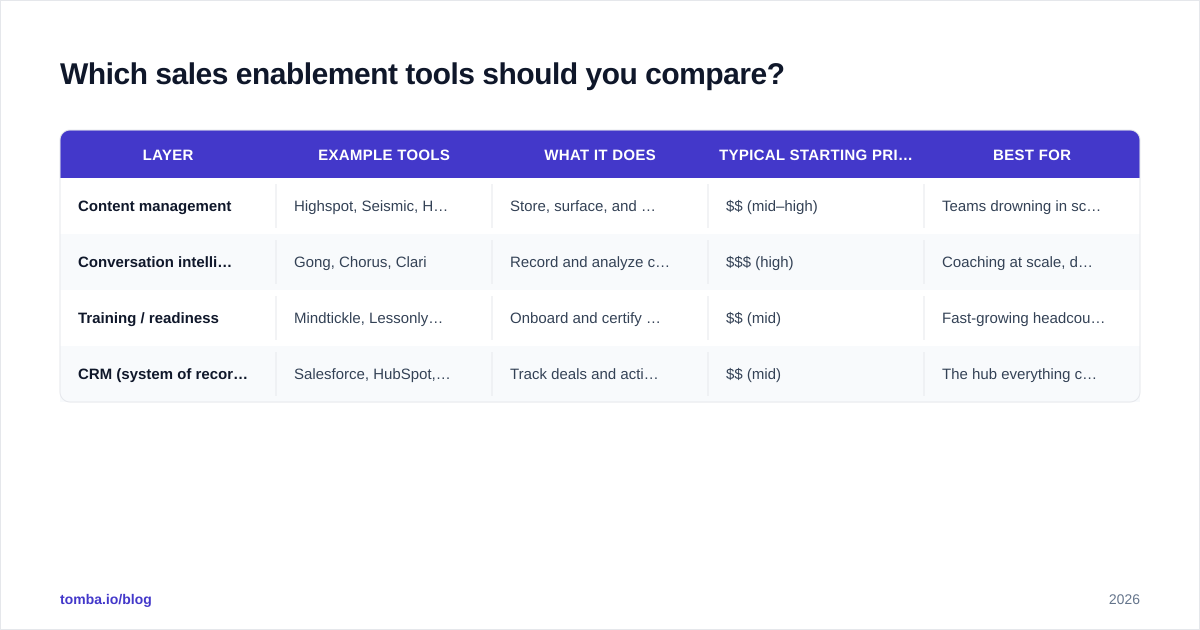
A few honest notes on this table. Enterprise content and conversation-intelligence platforms deliver real value but carry real cost and a multi-month rollout — don't buy them until you have a process worth instrumenting. Compare your own Tomba pricing options against the data-vendor column; for many teams the prospecting-data line is the cheapest layer to fix and the one with the fastest payback, because it removes wasted rep effort immediately.
If you're choosing a CRM hub to anchor the stack, HubSpot's Sales Hub and Salesforce dominate the mid-market and enterprise tiers respectively. Tomba connects to both via the Salesforce integration and HubSpot integration, so verified contacts land where reps already work.
How is sales enablement different from sales operations?#
They're cousins, not twins, and people conflate them constantly.
Sales operations owns the machinery: CRM administration, territory design, compensation plans, forecasting, and reporting. Ops asks, "Is the system running efficiently?"
Sales enablement owns the human readiness: can reps actually have winning conversations? Enablement asks, "Are our people equipped to sell?"
Here's the everyday analogy. If your sales team is a fleet of delivery trucks, sales operations builds the roads, sets the routes, and tracks fuel efficiency. Sales enablement trains the drivers, gives them the maps, and coaches them when a route goes wrong. You need both — a perfectly optimized route with an untrained driver still ends in a ditch.
The two overlap most around data and tooling. Ops keeps the CRM clean; enablement makes sure reps use it and feeds prospecting data into it. That shared border is exactly why your contact enrichment and data quality belong in any enablement conversation, even though it feels like an ops problem.
How do you build a sales enablement stack?#
Start with the problem, not the tool. The fastest way to waste budget is to buy a $40k platform to solve a problem a clean process would have fixed for free.
A sane build order looks like this:
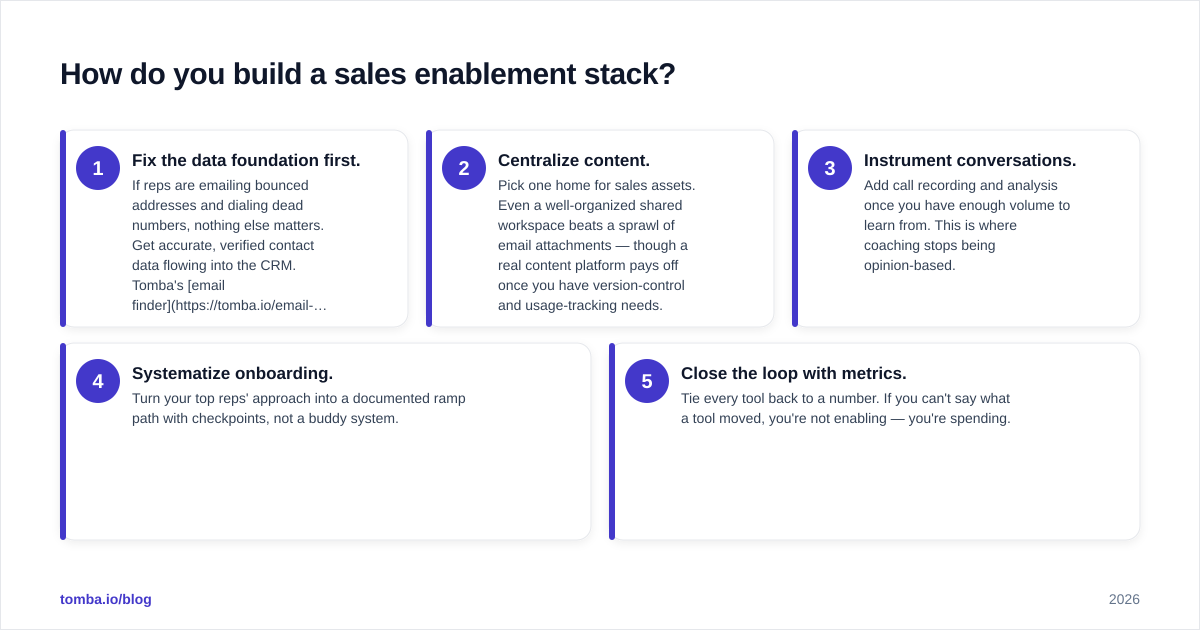
- Fix the data foundation first. If reps are emailing bounced addresses and dialing dead numbers, nothing else matters. Get accurate, verified contact data flowing into the CRM. Tomba's email finder and email verifier handle this layer cheaply, and bulk lookups mean you're not enriching one record at a time.
- Centralize content. Pick one home for sales assets. Even a well-organized shared workspace beats a sprawl of email attachments — though a real content platform pays off once you have version-control and usage-tracking needs.
- Instrument conversations. Add call recording and analysis once you have enough volume to learn from. This is where coaching stops being opinion-based.
- Systematize onboarding. Turn your top reps' approach into a documented ramp path with checkpoints, not a buddy system.
- Close the loop with metrics. Tie every tool back to a number. If you can't say what a tool moved, you're not enabling — you're spending.
The temptation — captured above — is to keep chasing the newest platform instead of fixing the boring fundamentals. Resist it. The teams that win in 2026 nail data quality and process first, then layer tools on a foundation that can actually use them.
What metrics prove sales enablement works?#
Vanity metrics will lie to you. "We published 40 new assets this quarter" tells you nothing about revenue. Tie enablement to numbers a CFO respects:
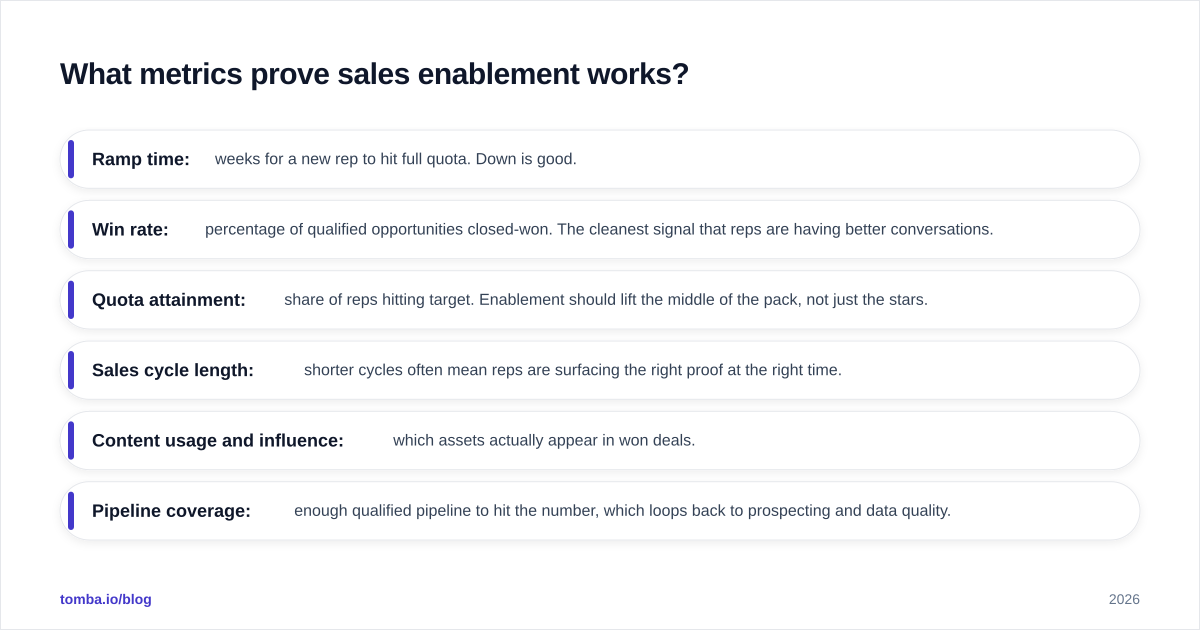
- Ramp time: weeks for a new rep to hit full quota. Down is good.
- Win rate: percentage of qualified opportunities closed-won. The cleanest signal that reps are having better conversations.
- Quota attainment: share of reps hitting target. Enablement should lift the middle of the pack, not just the stars.
- Sales cycle length: shorter cycles often mean reps are surfacing the right proof at the right time.
- Content usage and influence: which assets actually appear in won deals.
- Pipeline coverage: enough qualified pipeline to hit the number, which loops back to prospecting and data quality.
Track these before and after each enablement change so you can attribute impact. A note on the data layer specifically: if your bounce rate is high or your reps complain about bad numbers, that's a measurable problem with a measurable fix — and it usually shows up as wasted activity long before it shows up in win rate.
Frequently asked questions#
Is sales enablement only for big companies? No. A five-rep team benefits from documented messaging and clean data as much as a 500-rep org — arguably more, because every rep is a larger share of the number. Start lightweight: one content home, one documented ramp path, one clean data source.
Who owns sales enablement? At small companies, often a sales leader or RevOps generalist wears the hat part-time. As you scale, a dedicated enablement manager or team owns it, sitting between sales and marketing. What matters is that someone owns it; un-owned enablement decays into a stale folder.
Do I need an expensive platform to start? No. Begin with the cheapest high-leverage fixes — accurate prospecting data and centralized content — then add conversation intelligence and training platforms once you have process worth instrumenting. Tooling amplifies a good process; it can't create one.
How does data quality fit into enablement? It's the foundation. Every downstream layer — content, coaching, training — assumes reps are reaching real buyers. Bad contact data quietly wastes the effort you put into everything else.
Getting your enablement foundation right#
Sales enablement is a system, not a purchase. The framework — content, training, coaching, and data — only works as a loop, and the loop only turns if reps are reaching the right people in the first place. That's the layer most teams underinvest in and the one with the fastest payback.
If you're building or auditing your stack this year, start at the foundation: make sure your CRM is filling with verified, accurate contacts instead of guesses. The Tomba Email Finder finds professional email addresses by name, company, or domain, verifies them, and pushes them straight into the tools your reps already use — with a free tier to test it and plans from $49/mo when you scale. Fix the data, and every other enablement investment you make starts paying off faster.
// get started
Find, verify and enrich your first contacts today
Start on the free plan with 25 searches a month, then scale when your team is ready.
Free plan · No credit card required · GDPR & CCPA
// about the author