Web Scraping for B2B Sales: The 2026 Playbook & Tools
Web scraping fuels modern B2B pipelines—but raw HTML isn't a lead. Here's how scraping, enrichment, and verification actually fit together in 2026, plus a build-vs-buy breakdown.
Web scraping for B2B sales has quietly become the engine room of modern prospecting. Behind every "where did you get my number?" moment sits a pipeline. It pulls structured data out of messy web pages—company sites, directories, job boards, review platforms. Then it turns that data into a list someone can actually sell to.
But scraping is also where most sales teams waste time. They confuse "I collected data" with "I have leads." This guide separates the two.
TL;DR#
- Web scraping for B2B sales means pulling public business data (companies, roles, signals) from web pages and turning it into structured records.
- Raw scraped data is rarely usable on its own. It is missing verified emails, phone numbers, and firmographic context. Enrichment and verification are non-negotiable second steps.
- You have three paths: build your own scrapers, buy a data/API provider, or run a hybrid. Most teams underestimate the cost of building.
- Legality hinges on public data, no login walls, respect for terms and rate limits. It is not "anything I can see in a browser."
- The fastest ROI in 2026 comes from scraping intent signals. Then you enrich with a dedicated email finder and verifier rather than scraping contact details directly.
What is web scraping for B2B sales?#
Web scraping is the automated collection of data from websites. A scraper loads a page, reads the underlying HTML (or rendered DOM), and pulls out specific fields—company name, employee count, tech stack, job titles, locations. It then writes them into a database or spreadsheet.
Think of it like a research assistant who reads 10,000 company "About" pages overnight and hands you a clean table in the morning. The work isn't magic. It's just tireless and structured. The technical definition, per Wikipedia, is "extracting data from websites" using bots or crawlers. But in sales, the goal is narrower: build a targeted account and contact list faster than a human could.
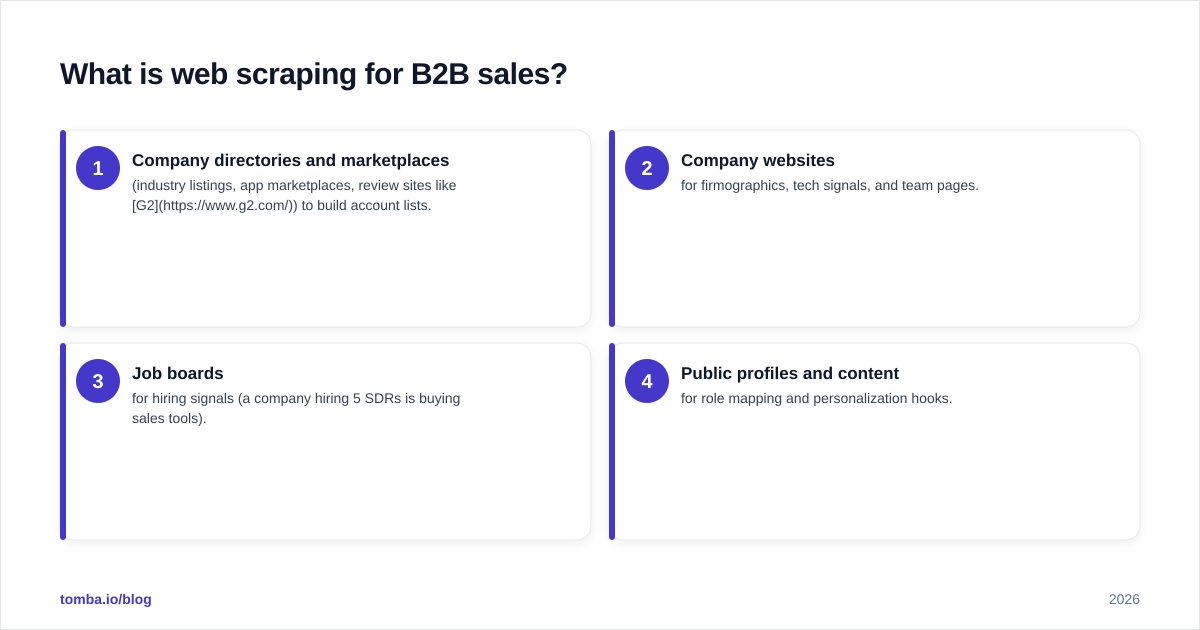
In practice, web scraping for B2B sales pulls from four kinds of sources:
- Company directories and marketplaces (industry listings, app marketplaces, review sites like G2) to build account lists.
- Company websites for firmographics, tech signals, and team pages.
- Job boards for hiring signals (a company hiring 5 SDRs is buying sales tools).
- Public profiles and content for role mapping and personalization hooks.
What scraping does not reliably give you: a verified, deliverable email address. That gap is where most pipelines break.
Why doesn't scraped data work as leads on its own?#
Because a scraped row is a hypothesis, not a contact.
Scrape a company page and you might get "John Smith, VP Sales." You still don't have his email. You don't know if he's still in the role. And you don't know whether the address you guessed will bounce and torch your sender reputation. Send to a list of guessed addresses and you'll learn the hard way how email deliverability collapses when bounce rates climb.
Here's the typical decay on raw scraped contact data:
- Role churn: B2B job changes run about 20–30% a year. A list scraped six months ago is already partly wrong.
- Format guessing: Scrapers often infer emails from patterns (
first.last@). Patterns vary, and catch-all domains accept everything. So a "valid-looking" guess can still be dead. - No verification: Without a verification step, you can't tell a real inbox from a spam trap.
This is why the modern stack treats scraping as step one of three: scrape the account/signal → find the verified contact → verify before send. Skip the middle and you're not prospecting. You're spamming.
How should you turn scraped data into real pipeline?#
Use scraping for what it's genuinely good at—discovering accounts and signals at scale—and hand off contact resolution to purpose-built tools.
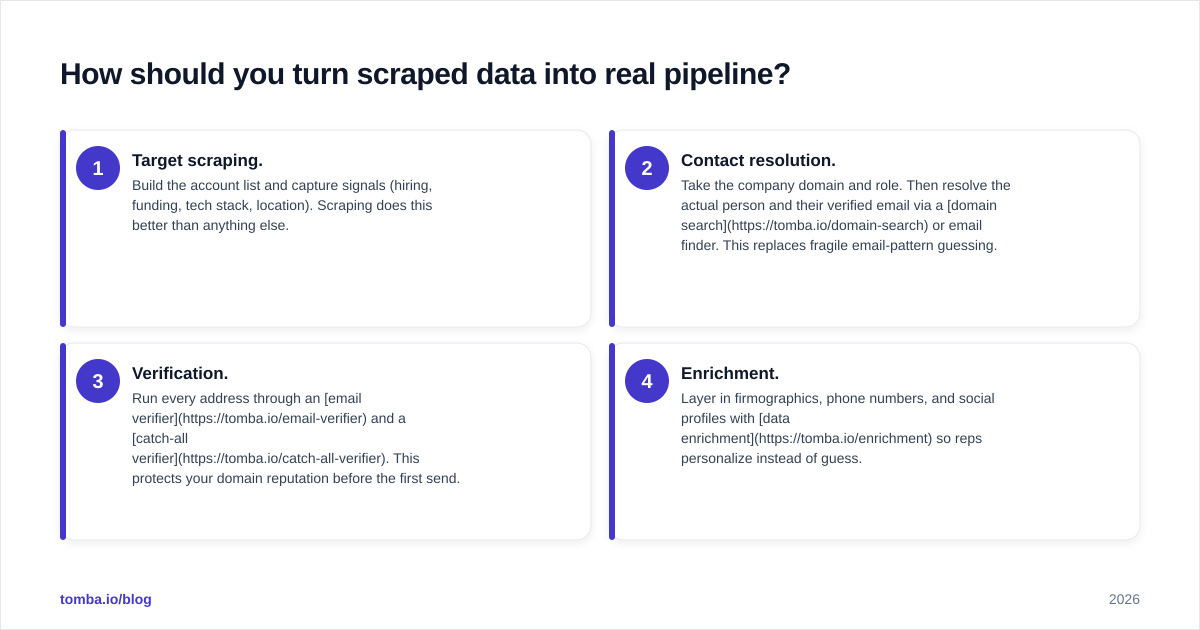
A clean four-stage workflow looks like this:
- Target scraping. Build the account list and capture signals (hiring, funding, tech stack, location). Scraping does this better than anything else.
- Contact resolution. Take the company domain and role. Then resolve the actual person and their verified email via a domain search or email finder. This replaces fragile email-pattern guessing.
- Verification. Run every address through an email verifier and a catch-all verifier. This protects your domain reputation before the first send.
- Enrichment. Layer in firmographics, phone numbers, and social profiles with data enrichment so reps personalize instead of guess.
The mental model is simple. Scraping fills the top of the funnel with accounts. Enrichment and verification convert those into contactable people. One without the other is half a system.
Should you build your own scraper or buy a data provider?#
Short answer: build only if scraping is your product. For everyone else, buy or run hybrid.
The build path looks cheap. Open-source frameworks like Scrapy are free, and a junior dev can ship a scraper in a week. The cost shows up later. Sites change their markup, add bot detection, switch to JavaScript rendering, and throttle requests. Your "free" scraper becomes a part-time maintenance job that breaks the week before quota close.
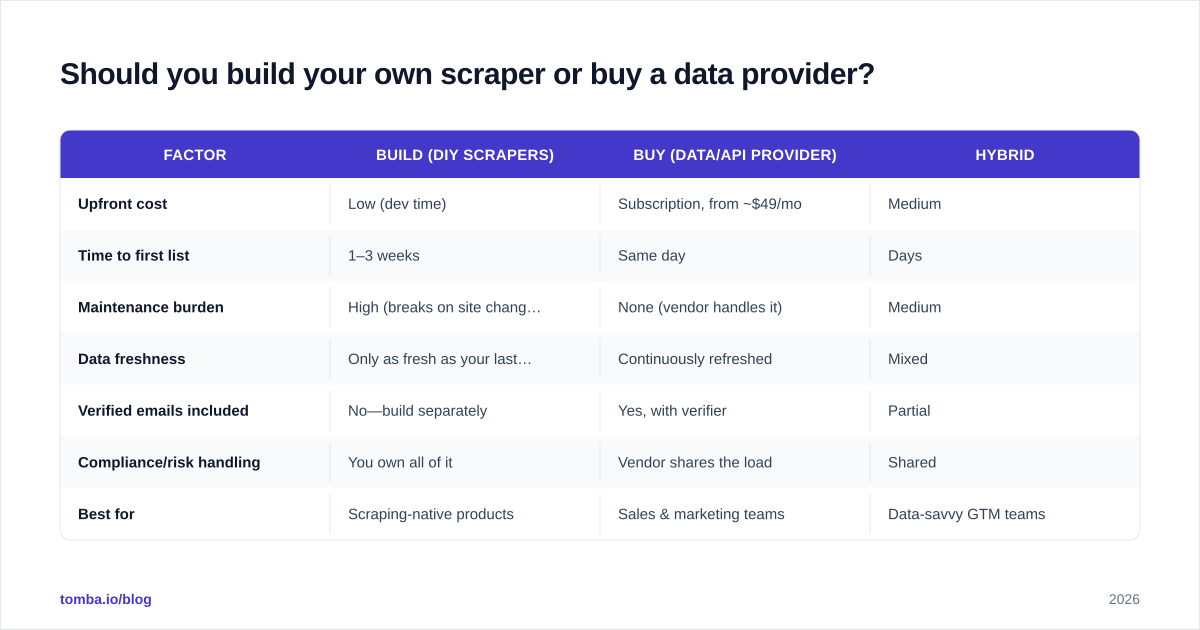
Here's the honest tradeoff:
| Factor | Build (DIY scrapers) | Buy (data/API provider) | Hybrid |
|---|---|---|---|
| Upfront cost | Low (dev time) | Subscription, from ~$49/mo | Medium |
| Time to first list | 1–3 weeks | Same day | Days |
| Maintenance burden | High (breaks on site changes) | None (vendor handles it) | Medium |
| Data freshness | Only as fresh as your last run | Continuously refreshed | Mixed |
| Verified emails included | No—build separately | Yes, with verifier | Partial |
| Compliance/risk handling | You own all of it | Vendor shares the load | Shared |
| Best for | Scraping-native products | Sales & marketing teams | Data-savvy GTM teams |
A hybrid wins for many revenue teams. Scrape your own niche signals (the stuff no vendor has). Then use an API for the heavy, maintenance-prone work of finding and verifying contacts. For example, scrape a niche directory for target accounts, push the domains into the bulk email finder, and let the provider return verified contacts at scale.
If you want to compare pricing across that decision, the Tomba pricing tiers (Free with 25 searches, Starter $49/mo, Growth $99/mo, Pro $249/mo) map cleanly onto "test it," "one rep," and "whole team" stages.
Is web scraping for B2B sales legal in 2026?#
Mostly yes, for public data. But the boundaries matter, and "legal" isn't the same as "compliant with a site's terms."
The defensible position rests on a few principles:
- Public data only. Data behind a login or paywall is off-limits. Courts have generally been friendlier to scraping of genuinely public pages than data that requires a login.
- Respect terms and
robots.txt. Ignoring an explicit ban weakens your position and can breach contract terms. - Rate-limit and don't degrade service. Hammering a site can cross from "data collection" into "interfering with operations."
- Privacy law still applies to the people. GDPR, CCPA, and similar rules govern how you store and use personal data—even if it was public when collected. You usually need a lawful basis (often legitimate interest for B2B). You must also honor opt-outs and deletion requests.
The nuance most teams miss: the legality of scraping and the legality of outreach are separate questions. You can lawfully collect a public business email and still break anti-spam rules (CAN-SPAM, CASL, GDPR). That happens if your outreach lacks a consent basis, identification, or an unsubscribe path. Treat compliance as a two-front problem.
This is another argument for using a reputable provider. Established vendors document their data sources and bake compliance handling into collection. So you're not personally judging every legal edge case. None of this is legal advice—loop in counsel for your jurisdiction—but the principles above keep most B2B programs on safe ground.
What should you actually scrape (and what should you skip)?#
Scrape signals. Skip contact guessing.
The highest-value scraping targets tell you a company is ready to buy, because timing beats volume in outbound:
- Hiring signals — job postings for roles your product serves. Hiring SDRs? They need sales tooling.
- Tech-stack signals — what tools a company already runs (detectable from site tags and front-end signatures). Complements and competitors are both buying triggers.
- Funding and growth signals — new rounds, office openings, headcount jumps.
- Engagement signals — content, events, and communities your buyers join, used for personalization hooks.
What to stop scraping directly: raw email addresses and phone numbers. Not because you can't, but because the result is low-quality without verification. Dedicated tools do it better. Resolve those through an email finder and a phone finder. They return confidence scores and verification status instead of a naked string you have to trust blindly.
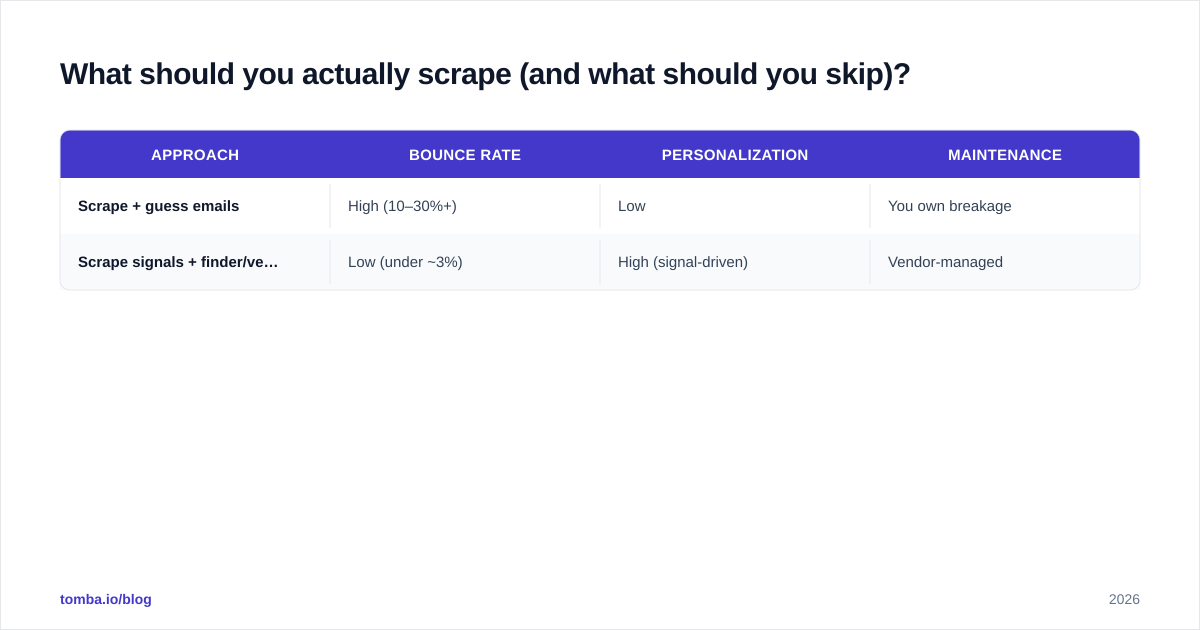
The difference in outcome is stark:
| Approach | Bounce rate | Personalization | Maintenance |
|---|---|---|---|
| Scrape + guess emails | High (10–30%+) | Low | You own breakage |
| Scrape signals + finder/verifier | Low (under ~3%) | High (signal-driven) | Vendor-managed |
That second row is the whole game. A clean list that lands in the inbox with a relevant hook beats a 10x-larger guessed list that gets filtered into spam.
How do you keep scraped data fresh and clean?#
Treat your database as perishable, because it is.
A few operational habits separate teams that compound from teams that re-scrape the same dead leads every quarter:
- Re-verify on a cadence. Run your active list through verification before each major campaign, not once at import. Addresses rot continuously.
- Deduplicate ruthlessly. Merge records by domain and person before outreach. This stops reps double-touching and stops you looking disorganized to the buyer.
- Store the source and timestamp. Knowing when and where a record came from lets you trust newer, higher-quality sources over stale ones.
- Close the loop with your CRM. Push enriched, verified records into your B2B database or CRM with status flags, so reps see confidence at a glance.
- Watch your sending health. Even perfect data fails if your domain reputation is poor. Pair clean lists with deliverability hygiene.
The teams that win aren't the ones with the biggest scrape. They're the ones whose data is freshest at the moment of send.
What does a modern scraping-to-pipeline stack look like?#
Layered, with each tool doing one job well:
- Discovery layer (scraping): custom scrapers or a directory/marketplace crawler to build account lists and capture signals.
- Resolution layer (finding): an email finder and domain search to turn "company + role" into "person + verified email."
- Verification layer: real-time verification, catch-all detection, and phone validation before anything reaches a rep's sequence.
- Enrichment layer: firmographics, social profiles, and intent data to fuel personalization.
- Activation layer: CRM/sequencer where reps work the now-clean, now-contactable list.
You can wire most of this through an email finder API. The resolution and verification layers then run automatically on every scraped record—no manual copy-paste between a spreadsheet and a tool. That's the difference between a workflow and a pile of CSVs.
The bottom line#
Web scraping for B2B sales is a powerful discovery engine and a terrible contact engine. Use it to find accounts and read buying signals at scale. Then hand the actual job of resolving and verifying contacts to tools built for it. The teams that treat scraping as step one of a three-step pipeline (discover → resolve → verify) ship cleaner lists, protect their domains, and book more meetings than teams chasing raw volume.
Ready to turn scraped account lists into verified, ready-to-contact pipeline? Start with the Tomba Email Finder. Feed it the domains and roles your scrapers surface, get back confidence-scored, verified emails, and skip the bounce-and-burn cycle entirely. Try it free with 25 searches—no scraper maintenance required.
// get started
Find, verify and enrich your first contacts today
Start on the free plan with 25 searches a month, then scale when your team is ready.
Free plan · No credit card required · GDPR & CCPA
// about the author