Cold Calling Fundamentals: A Step-by-Step Process for 2026
Cold calling still books meetings in 2026 — if you run a process. Here's the fundamentals framework top reps use to turn dials into pipeline.
TL;DR
- Cold calling isn't dead in 2026 — it's just unforgiving of reps who wing it. A repeatable cold calling process beats raw dial volume every time.
- The fundamentals break into five stages: research, the opener, discovery, objection handling, and the close-to-meeting. Each stage has one job.
- Accurate contact data is the multiplier. A perfect script wastes effort if the number is wrong or the prospect never picks up.
- Scripts are scaffolding, not a cage. Use them to stay structured, then sound human.
- Measure connect rate, conversation rate, and meetings booked separately — they fail for different reasons and need different fixes.
Cold calling has been declared dead roughly every year since the fax machine. It keeps booking meetings anyway. What actually died is the lazy version: blasting a list with no research, no structure, and a monotone pitch. In 2026, the reps who win on the phone are the ones who run a deliberate, measurable cold calling process — and this guide breaks that process down stage by stage.
What is the cold calling process, really?#
The cold calling process is the repeatable sequence a rep follows from "who do I call" to "meeting booked." Think of it like a pilot's pre-flight checklist: experienced pilots still run it on every flight, not because they forgot how to fly, but because skipping steps is how avoidable disasters happen.
A cold call is an unscheduled phone call to a prospect who hasn't expressed prior interest. That's the textbook definition on Wikipedia. What the textbook leaves out is that the call is only the visible tip. Most of the outcome is decided before you dial — by who's on your list and what you know about them.
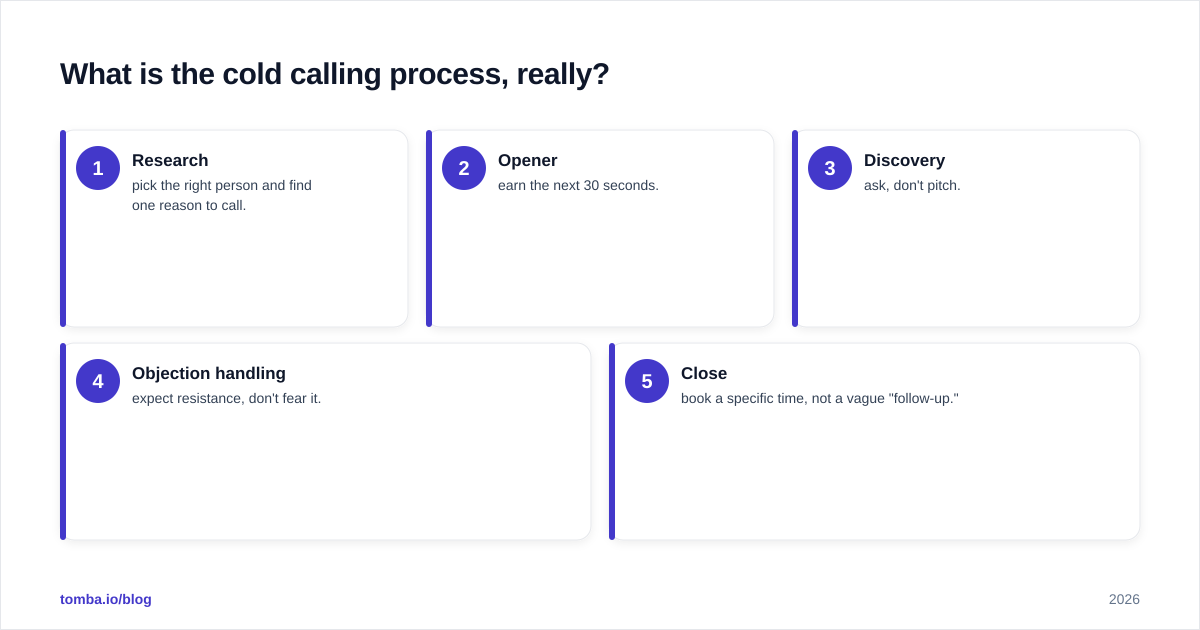
Here's the five-stage framework the rest of this article unpacks:
- Research — pick the right person and find one reason to call.
- Opener — earn the next 30 seconds.
- Discovery — ask, don't pitch.
- Objection handling — expect resistance, don't fear it.
- Close — book a specific time, not a vague "follow-up."
Why does data quality matter more than the script?#
Because you can't run any process on a phantom. The most polished opener in the world is worthless if the number rings a disconnected line or reaches the wrong department.
Connect rate — the percentage of dials that reach a live human — is the first lever, and it's almost entirely a data problem. Reps routinely lose a third of their dialing time to dead numbers, gatekeepers with no transfer authority, and direct lines that belong to someone who left the company 18 months ago. That's why serious outbound teams validate phone numbers before a campaign instead of discovering the rot mid-shift.
This is where tooling earns its keep. Pulling verified direct-dial and mobile numbers with a phone finder, then scrubbing the list through a phone validator to drop dead lines, can lift connect rate enough to change the math of an entire week. If your CRM is full of stale contacts, no script tweak will save the campaign.
A practical rule: spend your prep time on the top of the funnel. One hour cleaning a list returns more meetings than one hour rewriting an opener.
What does each stage of the cold calling process do?#
Each stage has exactly one job. Reps get into trouble when they try to do two jobs at once — pitching during discovery, or closing before they've earned attention.
Stage 1: Research (2–3 minutes per prospect)#
You're not writing a dossier. You're looking for one specific, recent, relevant trigger: a funding round, a new VP hire, a job posting that signals a pain you solve, a product launch. That single detail is what separates "Hi, is this a good time?" from "I saw you just opened a second office in Austin — that's usually when teams outgrow their old process."
Stage 2: The opener (first 15–30 seconds)#
The opener's only job is to buy the next 30 seconds. Most prospects decide whether to hang up in the first two sentences. A strong opener names who you are, acknowledges the interruption honestly, and immediately gives a reason rooted in your research. Don't ask "How are you today?" — it signals "sales call" before you've said anything useful.
Stage 3: Discovery (the longest stage)#
This is where amateurs pitch and pros ask. The goal is to get the prospect talking about their current state and frustrations. If you're talking more than 40% of the time during discovery, you've turned a conversation into a monologue. Open questions ("How are you handling X today?") outperform closed ones every time.
Stage 4: Objection handling#
Objections aren't rejection — they're engagement. "We already use a competitor" means they've thought about the problem. The fundamental move is acknowledge, then ask: "Totally fair — a lot of teams we work with were on [competitor] too. What made you originally pick them?" You learn more and lower defenses at the same time.
Stage 5: The close#
Close to a calendar slot, not a concept. "Does Thursday at 10 or Friday at 2 work better?" beats "Can I follow up next week?" by a wide margin. A specific ask gets a specific answer.
Is a cold calling script worth using?#
Yes — as scaffolding, not a cage. The debate over "scripted vs. natural" is a false choice. A script keeps you from forgetting your value proposition under pressure; sounding human keeps the prospect from hanging up. You need both.
The trick is to internalize the structure (the five stages) and improvise the words. New reps should read closely for the first two weeks, then wean off the page. By month two, the script should live in your head as a flowchart, not a teleprompter.
HubSpot's sales research consistently shows that personalization and relevance beat volume — a script that's been tailored to a persona will always outperform a generic one read to everyone.
How does cold calling compare to other outbound channels?#
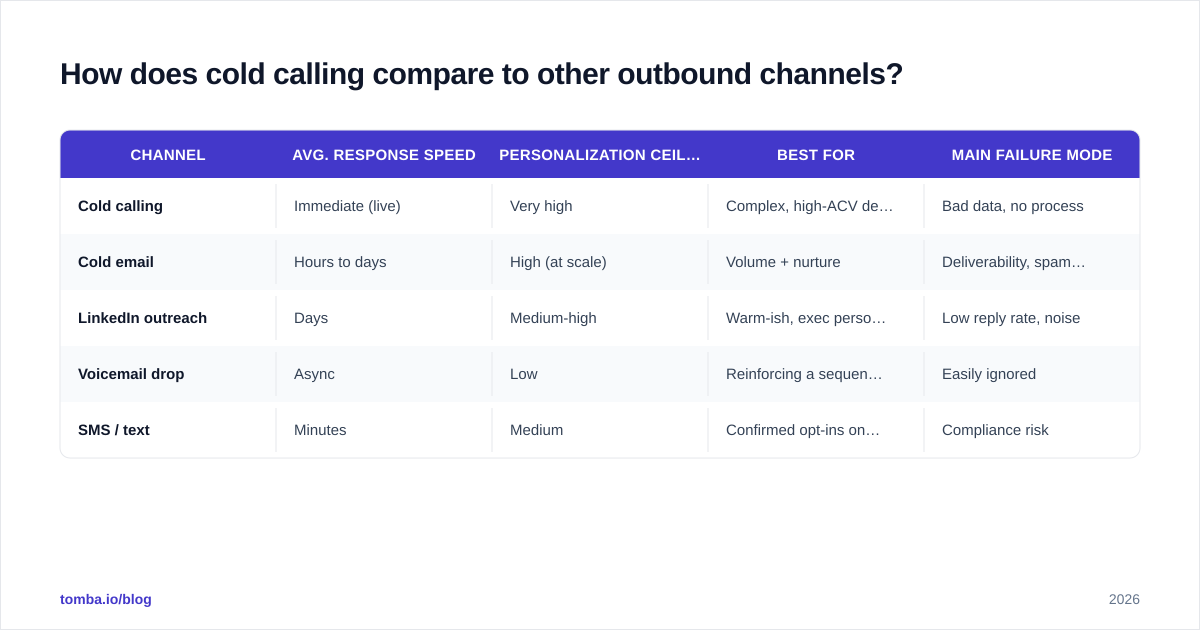
Cold calling isn't a religion — it's one channel in a mix. The best 2026 sequences blend calls with email and LinkedIn, because each channel reaches prospects who ignore the others. Here's how the fundamentals stack up:
| Channel | Avg. response speed | Personalization ceiling | Best for | Main failure mode |
|---|---|---|---|---|
| Cold calling | Immediate (live) | Very high | Complex, high-ACV deals | Bad data, no process |
| Cold email | Hours to days | High (at scale) | Volume + nurture | Deliverability, spam filters |
| LinkedIn outreach | Days | Medium-high | Warm-ish, exec personas | Low reply rate, noise |
| Voicemail drop | Async | Low | Reinforcing a sequence | Easily ignored |
| SMS / text | Minutes | Medium | Confirmed opt-ins only | Compliance risk |
The takeaway: calling wins on immediacy and depth, which is why it punches above its weight for higher-value deals. But it's strongest when it's reinforced by email and social touches, not run in isolation. A prospect who's seen your name in their inbox and on LinkedIn is far likelier to take your call.
If you're building a multi-channel motion, pairing verified phone data with an email finder lets you reach the same contact across channels without guessing. And tracking your response rate per channel tells you where to invest next quarter.
What metrics actually tell you if your process works?#
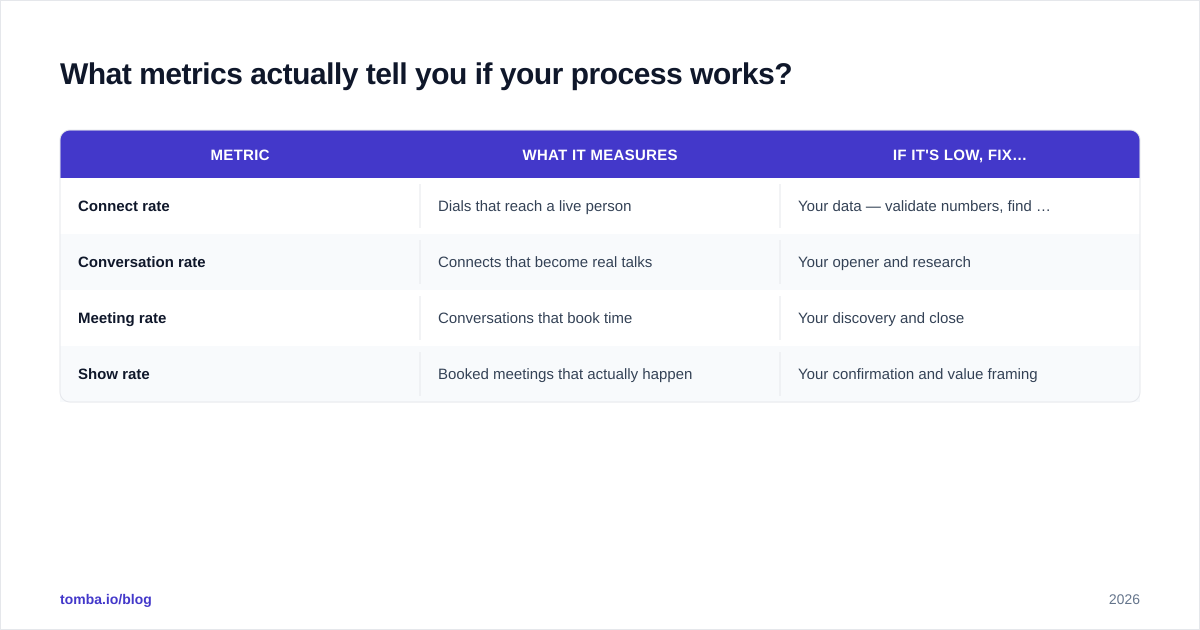
Track three rates separately, because they fail for different reasons and demand different fixes. Lumping them into one "success rate" hides the actual problem.
| Metric | What it measures | If it's low, fix… |
|---|---|---|
| Connect rate | Dials that reach a live person | Your data — validate numbers, find direct dials |
| Conversation rate | Connects that become real talks | Your opener and research |
| Meeting rate | Conversations that book time | Your discovery and close |
| Show rate | Booked meetings that actually happen | Your confirmation and value framing |
Watch the chain, not the average. A rep with a 35% connect rate but a 5% conversation rate has a script problem. A rep with a stellar opener but an 8% connect rate has a data problem — and no amount of coaching on tone will fix a dead phone list. According to Gartner's sales research, the highest-performing teams are the ones that diagnose by stage instead of chasing a single vanity number.
This is also why CRM hygiene matters. Logging call outcomes in your CRM against these four stages turns a pile of dials into a diagnostic dashboard.
What are the most common cold calling mistakes in 2026?#
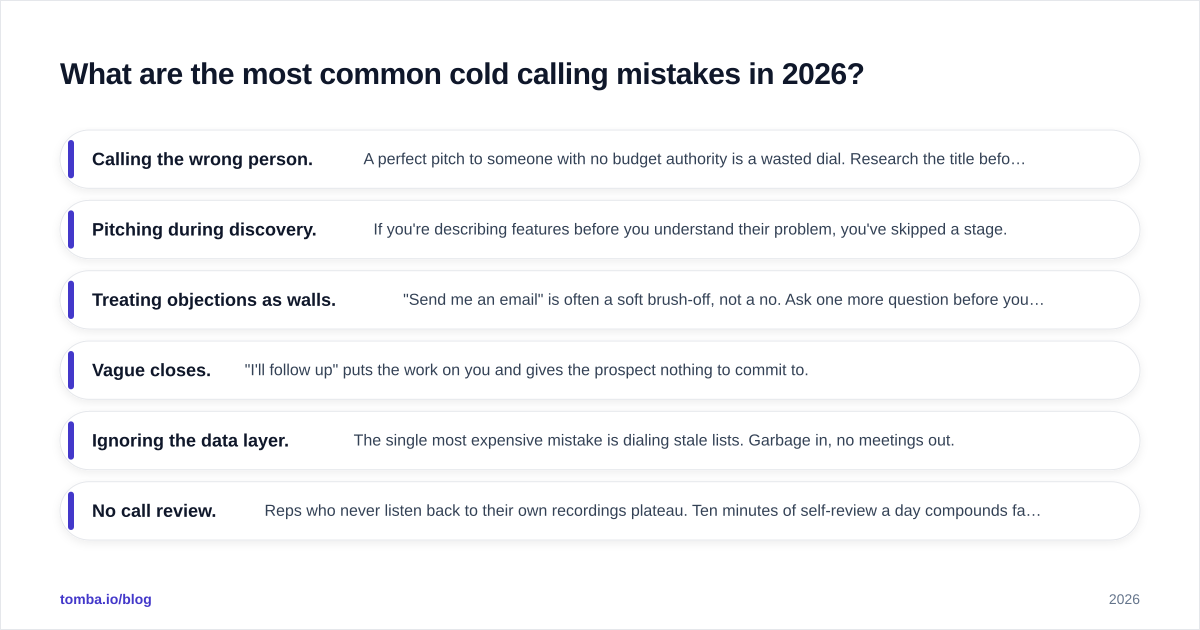
- Calling the wrong person. A perfect pitch to someone with no budget authority is a wasted dial. Research the title before the call.
- Pitching during discovery. If you're describing features before you understand their problem, you've skipped a stage.
- Treating objections as walls. "Send me an email" is often a soft brush-off, not a no. Ask one more question before you let go.
- Vague closes. "I'll follow up" puts the work on you and gives the prospect nothing to commit to.
- Ignoring the data layer. The single most expensive mistake is dialing stale lists. Garbage in, no meetings out.
- No call review. Reps who never listen back to their own recordings plateau. Ten minutes of self-review a day compounds fast.
How do you build a repeatable cold calling process for a team?#
Standardize the inputs, then let reps personalize the delivery. The fundamentals scale when everyone runs the same five stages against the same quality of data — even if the exact words differ by personality and persona.
Start with a shared, validated contact list so every rep dials from clean data. Build a one-page call guide per persona covering the opener, three discovery questions, the top three objections, and the close. Then run weekly call reviews where the team listens to one real recording together. That's how you turn one rep's good instinct into the whole team's default.
Tooling reduces the friction. A bulk workflow — find direct dials, validate them, push to the dialer — means reps spend their hours talking, not hunting for numbers. Reliable data sources are the foundation the whole process sits on; if you want to understand where contact data comes from and how it's kept fresh, Tomba documents its data sources openly.
The bottom line#
Cold calling in 2026 rewards process over hustle. Research the right person, earn the first 30 seconds, ask before you pitch, treat objections as openings, and close to a specific time. Then measure each stage so you fix the right thing. The reps who do this consistently book meetings while everyone else complains that "calling is dead."
But every stage of that process sits on top of one thing: accurate contact data. You can't run a great call against a wrong number or an empty CRM field. Start by building a clean, verified list — use the Tomba Email Finder to pull professional emails and pair it with verified phone data so your reps reach the right person on the first try. Clean data turns a good script into booked pipeline. Spin up a free account (25 searches a month, no card), check the Tomba pricing when you're ready to scale, and let your reps spend their day talking to humans instead of dialing the dead.
// get started
Find, verify and enrich your first contacts today
Start on the free plan with 25 searches a month, then scale when your team is ready.
Free plan · No credit card required · GDPR & CCPA
// about the author