Cold Calling Objections and Gatekeepers: 2026 Playbook
A field-tested 2026 playbook for handling cold calling objections and getting past gatekeepers, with scripts, a decision framework, and a tool comparison.
Cold calling did not die. The lazy version of it did. In 2026, the reps who book meetings are the ones who can disarm a "we're not interested" in four words and turn a gatekeeper into an internal champion. Everyone else gets the dial tone.
This guide is the playbook: the exact objections you will hear, the responses that work, the difference between a gatekeeper and a blocker, and the framework to decide which move to make in real time.
TL;DR#
- Objections are reflexes, not verdicts. "Send me an email" usually means "I haven't decided you're worth 30 seconds yet" — not no.
- Gatekeepers are allies, not obstacles. Treat the assistant like a decision-maker and you get routed; treat them like a wall and you get blocked.
- Use a fixed framework (Acknowledge → Reframe → Redirect) so you respond on instinct instead of freezing.
- Accurate contact data cuts the gatekeeper problem in half — a verified direct dial or the right named contact means fewer switchboards to clear.
- Track objection types, not just call counts. The pattern in your "no" tells you what to fix in your opener.
Why do prospects throw objections on cold calls?#
Conclusion first: most early objections are not about your product — they are about protecting time. A cold call is an interruption, and the brain's default response to an interruption is to end it as fast as possible. "We already have a vendor," "I'm in a meeting," and "just email me" are exit reflexes, fired before the prospect has actually evaluated anything you said.
Think of it like a doorbell ringing during dinner. You say "not interested" before you even know who is at the door. The objection is aimed at the interruption, not the offer.
That reframe matters because it changes your goal. On the first 10 seconds of a cold call, you are not selling the product. You are buying the next 30 seconds of attention. Every objection-handling technique below is built around that single job.
There are four objection families you will hear over and over:
- Brush-offs — "send me an email," "now's not a good time," "call me next quarter."
- Status-quo — "we already use someone," "we built it in-house," "we're happy."
- Authority — "that's not my decision," "you'd need to talk to X."
- Price/value — "we have no budget," "that sounds expensive."
Each family needs a different response. Treating all four the same is the most common reason a call collapses.
What framework handles cold calling objections in real time?#
Use Acknowledge → Reframe → Redirect (ARR). It is three beats, runs in under eight seconds, and keeps you from arguing.
- Acknowledge — validate the reflex so the prospect's guard drops. "Totally fair, you weren't expecting my call."
- Reframe — supply one piece of context that reframes the interruption as relevant. "The only reason I called instead of emailing is that [specific, account-relevant trigger]."
- Redirect — ask a small, low-commitment question that earns the next 30 seconds. "Can I take 20 seconds to tell you why, and you can hang up if it's not relevant?"
The redirect is the part most reps skip. They acknowledge, they reframe, and then they pitch — which re-triggers the exit reflex. Always end on a question that hands control back to the prospect. People stay on calls they feel they control.

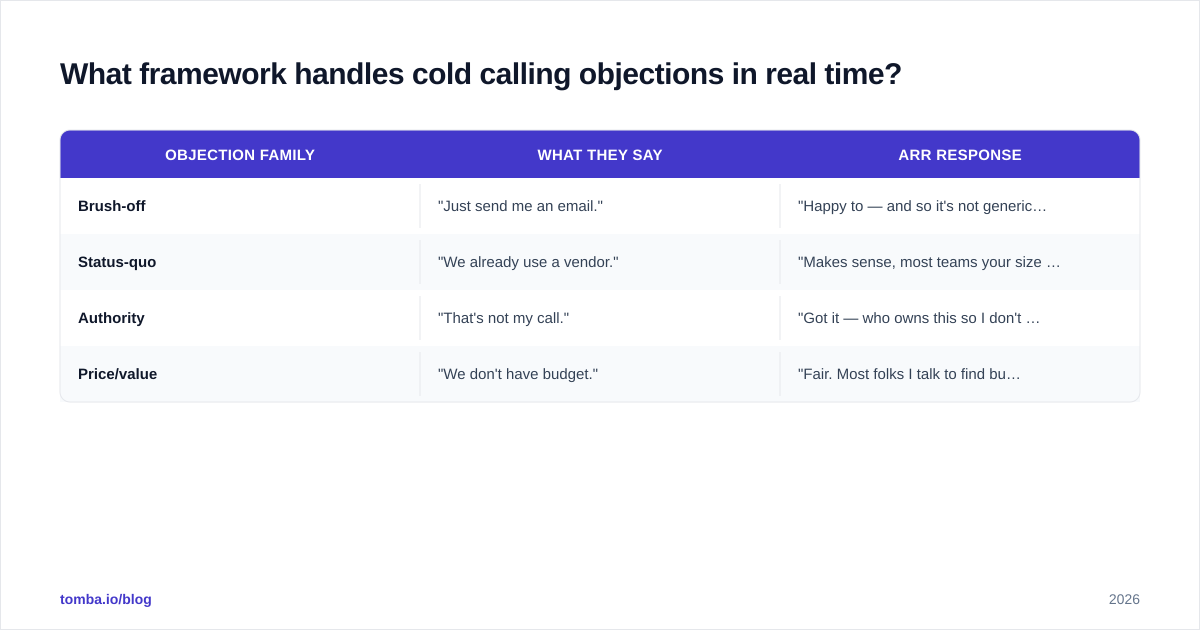
Here is ARR applied to the four families:
| Objection family | What they say | ARR response |
|---|---|---|
| Brush-off | "Just send me an email." | "Happy to — and so it's not generic, can I ask one quick question so I send the right thing?" |
| Status-quo | "We already use a vendor." | "Makes sense, most teams your size do. Quick check: is it [common gap] you're solving for, or something else?" |
| Authority | "That's not my call." | "Got it — who owns this so I don't waste your time? And out of curiosity, what's your read on it?" |
| Price/value | "We don't have budget." | "Fair. Most folks I talk to find budget once the [outcome] is clear. Worth 10 minutes to see if that's even the case here?" |
Notice none of these argue. You never tell a prospect they are wrong. You agree, add one fact, and ask one question. That cadence is what separates a conversation from a confrontation.
How do you get past a gatekeeper without lying?#
Conclusion first: stop trying to "get past" gatekeepers and start recruiting them. The assistant, receptionist, or office manager who screens calls is not your enemy — they are the single best-informed person about how that company makes decisions. Reps who respect that get routed to the right people. Reps who deploy tricks get flagged and blocked.
The old-school tactics — calling before 8am to dodge the assistant, pretending you have an existing relationship, mumbling a first name like you're old friends — are worse than useless in 2026. Gatekeepers have heard all of them. The moment you sound evasive, you are done.
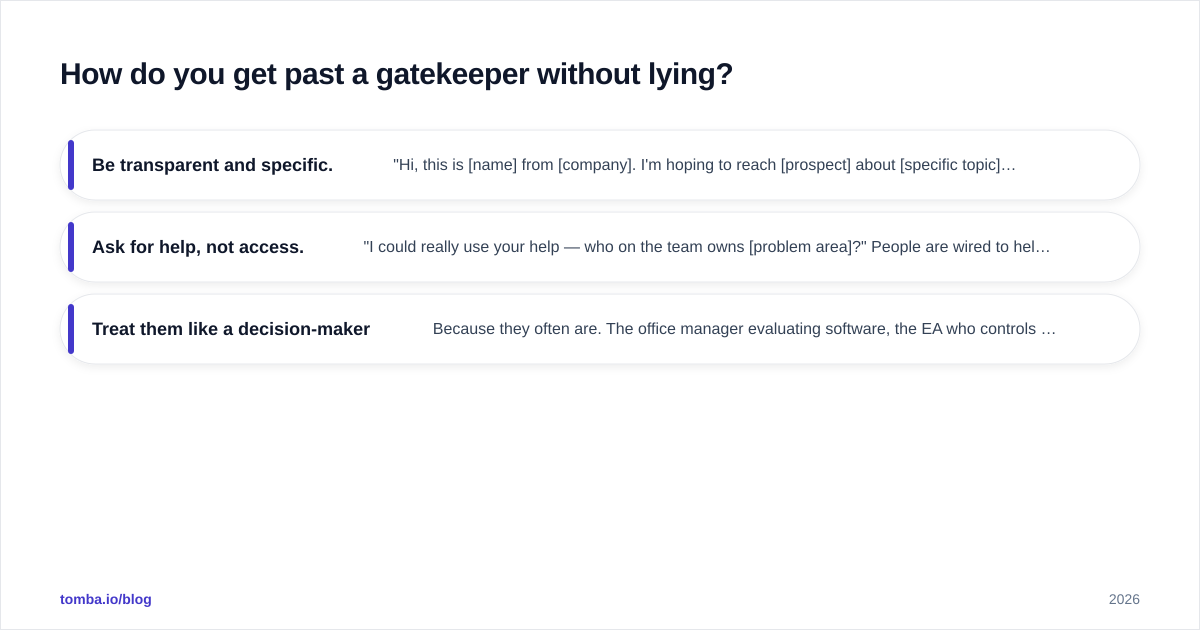
Three principles work instead:
- Be transparent and specific. "Hi, this is [name] from [company]. I'm hoping to reach [prospect] about [specific topic] — are they the right person, or is that someone else?" Confidence plus a real reason gets you further than any trick.
- Ask for help, not access. "I could really use your help — who on the team owns [problem area]?" People are wired to help when asked directly and politely. Gatekeepers know the org chart better than the website does.
- Treat them like a decision-maker. Because they often are. The office manager evaluating software, the EA who controls the calendar — these people influence and sometimes make the call. Pitch them the respect you'd give a VP.
When you do hit resistance, fall back to a question that gives them an easy out: "If [prospect] isn't the right person, who should I be talking to?" You either get a name or a referral. Both beat a hang-up.
For a deeper script library on the call itself, our guide to cold calling and phone sales breaks down openers by industry.
Gatekeeper vs. blocker: how do you tell the difference?#
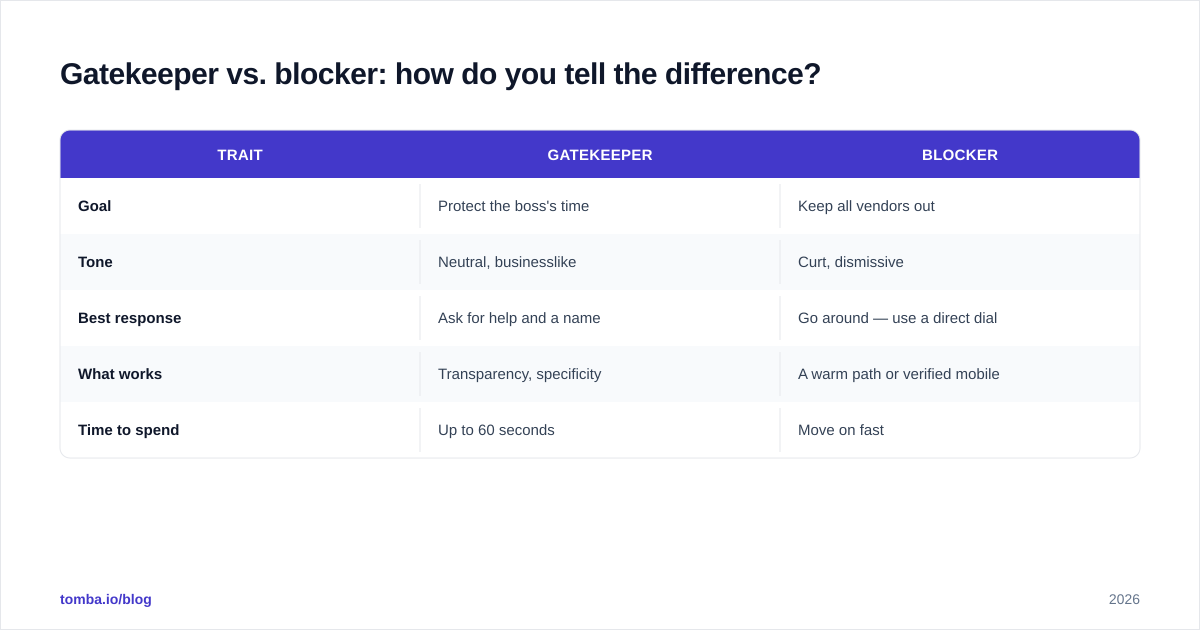
There is a difference between a gatekeeper (screens and routes) and a blocker (actively prevents). Your move depends on which one you have.
| Trait | Gatekeeper | Blocker |
|---|---|---|
| Goal | Protect the boss's time | Keep all vendors out |
| Tone | Neutral, businesslike | Curt, dismissive |
| Best response | Ask for help and a name | Go around — use a direct dial |
| What works | Transparency, specificity | A warm path or verified mobile |
| Time to spend | Up to 60 seconds | Move on fast |
When you've got a true blocker, the highest-leverage fix is not a better line — it's better data. If you already hold a verified direct dial or mobile number, you skip the switchboard entirely. That is why prospecting data quality and call-connect rates are joined at the hip. A phone finder that surfaces a named contact's direct line turns a blocker problem into a non-problem.
What scripts handle the five most common objections?#
Below are five word-for-word responses you can adapt. Keep them short — long rebuttals sound rehearsed and defensive.
1. "I'm not interested." "Totally fair — you don't know me yet. Most people I call say that for the first 15 seconds. Can I give you one reason I called, and if it's not relevant you hang up on me, no hard feelings?"
2. "Just send me some information." "I will. And I don't want to send you a generic deck you'll never open, so — what's the one thing that would make this worth your time to read?"
3. "We already work with [competitor]." "Great, they're solid. I'm not calling to rip them out. I'm calling because a few teams using them ran into [specific gap] — is that something you've noticed, or are you fully covered?"
4. "Now's not a good time." "Completely understand. I'll be quick or I'll get out of your hair — would later today or Thursday morning be better for 10 minutes?"
5. "We have no budget." "Makes sense, and I'm not asking you to spend anything today. If I could show you a way to [outcome] that pays for itself, would it be worth a short look next quarter?"
Each one acknowledges, adds context, and ends on a question. That is ARR on autopilot. Drill these until they are reflexes, because the prospect's objection is a reflex — you need yours to fire just as fast.
A quick note on tone: studies of sales calls consistently show that pace and confidence matter more than the exact words. HubSpot's research on cold calling found that talking slightly slower and pausing after questions measurably raises connect-to-meeting rates. Say less, ask more, and let silence do work.
How does better data reduce objections before you dial?#
Conclusion first: half of all "you've got the wrong person" objections are a data problem, not a skill problem. If you call the right person, at the right number, about a relevant trigger, you eliminate the entire authority-objection family before it starts.
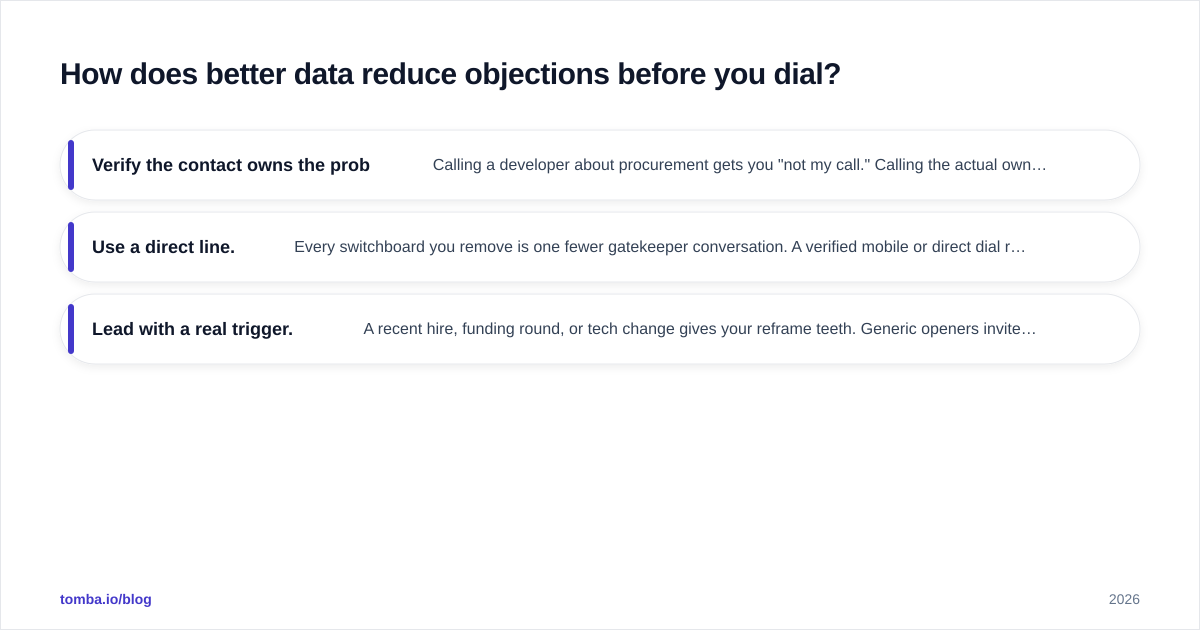
Three data moves change your objection mix:
- Verify the contact owns the problem. Calling a developer about procurement gets you "not my call." Calling the actual owner skips the routing entirely. Map roles before you dial.
- Use a direct line. Every switchboard you remove is one fewer gatekeeper conversation. A verified mobile or direct dial routes you straight in.
- Lead with a real trigger. A recent hire, funding round, or tech change gives your reframe teeth. Generic openers invite generic brush-offs.
This is where prospecting and dialing connect. Building your list with a domain search to find the right named contacts — then enriching with direct phone numbers — means you spend your call energy on objection handling, not on figuring out who to ask for. The reps with the cleanest data have the shortest path past gatekeepers because they already know the name to request.
Industry analysts agree the lever has moved. Gartner's research on B2B buying shows buyers now self-educate before they ever take a call, which means your job on the phone is precision, not volume. You cannot out-dial bad targeting.
How should you track objections to improve over time?#
Track objection type, not just call count. A spreadsheet column for "objection category" tells you more than any dials-per-day metric. If 60% of your objections are authority-based, your targeting is off. If 60% are status-quo, your reframe needs a sharper gap. If most are brush-offs, your opener isn't earning the next 30 seconds.
Review weekly and look for the pattern in the "no." The objection you hear most is a map to the thing you should fix first. One rep tracking this for a month usually finds a single change — a better opener, a different title to target, a verified phone field — that lifts their connect-to-meeting rate more than any motivational push ever did.
Pair that with your CRM so every logged call carries its objection tag. Over a quarter, the data writes your improvement plan for you. That feedback loop — call, tag, review, adjust — is what turns a script-reader into a closer.
The bottom line#
Objections and gatekeepers are not the hard part of cold calling — they are the predictable part. There are four objection families, a three-beat framework that handles all of them, and a clear line between gatekeepers you recruit and blockers you route around. Master the cadence, respect the people screening calls, and feed the whole thing with accurate contact data.
That last piece is the multiplier. The best rebuttal in the world can't fix a wrong number or a misrouted call. Before your next call block, build your list on contacts you can actually reach: use the Tomba Email Finder to lock down the right named decision-makers by company and domain, then enrich with verified direct dials so every conversation starts with the right person on the line — and fewer gatekeepers between you and the meeting. Start free with 25 searches, and see the Tomba pricing plans (Starter at $49/mo) when you're ready to scale your outbound list.
// get started
Find, verify and enrich your first contacts today
Start on the free plan with 25 searches a month, then scale when your team is ready.
Free plan · No credit card required · GDPR & CCPA
// about the author