Cold Email Copy Components: The 7 Building Blocks (2026)
Most cold emails fail on structure, not vocabulary. Here are the 7 cold email copy components that actually drive replies in 2026 — with length targets, examples, and an assembly framework.
You can spend three hours rewriting a cold email and still get zero replies — because the problem was never the wording. It was the parts. A cold email is an assembly of distinct copy components, each doing one job, and when one block is missing or bloated, the whole message collapses.
This guide breaks the cold email down into its seven core copy components, shows you how long each should be, and gives you a repeatable framework to assemble them. No fluff, no "craft a compelling narrative" hand-waving — just the building blocks and how they fit.
TL;DR#
- A high-performing cold email is built from 7 copy components: subject line, preview text, opener, value proposition, social proof, call to action, and signature.
- Most cold emails fail on structure, not vocabulary — a missing or bloated component kills replies faster than an imperfect word choice.
- The opener and CTA carry the most weight per character; keep the whole email under 120 words.
- Use the assembly framework below to combine components instead of writing from a blank page every time.
- Pair tight copy with verified contact data — a perfect email to a bounced address still scores zero.
What are cold email copy components?#
Cold email copy components are the discrete, single-purpose blocks that together form a cold outreach message. Think of them like the parts of a sandwich: bread, protein, sauce, filling. Each one is replaceable and testable on its own, but the sandwich only works when they're stacked in the right order and proportion.
Treating your email as one undifferentiated paragraph is the most common mistake in outbound. When you instead see it as seven labeled components, you can diagnose exactly where a campaign leaks: "my open rate is fine but nobody replies" points at the CTA, not the subject line.
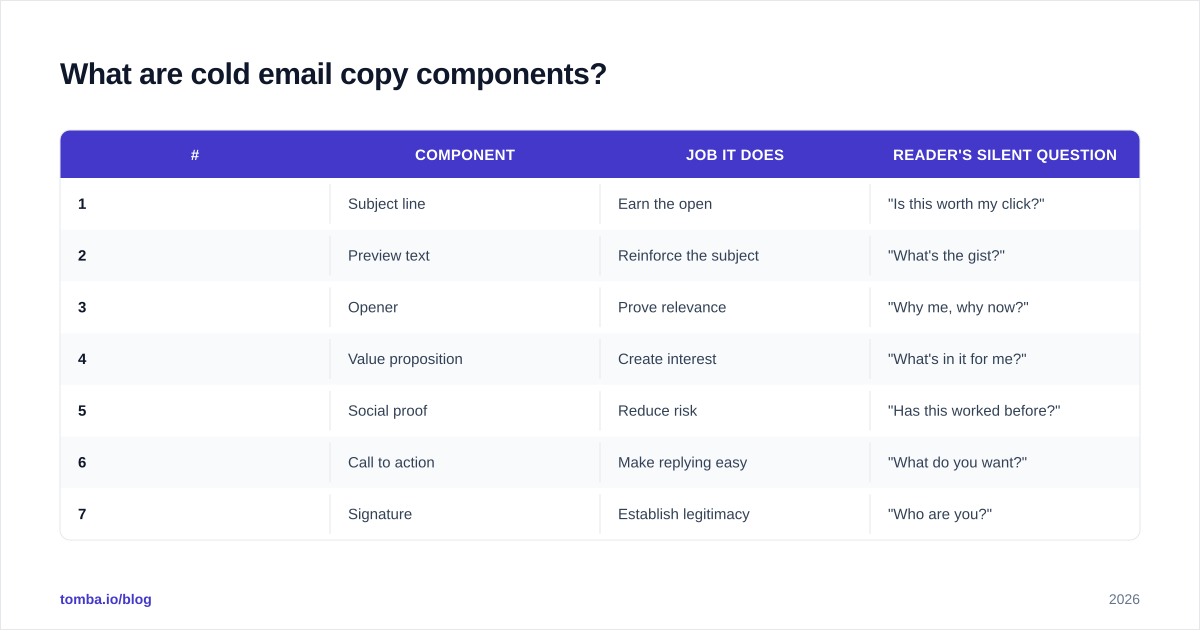
Here's the full set, in order:
| # | Component | Job it does | Reader's silent question |
|---|---|---|---|
| 1 | Subject line | Earn the open | "Is this worth my click?" |
| 2 | Preview text | Reinforce the subject | "What's the gist?" |
| 3 | Opener | Prove relevance | "Why me, why now?" |
| 4 | Value proposition | Create interest | "What's in it for me?" |
| 5 | Social proof | Reduce risk | "Has this worked before?" |
| 6 | Call to action | Make replying easy | "What do you want?" |
| 7 | Signature | Establish legitimacy | "Who are you?" |
Why do most cold emails fail on structure, not words?#
Because readers don't read cold emails — they scan them in under three seconds. During that scan, the brain is checking for the components above, not appreciating your prose. If the value proposition is buried in sentence four, the reader has already deleted the message.
Gong's analysis of sales outreach repeatedly shows that interest-based language and brevity beat clever phrasing. The implication is structural: you win by putting the right component in the right place, sized correctly, so the scanner finds it instantly. A beautifully written 250-word email loses to an ugly 70-word one with a clear CTA every time.
This is also why "AI rewrite my email" rarely fixes a dead campaign. The model polishes words inside a broken skeleton. Fix the components first.
What are the 7 cold email copy components?#
Let's walk each block with a concrete example for a fictional sender selling onboarding software to RevOps leaders.
1. Subject line#
Four to seven words, lowercase if you want it to feel personal, never clickbait. The subject's only job is the open. Avoid spam triggers and ALL CAPS.
quick question about your onboarding flow
Test variants before you send — a subject line tester will flag length and spam-risk issues, and a subject line generator gives you ten angles in seconds.
2. Preview text#
The 35–90 characters shown next to the subject in most inboxes. Don't waste it on "View in browser." Extend the subject's promise.
noticed you onboard ~40 reps a quarter
3. Opener#
The single hardest-working line. Replace "I hope this email finds you well" with one specific, true observation about them. This is where personalization lives.
Saw your team grew from 12 to 40 SDRs this year — congrats on the Series B.
4. Value proposition#
One sentence on the outcome you create, framed around their pain, not your features.
Teams your size usually lose 2 weeks ramping each new rep; we cut that to 4 days.
5. Social proof#
One quantified, relevant proof point. Names beat adjectives.
Did exactly this for Ramp and Deel's RevOps teams last quarter.
6. Call to action#
One ask, low-friction, answerable with yes/no or a single line. Avoid stacking two CTAs.
Worth a 12-minute call Thursday, or should I send the 2-min Loom instead?
7. Signature#
Name, role, company, and one credibility link. No giant banner images that trip spam filters.
How long should each cold email copy component be?#
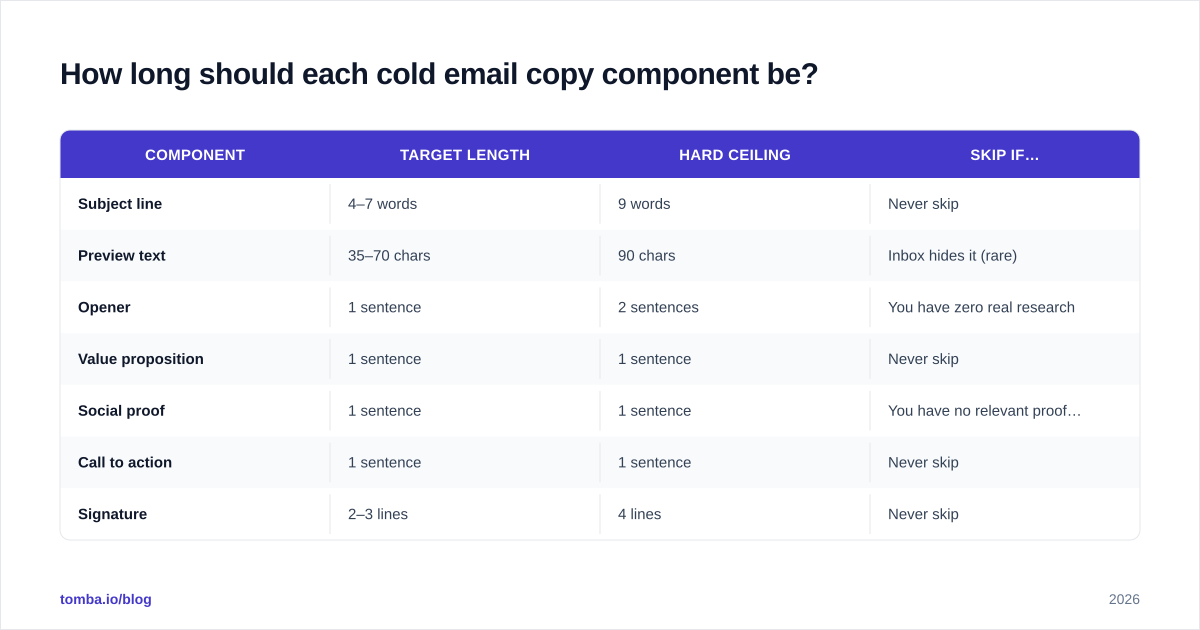
Aim for 50–125 words total. Anything longer reads as a pitch, and pitches get archived. Here's a working budget you can copy:
| Component | Target length | Hard ceiling | Skip if… |
|---|---|---|---|
| Subject line | 4–7 words | 9 words | Never skip |
| Preview text | 35–70 chars | 90 chars | Inbox hides it (rare) |
| Opener | 1 sentence | 2 sentences | You have zero real research |
| Value proposition | 1 sentence | 1 sentence | Never skip |
| Social proof | 1 sentence | 1 sentence | You have no relevant proof yet |
| Call to action | 1 sentence | 1 sentence | Never skip |
| Signature | 2–3 lines | 4 lines | Never skip |
Notice three components are "never skip": subject, value prop, CTA. Those are the load-bearing walls. The opener and social proof are powerful but optional when you genuinely lack the material — a fabricated proof point does more damage than an absent one.
If your draft blows past 125 words, the fix is almost never trimming adjectives. It's removing a whole component you didn't need, or collapsing two sentences into one. You can pressure-test readability with a free spam checker before the first send.
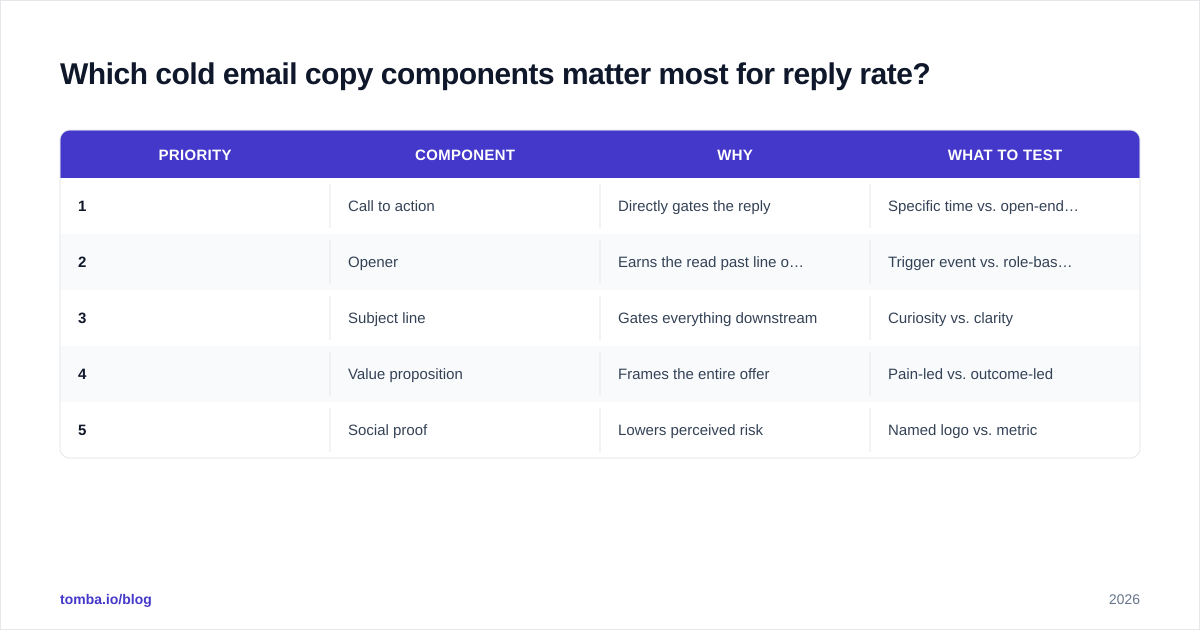
Which cold email copy components matter most for reply rate?#
The opener and the CTA. Opens are won by the subject, but replies are won by relevance (the opener) and friction (the CTA). HubSpot's sales benchmarks and most practitioner data agree that personalized, single-ask emails out-reply generic, multi-ask ones by a wide margin.
A simple way to prioritize your editing time:
| Priority | Component | Why | What to test |
|---|---|---|---|
| 1 | Call to action | Directly gates the reply | Specific time vs. open-ended ask |
| 2 | Opener | Earns the read past line one | Trigger event vs. role-based line |
| 3 | Subject line | Gates everything downstream | Curiosity vs. clarity |
| 4 | Value proposition | Frames the entire offer | Pain-led vs. outcome-led |
| 5 | Social proof | Lowers perceived risk | Named logo vs. metric |
Improving your email response rate is usually a matter of rewriting components 1 and 2, not 3 through 5. Most reps get this backwards and obsess over subject lines while shipping a vague, two-CTA close.
How do you assemble components into a repeatable template?#
Use a fixed skeleton and swap only the variable blocks. The structure stays constant across a campaign; the opener and proof point change per prospect. This is the difference between writing 200 emails and writing one template you personalize 200 times.
The assembly order:
- Lock your subject + preview as a tested pair for the whole segment.
- Write three opener variants tied to different trigger events (funding, hire, tech change).
- Keep one value proposition and one CTA constant — these are your control.
- Slot in the most relevant social proof for each prospect's industry.
- Keep the signature identical and clean.
A finished skeleton looks like this:
Subject: quick question about {{pain_area}}
Opener: {{specific_trigger_observation}}
Value prop: Teams like yours usually {{pain}}; we {{outcome}}.
Proof: Did this for {{relevant_logo}} last {{timeframe}}.
CTA: Worth {{specific_low_friction_ask}}?
Sig: Name / Role / Company / one link
Save your winners as reusable blocks. A library of vetted cold email templates means your team assembles from proven components instead of staring at a blank draft, and a cold email AI can generate first-pass openers you then fact-check against real research.
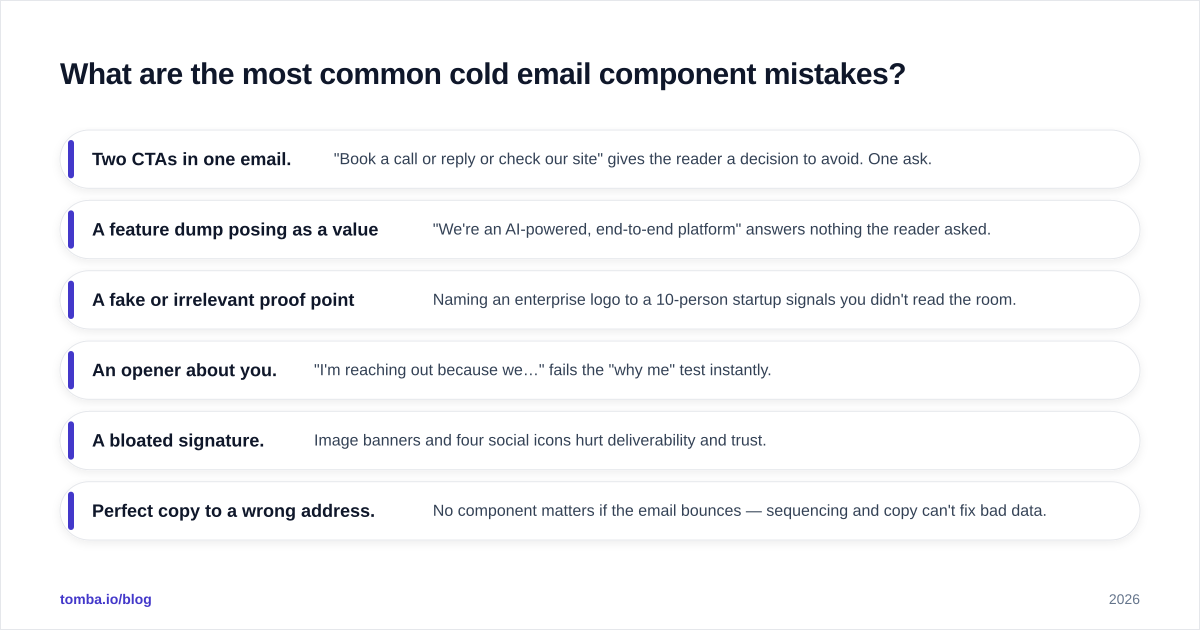
What are the most common cold email component mistakes?#
- Two CTAs in one email. "Book a call or reply or check our site" gives the reader a decision to avoid. One ask.
- A feature dump posing as a value prop. "We're an AI-powered, end-to-end platform" answers nothing the reader asked.
- A fake or irrelevant proof point. Naming an enterprise logo to a 10-person startup signals you didn't read the room.
- An opener about you. "I'm reaching out because we…" fails the "why me" test instantly.
- A bloated signature. Image banners and four social icons hurt deliverability and trust.
- Perfect copy to a wrong address. No component matters if the email bounces — sequencing and copy can't fix bad data.
That last point is the one most teams underestimate. You can A/B test components forever, but if 20% of your list is invalid, your reply-rate math is broken before the first send. Validate addresses with an email verifier and source contacts from a system built for accuracy rather than scraped guesses. G2 reviews of outbound tools consistently rank data quality above feature count for exactly this reason — see the sales intelligence category on G2 for how buyers weigh it.
For the underlying playbook on structure and timing, HubSpot's cold email guide is a solid, vendor-neutral reference to pair with this component model.
Putting it together#
Stop writing cold emails as paragraphs and start assembling them as components. Lock your subject and CTA, vary your opener and proof, and keep the whole thing under 125 words. Diagnose failing campaigns by component — open-rate problems live in the subject, reply-rate problems live in the opener and CTA — and you'll iterate ten times faster than the rep rewriting prose at random.
Then make sure those carefully built emails actually land in a real inbox. Tomba Email Finder finds and verifies professional email addresses by name, company, or domain, so every component you wrote reaches a deliverable, accurate contact instead of a bounce. Start free with 25 searches a month, and when you're ready to scale, Tomba pricing runs from a free tier through Starter at $49/mo — far cheaper than the replies you lose to bad data.
// get started
Find, verify and enrich your first contacts today
Start on the free plan with 25 searches a month, then scale when your team is ready.
Free plan · No credit card required · GDPR & CCPA
// about the author