Cold Email Personalization in 2026: A Practical Playbook
Generic templates are dead. Learn how cold email personalization actually works in 2026 — the tiers, the research signals, and how to scale it without sounding like a robot.
(title rendered separately)
Cold email personalization in 2026 is not "Hi {{first_name}}." That trick stopped working years ago, and prospects now read a merge-tagged greeting as a signal to delete. Real personalization means proving — in the first two lines — that you researched this person at this company for this reason. This guide breaks down how to do that at scale without turning every send into a 20-minute manual project.
TL;DR
- Mail-merge tokens (
{{first_name}},{{company}}) are table stakes, not personalization. Buyers ignore them. - Effective cold email personalization ties a specific, recent observation about the prospect to a relevant outcome you can deliver.
- Use a tiered model: Tier 1 (1:1 hand-written) for whales, Tier 2 (research-snippet) for your ICP core, Tier 3 (segment-level) for volume.
- Accurate contact data is the prerequisite — personalization on a bounced or wrong address is wasted effort. Verify before you write.
- The teams winning in 2026 combine human-quality first lines with automation for the repeatable 80%.
What is cold email personalization, really?#
Cold email personalization is the practice of tailoring an outreach message so the recipient believes it was written for them specifically — because, in the parts that matter, it was.
Think of it like a tailor versus a discount rack. A discount rack sells one jacket in five sizes and hopes one fits. A tailor measures your shoulders. Both sell jackets; only one makes you feel seen. A merge tag is the discount rack with your name stitched on the label — it still doesn't fit.
The mechanics break into three layers:
- Surface tokens — name, company, title. Necessary plumbing, zero persuasive value on their own.
- Observational relevance — a reference to something the prospect did, said, shipped, or is hiring for. This is where replies come from.
- Outcome framing — connecting that observation to a result the prospect cares about. Relevance without a reason to care is just stalking.
Most reps stop at layer one, blame "cold email is dead," and move on. The reps clearing 8–12% reply rates live in layers two and three.
Why do merge tags fail in 2026?#
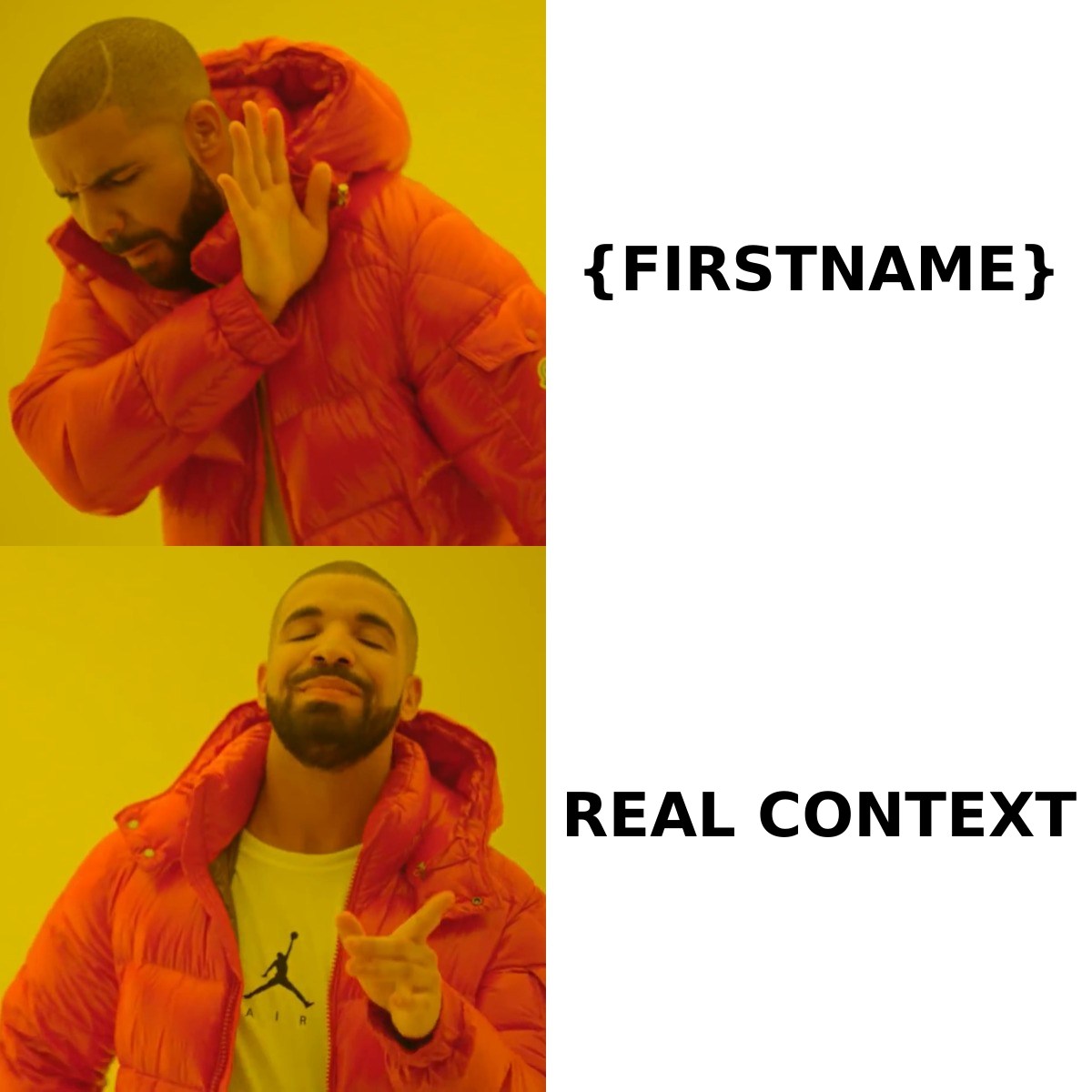
Because everyone has them. When 90% of the cold email a buyer receives opens with Hi {Name}, I saw {Company} is doing great things, the pattern itself becomes the spam signal. The brain filters it out before the conscious read.
There's also a deliverability cost. Identical templated bodies with only token swaps are exactly what spam filters cluster on. Mailbox providers in 2026 score send patterns, not just content — a thousand near-identical messages from a young domain is a textbook burst signature. Genuine variation in the body (which real personalization produces) actually helps you land in the inbox. If you want to go deeper on the infrastructure side, our notes on email deliverability and sender reputation cover the mechanics.
The blunt version: personalization is no longer a conversion tactic only. It's now also a deliverability tactic.
What does good personalization actually reference?#
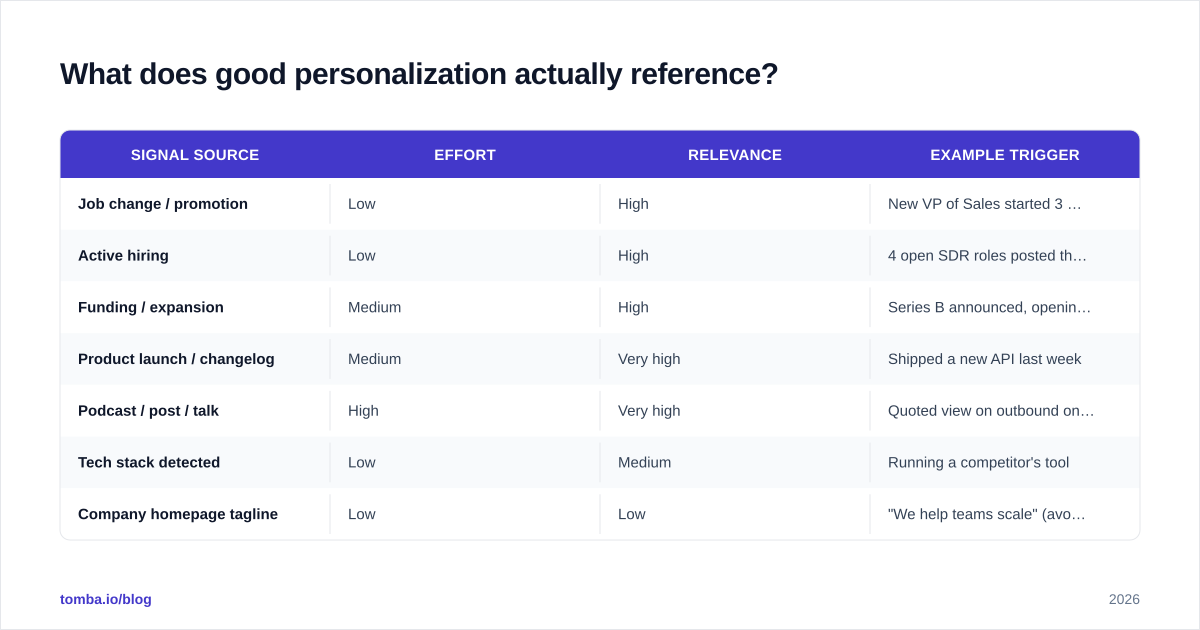
Strong first lines pull from observable, recent, specific signals. Weak ones pull from the company's homepage tagline. Here's the hierarchy of signal quality:
| Signal source | Effort | Relevance | Example trigger |
|---|---|---|---|
| Job change / promotion | Low | High | New VP of Sales started 3 weeks ago |
| Active hiring | Low | High | 4 open SDR roles posted this month |
| Funding / expansion | Medium | High | Series B announced, opening EU office |
| Product launch / changelog | Medium | Very high | Shipped a new API last week |
| Podcast / post / talk | High | Very high | Quoted view on outbound on LinkedIn |
| Tech stack detected | Low | Medium | Running a competitor's tool |
| Company homepage tagline | Low | Low | "We help teams scale" (avoid) |
The rule of thumb: the signal should be something the prospect would be mildly surprised a stranger noticed. "You just hired five SDRs" lands. "You're a leading provider of solutions" does not.
A practical research stack for sourcing these signals:
- LinkedIn for job changes, posts, and hiring (their own hiring data is public on company pages).
- Company changelogs and engineering blogs for product triggers.
- News and funding databases for growth events.
- Your own CRM for warm-ish signals (past demos, churned trials, website visits).
The bottleneck is rarely finding a signal. It's finding the signal and the verified email of the right person before the trigger goes stale. That's where data quality decides whether the personalization ever gets read.
How do you personalize without spending 20 minutes per email?#
You tier your list and match effort to value. Spending 20 minutes hand-writing a note to a $500/year prospect is malpractice; spending 90 seconds on a $200k whale is, too.

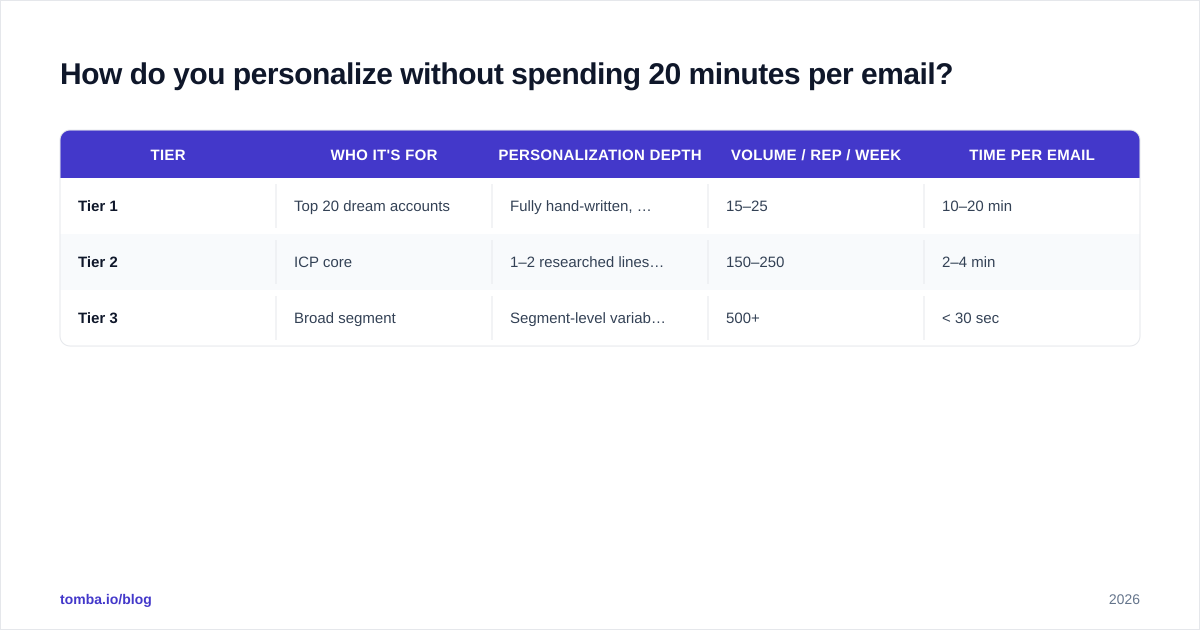
Here's the tiering model that scales:
| Tier | Who it's for | Personalization depth | Volume / rep / week | Time per email |
|---|---|---|---|---|
| Tier 1 | Top 20 dream accounts | Fully hand-written, multi-signal | 15–25 | 10–20 min |
| Tier 2 | ICP core | 1–2 researched lines + templated body | 150–250 | 2–4 min |
| Tier 3 | Broad segment | Segment-level variable (industry/role) | 500+ | < 30 sec |
The trap is treating all 700 prospects as Tier 1 (you burn out by Thursday) or all of them as Tier 3 (your reply rate flatlines). The art is sorting fast.
For Tier 2 — which is where most pipeline actually comes from — the workflow looks like:
- Build the list with a clear ICP filter.
- Enrich and verify every address so you're not personalizing into the void.
- Pull one observable signal per prospect into a spreadsheet column.
- Write a flexible template where the first line is the variable and the value prop is fixed.
- Spot-check 10% of sends manually before they go out.
Tools matter here. You can pull contacts and confirmed emails by company using domain search, enrich missing fields with data enrichment, and run the whole list through an email verifier so your carefully written line doesn't bounce. A great first sentence delivered to info@ that no human checks is still a zero.
What does a personalized cold email look like?#
Concrete beats abstract. Here's a Tier 2 example built on a hiring signal:
Subject: the 4 SDRs you're hiring
Hi Dana — saw the four SDR roles open on the Acme careers page. Usually when a team scales outbound that fast, the new hires spend their first month fighting bad data instead of selling.
We cut list-building time for {similar company} by ~60% by handing reps pre-verified contacts on day one. Worth a 15-minute look before your next cohort starts?
— Sam
Notice the structure:
- Line 1: specific, recent, observable signal (four SDR roles).
- Line 2: a consequence the prospect already feels (ramp pain).
- Line 3: outcome + light proof, framed around their timeline.
- CTA: low-friction, time-boxed, tied to a real event.
No "I hope this email finds you well." No three-paragraph company history. The whole thing is under 70 words because attention is the scarce resource. If you struggle with the opening, our cold email templates and subject line generator give you a starting skeleton to personalize into — not a finished message to blast.
Can AI personalize cold emails for you?#
Partly — and the nuance matters. AI in 2026 is excellent at drafting from a signal you supply and terrible at finding the right signal on its own. Point an LLM at a prospect's homepage and it will confidently write a flattering line about their "innovative solutions," which is exactly the generic mush you're trying to escape.
The reliable pattern is human-in-the-loop:
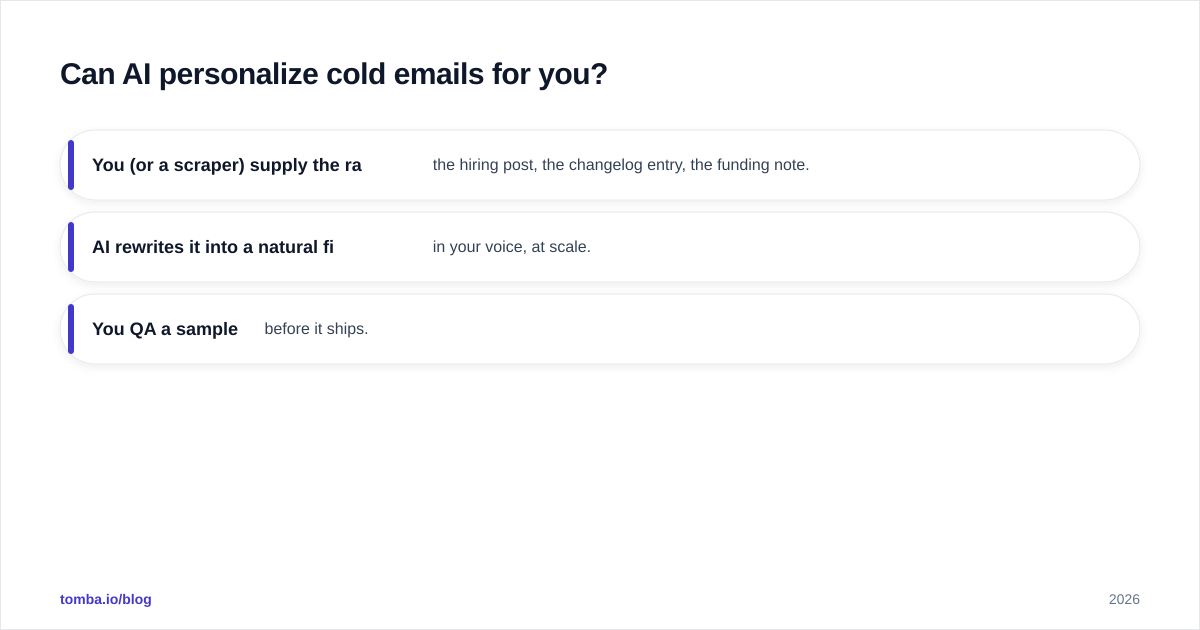
- You (or a scraper) supply the raw signal — the hiring post, the changelog entry, the funding note.
- AI rewrites it into a natural first line in your voice, at scale.
- You QA a sample before it ships.
Used this way, AI compresses Tier 2 from four minutes to ninety seconds per email without flattening quality. Used lazily — "write 500 cold emails about these companies" — it produces 500 deletions. Tools like cold email AI are accelerators for a good input, not substitutes for one.
A word of caution echoed by most deliverability researchers: AI-generated bulk content with no real variation can trip spam heuristics. HubSpot's research on email engagement consistently shows relevance and segmentation outperforming volume, and that holds double when the "personalization" is machine-flattened filler.
How do you measure if personalization is working?#
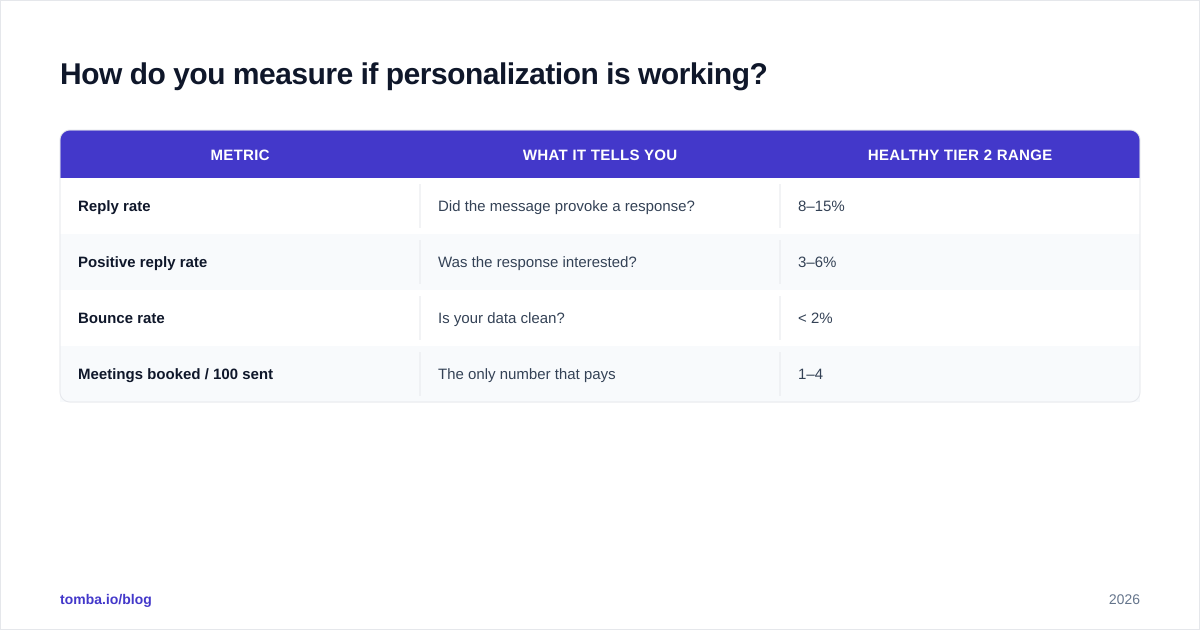
Track reply rate and positive-reply rate, not open rate. Opens became near-meaningless once Apple Mail Privacy Protection inflated them, and they tell you nothing about whether the personalization landed.
| Metric | What it tells you | Healthy Tier 2 range |
|---|---|---|
| Reply rate | Did the message provoke a response? | 8–15% |
| Positive reply rate | Was the response interested? | 3–6% |
| Bounce rate | Is your data clean? | < 2% |
| Meetings booked / 100 sent | The only number that pays | 1–4 |
If bounce rate is above 2–3%, stop optimizing copy — your list is the problem, and no first line survives a hard bounce. Clean the data first, then judge the personalization. This is why verification sits upstream of writing in every serious workflow; you can read more about why in our breakdown of data accuracy and sources.
Run small. Test one personalization angle (hiring signal) against another (product signal) across 100 prospects each, hold everything else constant, and let positive replies decide. Most teams over-test subject lines and under-test the actual first line, which is backwards — the first line carries the personalization weight.
What's the workflow that ties it all together?#
Putting the pieces in order, a repeatable cold email personalization system looks like this:
- Define the ICP tightly enough that a segment-level message is already half-relevant.
- Source contacts by company domain and role.
- Verify and enrich every record before a single word is written.
- Capture one signal per prospect in a structured field.
- Tier the list by account value.
- Write — hand for Tier 1, template-plus-signal for Tier 2, segment variable for Tier 3.
- QA a sample, send, and measure positive replies.
- Feed winners back into your templates and kill the losers.
The compounding advantage isn't any single clever line. It's the system that lets you produce hundreds of relevant messages a week while competitors produce thousands of ignored ones.
Closing: get the data right before you get clever#
Personalization fails most often not because the writing was bad, but because the message reached the wrong address, a stale contact, or an unverified catch-all that swallowed it silently. The cleverest first line in the world earns nothing if it bounces.
Start where the leverage is: build and verify your prospect list with the Tomba Email Finder. Pull the right person at the right company, confirm the address is deliverable, and enrich the fields you'll personalize around — all before you write a word. The free tier gives you 25 searches a month to test the workflow, and paid Tomba pricing starts at $49/mo when you're ready to scale. Get the data right, and your personalization finally has somewhere to land.
// get started
Find, verify and enrich your first contacts today
Start on the free plan with 25 searches a month, then scale when your team is ready.
Free plan · No credit card required · GDPR & CCPA
// about the author