Cold Email Testing and Optimization: The 2026 Playbook
Stop guessing why your cold emails flop. Here's a systematic cold email testing and optimization framework — what to test, how to measure it, and the workflow that compounds reply rates over time.
Most cold email "optimization" is just vibes. Someone changes a subject line on a Tuesday, replies tick up on Thursday, and the whole team declares victory — never mind that nobody controlled the list, the volume, or the day of the week. Real cold email testing is boring on purpose: one variable, a big enough sample, a clear metric, and a decision rule you set before you look at the numbers.
This playbook walks through exactly how to test and optimize cold email in 2026 — what to test first, how big your sample needs to be, how to know a "winner" is real, and how to turn results into a compounding system instead of a pile of one-off experiments.
TL;DR#
- Test one variable at a time, in priority order: list quality → offer → subject line → first line → CTA. Most teams test fonts while their targeting is broken.
- Sample size beats cleverness. A 2% vs 3% reply rate needs roughly 2,000+ sends per variant to be trustworthy. Smaller tests mostly measure noise.
- Pick your metric before you send. Reply rate and positive-reply rate matter; open rate is now a vanity number thanks to Apple Mail Privacy Protection.
- Protect the test from deliverability drift. Verify your list and warm your domain so you're measuring copy, not spam folders.
- Log every test. A simple experiment ledger turns scattered wins into a repeatable optimization engine.
What is cold email testing, really?#
Cold email testing is the practice of changing one element of your outreach, sending two versions to comparable audiences, and measuring which performs better against a metric you chose in advance. It's A/B testing applied to outbound — the same discipline marketers use on landing pages, just with reply rate instead of conversion rate.
Think of it like seasoning a sauce you're cooking for 500 people. You don't dump in salt, garlic, and chili all at once and then guess which one helped. You taste, adjust one thing, taste again. Change three variables in a single send and a lift tells you nothing about why it happened — so you can't repeat it.
The formal version is the same A/B testing framework used across the web: a control (your current best), a variant (one change), random assignment, and a significance threshold. The discipline is what separates optimization from superstition.
Why do most cold email tests fail to teach you anything?#
Three reasons, and you've probably hit all of them:
- The sample is too small. A campaign of 200 emails split into two cells of 100 cannot detect a 1-point difference in reply rate. You're reading tea leaves.
- Too many variables move at once. New subject line and new opener and a different send time means any result is uninterpretable.
- The metric is wrong. Since Apple's Mail Privacy Protection auto-loads images, open rates are inflated and unreliable. Optimizing for opens in 2026 is optimizing for a ghost.
There's also a quieter killer: deliverability drift. If half your variant landed in spam because your list was full of dead addresses, you didn't test copy — you tested your sender reputation. Clean the list with an email verifier and confirm your domain is warmed before you trust a single result.
What should you test first? (The priority order)#
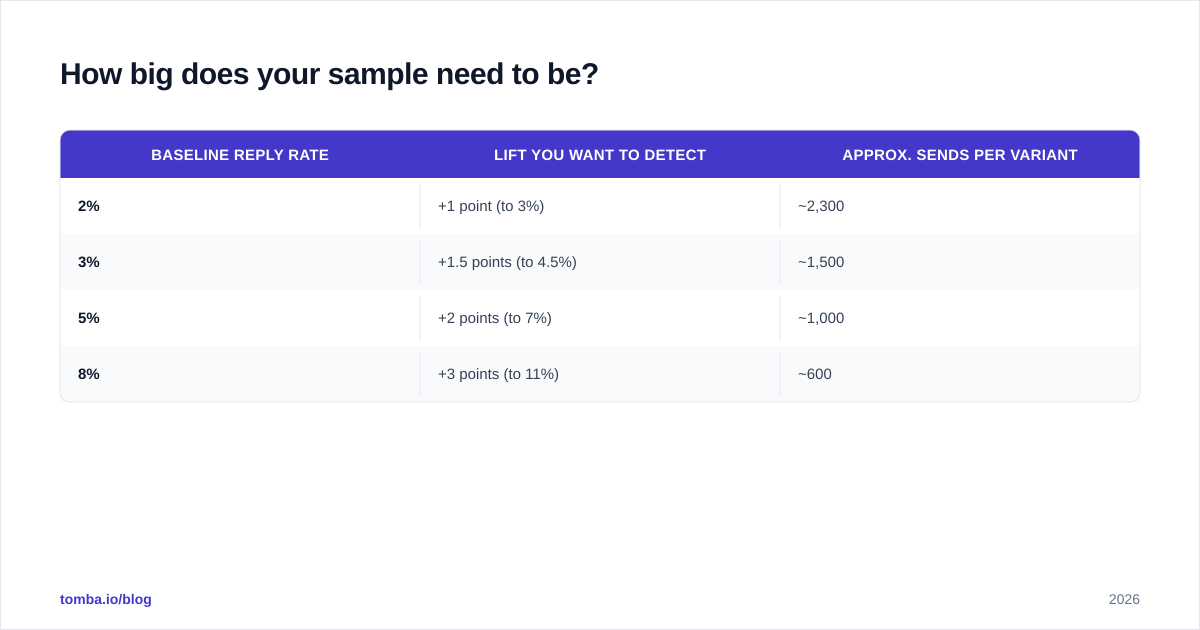
Test in order of leverage. The elements at the top of this list move reply rates by multiples; the ones at the bottom move them by rounding errors. Yet most teams start at the bottom because it's easy.
| Priority | What to test | Typical impact on reply rate | Effort |
|---|---|---|---|
| 1 | List / targeting (who you email) | Very high (2–5x) | High |
| 2 | Offer / angle (why they'd care) | High | Medium |
| 3 | Subject line (whether it's opened) | Medium–High | Low |
| 4 | First line / personalization | Medium | Medium |
| 5 | Call to action (the ask) | Medium | Low |
| 6 | Send time / day | Low | Low |
| 7 | Signature, formatting, length | Low | Low |
The hard truth: a perfectly worded email to the wrong 1,000 people will always lose to a mediocre email to the right 200. Fix targeting first. Everything downstream is multiplied by the quality of your list.
Testing the list itself#
You can A/B test audiences the same way you test copy: same email, two different segments (e.g., VP-level vs. director-level, or industry A vs. industry B). The "winning" segment tells you where to concentrate spend. Building those clean segments starts with accurate contact data — pull verified addresses with an email finder so segment performance reflects fit, not bounce rates.
How big does your sample need to be?#
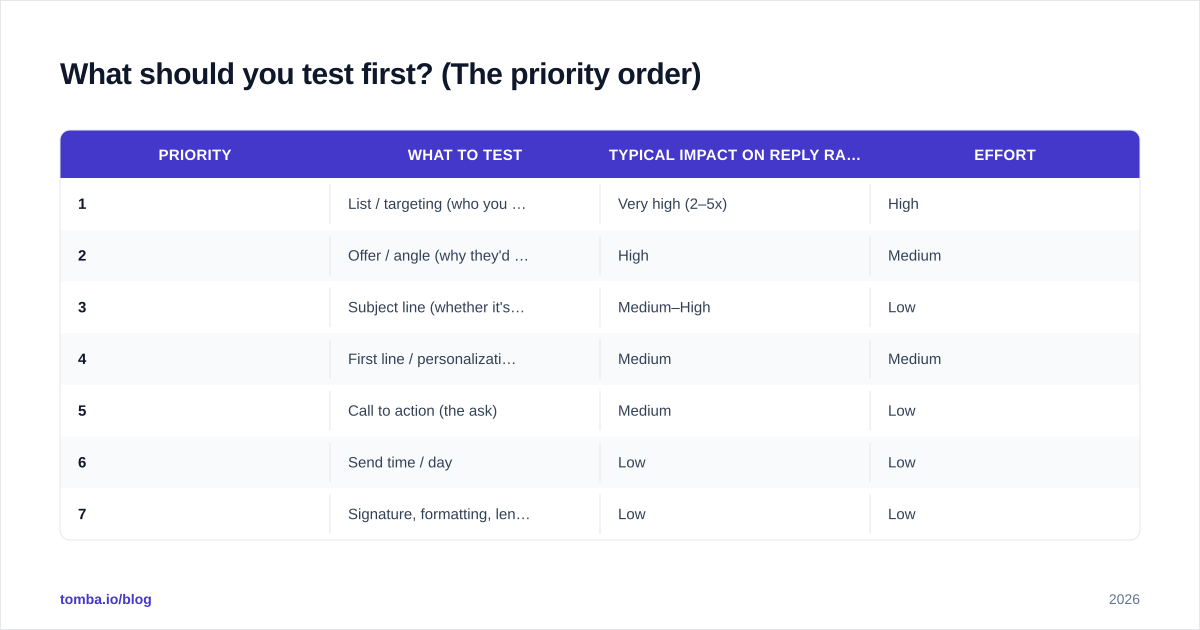
Big enough that the difference you see is unlikely to be luck. Here's a practical reference for cold email, where baseline reply rates are usually low (1–8%).
| Baseline reply rate | Lift you want to detect | Approx. sends per variant |
|---|---|---|
| 2% | +1 point (to 3%) | ~2,300 |
| 3% | +1.5 points (to 4.5%) | ~1,500 |
| 5% | +2 points (to 7%) | ~1,000 |
| 8% | +3 points (to 11%) | ~600 |
These are ballpark figures at roughly 95% confidence and 80% power — use a proper significance calculator for your exact numbers. The pattern is what matters: the smaller your baseline and the smaller the lift, the more volume you need. If you only send 300 emails a week, don't run five tests at once. Run one, accumulate sends across batches, and decide when you cross the threshold.
A useful rule of thumb: if you can't reach ~1,000 sends per variant in a reasonable window, you're better off making bold, obvious changes (a completely different angle) rather than subtle ones (two adjectives swapped). Big changes need smaller samples to register.
Which metric should you optimize for?#
Optimize for the metric closest to revenue that you can measure reliably. In cold email, that hierarchy looks like this:
- Positive reply rate — replies that signal interest ("tell me more," "send a time"). This is the gold standard. It filters out "unsubscribe" and "wrong person."
- Reply rate — all replies. A decent proxy when positive-reply tagging isn't set up.
- Meetings booked — the truest signal, but slow and noisy at low volume.
- Open rate — treat as directional at best. MPP inflation makes it unreliable for decisions. Use it only to sanity-check that a subject line isn't catastrophically broken.
- Bounce rate — not a copy metric, but watch it. A spike means a data or deliverability problem is contaminating your test.
Define the metric in writing before the send. The moment you let yourself pick the metric after seeing results, every test "wins" — you'll always find one number that went up. For a deeper look at benchmarks, see how response rate is defined and what's realistic for outbound.
How do you run a clean cold email A/B test? (Step by step)#
- State a hypothesis. "A question-based subject line will beat our statement subject line on reply rate." Specific and falsifiable.
- Change exactly one variable. Control = current best. Variant = one change. Everything else identical.
- Randomize assignment. Split the list randomly, not by alphabetical order or import date — those correlate with company size and seniority.
- Set the decision rule up front. "I'll call a winner at 95% significance, minimum 1,500 sends per variant, after at least 5 business days."
- Hold deliverability constant. Same sending domains, same warmup state, same time window. Verify both halves of the list so bounce rates match.
- Wait for the full window. Replies trickle in for days. Calling it at hour 6 because the variant is "crushing it" is how you ship noise.
- Decide, document, and roll out. Winner becomes the new control. Log it. Start the next test.
A worked example#
You currently run a 3% reply rate. Hypothesis: a sharper, pain-led first line lifts replies. You send 1,500 to control and 1,500 to variant over seven business days, tagging positive replies. Control returns 45 positive replies (3.0%); variant returns 66 (4.4%). Run it through a significance test — comfortably past 95%. That's a real, ~47% relative lift on your best metric. Variant becomes the new control, and the pain-led opener gets promoted into your default template.
What are the highest-leverage things to test in 2026?#
Beyond the priority table, these specific tests reliably produce signal:
- Offer reframing. Same product, different angle: outcome-led vs. problem-led vs. social-proof-led. This is the single biggest copy lever after targeting.
- First-line personalization depth. A generic opener vs. a one-line observation tied to the prospect's company. Test whether deep personalization actually pays for the time it costs at your volume.
- CTA softness. "Worth a 15-minute call Thursday?" vs. "Open to me sending a 2-minute Loom?" Low-friction asks often win on reply rate even when they lengthen the path to a meeting.
- Subject line style. Question vs. statement vs. two-word lowercase. Use a subject line tester to pre-screen for spam triggers before you commit a variant to a live test.
- Sequence length and cadence. Test 3-step vs. 5-step sequences on meetings booked, not just first-email reply rate. Many wins hide in follow-ups.

What tools do you actually need to test and optimize?#
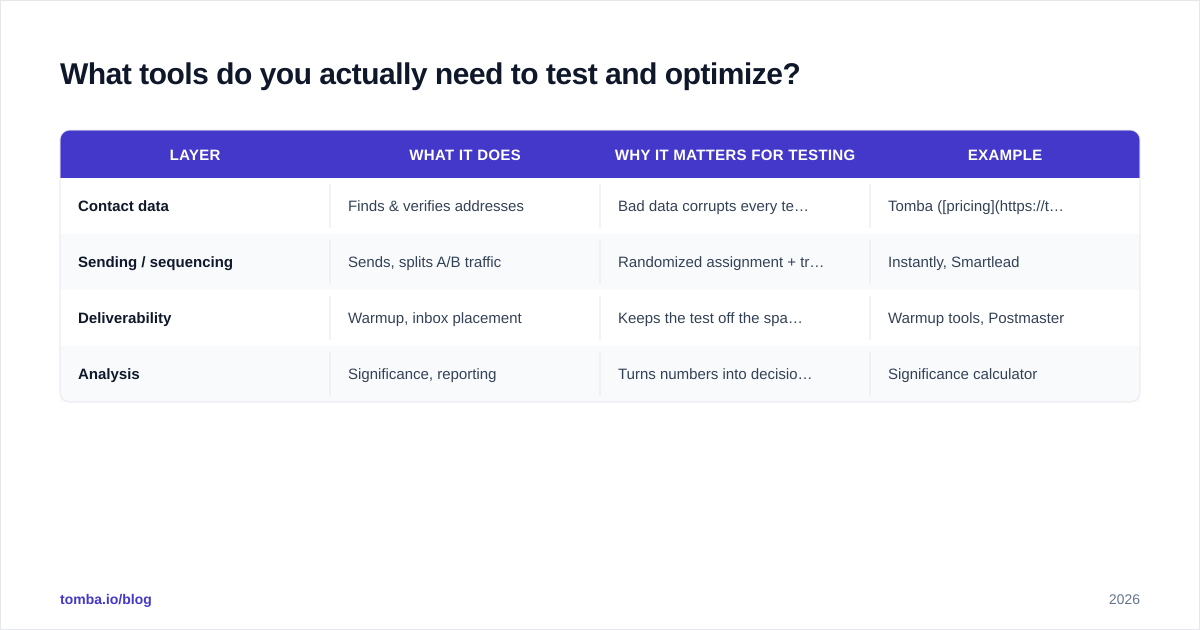
You don't need a 12-tool stack. You need clean data, a sending platform that splits traffic, and a way to read significance. Here's how the core layers compare on what they're for.
| Layer | What it does | Why it matters for testing | Example |
|---|---|---|---|
| Contact data | Finds & verifies addresses | Bad data corrupts every test via bounces | Tomba (pricing) |
| Sending / sequencing | Sends, splits A/B traffic | Randomized assignment + tracking | Instantly, Smartlead |
| Deliverability | Warmup, inbox placement | Keeps the test off the spam variable | Warmup tools, Postmaster |
| Analysis | Significance, reporting | Turns numbers into decisions | Significance calculator |
The non-negotiable foundation is the data layer. Tomba's Tomba pricing starts with a Free tier (25 searches/month) and a Starter plan at $49/mo, scaling to Growth at $99/mo and Pro at $249/mo — enough verified volume to keep your test cells clean without bouncing your way into a spam folder. Compare reply-rate benchmarks across vendors on G2 and you'll see the same pattern: the teams that win on outbound win on data hygiene first.
How do you turn one-off tests into a compounding system?#
Single tests give you single wins. A system gives you a curve that bends up over quarters. The difference is documentation.
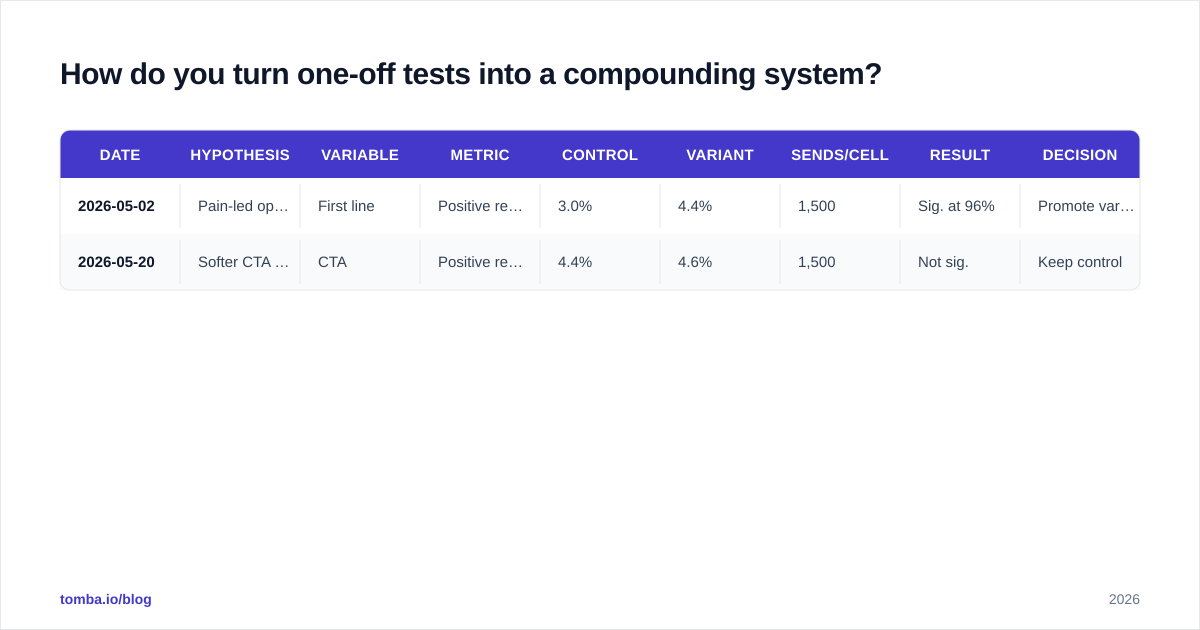
Keep an experiment ledger — a simple sheet with one row per test:
| Date | Hypothesis | Variable | Metric | Control | Variant | Sends/cell | Result | Decision |
|---|---|---|---|---|---|---|---|---|
| 2026-05-02 | Pain-led opener lifts replies | First line | Positive reply % | 3.0% | 4.4% | 1,500 | Sig. at 96% | Promote variant |
| 2026-05-20 | Softer CTA lifts replies | CTA | Positive reply % | 4.4% | 4.6% | 1,500 | Not sig. | Keep control |
Three things this ledger buys you:
- No re-testing what you already know. Six months in, you stop relitigating subject lines you settled in March.
- Pattern recognition. After 15 tests you'll see that for your audience, brevity and soft CTAs consistently win — that's a strategy, not a guess.
- Onboarding. New reps inherit a proven playbook instead of rediscovering it the hard way.
Pair the ledger with a steady cadence: one or two live tests at a time, no more. Outbound research from teams like HubSpot consistently shows that disciplined, iterative testing beats sporadic big swings — compounding small, verified lifts is how a 2% reply rate becomes a 6% one over a year.
Common testing mistakes to avoid#
- Peeking and stopping early. Watching results live and calling a winner the moment significance flickers green inflates false positives. Set the window; honor it.
- Testing during deliverability turbulence. New domain, recent blacklist scare, or a warmup reset? Pause testing. You can't separate copy effects from inbox-placement effects.
- Ignoring segment interactions. A subject line that wins for enterprise may lose for SMB. Segment your readouts when volume allows.
- Optimizing the email, ignoring the list. The most common failure. If bounces are above ~3%, fix data before touching copy.
- No control. "We changed everything and replies went up" is a story, not a result. Always keep a control cell.
Conclusion: test the few things that move the needle#
Cold email testing isn't about running more experiments — it's about running fewer, cleaner ones on the variables that actually matter, with samples big enough to trust and metrics you committed to in advance. Fix targeting, protect deliverability, change one thing at a time, and write down what you learn. Do that for two quarters and your reply rate won't drift up by luck; it'll climb by design.
All of it rests on clean, accurate contact data — because every bounced or wrong address is noise injected straight into your results. Start your testing program on a solid foundation with the Tomba Email Finder: find and verify professional email addresses by name, domain, or company so every A/B test measures your copy, not your data quality. Spin up the Free tier, build a clean test list, and let your optimization curve start bending up.
// get started
Find, verify and enrich your first contacts today
Start on the free plan with 25 searches a month, then scale when your team is ready.
Free plan · No credit card required · GDPR & CCPA
// about the author