Email Outreach Copywriting in 2026: The Complete Playbook
Most cold emails get deleted in two seconds. This is the email outreach copywriting playbook — frameworks, subject lines, and real templates that earn replies in 2026.
Cold email is not dead. Bad cold email is. The gap between a 1% reply rate and a 12% reply rate is almost never the tool you send from — it is the words inside the message. This is the working playbook for email outreach copywriting in 2026: the frameworks, the subject-line patterns, and the exact templates that turn a stranger's inbox into a booked call.
TL;DR#
- Relevance beats volume. A researched, one-to-one email to 50 people will out-perform a generic blast to 5,000 — and protect your domain reputation while doing it.
- The first line is the whole game. Lead with the prospect, not with "I hope this email finds you well." If your opener could be pasted into any inbox, rewrite it.
- Use a repeatable structure (hook → relevance → value → soft CTA). Frameworks like AIDA and PAS exist so you stop improvising every send.
- One clear ask per email. "Worth a 15-minute look?" converts better than "Let me know your thoughts on a partnership, demo, or intro."
- Copy and data are a team. The best line still fails if it lands on a dead address — verified contact data is half the deliverability equation.
What is email outreach copywriting?#
Email outreach copywriting is the craft of writing cold and semi-cold emails that get opened, read, and answered by people who never asked to hear from you. It sits at the intersection of sales, marketing, and direct-response writing.
Think of it like knocking on a stranger's door. You have about four seconds before they decide whether to keep listening or shut it. A door-to-door pro doesn't open with their life story — they open with a reason you should care. Outreach copy works the same way: every word earns the right to the next word.
Technically, strong outreach copy does four jobs in sequence: it earns the open (subject line + preview text), earns the read (first line), earns the trust (relevance + proof), and earns the reply (a low-friction ask). Miss any one and the whole chain breaks.
Why do most cold emails get ignored?#
Because they are written for the sender, not the reader. The classic failure pattern looks like this:
"Hi {{first_name}}, I hope this email finds you well! My name is X and I'm the founder of Y, an all-in-one platform that helps companies like yours leverage synergies across the customer lifecycle..."
Three sentences in and you have learned nothing about why this matters to you. According to Gong's analysis of sales conversations and outreach, messages that lead with the prospect's world consistently outperform messages that lead with the vendor's pitch.
The other silent killer is deliverability. Even perfect copy never gets read if it lands in spam or bounces off a dead address. Sending to unverified lists tanks your sender reputation, and once your domain is flagged, every future email pays the price. That is why serious teams pair their copy with an email verifier before any campaign goes out.
What is the best framework for outreach copy?#
There is no single "best" — there are proven structures, and you pick based on your goal. The point of a framework is to stop you staring at a blank screen and improvising tone every time.
Here are the three workhorses:
- AIDA (Attention, Interest, Desire, Action) — the oldest direct-response model, documented for over a century. Great for warmer audiences who already feel the problem. See the AIDA marketing model overview for its origins.
- PAS (Problem, Agitate, Solution) — best for cold audiences. You name a specific pain, make it vivid, then position your offer as relief.
- BAB (Before, After, Bridge) — paint their current state, paint the better state, position yourself as the bridge. Strong for transformation-led offers.
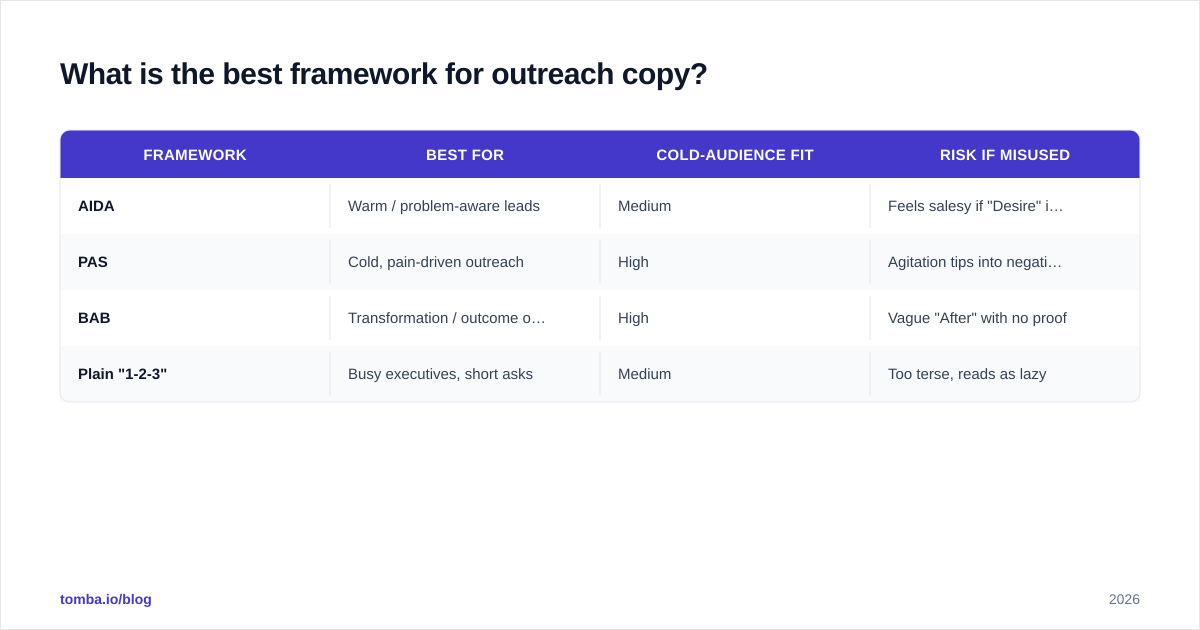
How do these frameworks compare?#
| Framework | Best for | Cold-audience fit | Risk if misused |
|---|---|---|---|
| AIDA | Warm / problem-aware leads | Medium | Feels salesy if "Desire" is overcooked |
| PAS | Cold, pain-driven outreach | High | Agitation tips into negativity |
| BAB | Transformation / outcome offers | High | Vague "After" with no proof |
| Plain "1-2-3" | Busy executives, short asks | Medium | Too terse, reads as lazy |
A practical rule: for genuinely cold sends, start with PAS or BAB. They force you to lead with the prospect's reality instead of your product spec.
How do you write a subject line that gets opened?#
Short, specific, and human. The subject line is a promise the body has to keep. Patterns that hold up in 2026:
- The specific observation: "Your pricing page vs. {{competitor}}'s"
- The honest question: "Worth a look for the Q3 hiring push?"
- The mutual connection: "{{name}} suggested I reach out"
- The pattern interrupt: "bad idea?"
Avoid ALL CAPS, exclamation marks, "FREE," and "act now" — spam filters and humans both punish them. If you want to pressure-test variants at scale, a subject line generator will give you a fast set of options to A/B, and a spam checker flags trigger words before you hit send.
Keep subject lines under ~6 words. Mobile inboxes truncate, and most B2B email is now read on a phone first.
What does a high-reply cold email actually look like?#
Here is a full PAS-structured template you can adapt. Notice how short it is — 90 words, one ask, zero fluff.
Subject: quick question about {{company}}'s onboarding
Hi {{first_name}},
Noticed {{company}} doubled headcount this year — congrats. Usually when sales teams scale that fast, new reps spend their first month hunting for contact data instead of selling.
We helped {{similar_company}} cut that ramp time roughly in half by handing reps verified contacts on day one.
Worth a 15-minute look to see if the same fits {{company}}?
— {{your_name}}
Why it works:
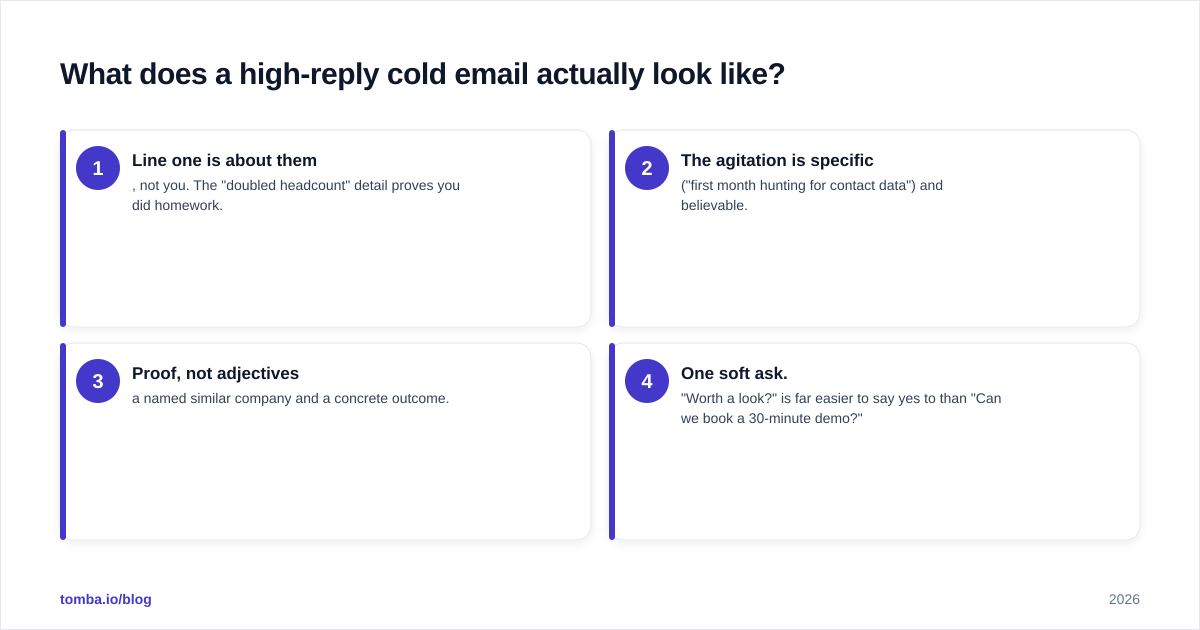
- Line one is about them, not you. The "doubled headcount" detail proves you did homework.
- The agitation is specific ("first month hunting for contact data") and believable.
- Proof, not adjectives — a named similar company and a concrete outcome.
- One soft ask. "Worth a look?" is far easier to say yes to than "Can we book a 30-minute demo?"
For a full library of starting points across use cases, the cold email templates collection saves you reinventing structure each time.
How do you personalize at scale without sounding like a robot?#
Personalization is a spectrum, not a switch. You do not need to hand-write 500 emails — you need one genuinely relevant detail per message. The trick is to systematize where the relevant detail comes from.
Three tiers of personalization, from cheapest to most powerful:
- Tier 1 — Firmographic: industry, headcount, funding, tech stack. Easy to merge-field, low signal on its own.
- Tier 2 — Trigger-based: a recent hire, product launch, funding round, or job posting. This is the sweet spot for cold outreach.
- Tier 3 — Individual: a podcast they were on, a post they wrote, a comment they left. Highest signal, slowest to gather.
The mistake teams make is jumping straight to Tier 3 for everyone — it does not scale. Instead, use Tier 2 triggers as your default and reserve Tier 3 for tier-one accounts.
None of this works on a stale list. Before you personalize, you need accurate, current contact data. That is where an email finder and bulk data enrichment earn their keep — they give you the verified email plus the firmographic and role context that fuels Tier 1 and Tier 2 personalization automatically.
What is the right follow-up cadence?#
Most replies come from follow-ups, not the first email. Yet most reps stop after one send. A balanced sequence respects the inbox while staying persistent.
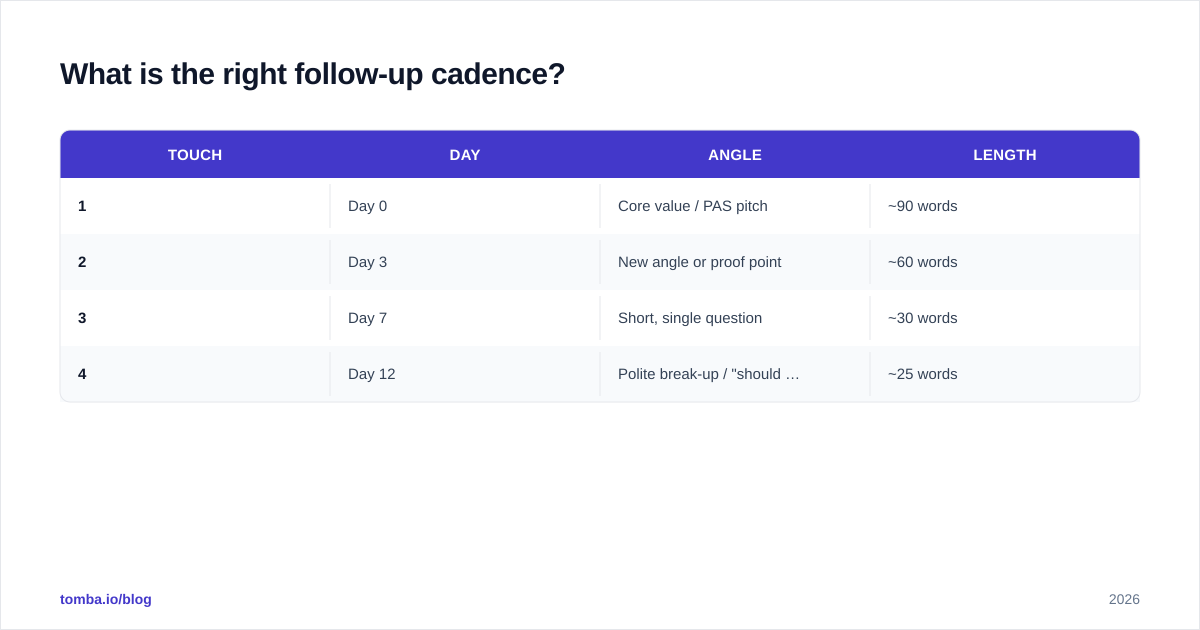
A reliable 4-touch cadence:
| Touch | Day | Angle | Length |
|---|---|---|---|
| 1 | Day 0 | Core value / PAS pitch | ~90 words |
| 2 | Day 3 | New angle or proof point | ~60 words |
| 3 | Day 7 | Short, single question | ~30 words |
| 4 | Day 12 | Polite break-up / "should I close the file?" | ~25 words |
Each follow-up must add something — a new case study, a different pain, a resource. Never just "bumping this to the top of your inbox." That phrase signals you have nothing new to say.
The break-up email is quietly one of the highest-converting touches. Loss aversion is real: "I'll assume the timing's off and close this out" often pulls the reply that three value emails could not. HubSpot's sales blog has documented this pattern across thousands of sequences.
How do you measure whether your copy is working?#
Track the funnel, not just the vanity metric. Opens tell you the subject line worked; they tell you nothing about the body. The metrics that matter, in order:
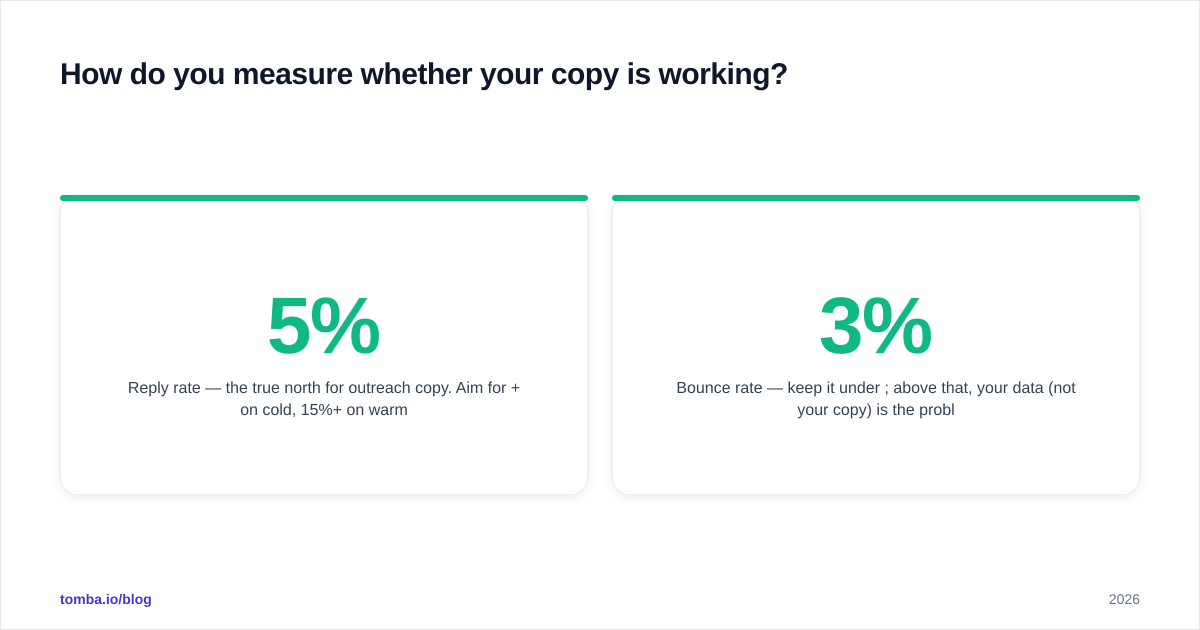
- Reply rate — the true north for outreach copy. Aim for 5%+ on cold, 15%+ on warm.
- Positive reply rate — replies that are interested, not "unsubscribe."
- Meeting-booked rate — the only metric your revenue team cares about.
- Bounce rate — keep it under 3%; above that, your data (not your copy) is the problem.
If your open rate is healthy but replies are flat, the problem is the body. If opens are low, fix the subject line and sender reputation. If bounces are high, stop everything and clean your list — a high bounce rate poisons every future send and is almost always a data problem, not a writing one. You can monitor your domain health with a sender reputation checker and confirm addresses up front with a bulk verify pass.
What separates a good outreach writer from a great one?#
Great writers edit ruthlessly. Their drafts start at 150 words and ship at 80. They read every email out loud — if it sounds like a human talking, it stays; if it sounds like a press release, it dies.
They also kill these habits permanently:
- "I hope this email finds you well." Delete it. It is filler that signals a template.
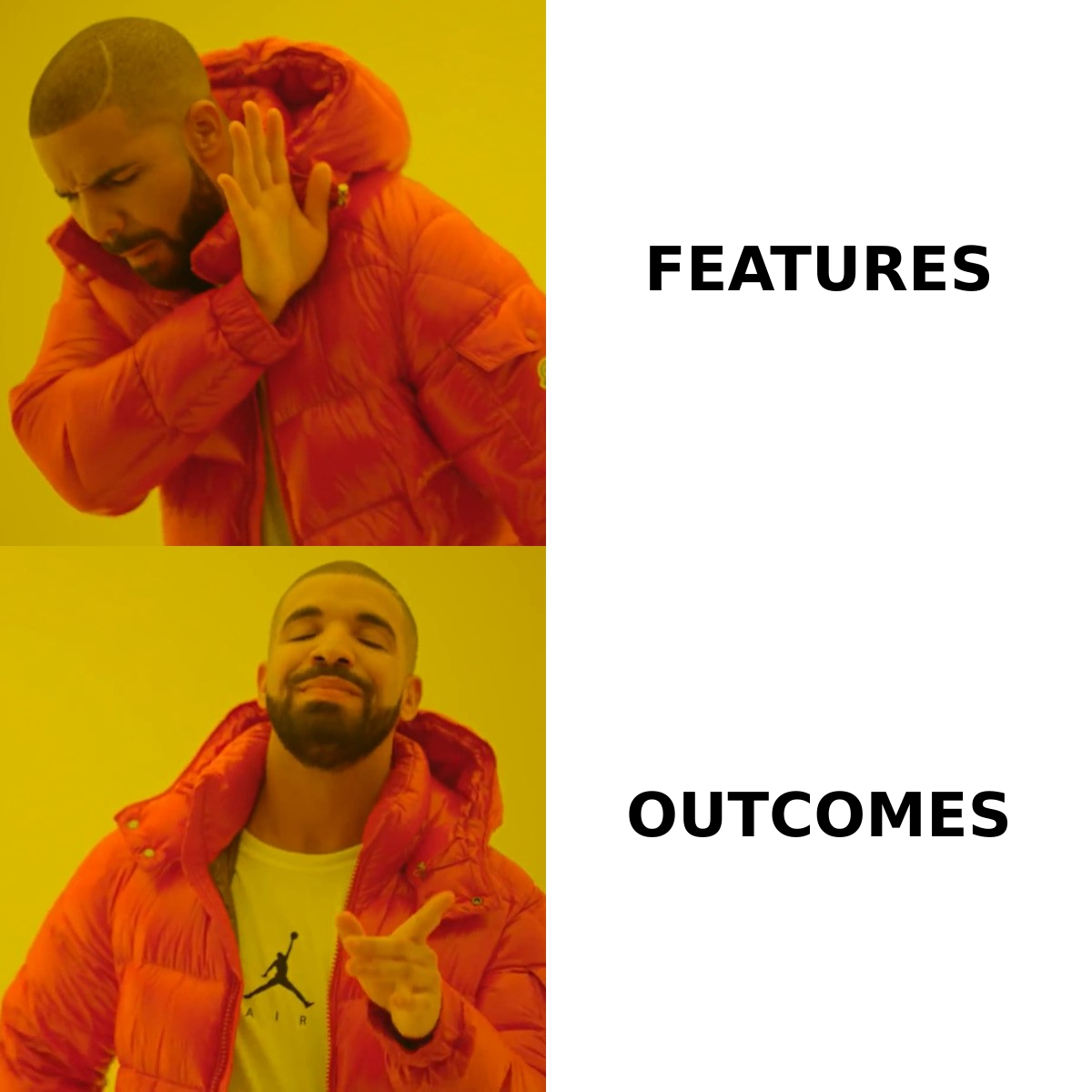
- Feature dumps. Nobody buys features. They buy the outcome the feature produces.
- The double ask. One CTA. Always.
- Fake urgency. "Limited spots" on a cold email destroys trust instantly.
- The wall of text. White space is persuasion. Three short paragraphs beat one dense block.
The honest truth: copy and data are inseparable. The sharpest PAS email in the world still bounces off a wrong address. The cleanest verified list in the world still gets ignored if the writing is lazy. Win on both, and outreach stops being a numbers game and becomes a precision one.
Putting it together#
Strong email outreach copywriting in 2026 is not about clever tricks — it is a system: research a real trigger, pick a framework that fits the audience, lead with the prospect, make one clear ask, and follow up with something new each time. Layer that on top of clean, verified contact data and your reply rates compound instead of decay.
Start your next campaign with contacts you can actually trust. Tomba's Email Finder gives you verified, professional email addresses by name, company, or domain — so every carefully written line lands in a real inbox instead of bouncing into the void. Pair it with the free email templates and subject line generator to ship your first high-reply sequence today, and check the Tomba pricing plans — starting free with 25 searches a month and scaling from $49/mo — when you are ready to run outreach at volume.
// get started
Find, verify and enrich your first contacts today
Start on the free plan with 25 searches a month, then scale when your team is ready.
Free plan · No credit card required · GDPR & CCPA
Get the Tomba newsletter
Product and data updates
// about the author