Contextual Follow-Up Emails: The 2026 Copywriting Playbook
Most follow-ups die because they say "just checking in." Learn how contextual follow-up emails use real triggers and value to lift reply rates in 2026.
TL;DR
- Contextual follow-up emails reference something real. A trigger, a prior reply, or content the prospect engaged with beats nagging with "just circling back."
- "Just checking in" follow-ups convert poorly because they add zero new information. Every send should give the reader a fresh reason to reply.
- Use a 4-touch cadence spaced over 12–18 days. Rotate the angle — value, social proof, new trigger, breakup — rather than repeating the same ask.
- Deliverability still decides whether your clever copy ever lands. Verify addresses and warm the domain before you scale.
- Templates are starting points. The context layer — timing plus trigger plus relevance — is what actually moves reply rates.
What are contextual follow-up emails?#
Contextual follow-up emails earn their place in the inbox. Each one references something specific and true about the recipient — a recent funding round, a job change, a webinar they attended, a reply they sent, or a page they viewed. The opposite is the generic bump: "Just following up on my last email." Those lines add no information, so the reader has no new reason to act.
Think of it like a second date. If your only line is "So… you never texted back," you sound needy. If you open with "You mentioned you were training for a marathon — how did the race go?" you sound like someone who was paying attention. The follow-up that wins proves you were listening.
Context comes from three sources, and the strongest follow-ups stack at least two of them:
- Behavioral signals — opens, clicks, page visits, content downloads, reply fragments.
- Firmographic / trigger events — funding, hiring, leadership changes, product launches, expansion into a new market.
- Conversational memory — what the prospect said in a prior thread, on a call, or on social.
Why do "just checking in" follow-ups fail?#
They fail because they shift work onto the reader. A bump with no new content asks the prospect to re-read your original pitch, re-evaluate it, and reply — all for your benefit, none for theirs. People answer emails that make their life easier or more interesting. They ignore emails that make them feel guilty.
There's also a deliverability cost. Sending three identical "circling back" messages to a cold address trains spam filters to treat your domain as low-value. Engagement is now a core ranking signal across major mailbox providers. Low-reply sequences quietly erode your sender reputation and drag down even your good campaigns. Improving your email response rate isn't just a copywriting goal — it's a deliverability strategy.
Generic follow-ups also waste your best asset: attention. You get only a handful of touches before a prospect files you under "ignore." Spending one of those touches on "just bumping this up" is like using a turn in a negotiation to say "so, anyway." You had the floor and said nothing.
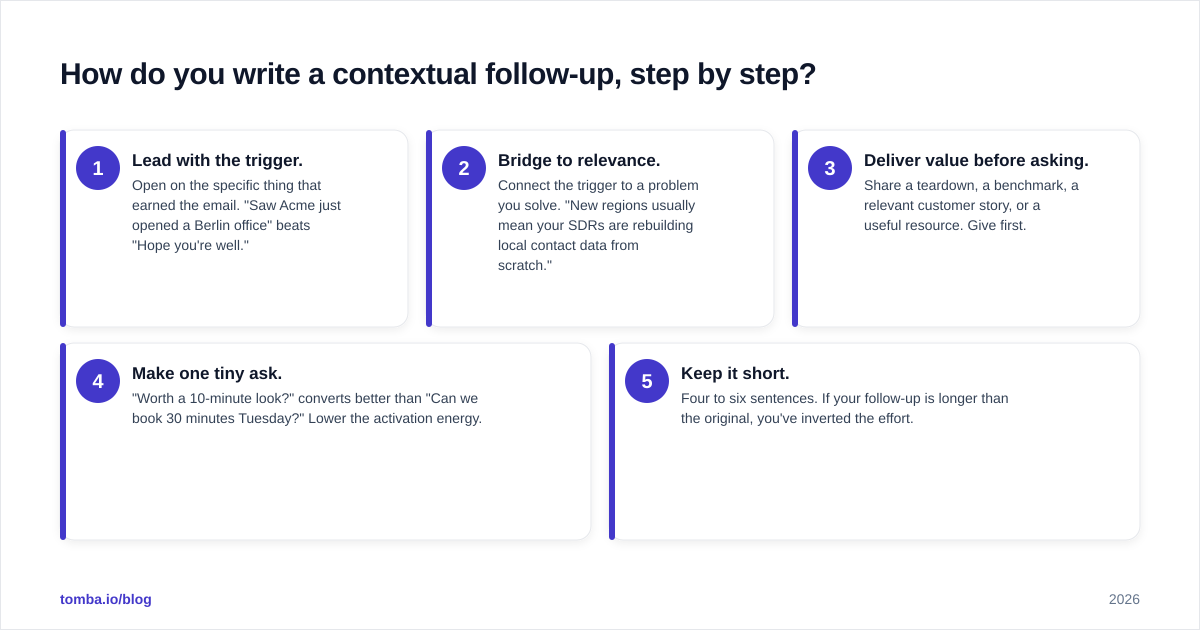
How do you write a contextual follow-up, step by step?#
Work from the outside in. Start with the trigger, then the relevance bridge, then the value, then a single low-friction ask.
- Lead with the trigger. Open on the specific thing that earned the email. "Saw Acme just opened a Berlin office" beats "Hope you're well."
- Bridge to relevance. Connect the trigger to a problem you solve. "New regions usually mean your SDRs are rebuilding local contact data from scratch."
- Deliver value before asking. Share a teardown, a benchmark, a relevant customer story, or a useful resource. Give first.
- Make one tiny ask. "Worth a 10-minute look?" converts better than "Can we book 30 minutes Tuesday?" Lower the activation energy.
- Keep it short. Four to six sentences. If your follow-up is longer than the original, you've inverted the effort.
There's a practical way to scale this without sounding robotic. Build a small library of modular openers tied to trigger types, then assemble per prospect. Pre-written email templates handle the structure, and you swap in the context layer manually. The template is the skeleton; the trigger is the heartbeat.
What does a good follow-up cadence look like?#
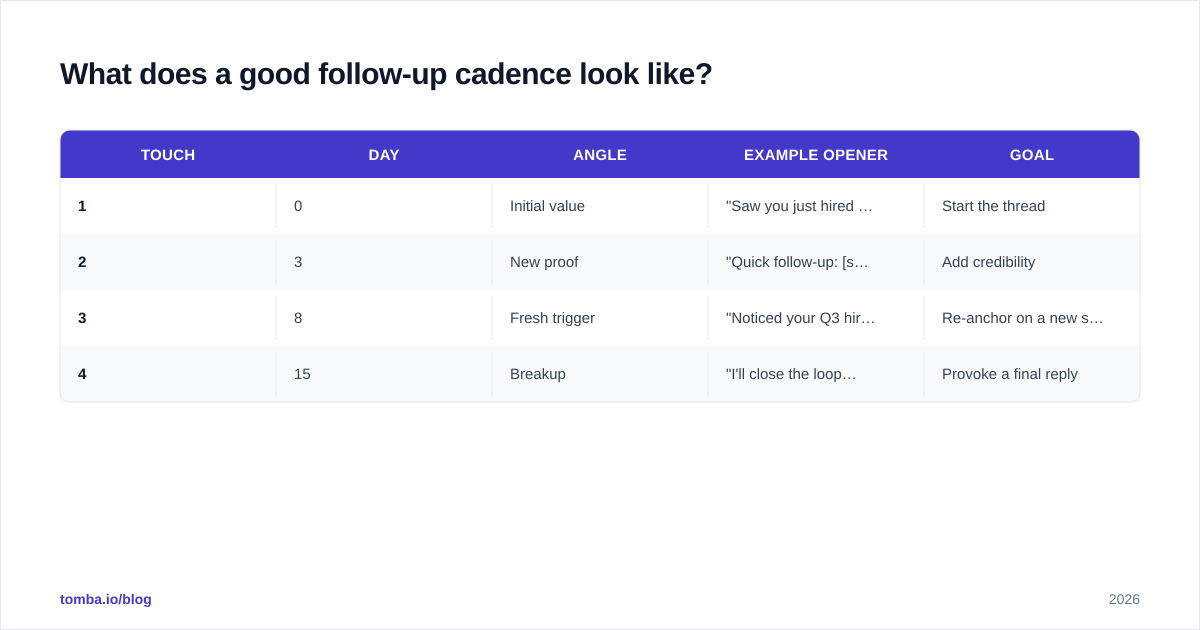
A good cadence rotates angle and spaces sends. You stay persistent without becoming noise. Repeating the same message louder is not persistence — it's pestering. Each touch should change the frame.
Here's a four-touch sequence that keeps every message contextual:
| Touch | Day | Angle | Example opener | Goal |
|---|---|---|---|---|
| 1 | 0 | Initial value | "Saw you just hired 5 AEs — here's how teams ramp them faster" | Start the thread |
| 2 | 3 | New proof | "Quick follow-up: [similar company] cut ramp time 40% doing this" | Add credibility |
| 3 | 8 | Fresh trigger | "Noticed your Q3 hiring page — timing might be right now" | Re-anchor on a new signal |
| 4 | 15 | Breakup | "I'll close the loop here — want me to send the playbook anyway?" | Provoke a final reply |
Notice that no two touches repeat the same sentence. Touch 2 adds social proof, and touch 3 introduces a new trigger. The breakup email reliably pulls a chunk of replies because it removes pressure. The "want me to send it anyway?" framing gives a yes that costs the reader nothing.
Spacing matters as much as content. Same-day or next-day follow-ups read as anxious. Spreading touches across 12–18 business days signals confidence and respects the reader's inbox.
Contextual vs. generic follow-up: which actually converts?#
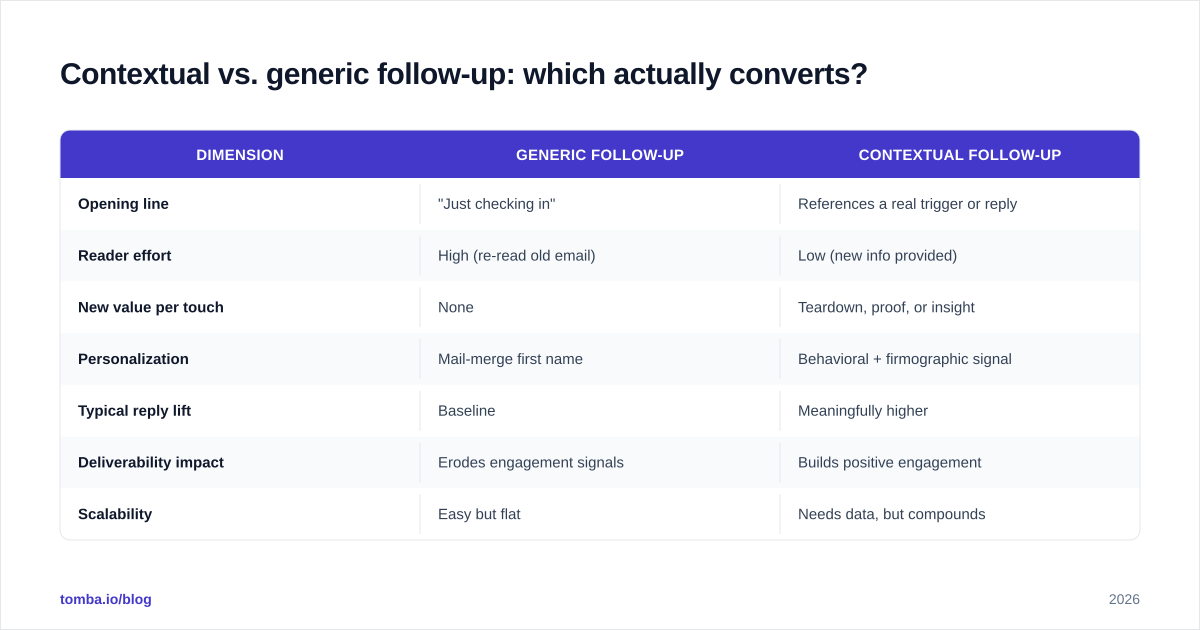
Side by side, the difference is stark. It's not that the contextual version is "cleverer." It does more of the reader's thinking for them.
| Dimension | Generic follow-up | Contextual follow-up |
|---|---|---|
| Opening line | "Just checking in" | References a real trigger or reply |
| Reader effort | High (re-read old email) | Low (new info provided) |
| New value per touch | None | Teardown, proof, or insight |
| Personalization | Mail-merge first name | Behavioral + firmographic signal |
| Typical reply lift | Baseline | Meaningfully higher |
| Deliverability impact | Erodes engagement signals | Builds positive engagement |
| Scalability | Easy but flat | Needs data, but compounds |
The catch is the bottom-right cell. Contextual follow-up emails need data — accurate contact info and reliable trigger signals — to scale. That's the operational cost. Generic blasts are cheap to send and expensive in reputation; contextual sequences are the reverse. Guidance from teams like HubSpot and the sales community on G2 agrees: relevance and timing out-perform volume once you account for deliverability.
How do you scale contextual follow-ups without spamming?#
You scale by industrializing the inputs — clean data and reliable triggers — not the sending. The sending stays disciplined.
Start with clean, verified contacts. A contextual follow-up to a bounced or guessed address is wasted context. Find verified, deliverable addresses with an email finder and confirm them before they enter a sequence. Every bounce you prevent protects the domain reputation that lets your good emails land. Bad data doesn't just cost you a send; it taxes every other email behind it.
Segment by trigger, not by list. Instead of one mega-cadence, run small trigger-based micro-sequences: "raised funding," "new VP of Sales," "expanded to new region." Each segment shares a relevant opener, so the context writes itself.
Pre-build the structure, customize the hook. Use a subject-line workflow such as a subject line generator to test angles, and keep your body templates modular. The human spends 30 seconds adding the one true detail. That's the entire job.
Respect frequency caps. Cap total touches per prospect, suppress anyone who engages negatively, and never let two sequences hit the same person at once. Persistence without context is just spam with a calendar.
Watch the leading indicators. Reply rate and positive-reply rate tell you whether the context is landing. Bounce rate and spam complaints tell you whether your data and frequency are healthy. If replies climb while complaints stay flat, scale up. If complaints rise, tighten targeting before you add volume.
A simple analogy helps. Contextual follow-up at scale is less like a megaphone and more like a good concierge who remembers your name and what you ordered last time. The warmth is templated behind the scenes, but every interaction feels specific.
What tools support a contextual follow-up workflow?#
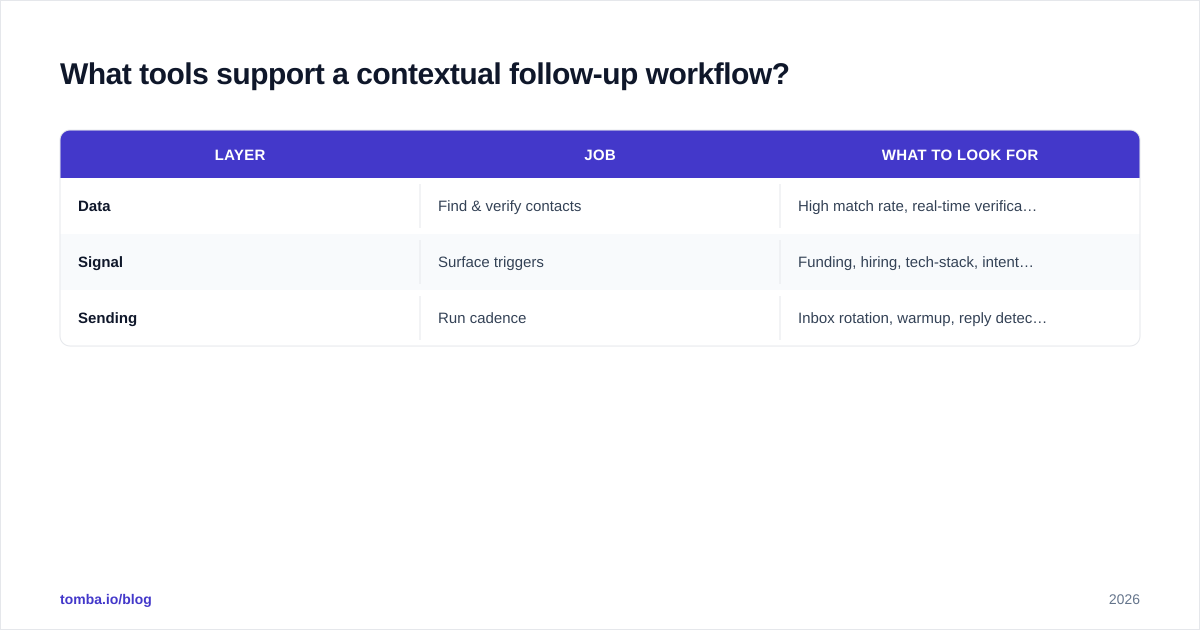
You need three layers: a data layer (who to contact, verified), a signal layer (why now), and a sending layer (cadence + deliverability). Many teams over-invest in the sending layer and starve the data layer. That's backwards, because the sending tool can only mail the addresses you feed it.
| Layer | Job | What to look for |
|---|---|---|
| Data | Find & verify contacts | High match rate, real-time verification, bulk + API |
| Signal | Surface triggers | Funding, hiring, tech-stack, intent feeds |
| Sending | Run cadence | Inbox rotation, warmup, reply detection, suppression |
For the data layer, accuracy is the whole game. A follow-up referencing a real trigger is worthless if it lands at the wrong address. That's where verified discovery tools earn their keep. Tomba sits in this data layer: it finds professional email addresses by name, company, or domain and verifies them before they reach your sequence, so your carefully written context actually arrives. Pricing scales from a free tier (25 searches/month) through Starter at $49/mo and Growth at $99/mo — see full Tomba pricing for the larger tiers.
For broader vendor research and category comparisons, references like Salesforce and independent review sites help you match a sending platform to your team size.
How do you measure if your follow-ups are working?#
Measure replies and positive replies first. Opens are noise in a privacy-protected world, and clicks only matter if your goal is content engagement. The metric that pays your salary is a human writing back.
Track these per sequence and per touch:
- Reply rate by touch — tells you which angle (value, proof, trigger, breakup) does the heavy lifting. Often the breakup email punches above its weight.
- Positive reply rate — strips out "not interested" so you measure real interest, not just any response.
- Bounce rate — should stay under ~2–3%. Higher means your data layer needs work before anything else.
- Spam complaint rate — keep it under ~0.1%. Above that, cut frequency and tighten targeting immediately.
- Meeting / opportunity conversion — the only number leadership truly cares about. Everything upstream is a proxy.
Run one variable at a time. If you change the trigger, the subject line, and the cadence at once, you'll never know which lever moved the result. Treat each sequence like a small experiment with a single hypothesis.
Closing: make every follow-up worth opening#
The fastest way to ruin good copywriting is to send it to the wrong address. Contextual follow-up emails depend on a foundation most teams skip: verified, deliverable contact data and the right trigger at the right moment. Get the context right and a four-touch sequence will out-perform a ten-touch nag every time.
If you want your follow-ups to reach a real person, start at the data layer. Use the Tomba Email Finder to find and verify professional email addresses by name, company, or domain. Then layer your triggers, value, and cadence on top. Clean data in, real replies out. Start free with 25 searches a month and scale your contextual outreach when the replies start rolling in.
// get started
Find, verify and enrich your first contacts today
Start on the free plan with 25 searches a month, then scale when your team is ready.
Free plan · No credit card required · GDPR & CCPA
// about the author