Re-Engagement Email Campaigns: The 2026 Win-Back Playbook
Most of your email list is asleep. Here's how to build re-engagement campaigns that wake dormant leads, win them back, and protect your sender reputation in 2026.
TL;DR
- A re-engagement email campaign is a short, deliberate sequence aimed at contacts who stopped opening, clicking, or replying — its job is to win them back or cleanly remove them.
- Re-engagement protects sender reputation: dead weight on your list drags down deliverability for everyone, including your hottest leads.
- The winning structure is three to four emails over two to three weeks: a pattern interrupt, a value reminder, an incentive, and a permission-based goodbye.
- Subject lines and timing matter more here than anywhere else — you are fighting against a contact who has already learned to ignore you.
- Always verify the list before you send. Re-engaging a list full of dead addresses is the fastest way to land in spam.
What is a re-engagement email campaign?#
A re-engagement email campaign is a targeted sequence sent to subscribers or leads who have gone quiet — no opens, no clicks, no replies for a defined window. Think of it like calling an old friend you have not spoken to in a year: you do not open with a sales pitch, you acknowledge the silence and give them a reason to respond.
The goal is binary. Either you reactivate the contact and pull them back into your funnel, or you confirm they are gone and remove them so they stop hurting your numbers. Both outcomes are wins. The only loss is doing nothing and letting dormant contacts quietly rot your deliverability.
In 2026 this matters more than it did even two years ago. Gmail and Yahoo now enforce stricter sender requirements, and a low engagement rate is one of the strongest negative signals a mailbox provider watches. A bloated list of people who never open you is not a vanity problem — it is a deliverability tax on every campaign you send.
Why do leads go dormant in the first place?#
Before you write a single line, diagnose the silence. Contacts disengage for predictable reasons, and the reason shapes the message.
- Wrong timing. They signed up while researching, then deprioritized the project. The need is dormant, not dead.
- Too much noise. You emailed three times a week and trained them to ignore you.
- Irrelevant content. They wanted pricing benchmarks and got newsletter fluff.
- Role or company change. The person moved jobs and the address still exists but the human is gone.
- They never engaged at all. Some addresses opted in for a lead magnet and never intended a relationship.
The first four are recoverable. The fifth usually is not, and your campaign should be built to surface the difference quickly so you stop spending sends on ghosts.
When should you trigger a re-engagement sequence?#
Timing is the variable most teams get wrong. Trigger too early and you nag active buyers; trigger too late and the contact has forgotten you entirely.
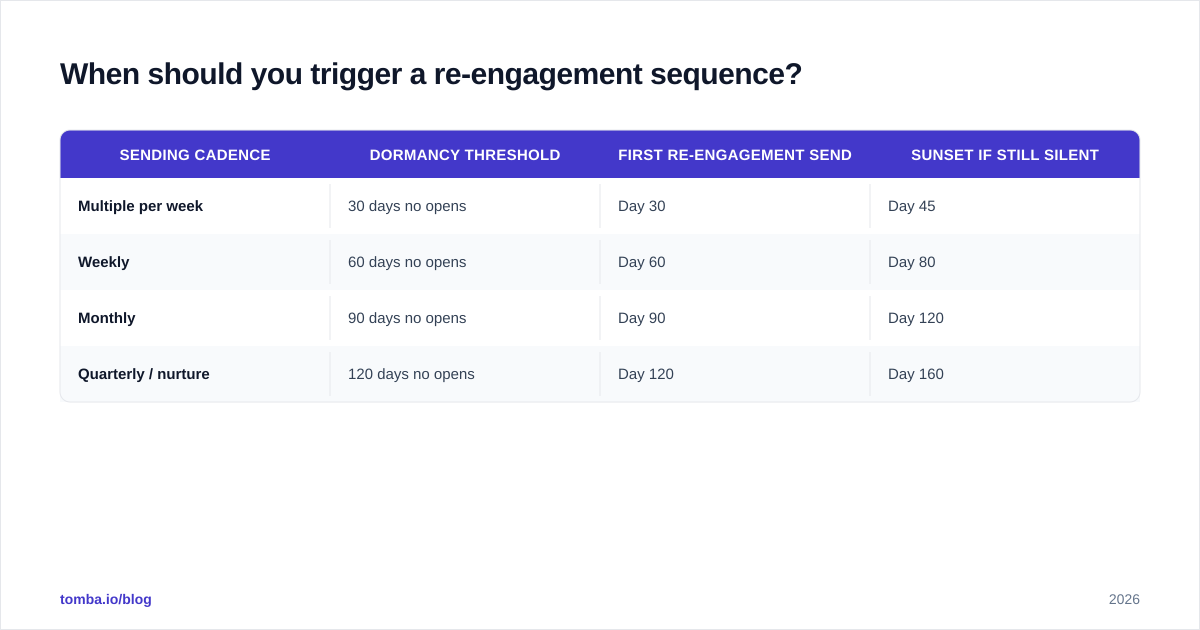
A practical rule: define "dormant" by your own sending cadence, not a fixed calendar. If you email weekly, 60 days of silence is meaningful. If you email monthly, give it 90 to 120 days. Tie the trigger to behavior — no opens and no clicks across a rolling window — rather than a single missed campaign.
| Sending cadence | Dormancy threshold | First re-engagement send | Sunset if still silent |
|---|---|---|---|
| Multiple per week | 30 days no opens | Day 30 | Day 45 |
| Weekly | 60 days no opens | Day 60 | Day 80 |
| Monthly | 90 days no opens | Day 90 | Day 120 |
| Quarterly / nurture | 120 days no opens | Day 120 | Day 160 |
Set the sunset date before you start. The whole point of a win-back is that it ends — either in reactivation or removal. An open-ended "we miss you" loop that runs forever defeats the purpose and keeps damaging your reputation.
What does a high-converting re-engagement sequence look like?#
Four emails, two to three weeks, each with one job. Do not collapse them into one heroic message — the spacing is what gives a busy contact multiple chances to surface.
Email 1 — The pattern interrupt. Acknowledge the silence directly. A subject line like "Should I stop emailing you?" outperforms "We miss you" because it breaks the template the reader expects. Keep the body to three sentences and one question.
Email 2 — The value reminder. Remind them what they are missing with a concrete, recent win — a new feature, a benchmark, a case study. This is where you re-establish relevance, not nostalgia.
Email 3 — The incentive. Offer a reason to act now: a discount, an exclusive resource, early access. Not every list needs this, but for commercial audiences it lifts reactivation meaningfully.
Email 4 — The permission goodbye. Tell them you are about to remove them and give a one-click way to stay. Counterintuitively, the goodbye email often gets the highest reply rate of the sequence — loss aversion is real.
You can A/B test the framing of each step, and a subject line generator is worth using here because the opener is doing 80% of the work. For a deeper read on how to benchmark improvement, track your response rate per email rather than just opens — replies are the signal that survives Apple Mail Privacy Protection inflating your open numbers.
How do you write re-engagement subject lines that get opened?#
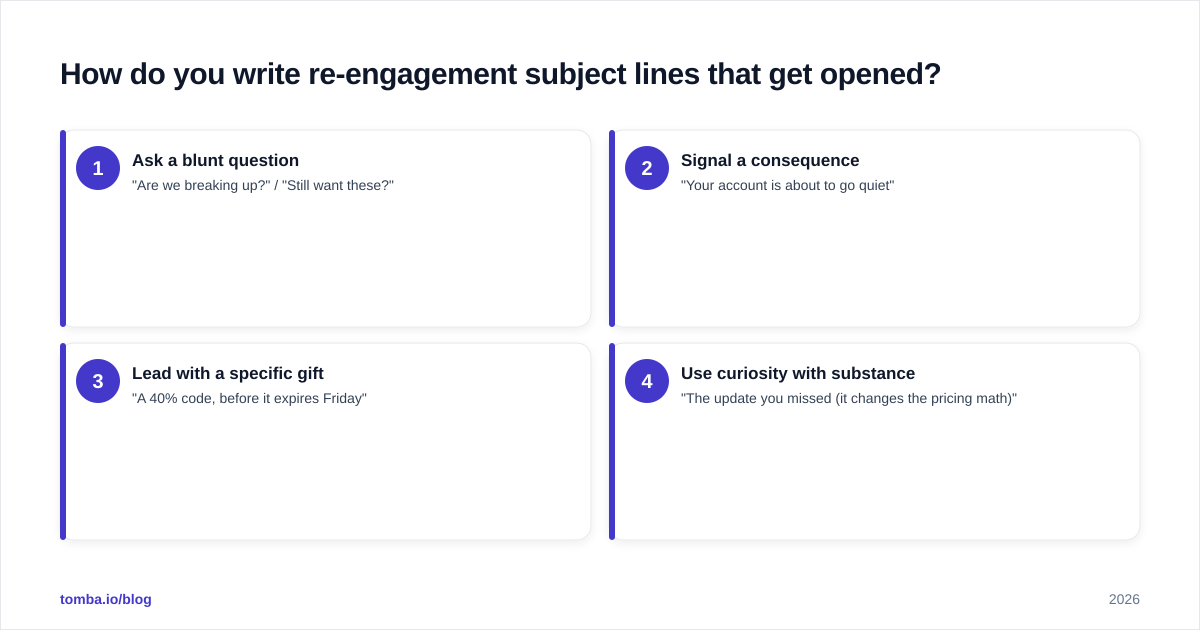
The subject line is the entire battle. Your contact has already decided you are skippable, so a generic line confirms that decision in under a second. Effective re-engagement subject lines do one of four things:
- Ask a blunt question — "Are we breaking up?" / "Still want these?"
- Signal a consequence — "Your account is about to go quiet"
- Lead with a specific gift — "A 40% code, before it expires Friday"
- Use curiosity with substance — "The update you missed (it changes the pricing math)"
Avoid the three worst patterns: "We miss you" (overused to invisibility), all-caps urgency that trips spam filters, and anything that overpromises relative to the body. Mailbox providers increasingly weigh complaint and deletion rates, so a clickbait subject that disappoints earns you a spam flag, not a win.
HubSpot's research on email engagement consistently shows that personalized, question-based subject lines lift open rates over generic broadcast copy — see their email marketing benchmarks for current figures. Test relentlessly; this is the one variable where a 5% lift compounds across the whole sequence.
Should you clean your list before re-engaging — or after?#
Before. Always before. This is the step most teams skip, and it is the one that decides whether the campaign helps or hurts you.
Here is the trap: a dormant list is also where stale, mistyped, and abandoned addresses accumulate. If you blast a win-back sequence at a list that is 20% invalid, you generate a wave of bounces and spam-trap hits at exactly the moment mailbox providers are scrutinizing your engagement. You can do everything else right and still tank your domain.
The correct order:
- Verify every address first. Run the dormant segment through an email verifier and drop hard bounces and known invalids before send. This protects your bounce rate.
- Segment the survivors. Separate "valid but quiet" from "never engaged." They deserve different copy.
- Re-engage the verified, quiet segment with the four-email sequence.
- Sunset the non-responders after the goodbye email — suppress, do not delete, so you keep the audit trail.
For accounts where the right contact has changed roles, re-engagement is not the answer — replacement is. If your champion left, use an email finder to identify their successor and start a fresh, warm intro rather than emailing a ghost. Comparing a verified-first workflow against a spray-and-pray send is night and day.
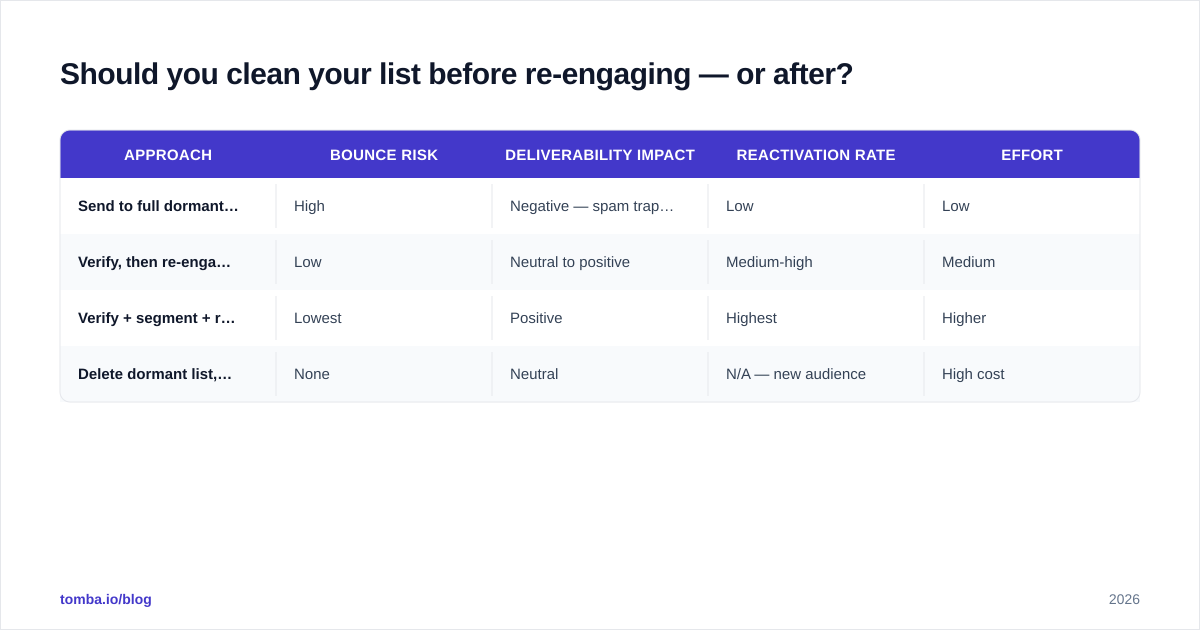
| Approach | Bounce risk | Deliverability impact | Reactivation rate | Effort |
|---|---|---|---|---|
| Send to full dormant list, no cleaning | High | Negative — spam traps, bounces | Low | Low |
| Verify, then re-engage quiet segment | Low | Neutral to positive | Medium-high | Medium |
| Verify + segment + replace lost contacts | Lowest | Positive | Highest | Higher |
| Delete dormant list, buy new leads | None | Neutral | N/A — new audience | High cost |
The bottom row is the expensive cop-out. Replacing your own list with purchased leads costs more and starts every relationship from zero. Winning back a contact who already knew you is cheaper and converts faster — provided the list is clean.
How do you measure whether the campaign worked?#
Set the scoreboard before you send, and do not let inflated open rates fool you. Apple's Mail Privacy Protection pre-loads images, so "opens" are now a soft metric. Anchor on harder signals.
- Reactivation rate — the share of dormant contacts who clicked or replied. This is your headline number.
- Reply rate — especially on the goodbye email; replies are real humans.
- Click-to-list-cleaned ratio — how many you reactivated versus how many you cleanly removed. Both count as success.
- Deliverability delta — compare inbox placement and spam rate before and after the sunset. A healthier list should lift your next broadcast.
- Downstream pipeline — did any reactivated contact convert within 30 to 60 days? That is the only number finance cares about.
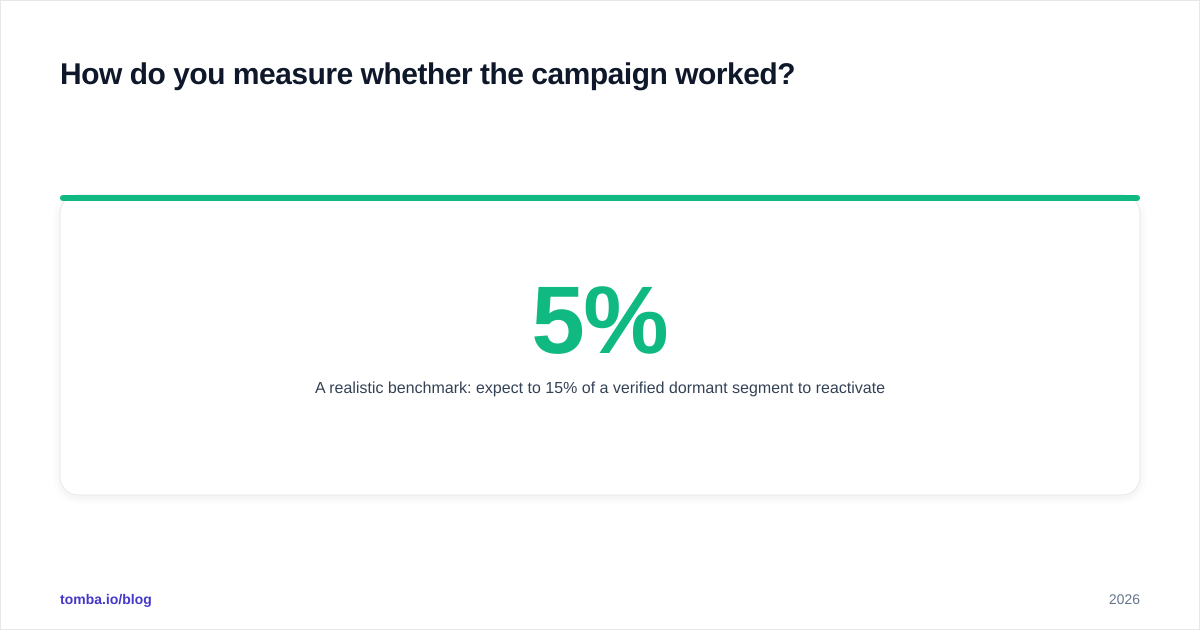
A realistic benchmark: expect 5% to 15% of a verified dormant segment to reactivate, with consumer lists trending higher and cold B2B lists lower. If you are reactivating under 3%, the problem is almost always the list quality or the offer, not the copy. Tools like G2 and platforms such as Mailchimp publish category benchmarks worth comparing against your own.
What are the most common re-engagement mistakes?#
- Sending to an unverified list. Covered above, but it bears repeating because it is the number one cause of failed campaigns.
- One mega-email instead of a sequence. You get one shot at a busy reader; spacing gives you four.
- No sunset. If the campaign never ends, you never clean the list, and you have just built a permanent deliverability liability.
- Generic copy. "We miss you" with a stock photo is indistinguishable from every other dead campaign in the inbox.
- Ignoring the role change. Half your "dormant" B2B contacts may have simply changed jobs. Detecting that and finding the replacement is a different motion than re-engagement.
- Re-adding people who unsubscribed. Never sweep opt-outs back into a win-back. It is a compliance violation and a fast track to blacklisting.
Putting it together: your 2026 win-back checklist#
Run this in order, every quarter:
- Define dormancy by your real cadence, not a guess.
- Pull the dormant segment.
- Verify it and drop invalids before anything else.
- Split "valid but quiet" from "never engaged."
- Send the four-email sequence to the verified quiet segment.
- Replace lost champions with fresh, valid contacts rather than emailing ghosts.
- Sunset non-responders after the goodbye email.
- Measure reactivation, replies, and deliverability lift — not vanity opens.
Done consistently, a re-engagement program does two things at once: it recovers pipeline you already paid to acquire, and it keeps your list lean enough that your active leads actually reach the inbox.
Start with a clean, deliverable list#
Every re-engagement campaign lives or dies on data quality, and that starts before the first email goes out. If your dormant segment is full of dead addresses, role changes, and typos, no subject line will save you. Use Tomba Email Finder to locate the current decision-maker when a contact has moved on, and pair it with verification so every send lands on a real, reachable human. You can start free with 25 searches a month, and scale up on the Starter plan at $49/mo once your win-back program is pulling dormant leads back into pipeline. Clean data first, clever copy second — in that order, re-engagement actually works.
// get started
Find, verify and enrich your first contacts today
Start on the free plan with 25 searches a month, then scale when your team is ready.
Free plan · No credit card required · GDPR & CCPA
Get the Tomba newsletter
Product and data updates
// about the author