Email Outreach Copywriting: The Writing Craft Guide (2026)
Most cold emails fail at the sentence level, not the strategy level. Here's the writing craft behind outreach copy that actually earns replies in 2026.
TL;DR
- Email outreach copywriting is a craft problem before it's a strategy problem — buyers reject your second sentence, not your ICP.
- The four highest-leverage levers are the subject line, the first line, a single clear ask, and a believable reason you're emailing this person.
- Frameworks (PAS, BAB, AIDA, QVC) are scaffolding, not scripts — pick one per email and cut everything that doesn't serve the ask.
- Short wins: target 50–125 words, one CTA, fifth-grade readability, and zero feature dumps.
- Personalization is research, not mail-merge tokens — and it starts with a verified, accurate contact, not a guessed address.
What is email outreach copywriting?#
Email outreach copywriting is the craft of writing cold or semi-cold emails that earn a reply from someone who did not ask to hear from you. That last clause is the whole game. A newsletter subscriber opted in. A cold prospect did not — so every word has to justify the interruption.
Think of it like knocking on a stranger's door. You have about three seconds before they decide whether to keep listening or close it. Your subject line is the knock, your first sentence is your face, and your ask is the reason you're standing there. Get any one of those wrong and the rest never gets read.
Technically, outreach copywriting sits at the intersection of direct-response copy and B2B sales. You borrow persuasion mechanics from advertising (curiosity, specificity, social proof) but operate under constraints advertisers never face: a spam filter, a busy operator, and a reader who can mark you as junk with one tap. Strong copy respects all three.
The mistake most teams make is treating outreach as a volume problem when it's a sentence problem. Sending 5,000 mediocre emails doesn't beat sending 500 sharp ones — it just burns your domain reputation faster. The craft is what compounds.
Why do most cold emails fail at the sentence level?#
Because the reader judges your email in fragments, in order, and bails at the first weak one.
Here's the sequence in a prospect's head: subject line → sender name → first sentence → "is this about me or about them?" → the ask. Most reps obsess over the offer (the last fragment) and neglect everything before it. By the time the reader reaches your beautifully crafted value proposition, they've already left.
Three failure patterns show up again and again:
- The throat-clear. "I hope this email finds you well. My name is X and I work at Y, a leading provider of Z solutions." You've spent your entire attention budget introducing yourself instead of saying something the reader cares about.
- The feature dump. Listing what your product does instead of what changes for the reader. Features are about you; outcomes are about them.
- The vague ask. "Let me know if you'd like to learn more" puts the work on the reader. A good ask is a single, low-friction yes/no question.
The fix is structural. Read your draft and ask, sentence by sentence: would a busy stranger keep reading after this line? If the answer is no, that's where you lose them — and no amount of strategy fixes a sentence-level leak.
Which copywriting framework should you use for cold email?#
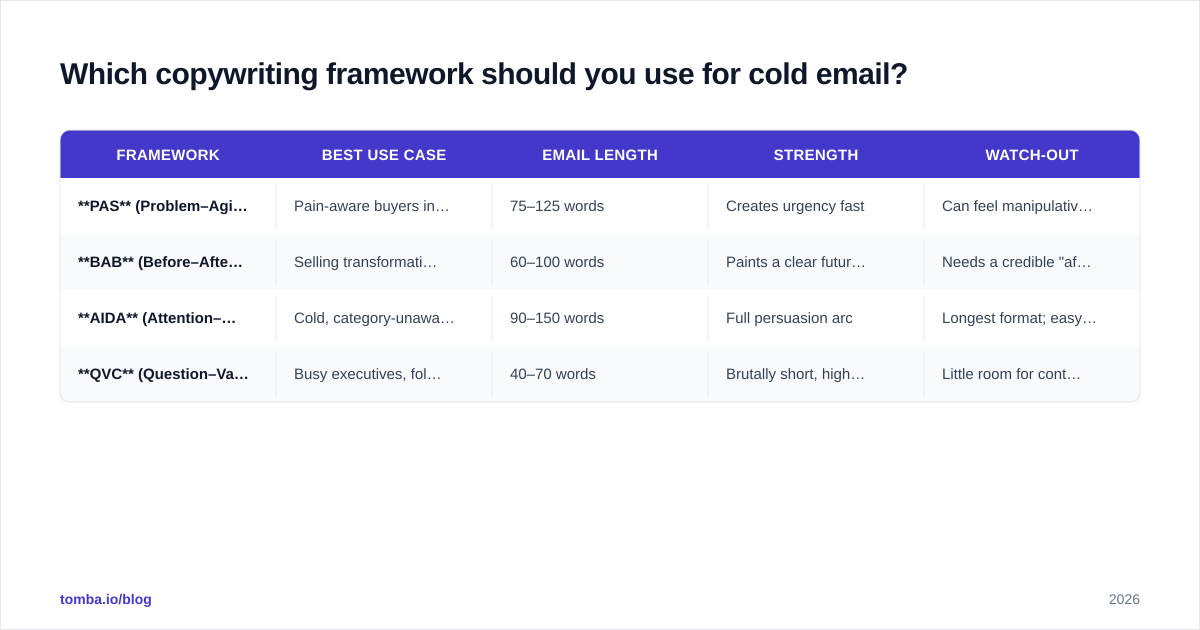
Frameworks are scaffolding that keep your email from collapsing into a feature list. Pick one per email — stacking them creates bloat. Here's how the four most useful frameworks compare for outreach.
| Framework | Best use case | Email length | Strength | Watch-out |
|---|---|---|---|---|
| PAS (Problem–Agitate–Solve) | Pain-aware buyers in a known category | 75–125 words | Creates urgency fast | Can feel manipulative if pain is invented |
| BAB (Before–After–Bridge) | Selling transformation or outcomes | 60–100 words | Paints a clear future state | Needs a credible "after" or it reads as hype |
| AIDA (Attention–Interest–Desire–Action) | Cold, category-unaware prospects | 90–150 words | Full persuasion arc | Longest format; easy to over-write |
| QVC (Question–Value–CTA) | Busy executives, follow-ups | 40–70 words | Brutally short, high reply rate | Little room for context or proof |
A practical rule: if your prospect already knows they have the problem, use PAS or QVC and get to the point. If they don't yet feel the pain, use BAB or AIDA to build it first. When in doubt for a senior buyer, default to QVC — short emails consistently outperform long ones for reply rate, a pattern HubSpot's sales research has documented across millions of sent messages.
Whatever you choose, write the framework as a skeleton, then delete the framework. The reader should never feel the seams.
How do you write each line of an outreach email?#
Break the email into its working parts and craft each on its own terms. Every part has one job.
The subject line: earn the open#
The subject line's only job is to get the email opened — not to summarize, not to sell. The best outreach subject lines are short (2–5 words), specific, and curiosity-driven without being clickbait. "Question about [specific initiative]" beats "Revolutionary AI solution for your sales team." Lowercase, plain-text, and personal tends to outperform polished marketing copy because it reads like a human, not a campaign. If you're stuck, run drafts through a subject line generator to break a blank-page stall, then edit by hand.
The first line: prove it's about them#
Never open with yourself. The first sentence should demonstrate you did 30 seconds of research: a recent hire, a product launch, a podcast quote, a specific page on their site. "Saw you just opened a second warehouse in Austin" earns more attention than any clever hook, because it proves the email isn't a blast. This is where verified contact data matters — personalization built on a wrong name or a guessed address dies on arrival.
The body: one idea, one outcome#
The body delivers a single, relevant outcome and (optionally) one piece of proof. Resist the urge to list three benefits. One sharp, believable claim — ideally with a number — beats a buffet. Keep paragraphs to one or two sentences. White space is a persuasion tool; a wall of text signals "this will take effort to read."
The CTA: make yes the easy answer#
End with one ask that's easy to say yes to. "Worth a 15-minute call next Tuesday?" is concrete. "Are you the right person to talk to about X?" is even lower-friction because it can be answered in two words. Avoid calendar links in a first touch — they ask for commitment before you've earned it. You can borrow proven structures from a library of cold email templates and adapt them to your voice rather than starting cold.
The P.S.: your second subject line#
Many readers skim to the P.S. first. Use it for your strongest social proof or a soft, curiosity-driven line. Don't waste it on "looking forward to hearing from you."
What does a strong outreach email actually look like?#
Here's a 78-word PAS example aimed at a RevOps leader:
Subject: messy lead routing?
Hi Dana — noticed your team grew from 4 to 11 AEs this year. Usually around that size, lead routing rules start breaking and good leads sit unworked for days.
We helped [similar company] cut speed-to-lead from 19 hours to under 30 minutes without ripping out their CRM.
Worth a quick look at how, or is routing already handled on your end?
— Sam
Notice what it does: the first line proves research, the second names a specific, believable pain, the proof is a number, and the CTA gives an easy out ("or is it already handled"). Giving the reader permission to say no, paradoxically, lifts reply rates — it removes the pressure that makes people ignore you.
Now compare it to the version most reps send: "Hi Dana, I hope you're well! My name is Sam from [Company], a leading provider of revenue operations solutions. We offer a comprehensive platform that..." Same product, zero replies. The difference is entirely craft.
How do you personalize at scale without sounding like a robot?#
Personalization is research distilled into one or two lines — not 20 merge tokens. The goal is for the reader to think "this could only have been written to me," and you can hit that with a single well-chosen detail.
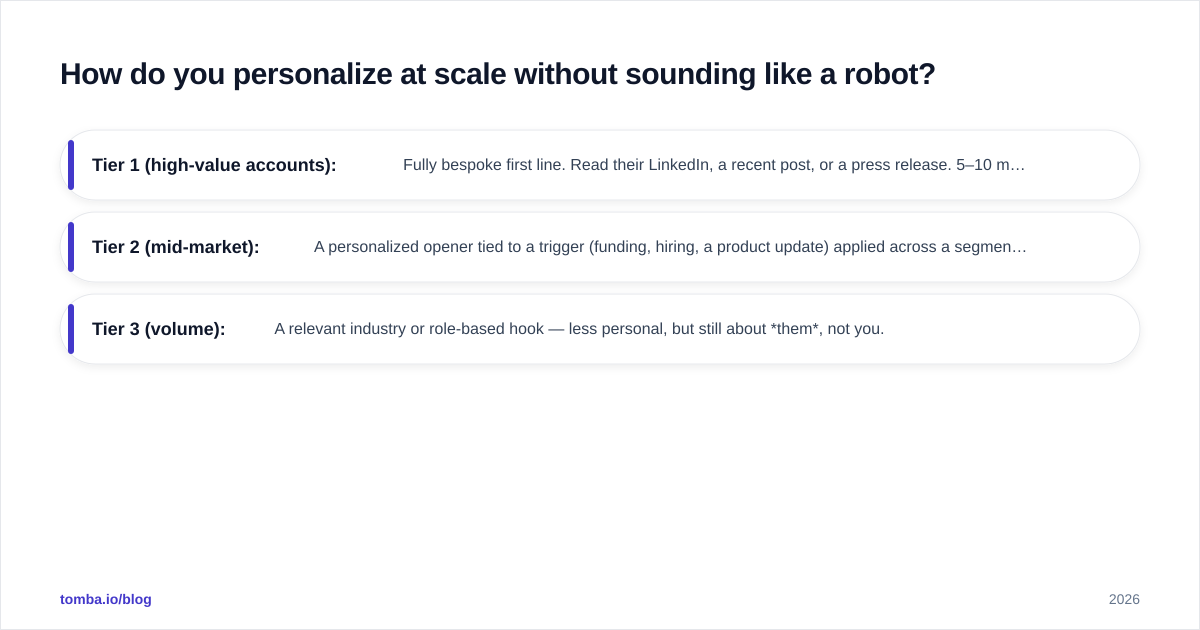
Tier your personalization by deal size:
- Tier 1 (high-value accounts): Fully bespoke first line. Read their LinkedIn, a recent post, or a press release. 5–10 minutes per email.
- Tier 2 (mid-market): A personalized opener tied to a trigger (funding, hiring, a product update) applied across a segment that shares that trigger.
- Tier 3 (volume): A relevant industry or role-based hook — less personal, but still about them, not you.
The unlock for all three tiers is data quality. Personalization mechanics only work if the underlying contact is real: the right person, the right company, a deliverable address. Building outreach on guessed emails wastes your best copy on bounces and tanks your sender reputation. Start by sourcing verified, accurate contacts with a tool like the Tomba Email Finder, then layer your research on top. Good copy on a bad list still fails.
AI can accelerate drafting — a cold email AI writer is genuinely useful for first drafts and variations — but treat its output as clay, not the finished pot. Models default to generic, slightly inflated phrasing ("I'd love to explore synergies"). Your edit is what makes it human. The teams winning in 2026 use AI for speed and humans for the last 20% that earns the reply.
What craft details separate good copy from great copy?#
The fundamentals get you to "doesn't get deleted." These details get you to "replied."
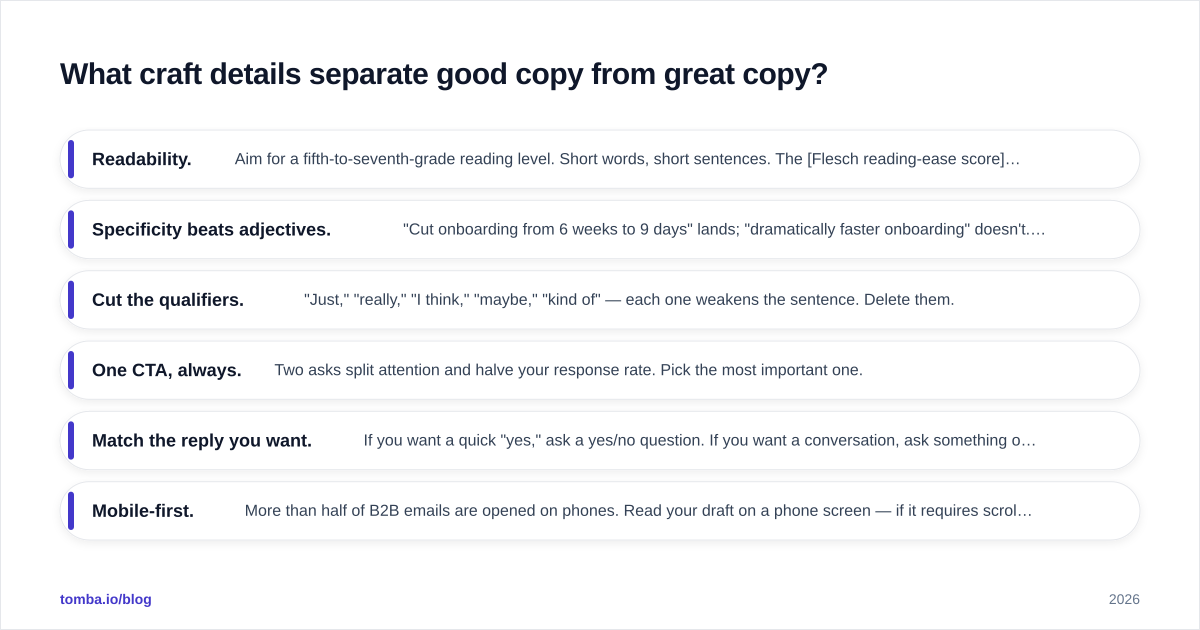
- Readability. Aim for a fifth-to-seventh-grade reading level. Short words, short sentences. The Flesch reading-ease score is a useful proxy — higher is easier, and easier wins in a crowded inbox.
- Specificity beats adjectives. "Cut onboarding from 6 weeks to 9 days" lands; "dramatically faster onboarding" doesn't. Numbers are credibility.
- Cut the qualifiers. "Just," "really," "I think," "maybe," "kind of" — each one weakens the sentence. Delete them.
- One CTA, always. Two asks split attention and halve your response rate. Pick the most important one.
- Match the reply you want. If you want a quick "yes," ask a yes/no question. If you want a conversation, ask something open but easy.
- Mobile-first. More than half of B2B emails are opened on phones. Read your draft on a phone screen — if it requires scrolling, it's too long.
- Read it aloud. If you stumble or run out of breath, so will the reader. The ear catches what the eye skims.
A simple way to pressure-test a draft: cover everything except the first two lines and the CTA. If a stranger could understand the ask from just those, the email works. Everything in the middle is supporting evidence — keep only what a skeptic would need.
How do you measure whether your copy is working?#
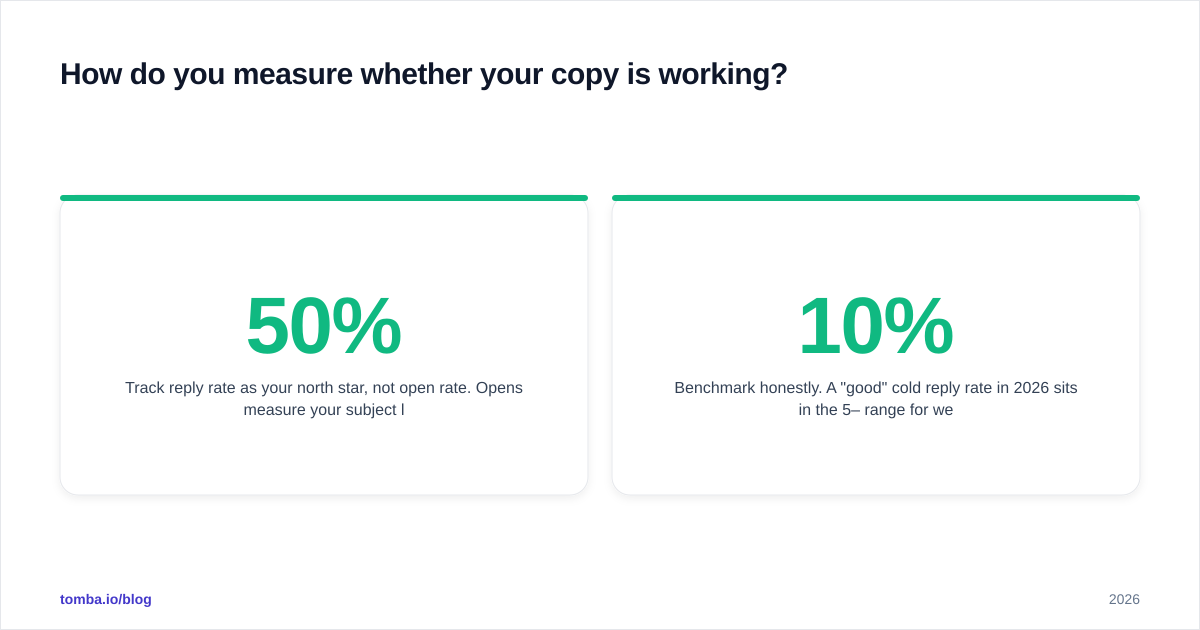
Track reply rate as your north star, not open rate. Opens measure your subject line and sender reputation; replies measure your actual copy and offer. A 30–50% open rate with a 1% reply rate means your subject line works but your body doesn't — a clear, actionable signal about where to edit.
Run A/B tests on one variable at a time: same email, different subject line; or same subject, different CTA. Change two things and you learn nothing. Aim for a meaningful sample (at least a few hundred sends per variant) before you trust the result, and watch email response rate trends over weeks, not single campaigns. Copy improvement is iterative — you're hunting for the 1–2 lines that move the number, then keeping them.
Benchmark honestly. A "good" cold reply rate in 2026 sits in the 5–10% range for well-targeted, well-written outreach; review aggregators like G2 show that tooling helps you scale but doesn't rescue weak copy. The craft is still the variable that moves the needle most.
Putting it together#
Email outreach copywriting rewards the same discipline as any craft: study the structure, practice the fundamentals, then make it look effortless. Pick one framework per email. Earn the open, prove it's about them, make one clear ask, and cut every word that doesn't serve it. Personalize with real research on real contacts. Measure replies, edit, repeat.
The best copy in the world still needs a real person on the other end to read it. Before you write a single line, make sure you're reaching the right inbox: use the Tomba Email Finder to source verified, accurate professional emails by name, company, or domain — so your sharpest outreach lands where it can actually earn a reply. Check current Tomba pricing (a free tier covers 25 searches a month to start), then point your best copy at a list worth writing for.
// get started
Find, verify and enrich your first contacts today
Start on the free plan with 25 searches a month, then scale when your team is ready.
Free plan · No credit card required · GDPR & CCPA
// about the author