Lead Generation Fundamentals: The 2026 Playbook for B2B Teams
Master lead generation fundamentals in 2026: how to define your ICP, pick the right channels, source clean data, and turn raw contacts into a predictable pipeline.
Lead generation is where every B2B revenue engine starts — and where most of them quietly break. You can have the best product and the sharpest reps, but if the top of your funnel is full of bad-fit contacts and unverified emails, nothing downstream works. This guide covers the fundamentals from first principles, so you can build a pipeline that's predictable instead of lucky.
TL;DR#
- Lead generation is the process of attracting and identifying potential buyers, then capturing enough data to start a real conversation.
- It splits into inbound (they find you) and outbound (you find them) — most teams need both, weighted by deal size.
- The fundamentals are always the same: define your ICP, pick channels that match it, source clean contact data, score leads, and measure cost per qualified lead.
- Bad data — not bad messaging — kills most outbound. Verified emails and accurate firmographics are non-negotiable in 2026.
- Tools like an email finder and email verifier turn a list of target companies into reachable, deliverable contacts.
What is lead generation, really?#
Lead generation is the work of turning strangers into known, contactable prospects who match your buyer profile. That's it. Everything else — content, ads, cold email, SDR calls — is just a delivery mechanism for that one outcome.
Think of it like fishing. The fish (buyers) are out there whether you act or not. Lead generation is choosing the right lake (your market), using the right bait (your offer and message), and bringing the right net (your data and tooling). Most teams obsess over the bait and ignore the lake. Pick the wrong lake and the best bait in the world catches nothing.
A "lead" in practical terms is a contact record with at least three things: who they are (name, role), where they work (company, size, industry), and how to reach them (verified email, phone, or a social profile). Without that third piece, you have a name — not a lead.
What are the two types of lead generation?#
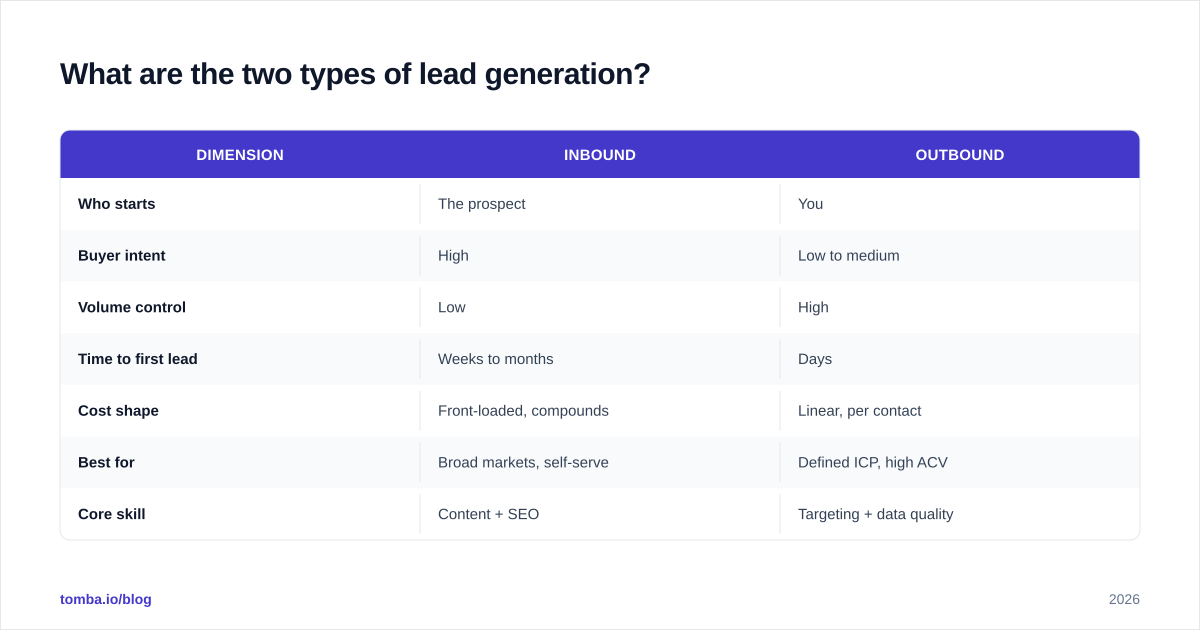
Every tactic rolls up into one of two motions. Knowing which one you're running keeps your metrics honest.
Inbound pulls prospects toward you through content, SEO, webinars, and product-led signups. The lead raises a hand. Intent is high, volume is harder to control, and the cost is front-loaded (you build assets once, they compound for years).
Outbound pushes your message to a defined list — cold email, cold calls, LinkedIn, and paid outreach. You control the volume and the targeting precisely, but you pay per contact in time or money, and you start every conversation from zero intent.
| Dimension | Inbound | Outbound |
|---|---|---|
| Who starts | The prospect | You |
| Buyer intent | High | Low to medium |
| Volume control | Low | High |
| Time to first lead | Weeks to months | Days |
| Cost shape | Front-loaded, compounds | Linear, per contact |
| Best for | Broad markets, self-serve | Defined ICP, high ACV |
| Core skill | Content + SEO | Targeting + data quality |
Most B2B teams under $50M ARR are outbound-led with inbound as a long-term hedge, because outbound produces pipeline on a schedule you control. The higher your average contract value, the more outbound earns its place.
How do you build an Ideal Customer Profile (ICP)?#
Your ICP is the single highest-leverage decision in lead generation. It defines the lake. Get it right and mediocre messaging still converts; get it wrong and nothing saves you.
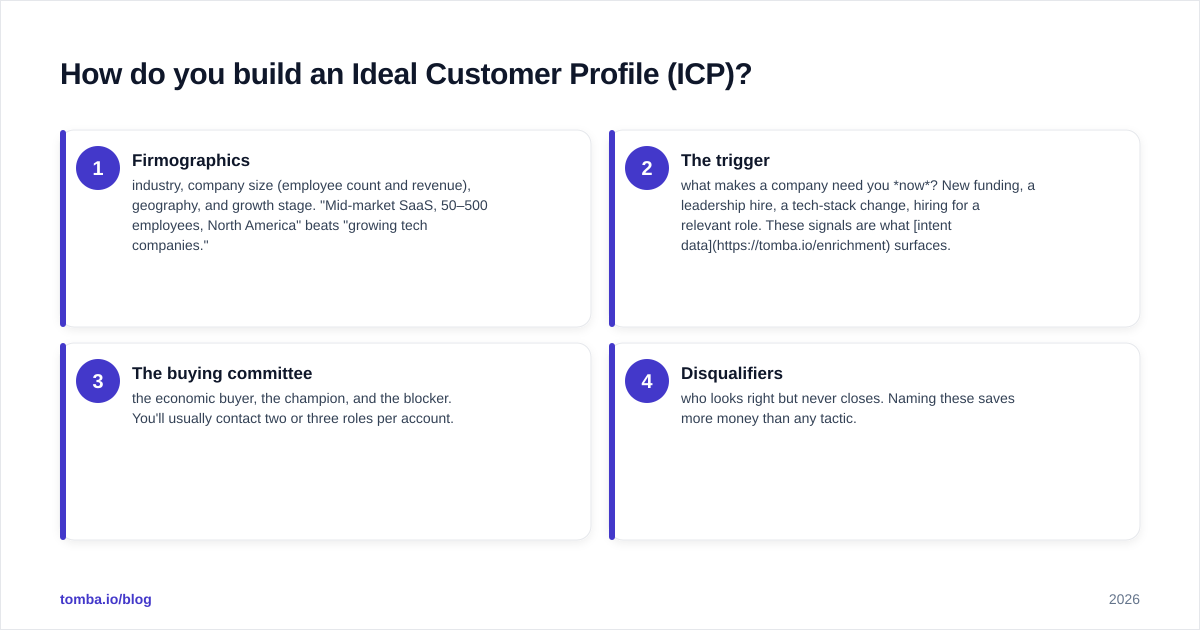
A usable ICP answers four questions with specifics, not adjectives:
- Firmographics — industry, company size (employee count and revenue), geography, and growth stage. "Mid-market SaaS, 50–500 employees, North America" beats "growing tech companies."
- The trigger — what makes a company need you now? New funding, a leadership hire, a tech-stack change, hiring for a relevant role. These signals are what intent data surfaces.
- The buying committee — the economic buyer, the champion, and the blocker. You'll usually contact two or three roles per account.
- Disqualifiers — who looks right but never closes. Naming these saves more money than any tactic.
Write your ICP down and pressure-test it against your last 20 closed-won deals. If your best customers don't match your stated ICP, the document is fiction — fix it before you spend a dollar on outreach. For a deeper primer on qualification stages, the marketing qualified lead definition is a good reference point.
Which lead generation channels should you use?#
Channels are downstream of your ICP, not a menu you pick from by preference. Match the channel to where your buyers actually pay attention.
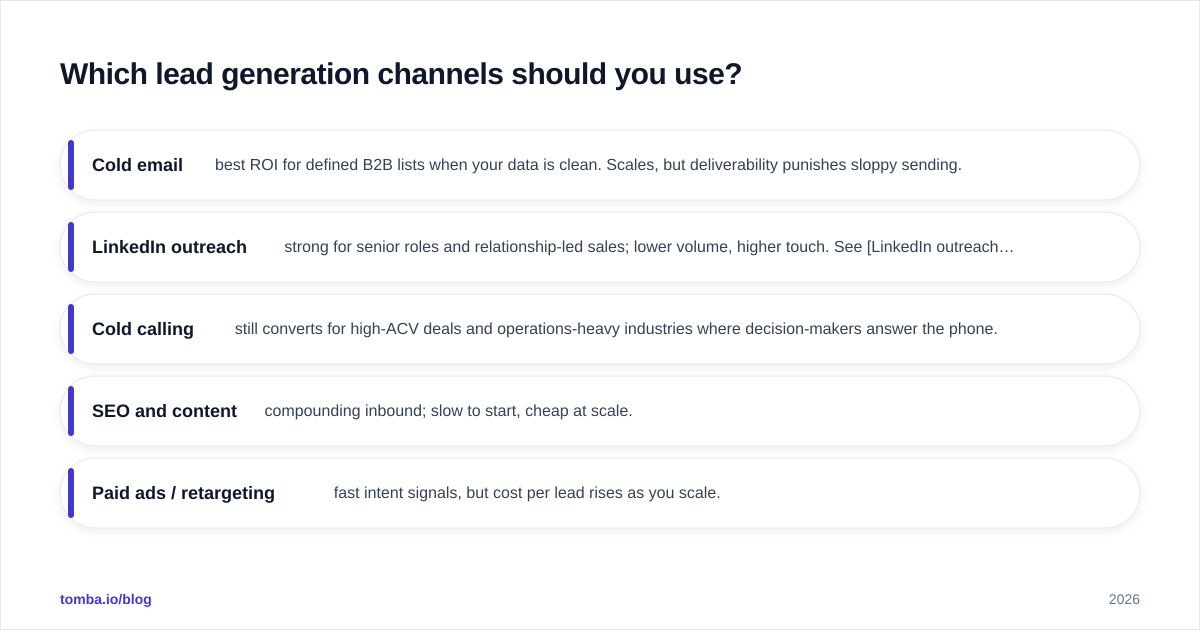
- Cold email — best ROI for defined B2B lists when your data is clean. Scales, but deliverability punishes sloppy sending.
- LinkedIn outreach — strong for senior roles and relationship-led sales; lower volume, higher touch. See LinkedIn outreach tactics.
- Cold calling — still converts for high-ACV deals and operations-heavy industries where decision-makers answer the phone.
- SEO and content — compounding inbound; slow to start, cheap at scale.
- Paid ads / retargeting — fast intent signals, but cost per lead rises as you scale.
The mistake is spreading thin across all five. Pick one primary channel that fits your ICP, get it producing pipeline, then layer a second. Two channels run well beat five run badly.
Why does data quality decide everything?#
Here's the fundamental most teams learn the expensive way: your outreach is only as good as the data underneath it. A perfect email to a wrong or dead address is worse than nothing — it burns sender reputation and skews every metric you track.
Bad data costs you three ways:
- Bounces wreck email deliverability. A bounce rate above 3–5% signals mailbox providers to throttle or spam-folder you, dragging down the leads you did reach correctly.
- Wrong-fit contacts waste rep time. Every hour spent emailing a 10-person company you can't serve is an hour stolen from real pipeline.
- Stale firmographics misroute messaging. People change jobs constantly; a title from 18 months ago means your "VP of Sales" pitch lands on someone who left.
The fix is a sourcing-and-verification workflow, not a one-time list purchase. You find candidate contacts, verify each email is deliverable, enrich with current firmographics, and refresh on a cadence. Tools like Tomba's domain search pull every email pattern for a target company, while a catch-all verifier handles the domains that accept everything and reveal nothing. According to HubSpot's research on data decay, B2B contact data degrades by roughly 22–30% per year — which is why "verify, don't trust" is a fundamental, not a nice-to-have.
How do you score and qualify leads?#
Not every captured contact deserves the same effort. Lead scoring is how you spend your best reps' time on the contacts most likely to close.
Keep it simple at first — a two-axis model beats a 40-variable spreadsheet nobody updates:
- Fit — how closely the contact matches your ICP (firmographics, role, company size). This you control with good data.
- Intent — observable buying signals: site visits, content downloads, funding events, hiring activity, tech changes.
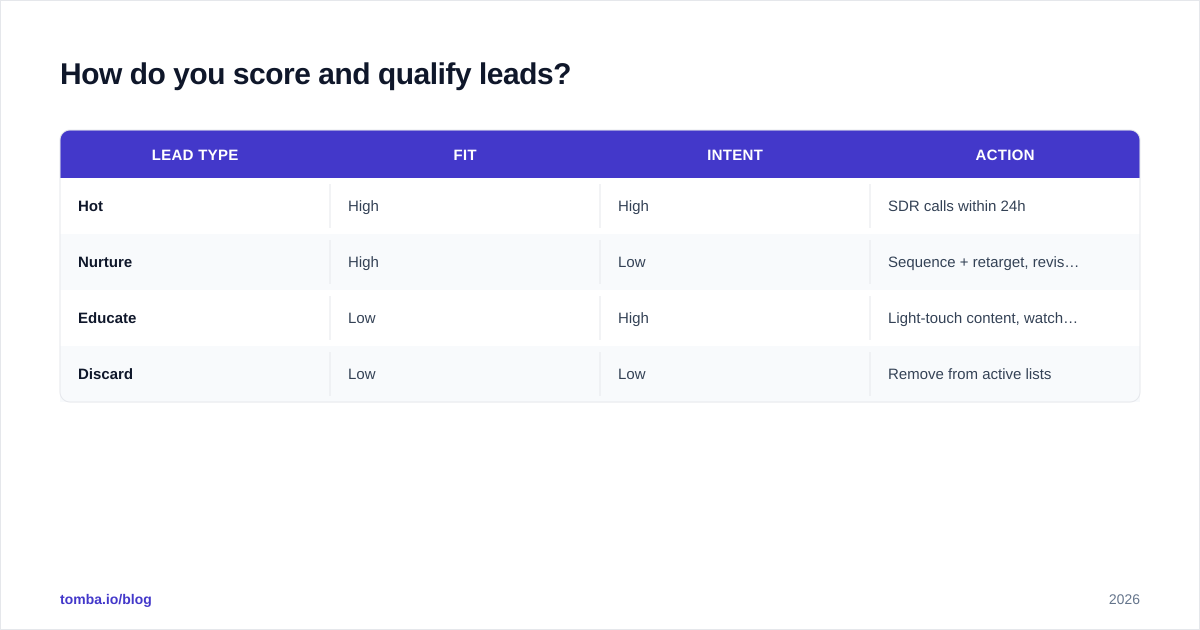
| Lead type | Fit | Intent | Action |
|---|---|---|---|
| Hot | High | High | SDR calls within 24h |
| Nurture | High | Low | Sequence + retarget, revisit on trigger |
| Educate | Low | High | Light-touch content, watch for fit change |
| Discard | Low | Low | Remove from active lists |
The discipline is acting on the matrix. A high-fit, high-intent lead getting the same generic sequence as a cold name is wasted advantage. Route hot leads to humans fast — speed-to-lead is one of the few metrics with a proven, direct line to win rate. For the broader picture, see how response rate ties back to targeting quality.
What metrics actually matter?#
Vanity metrics — "leads generated," raw open rates — feel good and decide nothing. Track the numbers that connect spend to revenue.
- Cost per qualified lead (CPQL) — total channel cost divided by leads that pass your fit-and-intent bar. The honest top-of-funnel number.
- Lead-to-opportunity rate — what share of qualified leads become real sales conversations. Low here means your qualification or targeting is off.
- Reply and positive-reply rate — for outbound, positive replies matter far more than opens, which are increasingly unreliable to measure.
- Pipeline contribution — dollar value of opportunities sourced, by channel. This is what your CFO cares about.
- Speed-to-lead — median time from capture to first human contact.
Review these weekly per channel. A channel with a low CPQL but terrible lead-to-opportunity rate isn't cheap — it's expensive in disguise, just deferred.
What's the simplest workflow to start tomorrow?#
You don't need a 12-tool stack to run effective lead generation. Here's the minimum viable loop:
- Define ICP — one page, four questions answered with specifics. Validate against closed-won deals.
- Build a target list — 100–200 accounts that match. Use domain search to pull contacts and email patterns per company.
- Verify everything — run every address through an email verifier before it touches your sender. Aim for under 3% bounce.
- Enrich — add current title, company size, and any trigger signal so messaging is relevant.
- Run one channel — pick cold email or LinkedIn, write three message variants, send in small batches, measure positive replies.
- Score and route — apply the fit/intent matrix; hand hot leads to a human within a day.
- Refresh monthly — re-verify and re-enrich; data decays whether you watch it or not.
Run that loop for 60 days before adding complexity. Most teams who "can't make outbound work" skipped steps 1 and 3 — the unglamorous fundamentals — and tried to brute-force volume instead. For more on tooling trade-offs, compare options on the Tomba pricing page against whatever you run today, and review independent ratings on G2 before committing to a stack.
Common lead generation mistakes to avoid#
- Buying static lists and treating them as truth. They're a starting point to verify, never a finished asset.
- Skipping verification to "save time." You'll lose far more time and reputation to bounces.
- Targeting too broadly. A tight ICP with 200 perfect accounts outperforms 5,000 maybes.
- Optimizing opens over replies. Apple Mail Privacy Protection and similar features make open rates noisy; positive replies are the signal.
- Treating lead gen as a campaign, not a system. Pipeline is a flywheel — it needs continuous data hygiene, not quarterly bursts.
Start with clean, reachable contacts#
Lead generation fundamentals come down to one chain: right accounts → right people → reachable, verified contacts → relevant message → fast follow-up. Break any link and the whole thing leaks. The link teams most often skip is the data — and it's the cheapest one to fix.
If you're ready to turn a target list into deliverable contacts, start with the Tomba Email Finder. Feed it a name and domain (or a whole company) and get verified, professional email addresses your reps can actually reach — so your first conversation isn't with a bounce notification. Pair it with the built-in email verifier, and you've covered the two fundamentals that decide whether everything downstream works. Try it on the free tier (25 searches a month) before you scale.
// get started
Find, verify and enrich your first contacts today
Start on the free plan with 25 searches a month, then scale when your team is ready.
Free plan · No credit card required · GDPR & CCPA
// about the author