B2B List Building and Lead Capture: The 2026 Playbook
Buying a 50,000-row list feels productive and tanks your pipeline. Here's how to build and capture a targeted B2B list in 2026 that actually converts.
TL;DR
- List building is the engineering side of lead generation: defining an ICP, sourcing matching accounts and contacts, then capturing verified contact data you can actually reach.
- Buying a giant pre-made list is the fastest way to wreck sender reputation. A smaller, self-built, verified list beats a 50k purchased dump on every metric that matters.
- A repeatable workflow has four stages: Define → Source → Capture → Verify. Skip verification and 20–30% of your sends bounce.
- Inbound capture (forms, lead magnets, website reveal) and outbound sourcing (domain search, enrichment) feed the same database — treat them as one system.
- Tools matter less than process, but the right finder-plus-verifier stack cuts list-building time by an order of magnitude.
What is B2B list building (and how is it different from buying a list)?#
B2B list building is the process of assembling a targeted set of companies and decision-makers — with verified contact details — that match a defined ideal customer profile (ICP). The key word is targeted. A list is not a goal in itself; it's the raw material your outbound and nurture programs run on.
Buying a list, by contrast, means paying a broker for a static spreadsheet of contacts you had no hand in selecting. It feels efficient. It almost never is. Purchased lists are typically stale, scraped without consent, shared across hundreds of other buyers, and riddled with spam traps. Send to one and you can torch your sender reputation in a single campaign.
The distinction matters because the two approaches produce opposite outcomes. Self-built lists are smaller but convert; bought lists are huge but poison your domain.
Think of it like cooking. Buying a list is ordering a mystery bulk-food crate off the internet — cheap per pound, but you don't know what's in it or whether it's safe. Building a list is shopping for the specific ingredients a recipe needs. Slower, but the meal is edible.
Why does buying a 50,000-contact list backfire?#
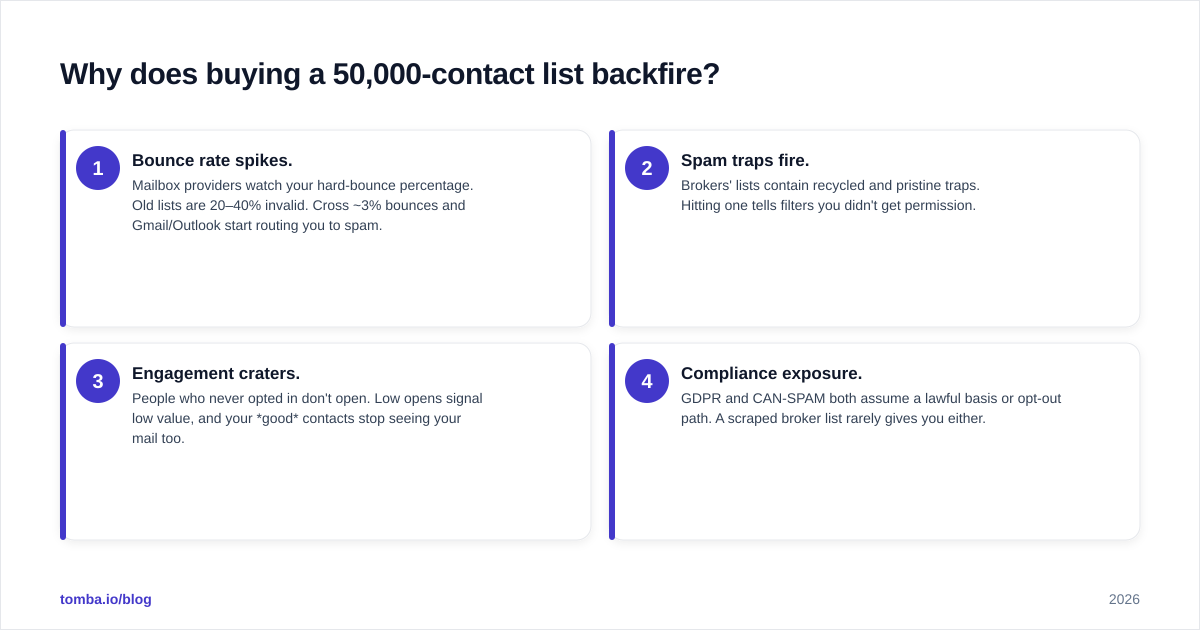
Conclusion first: a purchased mega-list lowers every downstream number — deliverability, reply rate, conversion — while raising your risk of blacklisting. Here's the chain of cause and effect.
- Bounce rate spikes. Mailbox providers watch your hard-bounce percentage. Old lists are 20–40% invalid. Cross ~3% bounces and Gmail/Outlook start routing you to spam.
- Spam traps fire. Brokers' lists contain recycled and pristine traps. Hitting one tells filters you didn't get permission.
- Engagement craters. People who never opted in don't open. Low opens signal low value, and your good contacts stop seeing your mail too.
- Compliance exposure. GDPR and CAN-SPAM both assume a lawful basis or opt-out path. A scraped broker list rarely gives you either.
According to HubSpot's research on email marketing, engagement-based sending consistently outperforms volume-based blasting — and purchased lists are the textbook volume play. The math is brutal: 2,000 verified, on-ICP contacts will out-pipeline 50,000 bought ones, at a fraction of the deliverability risk.
What does a good list-building framework look like?#
Use a four-stage loop. Each stage feeds the next, and the whole thing runs continuously rather than as a one-time project.
Stage 1 — Define the ICP#
Before you source a single contact, write down the firmographics (industry, headcount, revenue, region, tech stack) and the buying roles (titles, seniority, department) you're targeting. A precise ICP is what keeps your list from bloating. If you can't name the trigger that makes a company a fit, you'll end up "building" the same indiscriminate dump you were trying to avoid.
Stage 2 — Source accounts and contacts#
This is where most teams reach for the wrong lever. You have two complementary sources:
- Outbound sourcing — start from target domains and pull the right people. A domain search returns every discoverable email pattern and contact at a company, so you go from "I want to reach Acme" to a named list of people in seconds.
- Inbound capture — let interested prospects raise their hand (covered in the next section).
Stage 3 — Capture the data#
Capturing means turning a name + company into a reachable, structured record: email, role, LinkedIn, phone, and enrichment fields. An email finder resolves a person's professional address from their name and domain; data enrichment fills in the firmographic and role context your scoring model needs.
Stage 4 — Verify before you send#
Never trust a freshly built list. Run every address through an email verifier to strip invalids, catch-alls you can't confirm, and role accounts. This single step is the difference between a 1% bounce rate and a 25% one.
How do inbound lead capture and outbound sourcing fit together?#
They feed one database from two directions. Outbound sourcing is you going to find the prospect; inbound capture is the prospect coming to you. Mature teams run both and merge them into a single, deduplicated, scored list.
Inbound capture mechanics worth building:
- Lead-magnet forms — gated guides, calculators, templates, benchmarks. Ask for the minimum (work email + company) and enrich the rest server-side rather than making the form long.
- Website visitor reveal — most B2B traffic never fills a form. Visitor identification deanonymizes company-level traffic so your team can follow up with accounts that showed intent.
- Newsletter and content opt-ins — slow but the highest-consent, lowest-bounce source you'll ever have.
The reason to unify both: an inbound lead who also matches your outbound ICP is your hottest segment. You can only see that overlap if the two streams land in the same system and get scored together. (For scoring mechanics, see the difference between an MQL and a sales-ready lead.)
Build vs. buy vs. hybrid: which list-building approach wins?#
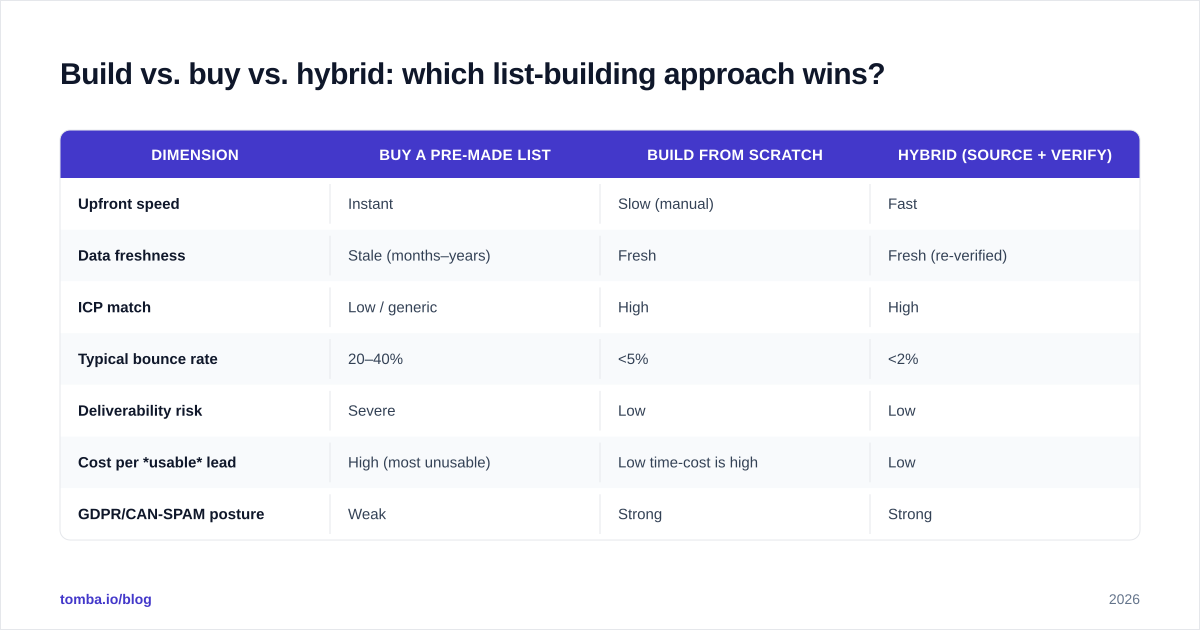
Here's a concrete comparison across the dimensions that actually decide pipeline outcomes.
| Dimension | Buy a pre-made list | Build from scratch | Hybrid (source + verify) |
|---|---|---|---|
| Upfront speed | Instant | Slow (manual) | Fast |
| Data freshness | Stale (months–years) | Fresh | Fresh (re-verified) |
| ICP match | Low / generic | High | High |
| Typical bounce rate | 20–40% | <5% | <2% |
| Deliverability risk | Severe | Low | Low |
| Cost per usable lead | High (most unusable) | Low time-cost is high | Low |
| GDPR/CAN-SPAM posture | Weak | Strong | Strong |
| Scales to 1,000s | Yes (badly) | No | Yes |
The hybrid row is the answer for almost everyone: define your ICP, source contacts at scale from real domains, then verify before sending. You get the speed of buying without the deliverability landmines.

What tools do you need to build a B2B list in 2026?#
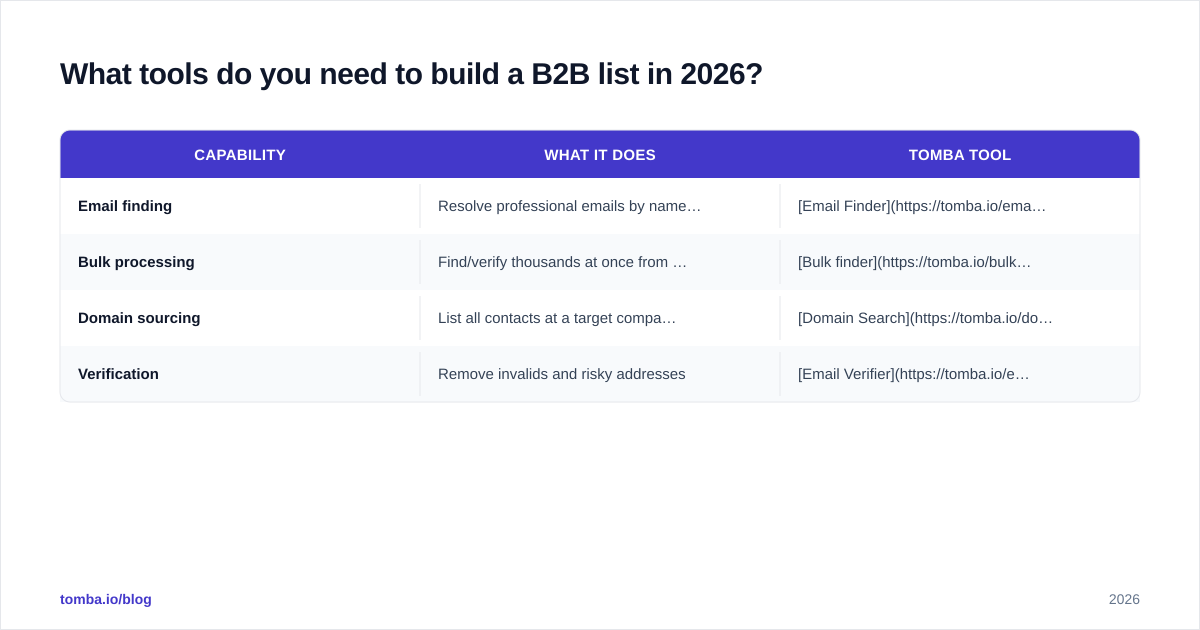
You need four capabilities. They can come from one platform or several, but the workflow is non-negotiable: find → enrich → verify → export to your sequencer or CRM.
| Capability | What it does | Tomba tool |
|---|---|---|
| Email finding | Resolve professional emails by name/domain | Email Finder |
| Bulk processing | Find/verify thousands at once from a CSV | Bulk finder |
| Domain sourcing | List all contacts at a target company | Domain Search |
| Verification | Remove invalids and risky addresses | Email Verifier |
A few selection rules that save you money:
- Accuracy beats database size. A vendor advertising "700M contacts" means little if 30% bounce. Check independent reviews on G2 rather than the vendor's own claims.
- Verification must be native. If you have to bolt on a separate verifier, you'll skip it under deadline pressure. Pick a stack where finding and verifying are one motion.
- Bulk + API matter at scale. Manual lookups are fine for 20 accounts. For 2,000, you want a bulk email finder and an email finder API wired into your workflow.
- Pricing should match volume. Don't overbuy. Tomba's pricing starts free (25 searches/mo), with Starter at $49/mo and Growth at $99/mo — enough to validate the workflow before committing to Pro at $249/mo.
For reference on how analysts frame this category, Gartner's coverage of sales intelligence tools is a useful neutral baseline when you're comparing vendors.
How do you keep a built list healthy over time?#
A list is a perishable asset. B2B contact data decays roughly 22–30% per year as people change jobs — so a list you built in January is measurably worse by July.
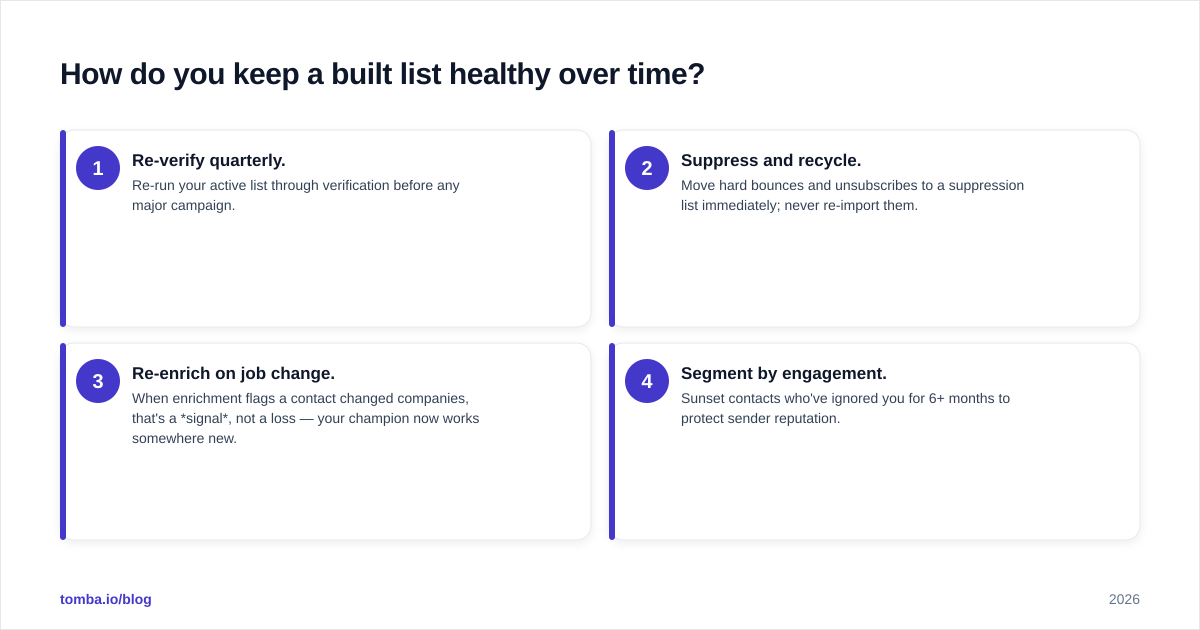
Maintenance routine:
- Re-verify quarterly. Re-run your active list through verification before any major campaign.
- Suppress and recycle. Move hard bounces and unsubscribes to a suppression list immediately; never re-import them.
- Re-enrich on job change. When enrichment flags a contact changed companies, that's a signal, not a loss — your champion now works somewhere new.
- Segment by engagement. Sunset contacts who've ignored you for 6+ months to protect sender reputation.
This is the unglamorous part of lead generation that separates teams with predictable pipeline from teams that re-buy lists every quarter and wonder why deliverability never recovers.
Frequently asked questions#
Is buying a B2B email list ever okay? Rarely. If you must, treat it as suspect: verify every address, warm up slowly, and expect poor engagement. The risk to your domain almost always outweighs the time saved.
How big should my list be? As big as your ICP honestly is, and no bigger. For most B2B teams, a few thousand precisely-matched contacts outperform tens of thousands of loose ones.
Can I build a list without any tools? You can, manually, from LinkedIn and company sites — but it doesn't scale past a few dozen contacts a week. A finder-plus-verifier stack is what makes list building a repeatable system rather than a chore.
What's the single most important step? Verification. It's the cheapest insurance you can buy against a deliverability disaster.
Start building lists that convert#
Stop measuring list quality by row count and start measuring it by reachable, on-ICP, verified contacts. The workflow is simple and it compounds: define a tight ICP, source from real domains, enrich for context, and verify before every send.
If you want the fastest path from "target company" to a clean, sendable contact, start with the Tomba Email Finder. Pair it with the built-in verifier and bulk processing, and you can stand up a targeted B2B list — the kind that protects your domain and fills your pipeline — without ever touching a broker's spreadsheet. The free tier gives you 25 searches to prove it works before you spend a dollar.
// get started
Find, verify and enrich your first contacts today
Start on the free plan with 25 searches a month, then scale when your team is ready.
Free plan · No credit card required · GDPR & CCPA
// about the author