Lead Scoring and Qualification: The 2026 Sales Playbook
Most teams treat lead scoring as a black box and qualification as a gut call. Here's a 2026 framework that ties scoring models, fit-and-intent signals, and clean data into pipeline you can trust.
TL;DR
- Lead scoring ranks how closely a contact matches your buyer; qualification confirms whether they can actually buy. You need both, in that order.
- The strongest 2026 models blend fit (firmographic + role data) with intent (behavioral + buying signals) instead of relying on either alone.
- Pick a qualification framework that matches deal complexity: BANT for velocity, MEDDIC for enterprise, CHAMP when pain drives the deal.
- Garbage data quietly breaks every model. Verified contact data and enrichment are prerequisites, not nice-to-haves.
- Review thresholds quarterly. A score that predicted closed-won last year drifts as your ICP and market shift.
If your reps argue about which leads are "good," you don't have a lead problem — you have a scoring and qualification problem. This guide gives you a model you can build this quarter, the framework choices that actually matter, and the data hygiene that keeps the whole thing honest.
What is the difference between lead scoring and qualification?#
Lead scoring and qualification are two different jobs that teams constantly blur together.
Lead scoring is a ranking system. It assigns a numeric value to each lead based on how well they match your ideal customer and how engaged they are. Think of it like a credit score: it doesn't approve the loan, it tells the loan officer where to look first.
Qualification is the decision. It's the human (or rules-based) judgment that a scored lead is worth a sales conversation — that they have budget, authority, need, and a timeline that fits your motion.
Here's the practical sequence:
- Scoring sorts the inbound flood so reps work the highest-probability contacts first.
- Qualification confirms, through a call or enrichment, that the high scorers are real opportunities.
- Disqualification (just as important) kicks bad-fit leads back to nurture before reps waste cycles.
When you skip scoring, reps work leads in the order they arrive — newest first, not best first. When you skip qualification, you stuff the pipeline with high-scoring tire-kickers and your win rate craters.
How does a lead scoring model actually work?#
A modern model scores two dimensions and combines them. Treating them separately is the single biggest upgrade most teams can make.
Dimension 1 — Fit (who they are). Firmographic and demographic attributes that don't change minute to minute:
- Company size, revenue, industry, region
- Job title, seniority, department
- Tech stack and tooling signals
Dimension 2 — Intent (what they're doing). Behavioral signals that decay over time:
- Pricing-page visits, demo requests, repeat sessions
- Email opens and replies, content downloads
- Third-party intent data (competitor research, category surges)
A contact who is a perfect fit but shows zero activity is a marketing problem. A contact who is highly active but a terrible fit is a distraction. Only the contacts that score high on both belong at the top of a rep's queue.
A simple points framework#
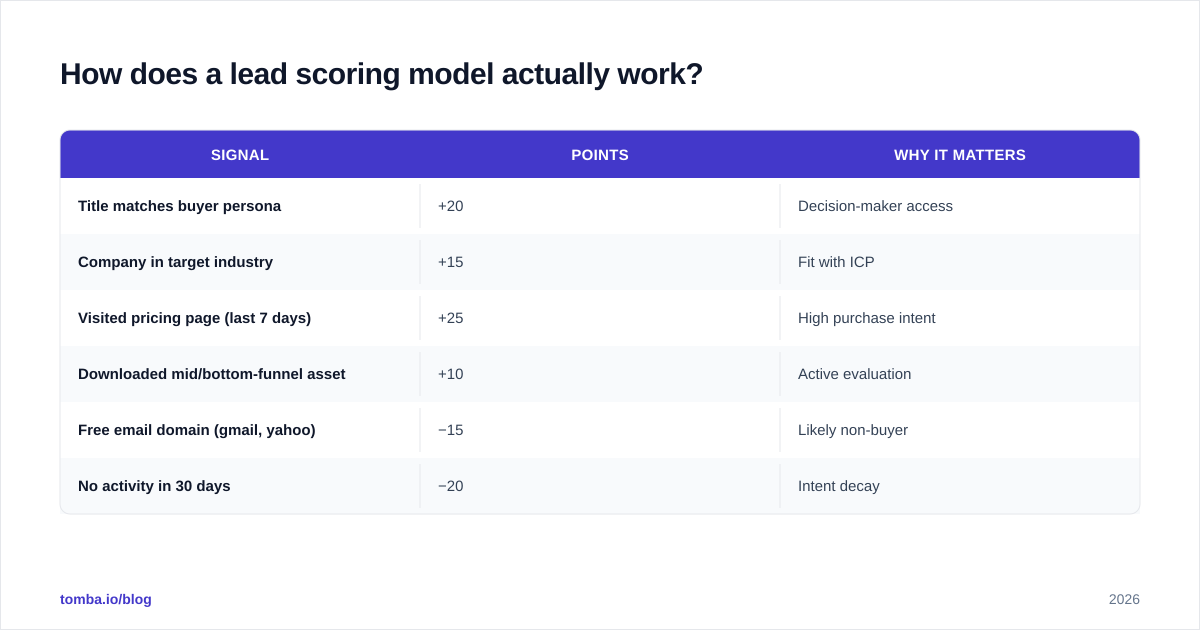
You don't need machine learning to start. A transparent points model beats a black box you can't tune:
| Signal | Points | Why it matters |
|---|---|---|
| Title matches buyer persona | +20 | Decision-maker access |
| Company in target industry | +15 | Fit with ICP |
| Visited pricing page (last 7 days) | +25 | High purchase intent |
| Downloaded mid/bottom-funnel asset | +10 | Active evaluation |
| Free email domain (gmail, yahoo) | −15 | Likely non-buyer |
| No activity in 30 days | −20 | Intent decay |
Set a threshold — say 50 points — where a lead becomes a Marketing Qualified Lead and routes to sales. Tune the numbers against your own closed-won history, not against a template. For a refresher on the handoff stage, see Tomba's glossary entry on the marketing qualified lead.
The points approach is what most teams run inside HubSpot's lead scoring tooling or Salesforce. Predictive (ML) scoring is worth graduating to once you have a few thousand clean, labeled outcomes — until then, rules are more explainable and easier to fix.
Which qualification framework should you use?#
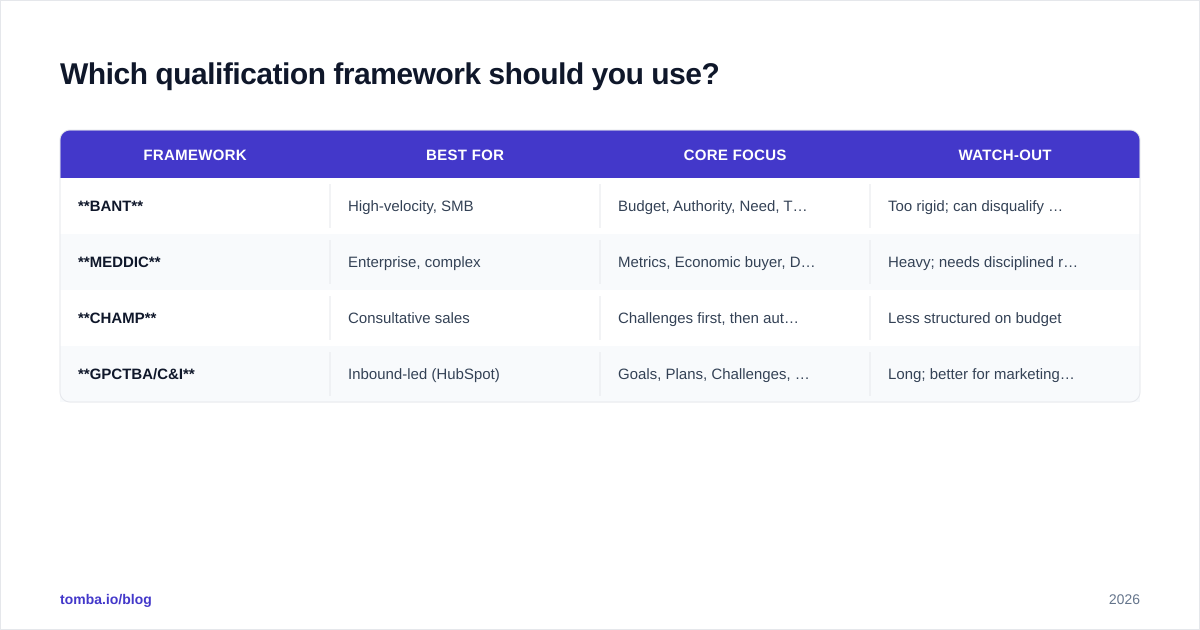
The right framework depends on deal size, sales cycle, and how much discovery each deal needs. Don't adopt MEDDIC for a $40/month SaaS product, and don't run pure BANT on a six-figure enterprise deal.
| Framework | Best for | Core focus | Watch-out |
|---|---|---|---|
| BANT | High-velocity, SMB | Budget, Authority, Need, Timeline | Too rigid; can disqualify early-stage buyers |
| MEDDIC | Enterprise, complex | Metrics, Economic buyer, Decision criteria | Heavy; needs disciplined reps |
| CHAMP | Consultative sales | Challenges first, then authority/money | Less structured on budget |
| GPCTBA/C&I | Inbound-led (HubSpot) | Goals, Plans, Challenges, Timeline | Long; better for marketing-rich pipelines |
A few rules of thumb:
- Short cycle, low ACV? Use BANT or a trimmed version. Speed matters more than depth.
- Long cycle, multiple stakeholders? Use MEDDIC. The "Economic buyer" and "Decision criteria" fields are where enterprise deals are won or lost.
- Problem-led selling? CHAMP leads with the prospect's challenge, which feels less like an interrogation.
Whatever you pick, encode it as required fields in your CRM so qualification isn't a vibe — it's data you can report on. Gartner's research on B2B buying consistently shows buyers spend only a fraction of their journey with any single vendor, so your qualification fields need to capture where they are, not just whether they picked up the phone. (See Gartner's B2B buying journey research.)
Why does data quality decide whether scoring works?#
Because every score is only as trustworthy as the data feeding it. A model that scores on job title and company size collapses the moment those fields are wrong, stale, or missing.
This is the failure mode nobody talks about: teams spend weeks tuning point values while 30% of their contact records have a bounced email, an outdated title, or a misattributed company. The model runs fine. It's just confidently ranking garbage.
Three data hygiene moves that protect your model:
- Verify contact data on entry. A valid, deliverable email is the cheapest signal that a lead is real. Run new contacts through an email verifier before they hit your scoring rules so dead addresses don't inflate scores.
- Enrich thin records. A form that only captures an email leaves your fit-score blind. Use data enrichment to backfill title, company, size, and industry so the fit dimension actually has inputs.
- Decay and re-verify. Roles change, people leave. Re-check your highest-value segments on a schedule, and pull fresh contacts from a maintained B2B database instead of letting your list rot.
If you're sourcing net-new leads to score in the first place, the cleanest starting point is verified, role-targeted contacts rather than scraped lists. That's where an accurate email finder earns its keep — you score real buyers, not noise.
How do you set and tune score thresholds?#
Set thresholds against outcomes, then revisit them on a cadence. A static threshold is a guess that gets worse over time.
Step 1 — Anchor on closed-won. Pull your last 6–12 months of won deals and look at what their scores would have been. The median winning score is a far better threshold than a round number someone liked.
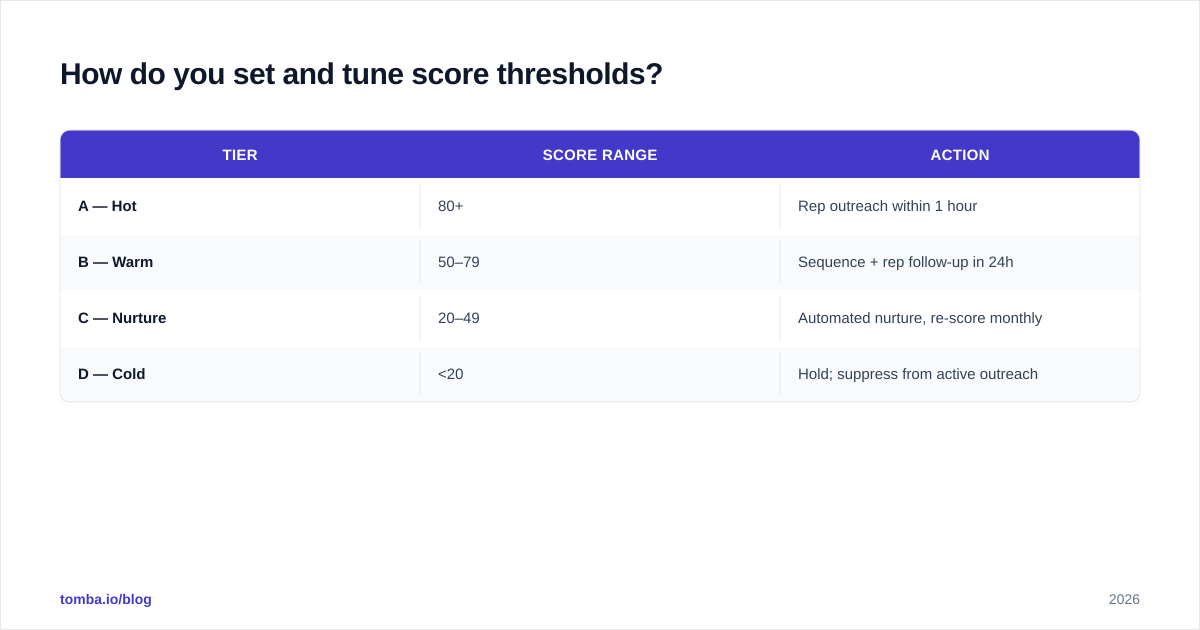
Step 2 — Define tiers, not a single line. Binary "qualified / not" wastes information. Use bands:
| Tier | Score range | Action |
|---|---|---|
| A — Hot | 80+ | Rep outreach within 1 hour |
| B — Warm | 50–79 | Sequence + rep follow-up in 24h |
| C — Nurture | 20–49 | Automated nurture, re-score monthly |
| D — Cold | <20 | Hold; suppress from active outreach |
Step 3 — Watch the leakage. Two numbers tell you if thresholds are off:
- MQL→SQL conversion below ~20% usually means your threshold is too low (sales drowns in junk).
- Reps cherry-picking low-scored leads that close means your model is missing a signal — interview them and add it.
Step 4 — Re-tune quarterly. Your ICP shifts, new products launch, markets move. Treat the model like a living system. G2's category data and your own win/loss reviews are good external sanity checks on whether your "ideal" lead still matches who's actually buying.
What does a working scoring-and-qualification loop look like?#
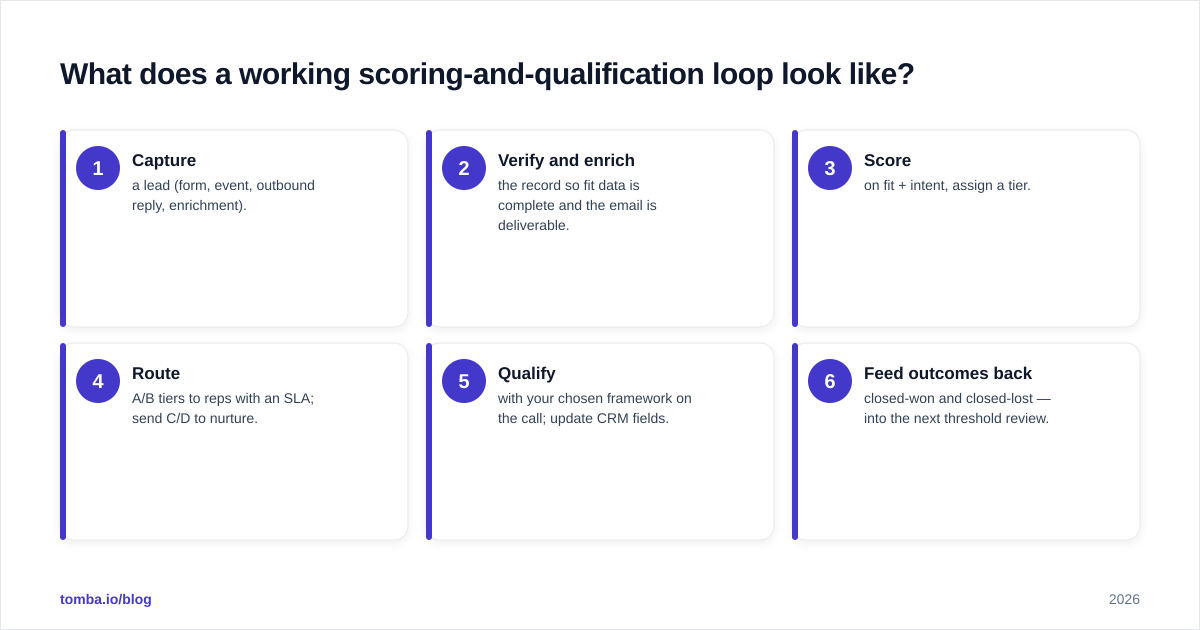
Put together, the operating loop is simple to describe and hard to fake:
- Capture a lead (form, event, outbound reply, enrichment).
- Verify and enrich the record so fit data is complete and the email is deliverable.
- Score on fit + intent, assign a tier.
- Route A/B tiers to reps with an SLA; send C/D to nurture.
- Qualify with your chosen framework on the call; update CRM fields.
- Feed outcomes back — closed-won and closed-lost — into the next threshold review.
The teams that win at this aren't the ones with the fanciest predictive model. They're the ones whose loop is closed: outcomes flow back into scoring, bad data gets caught before it scores, and thresholds get revisited before they drift. A points model on clean data, reviewed quarterly, beats a neural net on dirty data every single time.
One more discipline worth building in: disqualify loudly. A lead that fails qualification should be marked with a reason (no budget, wrong role, no timeline) so marketing can nurture it correctly and your model can learn from the rejection. Silent disqualification throws away your most useful training signal.
Common mistakes that quietly kill your model#
- Scoring only on engagement. A bored intern who opens every email is not a buyer. Without a fit dimension, you'll route enthusiasts instead of decision-makers.
- Never decaying intent. A pricing-page visit from eight months ago is not hot. If old behavior keeps a lead at the top, reps lose trust in the score fast.
- Letting fields go stale. Title and company drive fit scoring. If they're not refreshed, your "perfect fit" might have changed jobs a year ago.
- One threshold forever. Set it and forget it, and you'll be optimizing for last year's market.
- No feedback loop. If closed-won data never re-enters the model, you're flying on the assumptions you made on day one.
The bottom line#
Lead scoring and qualification work as a system, not as two separate checkboxes. Score on fit plus intent so reps see the best leads first. Qualify with a framework that matches your deal complexity. And protect the whole thing with verified, enriched data, because a perfect model on bad records is just confident guessing.
Start where the leverage is highest: clean inputs. If your scoring model is starving for accurate, role-targeted contacts, the Tomba Email Finder gives you verified professional emails by name, company, or domain — so the leads entering your model are real buyers worth scoring. Pair it with verification and enrichment, and your scores finally mean what they say. Check Tomba pricing to see which plan fits your lead volume, and put your reps back on the leads most likely to close.
// get started
Find, verify and enrich your first contacts today
Start on the free plan with 25 searches a month, then scale when your team is ready.
Free plan · No credit card required · GDPR & CCPA
// about the author