Revenue Operations and GTM Alignment: 2026 RevOps Guide
RevOps turns three siloed go-to-market teams into one revenue engine. Here is the 2026 playbook for aligning sales, marketing, and CS around shared data, process, and pipeline.
TL;DR
- Revenue operations (RevOps) is the discipline of running sales, marketing, and customer success as one go-to-market (GTM) engine instead of three departments that each own a slice of the funnel.
- The payoff is concrete: companies with tight GTM alignment grow faster and forecast more accurately because data, process, and incentives point the same direction.
- The four pillars are data, process, technology, and enablement — get those wrong and no amount of tooling saves you.
- Your RevOps stack only works if the data feeding it is clean. Garbage contacts in your CRM break routing, scoring, and attribution downstream.
- Start small: unify your funnel definitions, instrument one source of truth, then automate. Don't buy a 12-tool stack before you can agree on what "qualified" means.
What is revenue operations (RevOps)?#
Revenue operations is the function that aligns sales, marketing, and customer success around a single, shared revenue process. Think of it like the pit crew in motorsport: the driver gets the glory, but the car only wins because fueling, tires, and strategy are coordinated to the millisecond. RevOps is that coordination layer for your go-to-market teams.
The term was popularized by analysts like Gartner, who observed that the old model — Sales Ops, Marketing Ops, and CS Ops each operating in isolation — created friction at exactly the handoff points where deals get lost. A lead converts in marketing's system, gets "passed" to sales through a broken integration, sits unrouted for three days, and the prospect has already booked a demo with your competitor.
RevOps collapses those silos into one operating model with shared definitions, shared tooling, and a shared number. If you want the textbook definition, Tomba's glossary entry on revenue operations is a clean reference. But the short version: RevOps owns the how of revenue so the customer-facing teams can own the who and the what.
Why does GTM alignment actually matter?#
Because misalignment is expensive, and it compounds silently.
When marketing optimizes for MQLs, sales optimizes for closed-won, and CS optimizes for retention — with no shared scoreboard — you get three teams each hitting their own target while total revenue stalls. Marketing celebrates a record lead month; sales complains the leads are junk; CS inherits customers who were oversold. Everyone is "winning" and the business is losing.
GTM alignment fixes the incentive math. When all three teams share pipeline and revenue goals, the questions change. Marketing stops asking "how many leads?" and starts asking "how much pipeline did we source, and did it close?" Sales stops blaming lead quality and starts feeding closed-lost reasons back into targeting. CS becomes an expansion engine instead of a cost center.
The financial case is well documented. Vendors and analysts including HubSpot and Salesforce consistently report that aligned revenue teams forecast more accurately, shorten sales cycles, and retain customers at higher rates. The mechanism is boring but real: fewer handoff leaks, one version of the truth, and decisions made on the same data.
What are the core pillars of a revenue operations GTM model?#
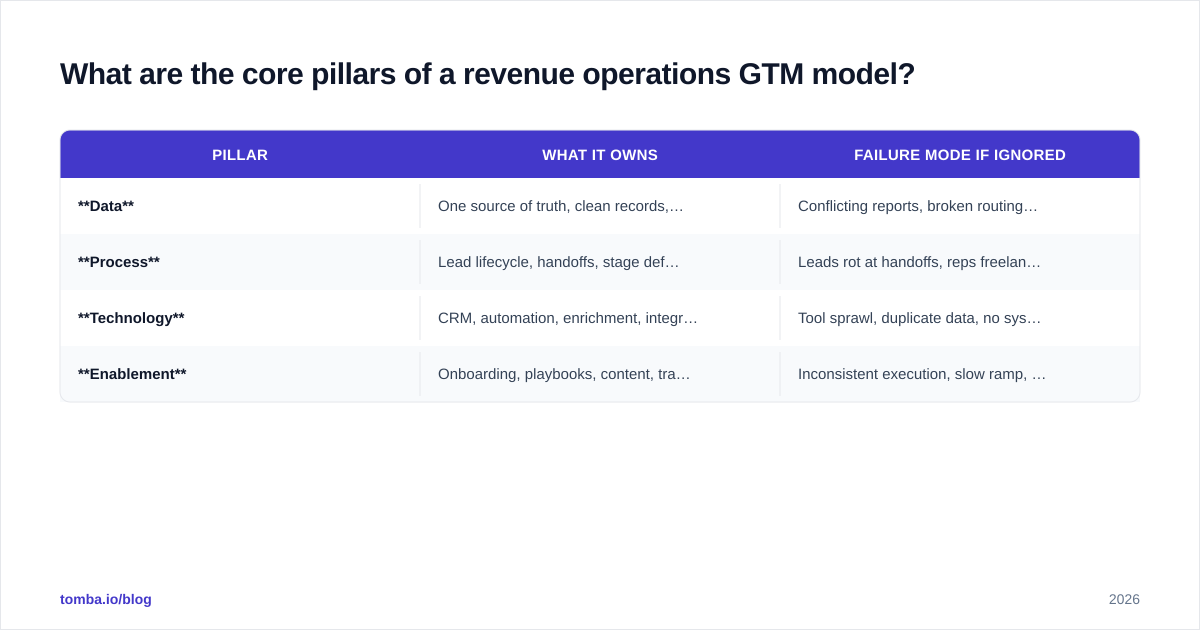
Every durable RevOps function rests on four pillars. Skip one and the model wobbles.
| Pillar | What it owns | Failure mode if ignored |
|---|---|---|
| Data | One source of truth, clean records, shared definitions | Conflicting reports, broken routing, garbage forecasts |
| Process | Lead lifecycle, handoffs, stage definitions, SLAs | Leads rot at handoffs, reps freelance their own stages |
| Technology | CRM, automation, enrichment, integrations | Tool sprawl, duplicate data, no system of record |
| Enablement | Onboarding, playbooks, content, training | Inconsistent execution, slow ramp, tribal knowledge |
Data comes first on purpose. Every other pillar is downstream of it. If your CRM is full of duplicate accounts, stale titles, and unverified emails, your routing rules misfire, your lead scoring lies, and your attribution model is fiction. This is the single most common reason RevOps initiatives stall — teams buy sophisticated tooling and feed it dirty inputs.
Process is where alignment becomes operational. You need agreed definitions: what is an MQL, when does it become an SQL, what triggers the sales-to-CS handoff. Without these, every team uses the same words to mean different things.
Technology should be chosen after data and process, not before. The tool stack serves the operating model, never the reverse.
Enablement is the multiplier. The best process in the world fails if reps don't know it exists or can't execute it consistently.
How is RevOps different from Sales Ops or Marketing Ops?#
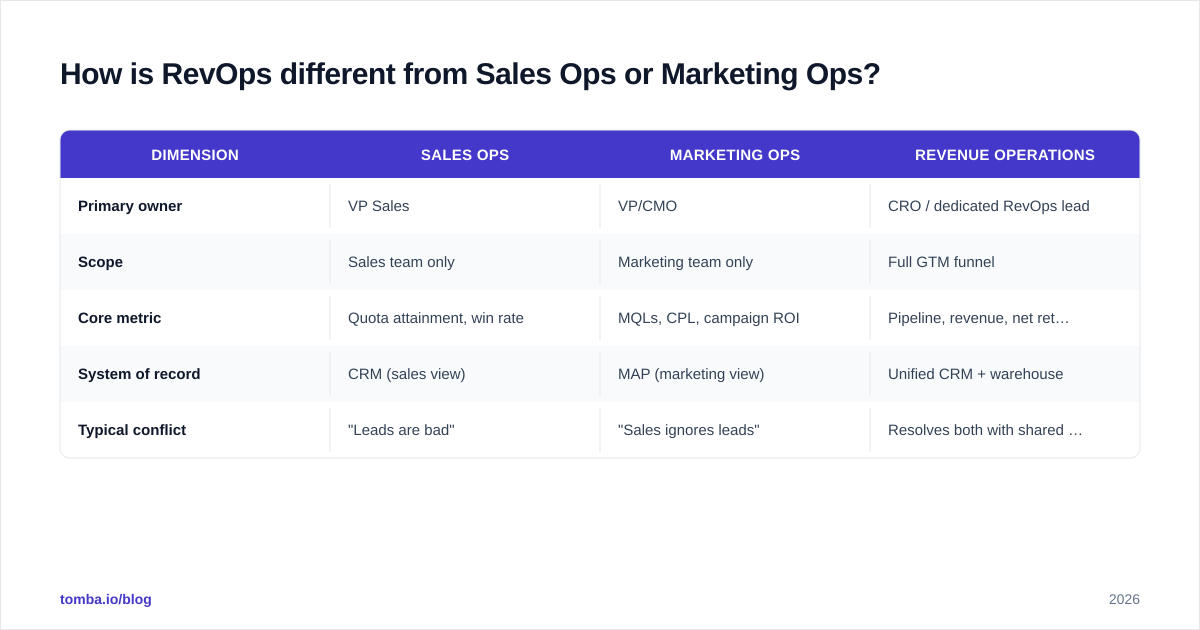
The difference is scope and mandate. Sales Ops optimizes the sales team. Marketing Ops optimizes the marketing team. RevOps optimizes the revenue — across all three customer-facing functions — and has the authority to make trade-offs between them.
| Dimension | Sales Ops | Marketing Ops | Revenue Operations |
|---|---|---|---|
| Primary owner | VP Sales | VP/CMO | CRO / dedicated RevOps lead |
| Scope | Sales team only | Marketing team only | Full GTM funnel |
| Core metric | Quota attainment, win rate | MQLs, CPL, campaign ROI | Pipeline, revenue, net retention |
| System of record | CRM (sales view) | MAP (marketing view) | Unified CRM + warehouse |
| Typical conflict | "Leads are bad" | "Sales ignores leads" | Resolves both with shared SLAs |
The practical tell: in a Sales Ops world, when a deal slips, sales and marketing point fingers. In a RevOps world, there's a shared dashboard that shows exactly where the funnel leaked, and the fix is a process change both teams already agreed to. RevOps doesn't end the debates — it gives them a referee and a rulebook.
How do you build a revenue operations function in 2026?#
Build it in stages. Trying to stand up a full RevOps org in one quarter is how you get an expensive reorg and a confused team. Follow the maturity curve.
Stage 1 — Align definitions. Get sales, marketing, and CS in a room and agree on lifecycle stages, the MQL/SQL handoff, and SLAs (e.g., "every MQL is worked within 4 business hours"). Write it down. This costs nothing and unlocks everything.
Stage 2 — Establish one source of truth. Pick the system of record, usually your CRM, and ruthlessly clean it. De-duplicate accounts, standardize fields, and verify contact data. This is where most teams underinvest. A pipeline built on bad data produces confident, wrong forecasts.
Stage 3 — Instrument the funnel. Build the shared dashboard. Pipeline created, by source, by stage, with conversion rates between each. When all three teams look at the same chart, the arguments get shorter.
Stage 4 — Automate the repetitive. Now — and only now — layer in automation: lead routing, enrichment, sequence triggers, handoff alerts. Automating a broken process just breaks things faster.
Stage 5 — Close the loop. Feed closed-won and closed-lost data back into targeting and scoring. RevOps is a flywheel, not a project. Each cycle should make the next one smarter.
Why does data quality make or break your RevOps stack?#
Because every downstream RevOps mechanism — routing, scoring, segmentation, attribution, forecasting — is a function applied to your contact and account data. If the input is wrong, the output is wrong, and it's wrong confidently, which is worse than no data at all.
Consider lead routing. You build a rule: "route enterprise leads with a VP+ title to the named-accounts team." That rule depends on the company size field and the job title field being accurate. If 30% of your records have stale or missing titles — normal for a database that isn't actively maintained — then 30% of your routing misfires, and your best reps are working the wrong accounts.
Or take lead scoring. You weight "verified business email" and "matched to target account" heavily. If your emails aren't verified, you're scoring on noise, and your sales team learns to ignore the scores entirely.
This is why serious RevOps teams treat data hygiene as a continuous operation, not a one-time cleanup. Three practices matter most:
- Verify at capture. Validate email addresses the moment a lead enters the system, so invalid contacts never pollute the funnel. An email verifier in the inbound flow stops bad data at the door.
- Enrich systematically. Fill the gaps — firmographics, titles, direct contact info — so segmentation and routing have something to work with. Data enrichment turns a name and a domain into a routable, scorable record.
- Re-verify on a cadence. People change jobs constantly. A record that was accurate twelve months ago may be useless today. Periodic re-verification keeps your database from decaying into a liability.
When the prospect data is clean, your reps can also find the right contacts faster — a good email finder turns a target account list into reachable decision-makers without manual digging. The whole RevOps machine runs on the assumption that the contact you're routing, scoring, and sequencing actually exists and is reachable.
What metrics should a RevOps team own?#
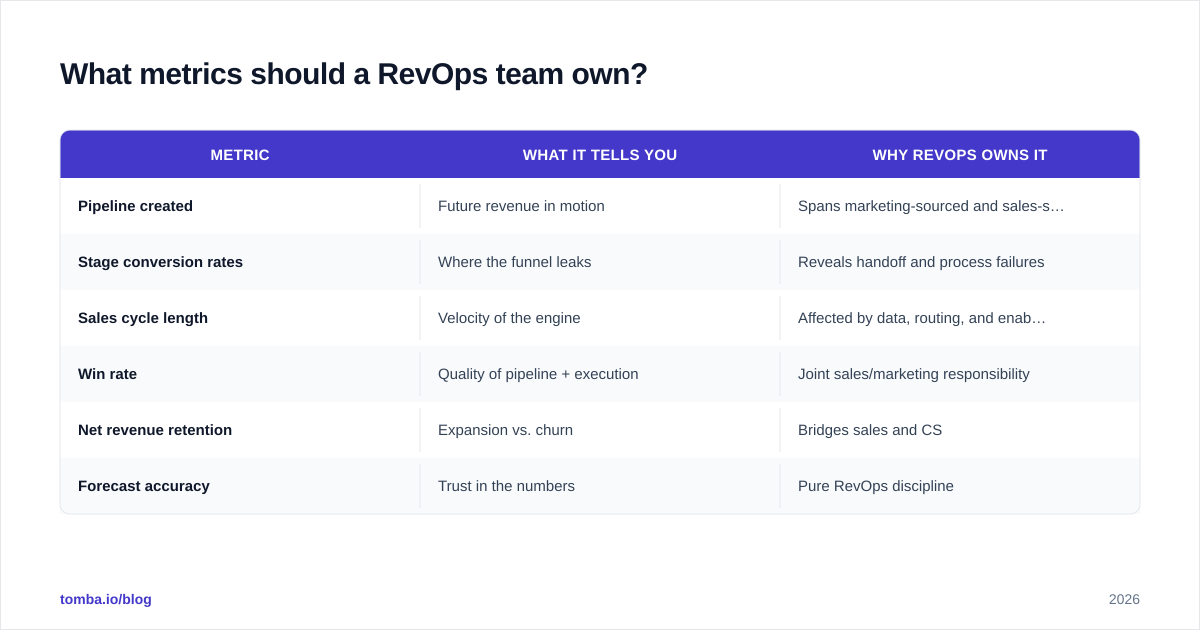
RevOps should own the metrics that span the funnel — the ones no single department can fully control. Vanity metrics belong to the departments; throughput and efficiency metrics belong to RevOps.
| Metric | What it tells you | Why RevOps owns it |
|---|---|---|
| Pipeline created | Future revenue in motion | Spans marketing-sourced and sales-sourced |
| Stage conversion rates | Where the funnel leaks | Reveals handoff and process failures |
| Sales cycle length | Velocity of the engine | Affected by data, routing, and enablement |
| Win rate | Quality of pipeline + execution | Joint sales/marketing responsibility |
| Net revenue retention | Expansion vs. churn | Bridges sales and CS |
| Forecast accuracy | Trust in the numbers | Pure RevOps discipline |
The discipline here is to resist reporting everything. A RevOps dashboard with 40 metrics is a dashboard nobody reads. Pick the handful that drive decisions, instrument them well, and make them the shared scoreboard for the whole GTM org. If a metric doesn't change a decision, it's decoration.
What does a modern RevOps tech stack look like?#
Layered, integrated, and centered on one system of record. The mistake is buying point solutions that don't talk to each other; the result is the exact data fragmentation RevOps exists to eliminate.
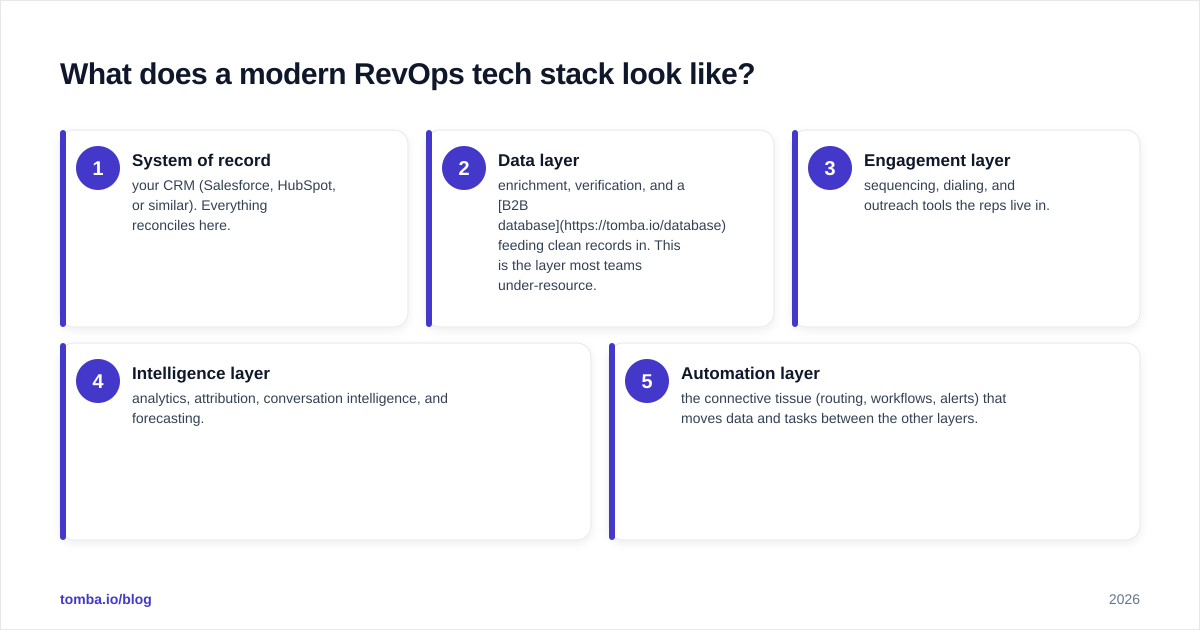
A sane 2026 stack has five layers:
- System of record — your CRM (Salesforce, HubSpot, or similar). Everything reconciles here.
- Data layer — enrichment, verification, and a B2B database feeding clean records in. This is the layer most teams under-resource.
- Engagement layer — sequencing, dialing, and outreach tools the reps live in.
- Intelligence layer — analytics, attribution, conversation intelligence, and forecasting.
- Automation layer — the connective tissue (routing, workflows, alerts) that moves data and tasks between the other layers.
The non-negotiable is integration. Each tool must read from and write to the system of record, or you recreate silos in software. When you evaluate a new tool, the first question isn't "what does it do?" — it's "how cleanly does it sync with my CRM?" A brilliant tool that fragments your data is a net negative.
You can review Tomba pricing if you're scoping the data layer specifically — the free tier (25 searches/month) is enough to test verification and enrichment quality against your own records before you commit budget.
Common RevOps mistakes to avoid#
- Buying tools before fixing process. A tool encodes a process. If the process is broken or undefined, the tool just automates the mess.
- Ignoring data quality. Covered above, but worth repeating: it's the number-one silent killer of RevOps ROI.
- Reporting everything. Forty metrics means zero focus. Own the throughput metrics, delegate the rest.
- Treating RevOps as a project. It's an operating model and a flywheel. Stand it up, then keep turning the loop.
- Leaving CS out of the model. Net revenue retention is where modern B2B growth lives. A RevOps function that only spans sales and marketing is leaving the highest-margin revenue uncoordinated.
Bringing it together#
Revenue operations isn't a new department to bolt onto your org chart — it's a commitment to running your go-to-market motion as one coordinated engine. Align the definitions, build one source of truth, instrument the funnel, automate what's repetitive, and close the loop. Do that on a foundation of clean, verified data, and the compounding starts: tighter forecasts, shorter cycles, higher retention.
The unglamorous truth is that most RevOps wins come from the data layer, not the dashboard layer. Before you invest in another analytics platform, make sure the contacts flowing into your CRM are real, reachable, and accurate. The Tomba Email Finder gives your GTM teams verified, decision-maker contact data at the top of the funnel — the clean input every downstream RevOps process depends on. Start on the free tier, point it at your target account list, and see how much of your routing and scoring improves when the data underneath it is actually correct.
// get started
Find, verify and enrich your first contacts today
Start on the free plan with 25 searches a month, then scale when your team is ready.
Free plan · No credit card required · GDPR & CCPA
// about the author