RevOps Core: The 2026 Guide to Revenue Operations Foundations
RevOps core is the operating layer that unifies marketing, sales, and success around one revenue engine. Here's how to build it in 2026 — model, metrics, stack, and rollout.
TL;DR
- RevOps core is the central operating layer — people, process, data, and tools — that aligns marketing, sales, and customer success behind a single revenue number.
- The payoff is concrete: companies that unify go-to-market operations report faster deal cycles, cleaner forecasts, and double-digit gains in revenue efficiency.
- A working RevOps core rests on four pillars: a shared data model, end-to-end process design, a connected tech stack, and accountable metrics.
- Bad contact data quietly breaks the whole engine. Enrichment and verification are not "nice to have" — they are core infrastructure.
- You don't need a 12-person team to start. You need one owner, one source of truth, and a 90-day rollout that fixes the leakiest handoff first.
What is the RevOps core?#
The RevOps core is the operating system for revenue. Think of it like the electrical panel in a house: nobody admires it, but every light, outlet, and appliance depends on it being wired correctly. When marketing, sales, and customer success each run their own panel, you get flickering lights — leads that vanish between teams, forecasts that disagree, and finger-pointing at the quarterly review.
Revenue operations (RevOps) collapses those separate panels into one. The "core" is the non-negotiable foundation underneath the org chart: the unified data layer, the agreed-upon process for how a stranger becomes a customer, the connected stack that moves that record without re-keying, and the metrics everyone is measured against. Get the core right and the rest of go-to-market becomes tuning. Get it wrong and every new tool just adds another place for data to rot.
Industry analysts have been blunt about the stakes. Gartner has predicted that the majority of B2B organizations would adopt a RevOps model precisely because siloed operations cap growth. The reason is structural, not motivational — sales reps aren't lazy and marketers aren't careless. They're optimizing for different numbers inside different systems. The RevOps core gives them one number and one system of record.
Why does the RevOps core matter in 2026?#
Because the cost of misalignment compounds. A lead that takes three days to route is a lead a competitor already called. A duplicate account in the CRM is a forecast that's wrong before the quarter starts. A bounced cold email is a damaged sender reputation that suppresses the next 5,000 sends. None of these are dramatic on their own. Together they are the difference between a GTM motion that scales and one that stalls at $10M ARR.
Three shifts make the RevOps core urgent right now:
- AI moved the bottleneck. When reps can draft sequences and summarize calls in seconds, the constraint is no longer content — it's clean, trustworthy data feeding those models. Garbage in, confidently-worded garbage out.
- Buyers got harder to reach. Reply rates dropped, inboxes tightened spam filtering, and a single dirty list can blacklist a domain. Deliverability is now a RevOps responsibility, not a marketing afterthought.
- Boards want efficiency, not just growth. "Spend to grow" gave way to "grow per dollar." Forrester and others tie that efficiency directly to operational alignment — the RevOps core is where waste hides or gets eliminated.
In short: the teams winning in 2026 aren't the ones with the most tools. They're the ones whose tools share a brain.
What are the four pillars of a RevOps core?#
A durable RevOps core stands on four pillars. Skip one and the structure leans.
Pillar 1 — A shared data model#
One definition of an "account," one definition of an "opportunity stage," one source of truth. Most data chaos comes from teams inventing their own fields. The core fixes the schema first: what objects exist, who owns each field, and how records flow. This is also where data enrichment earns its keep — a record with a verified work email, title, and company size is worth ten records with a first name and a guess.
Pillar 2 — End-to-end process design#
Map the customer's journey, not your org chart. Where does marketing hand off to sales? What exactly triggers it? What's the SLA on follow-up? The core documents these handoffs as plumbing, not vibes. A marketing qualified lead should mean the same thing on Tuesday as it did last quarter.
Pillar 3 — A connected tech stack#
Your CRM is the spine; everything else either feeds it or reads from it. The test of a healthy stack: a new contact entered once should appear everywhere it's needed without a human copying it. Integrations, not exports, are the standard.
Pillar 4 — Accountable metrics#
If marketing optimizes MQLs and sales optimizes closed-won, they will fight forever. The RevOps core defines shared metrics — pipeline velocity, win rate, net revenue retention — and makes them visible to all three teams on the same dashboard.
How is RevOps different from siloed sales and marketing ops?#
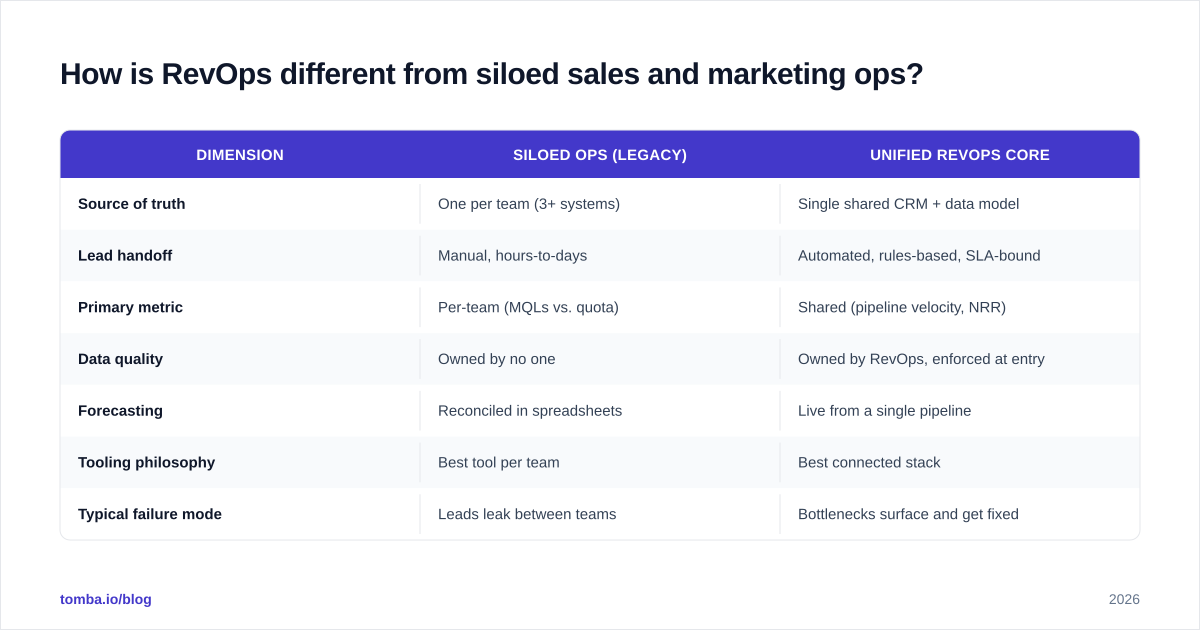
The simplest way to see the difference is side by side. Traditional operations split the funnel into territories; RevOps treats it as one continuous system.
| Dimension | Siloed Ops (legacy) | Unified RevOps core |
|---|---|---|
| Source of truth | One per team (3+ systems) | Single shared CRM + data model |
| Lead handoff | Manual, hours-to-days | Automated, rules-based, SLA-bound |
| Primary metric | Per-team (MQLs vs. quota) | Shared (pipeline velocity, NRR) |
| Data quality | Owned by no one | Owned by RevOps, enforced at entry |
| Forecasting | Reconciled in spreadsheets | Live from a single pipeline |
| Tooling philosophy | Best tool per team | Best connected stack |
| Typical failure mode | Leads leak between teams | Bottlenecks surface and get fixed |
The legacy column isn't a strawman — it's where most companies actually live. Each team bought the best tool for its job, and each tool became an island. RevOps doesn't necessarily rip those tools out; it forces them to agree on one record.
Who owns the RevOps core, and what roles sit inside it?#
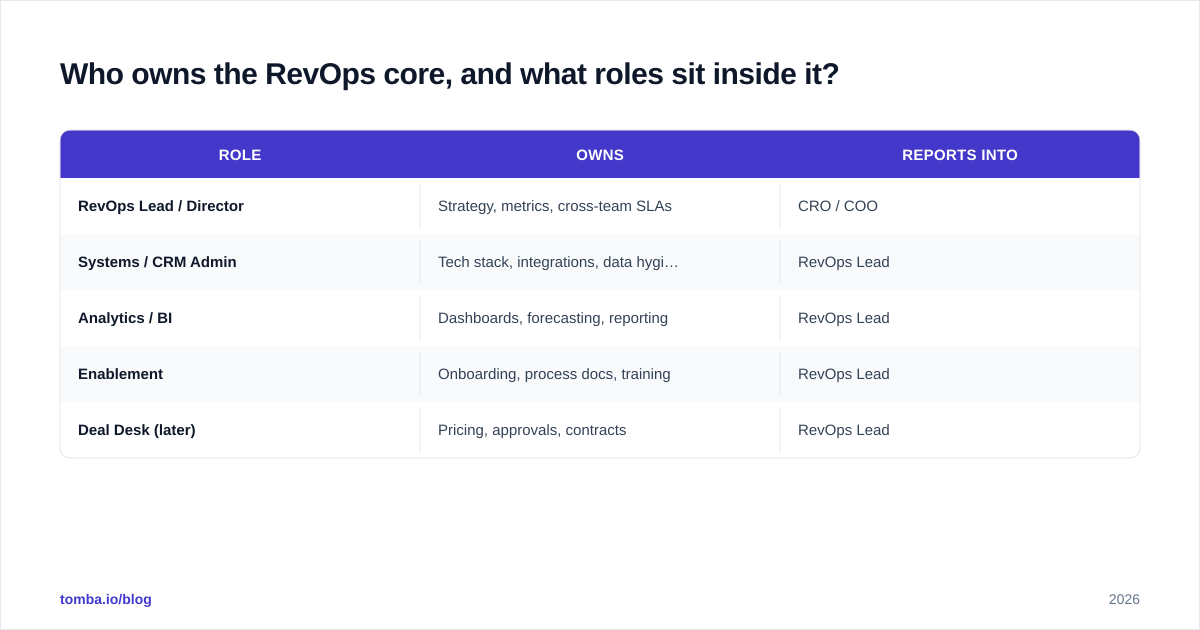
Ownership is the question that kills most RevOps initiatives. The answer: one accountable leader, even if the team is one person to start. Below that leader, the core typically grows into a few specialized roles.
| Role | Owns | Reports into |
|---|---|---|
| RevOps Lead / Director | Strategy, metrics, cross-team SLAs | CRO / COO |
| Systems / CRM Admin | Tech stack, integrations, data hygiene | RevOps Lead |
| Analytics / BI | Dashboards, forecasting, reporting | RevOps Lead |
| Enablement | Onboarding, process docs, training | RevOps Lead |
| Deal Desk (later) | Pricing, approvals, contracts | RevOps Lead |
You do not hire all five on day one. A common and effective starting point is a single RevOps Lead who is also the CRM admin, with analytics borrowed part-time. The mistake is leaving the core ownerless — "everyone owns it" reliably means no one does. Vendors like HubSpot have built entire product lines around this consolidation, which tells you how real the pain is.
What does the RevOps core tech stack look like?#
The stack has layers, and the layers matter more than the logos. From the bottom up:
- System of record — your CRM (Salesforce, HubSpot, Pipedrive). Everything else orbits this.
- Data layer — enrichment, verification, and deduplication that keep records trustworthy.
- Engagement layer — sequencing, cold email, calling, and social tools that act on records.
- Intelligence layer — analytics, forecasting, and increasingly AI assistants reading from the core.
- Automation glue —
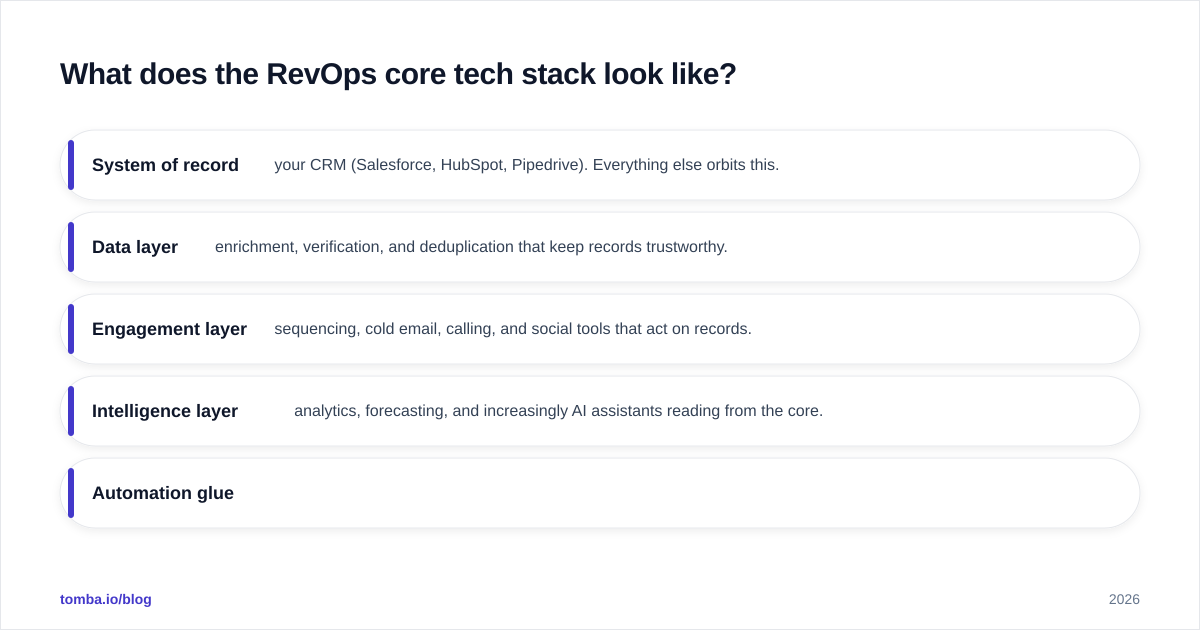
Zapier, Make, or native integrations that move data without humans.
Notice that the data layer sits second from the bottom, directly above the CRM. That placement is deliberate. The most common RevOps failure isn't a missing analytics tool — it's a system of record full of bounced emails, missing titles, and duplicate accounts. No dashboard can fix a foundation that's lying to it.
This is where a tool like the Tomba Email Finder plugs into the core rather than bolting onto the edge. When new accounts enter the CRM, you want verified work emails and firmographics attached automatically — through the Tomba API, a HubSpot integration, or Google Sheets for lighter workflows. The principle: enrich once, at entry, so every downstream team inherits clean data instead of cleaning it themselves.
How do you build a RevOps core in 90 days?#
Don't boil the ocean. Fix the single leakiest part of the funnel first, prove the value, then expand. A pragmatic 90-day sequence:
Days 1–30: Audit and align.
- Map the full lifecycle from first touch to renewal. Find every manual handoff.
- Audit data quality: count duplicates, missing emails, and stale records. This number is your baseline.
- Agree on shared definitions (MQL, SQL, opportunity stages) in writing.
Days 31–60: Consolidate and clean.
- Designate the one source of truth and connect the top three tools to it.
- Run a deduplication and enrichment pass. Verify existing emails before any campaign so you protect email deliverability.
- Automate the worst handoff — usually marketing-to-sales lead routing.
Days 61–90: Measure and iterate.
- Stand up one shared dashboard: pipeline velocity, win rate, and data-quality score.
- Set SLAs and make them visible. A 5-minute lead response SLA beats a 5-hour one by a wide margin.
- Pick the next bottleneck and repeat.
The discipline here is sequencing, not heroics. Each 30-day block delivers something usable, so leadership sees momentum instead of a six-month black box.
What metrics prove the RevOps core is working?#
A RevOps core is only as credible as the numbers it moves. Track a small, honest set rather than a vanity wall:
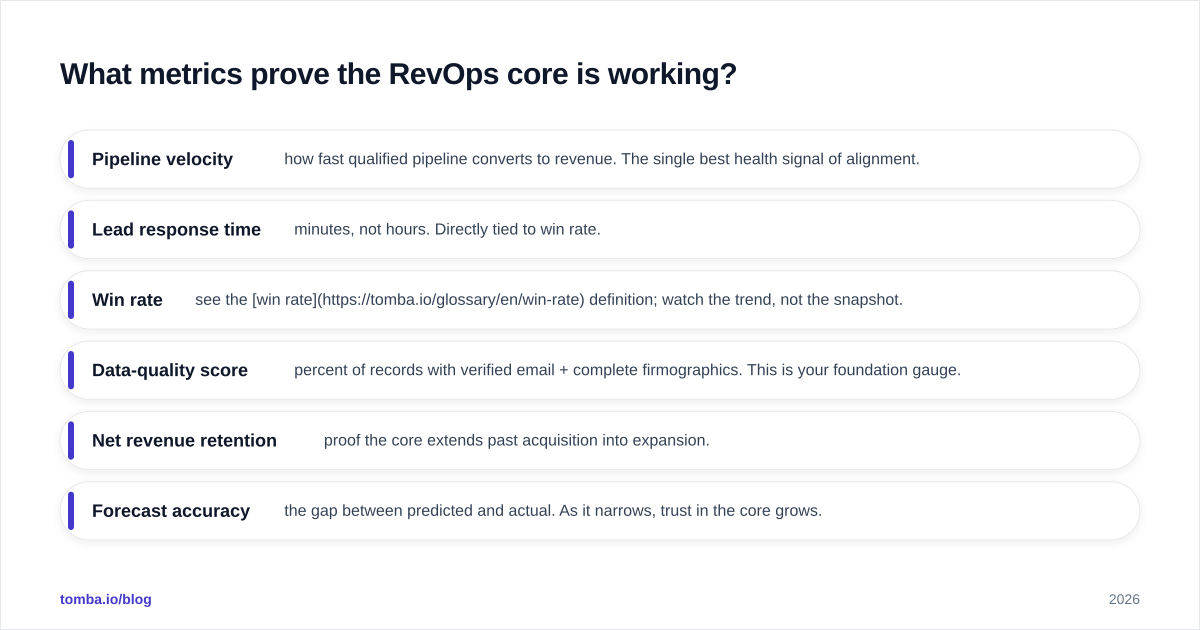
- Pipeline velocity — how fast qualified pipeline converts to revenue. The single best health signal of alignment.
- Lead response time — minutes, not hours. Directly tied to win rate.
- Win rate — see the win rate definition; watch the trend, not the snapshot.
- Data-quality score — percent of records with verified email + complete firmographics. This is your foundation gauge.
- Net revenue retention — proof the core extends past acquisition into expansion.
- Forecast accuracy — the gap between predicted and actual. As it narrows, trust in the core grows.
If the data-quality score is low, treat it as the root cause, not a side issue. A clean record is the atom of every other metric on this list.
Common RevOps core mistakes to avoid#
A few failure patterns show up again and again:
- Buying tools before fixing process. A new platform on a broken process just automates the mistakes faster.
- Leaving the core ownerless. Shared accountability decays into none. Name a leader.
- Ignoring the data layer. Teams obsess over engagement and AI while feeding both dirty records.
- Measuring per-team. If the dashboards don't agree, the teams won't either.
- Big-bang rollouts. Six-month replatforming projects lose executive patience. Ship in 30-day increments.
Most of these trace back to the same instinct — treating RevOps as a tooling project instead of an operating model. The tools are the easy part.
Build your RevOps core on data you can trust#
A RevOps core succeeds or fails on the quality of the records flowing through it. Strategy decks and dashboards don't matter if the email bounces, the title is blank, or the account is duplicated three times. Start at the foundation: enrich and verify your contact data at the point of entry so every team downstream inherits records they can act on.
The Tomba Email Finder is built for exactly that layer of the core — find verified professional emails by name, company, or domain search, then push them straight into your CRM via the Tomba API or native integrations. The free tier gives you 25 searches a month to test the fit, and paid plans start at $49/mo when you're ready to feed the whole engine. Fix the data layer first, and the rest of your RevOps core finally has something solid to stand on.
// get started
Find, verify and enrich your first contacts today
Start on the free plan with 25 searches a month, then scale when your team is ready.
Free plan · No credit card required · GDPR & CCPA
// about the author