Sales Ops vs RevOps: Key Differences and Which You Need
Sales ops vs RevOps: what each team owns, where they overlap, and how to decide which one your company needs first.
Both teams sit behind the sellers. Both care about the CRM, the process and the numbers. So when a company asks whether it needs sales ops or RevOps, the line between them can look blurry.
This guide explains sales ops vs RevOps in plain terms: what each team owns, where they overlap, and how to decide which one your company needs now.
What sales ops does#
Sales operations supports the sales team. The sales operations function exists to help reps spend more time selling and less time on admin. Its work usually covers:
- CRM administration. Fields, stages, permissions and clean data.
- Territories and quotas. Dividing accounts and setting targets with sales leaders.
- Forecasting support. Pipeline reports and forecast roll-ups for managers.
- Sales tools. Picking, setting up and managing tools such as engagement platforms and dialers.
- Process. Lead handoff rules, deal stages and approval flows.
- Compensation support. Commission plans and reporting.
- Enablement support. Onboarding material and playbooks, often with a sales enablement team.
The scope is the sales organization. The main customer of sales ops is the sales team.
What RevOps does#
Revenue operations extends the same idea across the full customer journey. Instead of supporting only sales, RevOps aligns marketing, sales and customer success around shared data, process and goals. Its work usually includes:
- One view of the funnel. From first touch to renewal, in one set of definitions.
- Shared systems. The CRM, marketing automation and customer success tools, connected.
- Lead and account lifecycle. Stages, handoffs and service levels between teams.
- Full-funnel reporting. Pipeline, conversion, retention and revenue in one place.
- Planning. Go-to-market planning, capacity and territory design.
- Data quality. Standards and checks across every system.
The scope is the whole revenue engine. The customers of RevOps are marketing, sales and customer success.
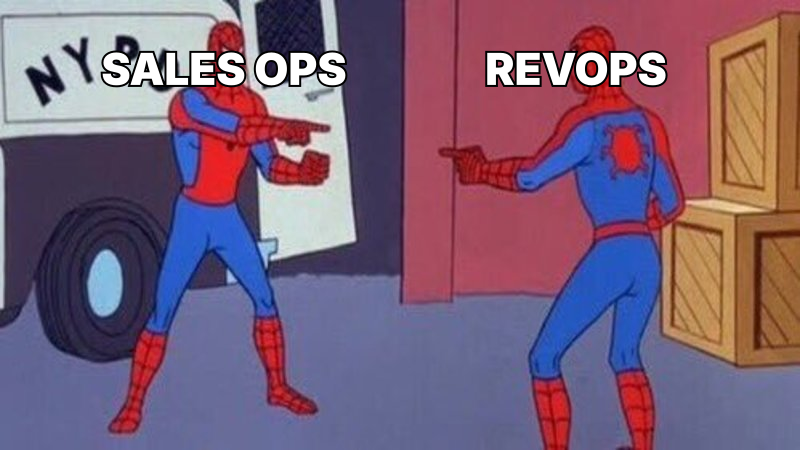
Sales ops vs RevOps: the key differences#
| Area | Sales ops | RevOps |
|---|---|---|
| Scope | The sales team | Marketing, sales and customer success |
| Main goal | Make sellers more productive | Align the whole revenue process |
| Data view | Pipeline and sales activity | The full customer lifecycle |
| Tools | Sales tools and CRM | The whole revenue tech stack |
| Reports to | Head of sales | Often a chief revenue officer or COO |
| Typical focus | Quota, forecast, rep efficiency | Funnel flow, retention, revenue growth |
The titles vary by company. Some firms call a team sales ops and give it a RevOps job. Others do the reverse. Look at what the team owns, not at the label.
Where sales ops and RevOps overlap#
The two groups share a lot of ground.
- Both manage the CRM and care about data quality.
- Both build reports and dashboards.
- Both design handoff rules and lead routing.
- Both pick and manage tools.
- Both support forecasting.
Because of this overlap in sales ops vs RevOps, many companies grow from sales ops into RevOps. They start with a person who fixes the CRM, then add marketing and customer success as the process gets more connected.
Sales ops vs RevOps: which one does your company need?#
Use these questions to decide.
Sales ops may be enough if:
- Your main problems are inside the sales team, such as territories, quotas and forecasting.
- Marketing and customer success already work well with sales.
- You are small, and one person can handle the CRM and the reports.
RevOps may fit better if:
- Marketing and sales argue about lead quality or definitions.
- You cannot see one number for conversion from lead to renewal.
- Data lives in separate tools that do not match.
- Handoffs between teams lose leads or slow deals down.
- You are scaling, and every team is adding its own tools.
You do not have to choose forever. Start with the problem that costs you the most, and widen the scope as it grows.
Skills for sales ops vs RevOps roles#
Sales ops people often have strengths in CRM setup, forecasting and sales process. RevOps people add skills in cross-team planning, data modeling and systems that join marketing, sales and service data.
Both benefit from the same basics:
- Clear, written definitions for stages and fields
- Comfort with spreadsheets and BI tools
- Good judgment about which tools to add and which to drop
- The ability to work with sellers, marketers and executives
Data quality: the shared job#
Whichever side of the sales ops vs RevOps choice you pick, clean data is the base. Duplicate records, missing emails and old contacts make every report doubtful and every handoff slower.
A few simple steps help both teams:
- Verify emails. Use an email verifier before contacts enter campaigns or sequences.
- Fill the gaps. Add missing fields with data enrichment, so routing and scoring rules have what they need.
- Connect the tools. The Tomba integrations page shows the systems Tomba works with.
- Process lists in bulk. Use bulk tasks for large files.
- Write the rules down. Standards that live in a document survive staff changes.
How to start with sales ops vs RevOps#
If you are building the function from scratch, keep it small.
- Pick one owner for the CRM and its data.
- List the three biggest handoff problems between teams.
- Agree on shared definitions for lead, opportunity and customer.
- Build one report that shows the full funnel.
- Review it monthly with sales, marketing and customer success.
Add roles only when the work needs them.
FAQ#
What is the difference between sales ops and RevOps?#
Sales ops supports the sales team. RevOps covers marketing, sales and customer success, with one shared view of the revenue process.
Is RevOps just a new name for sales ops?#
Not exactly. They share many tasks, but RevOps has a wider scope across the full customer lifecycle.
Which should a startup hire first?#
Usually one operations person who owns the CRM and the data. Their scope can grow from sales into RevOps as the company grows.
Who does RevOps report to?#
It varies. Many companies place it under a chief revenue officer, a COO or a CEO, so that it stays neutral between teams.
Do I need both in the sales ops vs RevOps debate?#
Often one team does both jobs. Larger companies may keep a sales ops group inside a wider RevOps organization.
// start free
See who Tomba finds at any company
Type a company's domain to see its people, their roles and verified work emails, each with the pages it was found on. Free account, no card.
Free plan · No credit card required · GDPR & CCPA
// about the author