6sense vs Demandbase 2026: Which ABM Platform Wins?
6sense vs Demandbase is the defining ABM platform debate of 2026. Here's an honest, side-by-side breakdown of intent data, pricing, and fit before you sign a multi-year contract.
6sense vs Demandbase 2026: Which ABM Platform Wins?
TL;DR
- 6sense leads on predictive intent and AI-driven account scoring, with the deepest behavioral signal graph in the ABM category.
- Demandbase wins on advertising execution, account-based display orchestration, and native sales intelligence after the InsideView and DemandMatrix acquisitions.
- Pricing is the great unknown — both vendors quote custom and rarely come in under $60K per year for mid-market deployments.
- Revenue teams that already have strong outbound talent want 6sense. Brand-led marketing orgs that need ABM advertising at scale want Demandbase.
- Neither platform replaces a contact database. You still need a verifiable email finder to turn account-level intent into actual conversations.
What is the real 6sense vs Demandbase question in 2026?#
The 6sense vs Demandbase debate is not really about features anymore. Both vendors check almost every box on an enterprise ABM RFP: intent data, account identification, predictive scoring, segmentation, advertising, CRM sync, and reporting. The honest question is which platform fits the way your revenue team actually works.
6sense built its reputation on the "dark funnel" — the idea that 70% of buying activity happens before a prospect ever fills out a form. Its platform exists to surface that hidden activity and tell sales who to call this week.
Demandbase, especially after merging with Engagio and acquiring InsideView and DemandMatrix, positioned itself as the end-to-end ABM operating system. Less "tell me who to call" and more "run the entire account-based motion, including the ads."
If you only remember one thing: 6sense is a prediction engine bolted to a sales workflow. Demandbase is an advertising and orchestration engine bolted to a sales workflow. They overlap heavily, but the center of gravity is different.
How do 6sense and Demandbase compare head-to-head?#
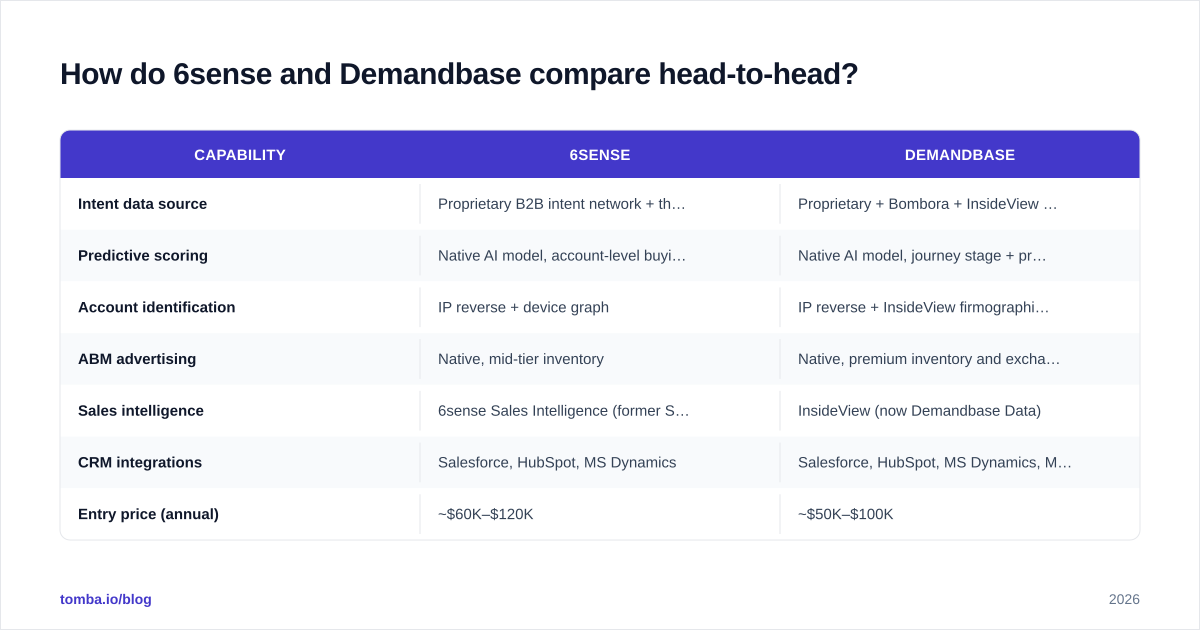
Here is the side-by-side that matters once you get past the marketing pages.
| Capability | 6sense | Demandbase |
|---|---|---|
| Intent data source | Proprietary B2B intent network + third-party (Bombora) | Proprietary + Bombora + InsideView signals |
| Predictive scoring | Native AI model, account-level buying stage | Native AI model, journey stage + propensity |
| Account identification | IP reverse + device graph | IP reverse + InsideView firmographics |
| ABM advertising | Native, mid-tier inventory | Native, premium inventory and exchanges |
| Sales intelligence | 6sense Sales Intelligence (former Slintel) | InsideView (now Demandbase Data) |
| CRM integrations | Salesforce, HubSpot, MS Dynamics | Salesforce, HubSpot, MS Dynamics, Marketo |
| Entry price (annual) | ~$60K–$120K | ~$50K–$100K |
| Enterprise pricing | Six figures, frequently $150K+ | Six figures, frequently $120K+ |
| Free tier | No (limited trial only) | No (limited trial only) |
| Best for | Outbound-led revenue teams | Brand + advertising-led marketing teams |
Neither vendor publishes hard pricing, so the numbers above reflect what teams report on G2, Capterra, and procurement leaks throughout 2025-2026. Always assume an annual commitment and a multi-seat minimum.
Which platform has better intent data?#
This is where the religious wars start. Both vendors claim the largest, most accurate intent graph. Here is what is actually different.
6sense runs its own bidstream and co-op network and supplements with Bombora. The proprietary signal is dense in tech and software verticals because that's where its early customers concentrated. The predictive model — what 6sense calls the "6QA" (6sense Qualified Account) — has been in market longer and is generally considered the more mature classifier.
Demandbase also blends proprietary signal with Bombora, and after acquiring DemandMatrix and InsideView it now layers in technographic and firmographic context most ABM tools cannot match natively. The Demandbase One model leans heavier on journey stage than raw probability.
In practice, the intent quality is closer than either marketing team will admit. The differentiator is what you do with the signal:
- 6sense pushes signal aggressively into the seller workflow — Salesforce widgets, Chrome extension, Slack alerts. SDRs feel the platform daily.
- Demandbase pushes signal into orchestration — audiences, ad targeting, web personalization. Marketers feel the platform daily.
If your AEs and SDRs would actually open a daily "who to call" feed, 6sense usually wins. If your marketers will spend the money on display and run real ABM campaigns, Demandbase usually wins.
Is 6sense or Demandbase better for advertising?#
Demandbase. This is not close.
Demandbase has been building account-based advertising since 2007 and owns premium inventory relationships and an exchange that 6sense does not match. If your strategy depends on running display campaigns to a target account list — with proper account-level reporting, frequency caps, and creative rotation — Demandbase is the more credible choice.
6sense does offer native advertising and improved it significantly over the last two years, but most reviewers still describe it as "good enough" rather than category-leading. Teams running serious ad spend usually pair 6sense with a dedicated DSP like StackAdapt or Terminus instead of relying on 6sense's native ad product.
Quick test: if more than 30% of your planned ABM budget is going to paid media, lean Demandbase. If less than 30%, the advertising gap matters less.
What about sales intelligence and contact data?#
Neither platform is a contact database, despite what their sales reps imply.
6sense Sales Intelligence (the former Slintel product) and Demandbase Data (the former InsideView product) both ship with B2B contact records, technographics, and firmographics. Coverage is decent at the enterprise end and thin in mid-market, SMB, and most non-US geographies.
Three honest realities about ABM-platform contact data in 2026:
- Bulk exports are throttled, often to a few thousand records per quarter, even on six-figure contracts.
- Email deliverability on platform-supplied contacts is meaningfully lower than from purpose-built finders. Plan to verify every address.
- Phone coverage is shallow outside North America.
This is why mature ABM stacks pair 6sense or Demandbase with a dedicated finder for the actual outreach motion. Tomba's email finder and email verifier are designed specifically for the "I have an account list, I need verified contacts at the right titles" workflow that ABM platforms create.

The pattern most RevOps teams settle on: ABM platform surfaces the in-market accounts, finder + verifier produces the contact list, sales engagement runs the cadence.
How does pricing actually shake out?#
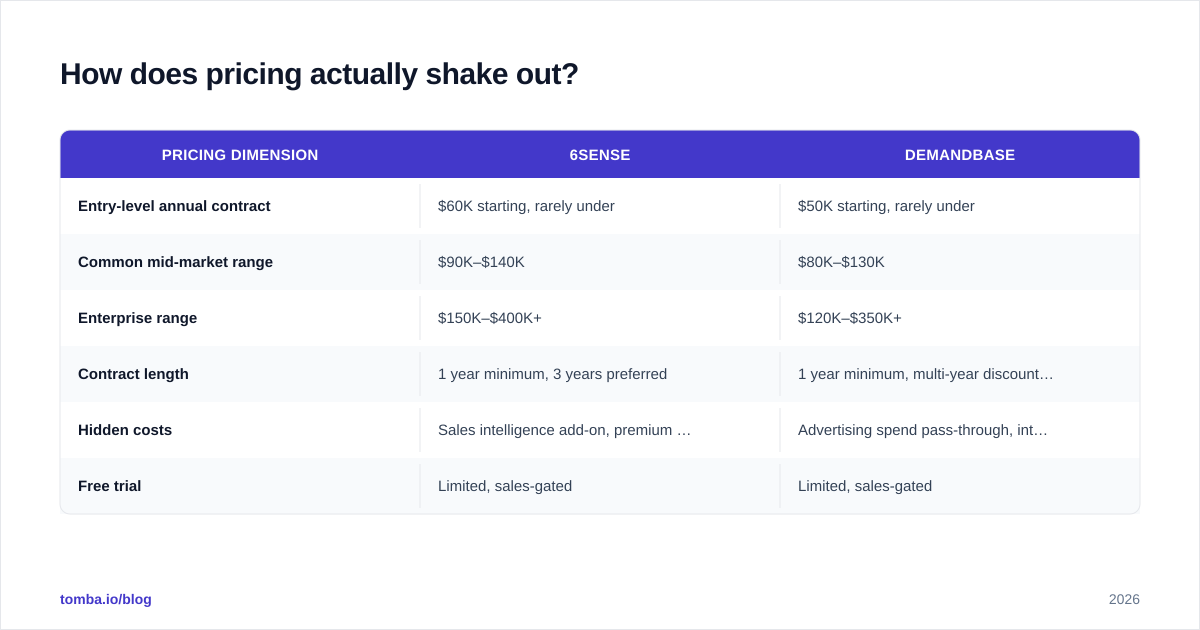
Both vendors price on annual contracts with custom quotes, so anyone telling you a specific public number is guessing. Here is the realistic 2026 picture from procurement conversations and review-site disclosures.
| Pricing dimension | 6sense | Demandbase |
|---|---|---|
| Entry-level annual contract | $60K starting, rarely under | $50K starting, rarely under |
| Common mid-market range | $90K–$140K | $80K–$130K |
| Enterprise range | $150K–$400K+ | $120K–$350K+ |
| Contract length | 1 year minimum, 3 years preferred | 1 year minimum, multi-year discounted |
| Hidden costs | Sales intelligence add-on, premium intent | Advertising spend pass-through, integrations |
| Free trial | Limited, sales-gated | Limited, sales-gated |
A few things to negotiate:
- Push for a 1-year contract on first deployment. Both vendors will resist; both will eventually agree if you walk.
- Cap the user seat count for year one. Both upsell aggressively on seats.
- Get the advertising fees and intent volumes in writing. "Unlimited" rarely is.
- Insist on data export rights. You should own the intent signal history if you churn.
For comparison, a comparable budget at the SDR-tooling layer (a finder + verifier + a sales engagement tool) sits closer to $15K–$30K annually. ABM platforms only pay back when your average deal size and sales cycle justify the premium — typically $25K+ ACV and 60+ day cycles.
Which one wins on integrations?#
Both vendors integrate cleanly with Salesforce, HubSpot, and Marketo. Demandbase has historically integrated better with Marketo (legacy of the Engagio team) and Adobe. 6sense has historically integrated better with Outreach, Salesloft, and most sales-engagement platforms.
The integration story matters more than the brochure suggests. The platform you choose lives or dies on whether SDRs see the data inside the tools they already use:
- 6sense's Salesforce widget is denser and updates faster.
- Demandbase's Marketo integration handles smart-list updates more reliably.
- Both ship usable Chrome extensions; both are improving rapidly.
- Both expose APIs, but 6sense's API documentation is more developer-friendly.
If your team lives in Salesforce + Outreach + Slack, 6sense will feel native. If your team lives in Marketo + Adobe + a DSP, Demandbase will feel native.
What do real customers say in 2026?#
Pulling honest signal from G2, Gartner Peer Insights, and Reddit r/B2BMarketing through Q1 2026:
Where 6sense wins reviews:
- AI predictions and dashboards feel more polished
- Sales adoption is higher
- The Chrome extension is a daily-driver
- Onboarding is faster (4–8 weeks typical)
Where 6sense loses reviews:
- Advertising product is "fine"
- Pricing creep on renewal
- Sales intelligence coverage thin outside North America
Where Demandbase wins reviews:
- Advertising performance is genuinely best-in-class
- Site personalization is a hidden strength
- Account-based reporting is richer
- More flexible on contract structure
Where Demandbase loses reviews:
- UI feels stitched together across acquired products
- SDR adoption is harder
- Onboarding takes 8–14 weeks
- "Demandbase One" branding masks distinct legacy products
The honest summary: 6sense gets higher daily active usage from sales; Demandbase gets higher marketing satisfaction and better ad outcomes.
When should you skip both?#
This is the question neither vendor wants to answer. Skip ABM platforms entirely if any of these are true:
- Annual contract value under $20K (the math does not work)
- Sales cycle under 30 days (predictive lead time has no value)
- TAM under 5,000 accounts (you can run a target-account list in a spreadsheet)
- No dedicated RevOps person to own the deployment (the platform will fail)
- You have not yet nailed your ICP (you'll waste a year of signal on the wrong accounts)
Most teams under 50 reps get more ROI from a clean ICP + a strong B2B database + a verified outbound motion than from a six-figure ABM platform. ABM platforms compound value above a threshold; below it, they just compound cost.
How do I pick between 6sense vs Demandbase?#
A short decision tree that actually works in 2026:
- Does more than 30% of your ABM budget go to paid media? → Demandbase
- Is your SDR team larger than your demand-gen team? → 6sense
- Is Marketo your primary marketing automation platform? → Slight lean Demandbase
- Is Outreach or Salesloft your primary sales engagement platform? → Slight lean 6sense
- Are you replacing a failed ABM deployment? → Demandbase (more configurable for second attempts)
- Are you greenfield with no current ABM tooling? → 6sense (faster time-to-value)
- Is your CEO going to demand ROI numbers in 90 days? → Neither. Buy time.
The wrong question is "which is better." The right question is "which one will my organization actually use." Both platforms have customers extracting enormous value, and both have shelfware deployments costing $200K a year.
You can also explore lighter-weight options. If 6sense and Demandbase feel too heavy, our 6sense alternative and Demandbase alternative breakdowns cover what mid-market teams are choosing instead.
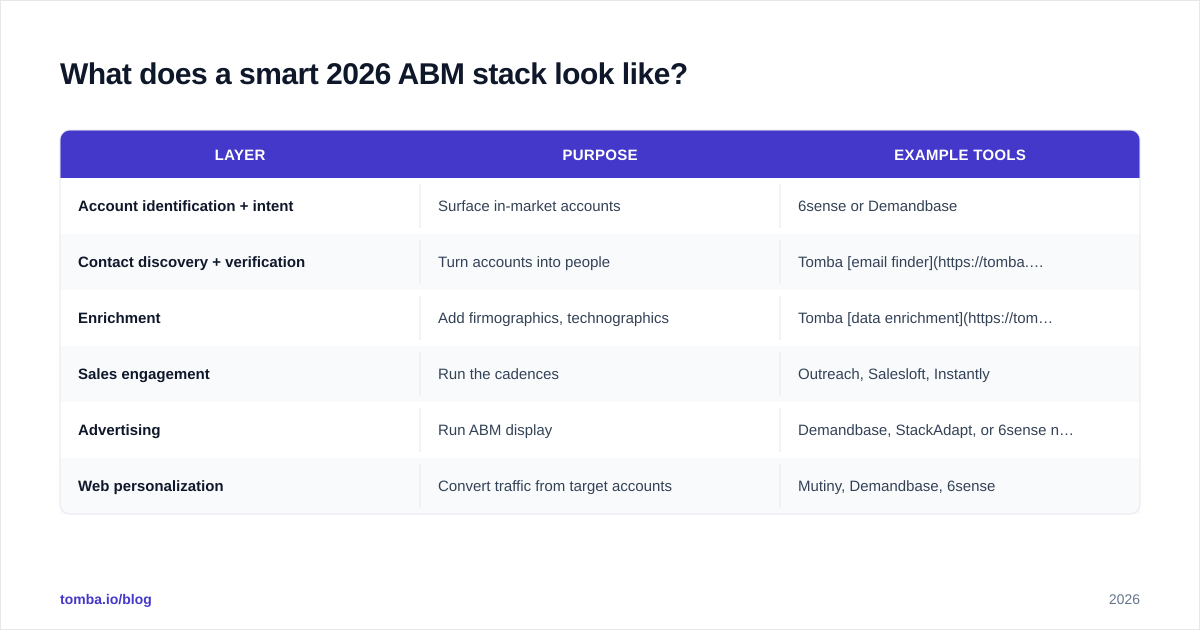
What does a smart 2026 ABM stack look like?#
The teams getting actual revenue out of ABM in 2026 are running a layered stack, not a monolith:
| Layer | Purpose | Example tools |
|---|---|---|
| Account identification + intent | Surface in-market accounts | 6sense or Demandbase |
| Contact discovery + verification | Turn accounts into people | Tomba email finder, email verifier |
| Enrichment | Add firmographics, technographics | Tomba data enrichment |
| Sales engagement | Run the cadences | Outreach, Salesloft, Instantly |
| Advertising | Run ABM display | Demandbase, StackAdapt, or 6sense native |
| Web personalization | Convert traffic from target accounts | Mutiny, Demandbase, 6sense |
The ABM platform is the brain. The finder, verifier, and engagement tools are the hands. Skip either layer and the motion breaks.
Final verdict#
Pick 6sense if you are sales-led, your SDRs need a daily "who to call" feed, you live in Salesforce + Outreach, and predictive accuracy matters more than ad reach.
Pick Demandbase if you are marketing-led, ABM advertising is a real budget line, you live in Marketo + Adobe, and orchestration across channels matters more than predictive depth.
Pick neither if your ACV, TAM, or RevOps maturity does not justify the spend yet. Build the contact and outbound motion first, then layer ABM when you can prove it pays back.
Whichever platform you choose, the bottleneck is rarely intent data — it's the verified contact data downstream of the account list. Tomba's email finder plugs straight into either 6sense or Demandbase exports, returns verified work emails at the titles you care about, and starts at $49/month so the contact layer doesn't add another $50K to your ABM bill. Pricing details and a free 25-search tier are on the site — bring your ABM target-account list and see whether the contact layer is what's actually been holding back your pipeline.
// get started
Find, verify and enrich your first contacts today
Start on the free plan with 25 searches a month, then scale when your team is ready.
Free plan · No credit card required · GDPR & CCPA
// about the author