7 Stages of the Sales Cycle: The 2026 Playbook
Map every deal to the 7 stages of the sales cycle. Get exit criteria, conversion benchmarks, and the tools that move reps from prospecting to referral in 2026.
TL;DR#
- The 7 stages of the sales cycle are prospecting, contact, qualification, presentation, objection handling, closing, and follow-up/referral.
- Each stage needs an exit criterion — a specific buyer action — before the deal moves forward. "Good feeling" is not a stage gate.
- Top B2B teams in 2026 hit roughly 25-30% lead-to-meeting, 40-50% meeting-to-opportunity, and 20-25% opportunity-to-close. If your numbers are below this, the leak is almost always in stages 1-3, not closing.
- The biggest 2026 shift is the collapse of stage 1 (prospecting) and stage 2 (contact) into a single signal-driven motion powered by intent data and verified contact discovery.
- A clean cycle is faster than a long one. Reps with strict exit gates close 28% faster than reps who advance deals on gut feel.
What is the sales cycle?#
The sales cycle is the repeatable process a deal moves through from "we don't know this buyer exists" to "they've bought, used the product, and sent us a referral." It is not the same as a buyer's journey (that's the buyer's perspective) and not the same as a sales funnel (that's an aggregate view).
Think of the sales cycle as a relay race. Each stage hands the baton to the next runner only when a clear condition is met. Skip a handoff and the runner drops the baton — meaning the deal stalls in your CRM for three months while the AE blames marketing.
The seven-stage model has been the dominant B2B framework since the 1990s. It survived because it maps cleanly to how complex purchases actually work: discovery, evaluation, decision, and post-sale expansion. Industry sources from HubSpot and Salesforce still teach variants of it for a reason — it's specific enough to coach against and loose enough to fit most B2B motions.
What are the 7 stages of the sales cycle?#
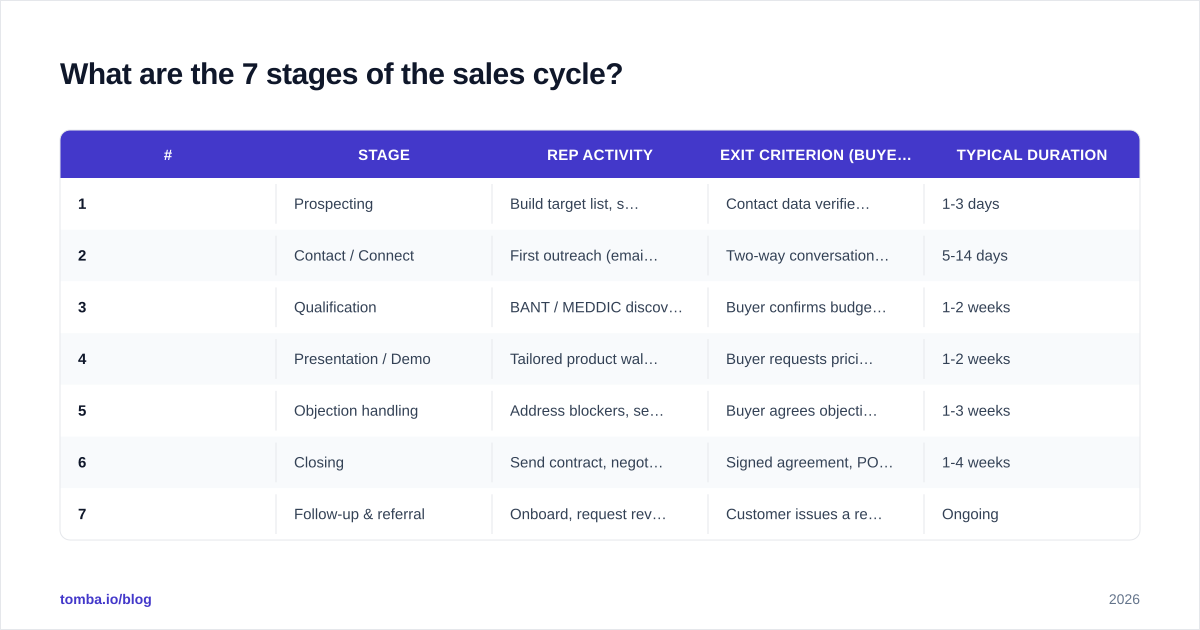
Here is the standard taxonomy, with the buyer action that gates exit from each stage.
| # | Stage | Rep activity | Exit criterion (buyer action) | Typical duration |
|---|---|---|---|---|
| 1 | Prospecting | Build target list, score accounts | Contact data verified, ICP match confirmed | 1-3 days |
| 2 | Contact / Connect | First outreach (email, call, LinkedIn) | Two-way conversation initiated | 5-14 days |
| 3 | Qualification | BANT / MEDDIC discovery | Buyer confirms budget, authority, need, timing | 1-2 weeks |
| 4 | Presentation / Demo | Tailored product walkthrough | Buyer requests pricing or next-step proposal | 1-2 weeks |
| 5 | Objection handling | Address blockers, send proof | Buyer agrees objections are resolved | 1-3 weeks |
| 6 | Closing | Send contract, negotiate terms | Signed agreement, PO issued | 1-4 weeks |
| 7 | Follow-up & referral | Onboard, request review, ask for intro | Customer issues a referral or renews | Ongoing |
Total cycle length for B2B SaaS in 2026 averages 84 days according to repeated G2 buyer surveys — and the gap between the fastest and slowest quartile is about 3x. The difference is almost entirely how strictly teams enforce exit criteria.
What happens in stage 1: prospecting?#
Prospecting is where you decide who is worth talking to. It is not cold-calling random lists from 2019 — that's a sign your prospecting layer is broken.
A modern prospecting stage in 2026 has three jobs:
- Define the ICP — firmographics (industry, headcount, revenue, tech stack) plus a triggering signal (recent funding, new hire in a specific role, a product launch, intent data from review sites).
- Source contacts — pull verified emails, phone numbers, and LinkedIn URLs for the relevant buying committee, not just the first name on the org chart.
- Score and prioritize — rank accounts by ICP fit × signal strength. Top decile gets 1:1 outreach; the long tail gets a lighter sequence.
This is where a verified email finder earns its keep. If your prospector spends 40 minutes per account hunting for contact info and ends up emailing an address that bounces, the entire downstream cycle is poisoned before stage 2 begins. Pair the finder with an email verifier to drop your bounce rate below 2% — anything higher and your domain reputation starts taking on water.
Exit criterion: named contacts, verified email + phone, ICP match confirmed in writing in the CRM. If a rep can't paste those four things into the deal record, the deal does not advance.
What happens in stage 2: contact?#
Stage 2 is the first two-way conversation. The goal is not to sell anything — it is to earn 20 minutes of the prospect's time for discovery.
The 2026 reality: response rates to single-channel cold email have collapsed to 1-3% for unwarmed sequences. Multi-channel sequences (email + LinkedIn + phone) running across 14-21 days are pulling 8-12% reply rates when the contact data is clean and the message is tied to a real signal.
What "contact" looks like in practice:
- Email 1: signal-based opener referencing something specific (their recent fundraise, a job posting, a product change).
- LinkedIn connection + light voice note 2-3 days later.
- Email 2: short, asks for the meeting.
- Call attempt with a voicemail and follow-up text.
- Email 3: breakup or pattern interrupt.
If you are still running 9-step "just bumping this" email sequences in 2026, you are training prospects to mark you as spam. The response rate ceiling on this approach is about 2%. Cut the sequence in half and tie every touch to a real trigger.
Exit criterion: prospect replies with intent (a question, an objection, a scheduling link, a "not now but Q3"). Auto-replies don't count.
What happens in stage 3: qualification?#
Qualification is where 60% of B2B pipeline leaks. Reps either skip it (because the prospect "seems interested") or run it as an interrogation that kills the relationship.
The job of stage 3 is to disqualify aggressively. Every deal you carry past qualification without a real budget, real authority, and real timing is a deal that will stall in stage 5 or 6 and rot your forecast.
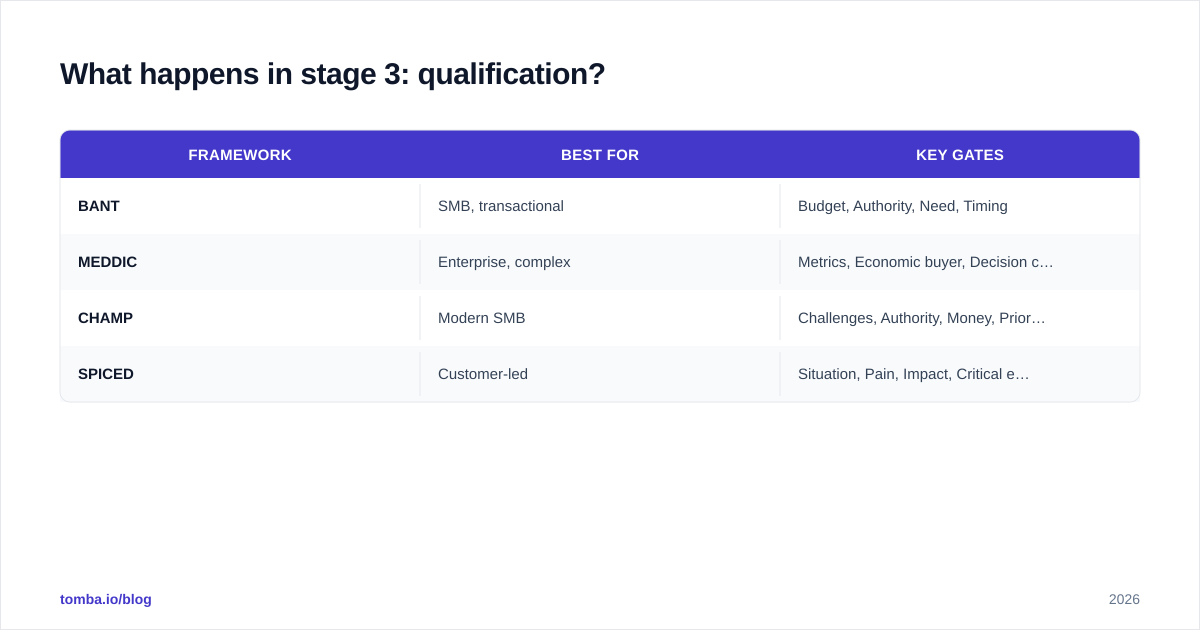
Pick one framework and enforce it. The most common in 2026:
| Framework | Best for | Key gates |
|---|---|---|
| BANT | SMB, transactional | Budget, Authority, Need, Timing |
| MEDDIC | Enterprise, complex | Metrics, Economic buyer, Decision criteria, Decision process, Identify pain, Champion |
| CHAMP | Modern SMB | Challenges, Authority, Money, Prioritization |
| SPICED | Customer-led | Situation, Pain, Impact, Critical event, Decision |
Whichever you pick, document the answers in the deal record. If a deal is in stage 4 without a documented economic buyer, your CRM is lying to you.
Exit criterion: all framework fields filled in by the buyer (not the rep guessing). Champion identified by name. Compelling event with a date.
What happens in stage 4: presentation?#
A presentation is not a feature tour. It is a tailored argument that this product solves the specific pain documented in stage 3.
Three patterns separate good demos from bad ones in 2026:
- Recap before reveal. Start by replaying the buyer's stated pains and success criteria. If you can't do this in two sentences, you didn't qualify hard enough.
- Show outcomes, not screens. Lead with the dashboard the buyer's CFO will see, not the admin settings page.
- End with a mutual action plan. Walk out with a date for the next step and a named owner on the buyer's side.
Tools matter less than discipline here. A bad demo on Gong-recorded Zoom is still a bad demo. That said, recording every call and tagging objections is now table stakes — without it you can't coach reps out of bad habits.
Exit criterion: the buyer asks "what would this cost for our team?" or requests a proposal. If they don't, the demo was a product education session, not a sales call.
What happens in stage 5: objection handling?#
Objections aren't a stage that happens after the demo — they show up throughout. But there's a distinct phase between "send me a proposal" and "let's sign" where the deal lives or dies on how well you handle pushback.
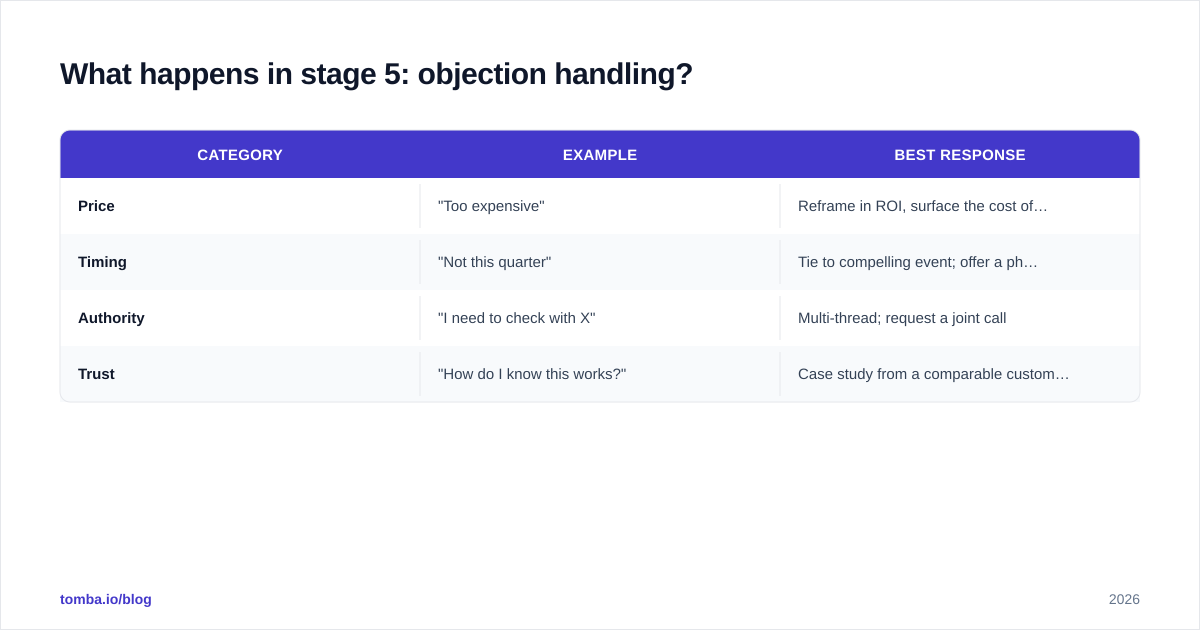
The four objection categories in B2B 2026:
| Category | Example | Best response |
|---|---|---|
| Price | "Too expensive" | Reframe in ROI, surface the cost of doing nothing |
| Timing | "Not this quarter" | Tie to compelling event; offer a phased start |
| Authority | "I need to check with X" | Multi-thread; request a joint call |
| Trust | "How do I know this works?" | Case study from a comparable customer + pilot terms |
The mistake reps make is treating every objection as a price objection. A "too expensive" almost always masks a "not convinced of the value" or "haven't sold this internally." If you discount before you diagnose, you train every future buyer to fake a price objection.
For data-driven objection handling — "show me your accuracy numbers vs the competitor we already use" — you need real proof, not marketing claims. Tomba publishes its data sources and accuracy methodology specifically because B2B buyers ask this in stage 5.
Exit criterion: the prospect verbally confirms the objection is resolved. Not "I think we're good" — an explicit "yes, that addresses my concern."
What happens in stage 6: closing?#
Closing is the most overhyped stage. By the time you're here, the deal is mostly won or lost — closing is about not breaking it.
The 2026 closing playbook:
- Send the contract within 24 hours of verbal yes. Every day of delay is a chance for a competing priority to surface.
- Pre-negotiate procurement. Ask in stage 3 who the procurement contact is. Brief them before the contract lands.
- Default to mutual close plans. A shared doc with each step, owner, and date keeps the deal off the rocks.
- Hold the line on terms. If you discount in stage 6 without a concession, you've trained the buyer for the renewal.
The single biggest closing-stage failure is "going dark" — the buyer stops responding for two weeks. The fix isn't more follow-up; it's having multi-threaded the deal in stages 3-4 so you have other contacts who can tell you what's actually happening internally.
Exit criterion: signed contract, PO issued, kickoff scheduled.
What happens in stage 7: follow-up and referral?#
Stage 7 is where most teams quit and where most revenue lives. A customer in their first 90 days is the highest-trust referral source you will ever have.
What stage 7 looks like done well:
- Day 0-7: kickoff, success criteria documented, executive sponsor briefed.
- Day 30: first-value check-in. Ask "what would make this a 10/10 so far?"
- Day 60: review on G2 or Capterra requested.
- Day 90: referral ask — "who else in your network has this problem?"
- Day 180+: expansion conversation begins.
Referrals close 3x faster than cold outbound and have ~70% higher win rates per consistent Gartner survey data. If you don't have a structured stage 7, you are leaving the easiest revenue on the table to chase cold leads.
Enrichment tools help here too — when your champion moves to a new company, you want to know within a week, not a quarter. A data enrichment feed against your customer list catches role changes and triggers a "follow them to the new account" play automatically.
Exit criterion: customer has issued at least one referral or renewed/expanded.
How long should each stage take in 2026?#
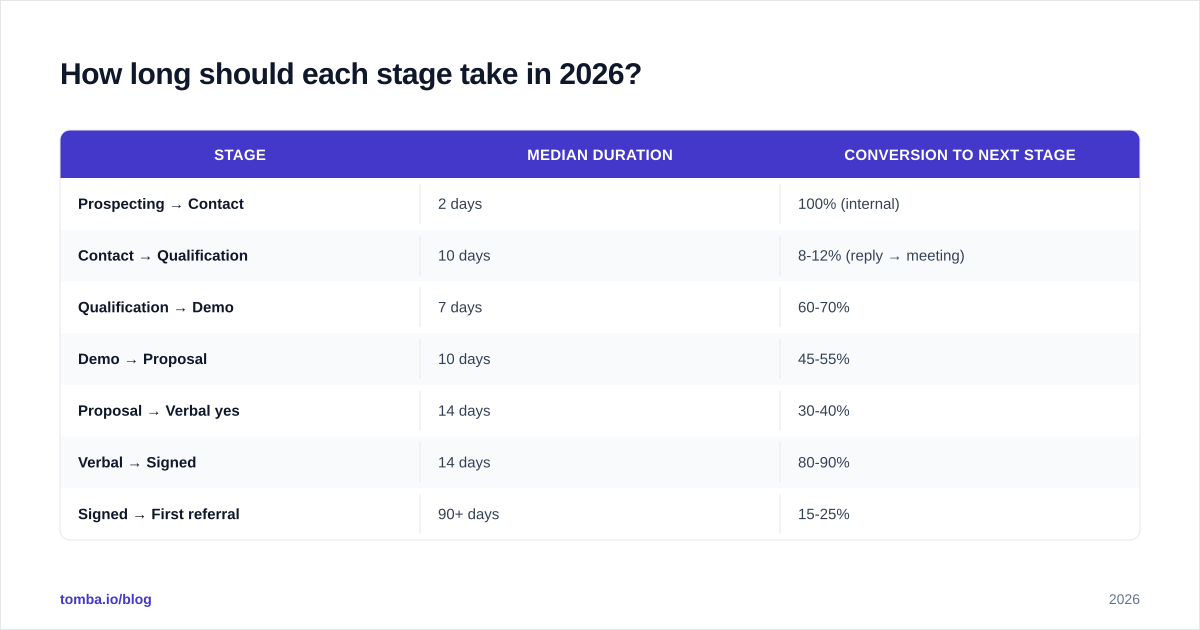
Benchmarks vary by segment. Here are reasonable 2026 medians for B2B SaaS, $10K-$100K ACV:
| Stage | Median duration | Conversion to next stage |
|---|---|---|
| Prospecting → Contact | 2 days | 100% (internal) |
| Contact → Qualification | 10 days | 8-12% (reply → meeting) |
| Qualification → Demo | 7 days | 60-70% |
| Demo → Proposal | 10 days | 45-55% |
| Proposal → Verbal yes | 14 days | 30-40% |
| Verbal → Signed | 14 days | 80-90% |
| Signed → First referral | 90+ days | 15-25% |
If your numbers are wildly off in one stage, that's the stage to fix. Don't rebuild the cycle — surgical changes beat full overhauls.
What's the biggest 2026 change to the sales cycle?#
Stages 1 and 2 are collapsing. Five years ago, prospecting was a Monday-morning list-building exercise. Today, the best teams treat prospecting as a continuous, signal-driven motion: a buyer hires a new VP of RevOps → an enrichment platform pings the AE → outreach goes out within 2 hours. The list isn't built; it builds itself.
This shift demands two things most teams still don't have:
- A verified contact layer that updates in near-real-time as people change jobs.
- A signal layer that surfaces buying intent before the prospect is in-market.
If either layer is missing, the 7-stage cycle still works — it just runs at 2019 speeds.
Build a stage-gated pipeline with verified data#
The 7 stages of the sales cycle only work if every stage has a hard exit criterion and the underlying data is clean. The two failure modes are the same in 2026 as they were a decade ago: reps advancing deals on hope, and reps wasting time on bad contact data.
Tomba's Email Finder fixes the second failure mode at the source. Verified emails, accurate firmographics, and an API that drops into HubSpot, Salesforce, Pipedrive, or your own CRM mean stage 1 takes minutes instead of hours — and stage 2 actually reaches the buyer. Start free with 25 searches a month, scale to Starter at $49/mo when your pipeline does. Pair it with a strict exit-criterion checklist and your cycle will move faster than your competitors' — without adding a single headcount.
// get started
Find, verify and enrich your first contacts today
Start on the free plan with 25 searches a month, then scale when your team is ready.
Free plan · No credit card required · GDPR & CCPA
// about the author