7 Steps of the Sales Process: The Complete 2026 Playbook
The 7 steps of the sales process haven't changed in 100 years — but how you run them has. Here's the modern 2026 playbook with benchmarks, tools, and templates.
7 Steps of the Sales Process: The Complete 2026 Playbook
TL;DR
- The classic 7 steps of the sales process — prospecting, preparation, approach, presentation, handling objections, closing, follow-up — still describe how B2B deals actually move in 2026.
- What changed is the toolchain. AI research, intent signals, and verified contact data have collapsed the prospecting and preparation stages from days to minutes.
- Reps who skip steps (especially preparation and follow-up) lose 4-6x more deals than reps who run the full sequence.
- The single highest-leverage step is preparation — Gartner data shows buyers spend only 5% of their journey with sellers, so the 95% you spend prepping matters more than the call itself.
- Use this playbook as a checklist: every deal in your pipeline should map to one of the seven steps, and every stage should have an exit criterion.
What are the 7 steps of the sales process?#
The 7 steps of the sales process are the repeatable, stage-gated activities a salesperson runs to move a stranger into a paying customer. The framework dates back to Dubinsky's 1918 sales training manuals, and despite a century of "everything has changed" think-pieces, the underlying logic still holds because it mirrors how buyers actually decide.
Here they are, in order:
- Prospecting — finding fit accounts and the right contacts inside them
- Preparation — researching the prospect, their company, and their trigger
- Approach — making first contact (email, call, LinkedIn, referral)
- Presentation — demonstrating how your product solves their problem
- Handling objections — surfacing and resolving concerns
- Closing — asking for the business and getting commitment
- Follow-up — onboarding, expansion, and referral capture
Every modern sales methodology — MEDDIC, Challenger, SPIN, Sandler — sits on top of these seven steps. They aren't competing frameworks; they're different ways to execute the same skeleton.
Why does the 7-step process still matter in 2026?#
Because buyers are doing more research alone, not less. Gartner research shows the typical B2B buyer now spends only 17% of their total purchase time meeting with sales reps — and when comparing multiple vendors, that drops to 5% per rep.
That means two things:
- The "selling" you do happens before the call (preparation, account research) and after the call (follow-up, multithreading) more than during the call itself.
- Skipping steps doesn't speed up the deal — it just makes you the vendor that gets ghosted in week 3.
The reps hitting quota in 2026 are running a tighter version of the same 7 steps, not a different framework.
Step 1: Prospecting — who are you actually selling to?#
Prospecting is the act of finding companies that look like your best customers, then finding the specific humans inside those companies who can buy. Get this wrong and the next six steps don't matter.
What good looks like in 2026:
- A written ICP (industry, size, tech stack, trigger events)
- A target list built from a B2B database, intent signals, and your CRM
- Verified contact data for the buying committee (not just one champion)
- A prospecting cadence with daily activity targets
Most reps under-invest here. They take whatever list marketing hands them and start dialing. The reps with 60%+ win rates start with a tight list and verified email addresses — sending to bounced inboxes torches sender reputation and kills the whole sequence.
A clean stack for this step: pull accounts from your B2B database, enrich the contacts with an email finder, and run them through an email verifier before they ever hit your sequencer.
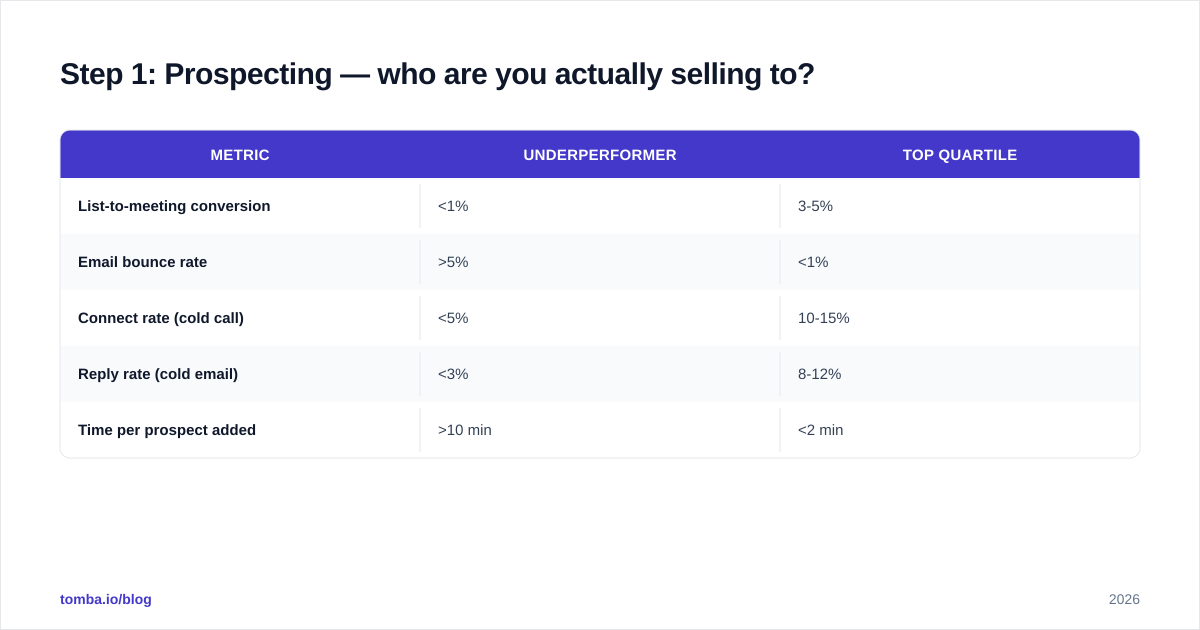
Prospecting KPIs to track:
| Metric | Underperformer | Top quartile |
|---|---|---|
| List-to-meeting conversion | <1% | 3-5% |
| Email bounce rate | >5% | <1% |
| Connect rate (cold call) | <5% | 10-15% |
| Reply rate (cold email) | <3% | 8-12% |
| Time per prospect added | >10 min | <2 min |
Step 2: Preparation — the step everyone skips#
Preparation means knowing more about the prospect than they expect you to. In 2026, with public LinkedIn, podcast transcripts, 10-Ks, Crunchbase, and AI summarization, there is zero excuse to walk into a discovery call cold.
A 15-minute preparation checklist:
- Read the prospect's LinkedIn (last 90 days of posts)
- Read the company's "about" page and latest press
- Check funding stage, headcount trend, current tech stack
- Identify a trigger event (hire, raise, launch, layoff, M&A)
- Map the buying committee (champion, economic buyer, technical buyer, blocker)
- Form a hypothesis: what problem do they probably have, and why now?
Reps who do this consistently turn discovery calls into commercial conversations. Reps who don't get the polite "send me some info" brush-off.
This is also where a reverse email lookup or LinkedIn finder earns its keep — when a stranger replies to your sequence, you have 90 seconds before the next call to figure out who they are and whether they're worth a meeting.
Step 3: Approach — first contact without sounding like a robot#
The approach is where most cold outbound dies. The script is the same one prospects have heard 400 times this quarter, and the AI personalization is so obvious it's now a negative signal.
What works in 2026:
- Multi-channel, not multi-touch-on-one-channel. Email + LinkedIn + phone in a coordinated sequence beats 12 emails.
- Specificity over personalization. "Saw you raised your Series B" is not personalization. "Your VP Eng's talk at SaaStr on Rust adoption" is.
- One question, one CTA. A first message asking for a 30-minute "discovery call" gets ignored. A first message asking "is this even a priority for Q3?" gets a reply.
A common mistake: optimizing the first email when the fourth email is what actually books meetings. Industry data from outreach platforms shows that 70-80% of replies come from touches 3-7, not touch 1.
Step 4: Presentation — show, don't pitch#
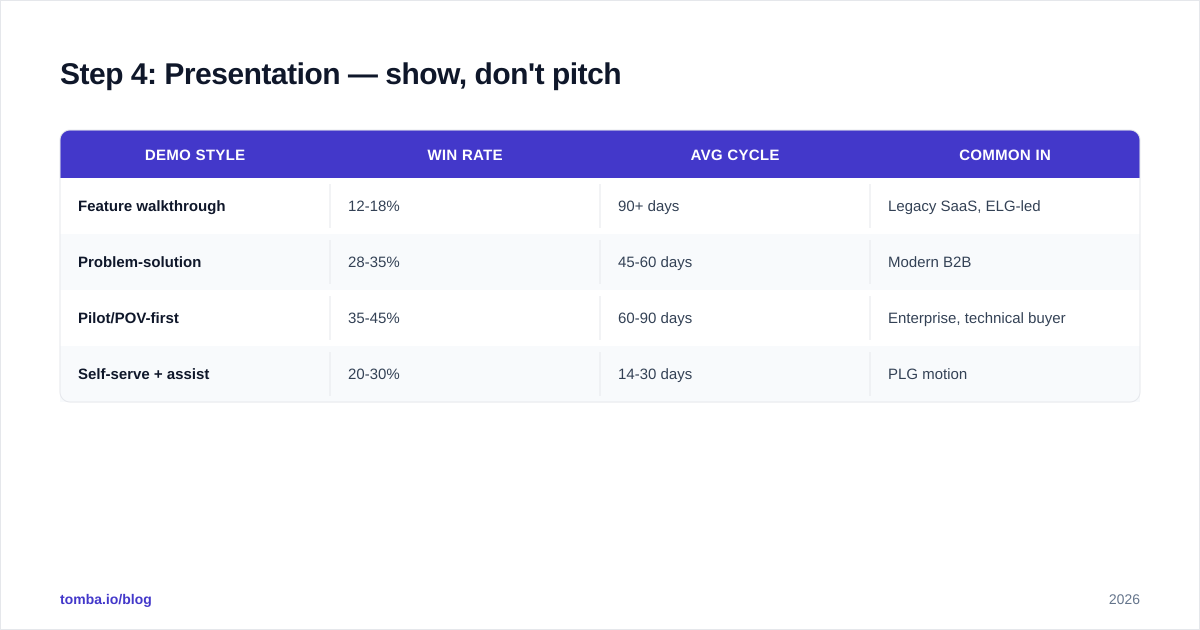
The presentation step covers the discovery call, demo, and any technical deep-dives. The single most common mistake is treating it as a product walkthrough instead of a problem-solution mapping.
A 2026 demo structure that converts:
- Recap their problem in their words (2 minutes)
- State the desired outcome (1 minute)
- Show only the features that get them to that outcome (15 minutes)
- Confirm fit and quantify the gap (5 minutes)
- Agree on a next step with a date (2 minutes)
Notice what's missing: the 10-tab feature tour, the "and we also do..." sidebars, the founder story. None of that helps the buyer make a decision.
| Demo style | Win rate | Avg cycle | Common in |
|---|---|---|---|
| Feature walkthrough | 12-18% | 90+ days | Legacy SaaS, ELG-led |
| Problem-solution | 28-35% | 45-60 days | Modern B2B |
| Pilot/POV-first | 35-45% | 60-90 days | Enterprise, technical buyer |
| Self-serve + assist | 20-30% | 14-30 days | PLG motion |
Step 5: Handling objections — make them surface, don't dodge#
Objections aren't a problem to solve at the end of the call. They're information you actively dig for. The classic four — no need, no money, no urgency, no trust — show up in every B2B deal.
A simple framework:
- Acknowledge: "That's a fair concern."
- Clarify: "When you say 'too expensive', do you mean vs. your current vendor or vs. doing nothing?"
- Reframe: Reposition the cost against the cost of inaction.
- Confirm: "If we solved X, would this move forward?"
The reps who lose to objections are the ones who treat them as endings. The reps who win treat them as the start of the real conversation.
Step 6: Closing — ask the question#
Closing in 2026 isn't a Glengarry-style pressure tactic. It's a clean, direct request for commitment, made at the moment the buyer has enough information to say yes.
Closing techniques that still work:
- Assumptive close: "I'll send the order form for the Growth plan — anything else you need from me?"
- Summary close: "We agreed X, Y, Z were the must-haves. We solve all three. Should we start the procurement track?"
- Urgency close (only when real): "Pricing changes Jan 1 — locking now saves you 12%."
- Alternative close: "Annual or quarterly?"
Avoid: fake scarcity, manufactured deadlines, "what would it take to earn your business today?" None of it works on modern buyers.
This is also where pricing transparency matters. Buyers who can't find your pricing publicly assume the worst. If your product is $50K ACV, say so before the demo — you'll lose the bad-fit deals faster, which is the whole point. (For reference, Tomba pricing starts at $49/mo for the Starter plan and goes to custom Enterprise — you can see every tier on the page.)
Step 7: Follow-up — where compounding revenue lives#
Follow-up is the step new reps skip because they think the deal is "done" at signature. Top performers know it's where most of their pipeline comes from.
What follow-up actually covers:
- Day 1-30: Onboarding hand-off, success milestones, exec intro
- Day 30-90: First QBR, identify expansion signals, get a case study
- Day 90+: Referral request, renewal motion, upsell triggers
A single satisfied customer who gives you two warm introductions and renews for three years is worth 10x a new logo. Most CRMs are graveyards of closed-won deals nobody touches. Don't be that rep.
For ongoing contact maintenance — people change jobs, emails change — a data enrichment workflow keeps your account base from rotting.
How do MEDDIC, Challenger, and SPIN map to the 7 steps?#
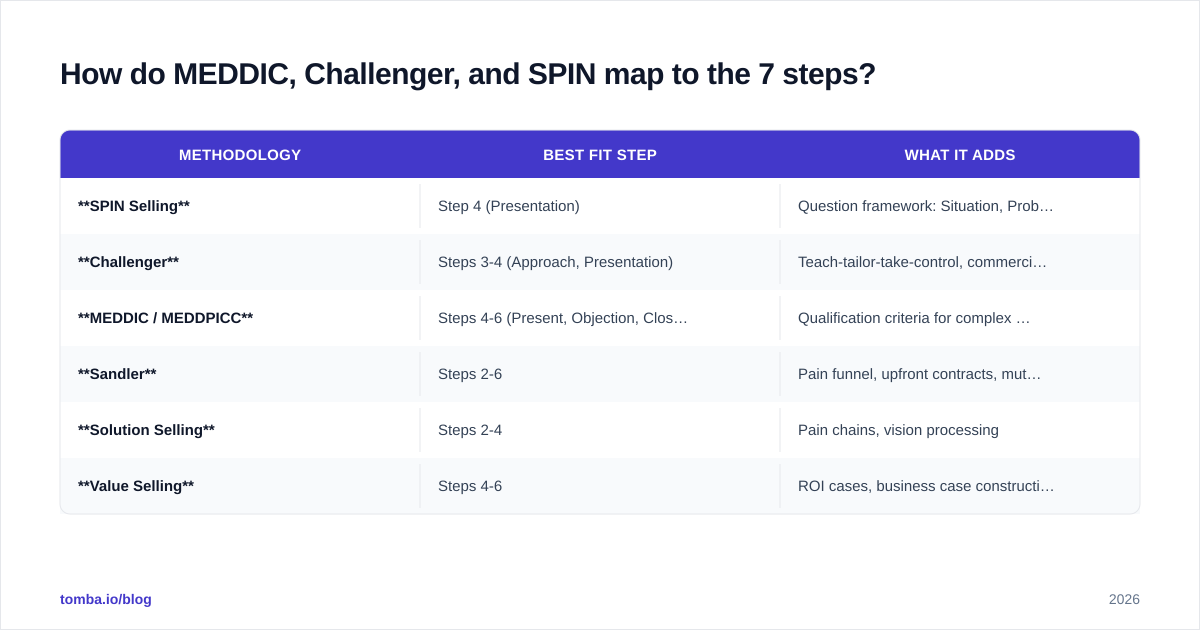
A common confusion: are the 7 steps a methodology or a framework? They're a framework. Methodologies are the how that sits inside each step.
| Methodology | Best fit step | What it adds |
|---|---|---|
| SPIN Selling | Step 4 (Presentation) | Question framework: Situation, Problem, Implication, Need-payoff |
| Challenger | Steps 3-4 (Approach, Presentation) | Teach-tailor-take-control, commercial insight |
| MEDDIC / MEDDPICC | Steps 4-6 (Present, Objection, Close) | Qualification criteria for complex deals |
| Sandler | Steps 2-6 | Pain funnel, upfront contracts, mutual qualification |
| Solution Selling | Steps 2-4 | Pain chains, vision processing |
| Value Selling | Steps 4-6 | ROI cases, business case construction |
You don't pick one — you pick the methodology whose primitives match your deal complexity and bolt it onto the 7-step skeleton.
What benchmarks should each step hit?#
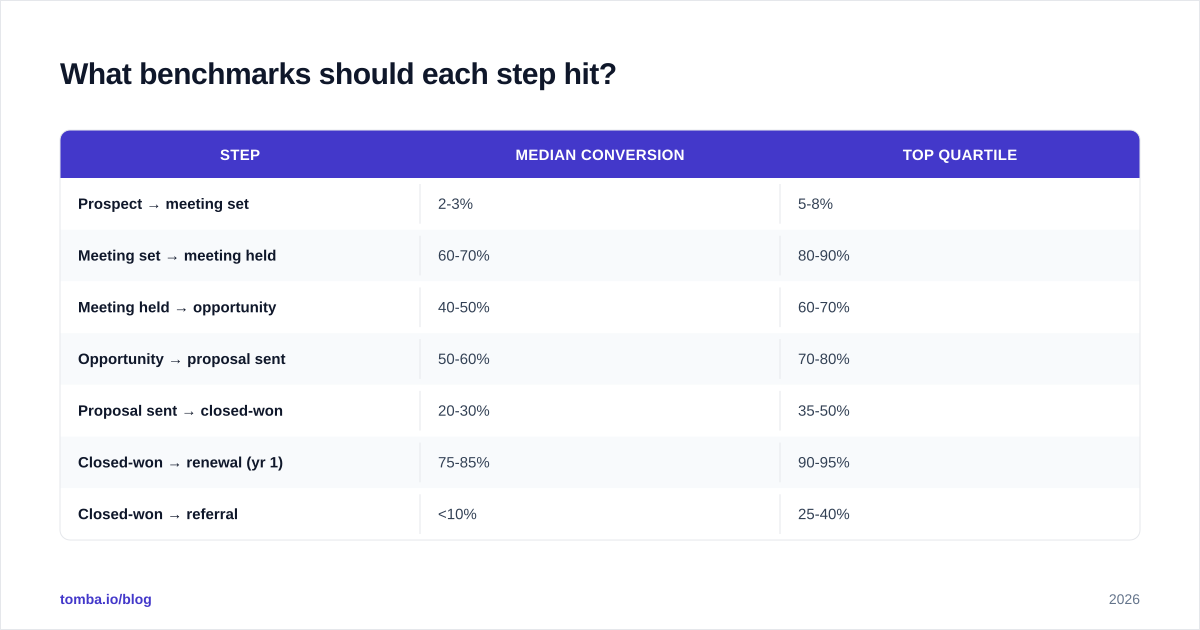
These are 2026 medians from public benchmarks (HubSpot State of Sales, Salesforce State of Sales, and aggregated SaaS data on G2):
| Step | Median conversion | Top quartile |
|---|---|---|
| Prospect → meeting set | 2-3% | 5-8% |
| Meeting set → meeting held | 60-70% | 80-90% |
| Meeting held → opportunity | 40-50% | 60-70% |
| Opportunity → proposal sent | 50-60% | 70-80% |
| Proposal sent → closed-won | 20-30% | 35-50% |
| Closed-won → renewal (yr 1) | 75-85% | 90-95% |
| Closed-won → referral | <10% | 25-40% |
If your numbers fall below median on any single step, that's where the leverage is. Optimizing already-strong steps gives marginal returns; fixing the worst step usually fixes the whole pipeline.
What tools do reps actually use at each step?#
| Step | Tool category | Common picks |
|---|---|---|
| Prospecting | Email finder + B2B database | Tomba, Apollo, ZoomInfo |
| Preparation | Account research + intent | LinkedIn Sales Nav, 6sense, Clay |
| Approach | Sequencer + dialer | Outreach, Salesloft, Instantly |
| Presentation | Demo + recording | Zoom, Gong, Chorus |
| Objections | Battle cards + coaching | Highspot, Gong |
| Closing | CPQ + e-sign | DocuSign, PandaDoc |
| Follow-up | CRM + CS platform | HubSpot, Salesforce, Gainsight |
The mistake is stitching together 12 point tools when 5 well-integrated ones would do. Every handoff between tools is a place data goes missing.
How do you build a 7-step process in your CRM?#
Map each step to a stage in your CRM pipeline, with an exit criterion. A stage without an exit criterion is just a wish.
Example HubSpot/Salesforce stage map:
- Prospect — Lead has fit + verified email
- Engaged — Replied or accepted meeting
- Discovery — 30+ min call held, BANT/MEDDIC fields filled
- Demo — Tailored demo delivered, mutual action plan started
- Proposal — Pricing sent, decision criteria confirmed
- Negotiation — Redlines exchanged, legal engaged
- Closed-won / Closed-lost — Signed or written off
Then build dashboards that show conversion between stages, not just volume in stages. Volume tells you who's busy. Conversion tells you who's effective.
Frequently asked questions#
Is there a 5-step or 8-step version of the sales process?
Yes — some frameworks collapse "preparation" into "prospecting" (5 steps) or split "presentation" into "discovery" and "demo" (8 steps). The 7-step version is the most widely taught and maps cleanly to most B2B CRMs.
Which step is the hardest?
Prospecting is hardest because it has the worst conversion rate (1-3%) and the most rejection. Preparation is the most underrated — it's where top performers separate from average ones.
How long should a full cycle take?
It depends on ACV. Under $5K ACV: 1-14 days. $5-50K: 30-60 days. $50K-$250K: 60-120 days. $250K+: 6-18 months. If your cycle is materially longer than these, you have a qualification problem, not a closing problem.
Can you automate the 7 steps?
Steps 1, 3, and parts of 7 can be heavily automated. Steps 2, 4, 5, 6 are human-judgement work that AI assists but doesn't replace. The reps who try to automate steps 4-6 are the ones who complain that "outbound is dead."
Run the 7 steps faster with verified data#
Every step in this playbook breaks if the data at the top of the funnel is wrong. Bounced emails kill your sender reputation, wrong-person outreach burns your ICP, and stale data wastes the 15 minutes of preparation that separates winners from losers.
The Tomba Email Finder is the cleanest way to start step 1 with verified, deliverable contacts — free up to 25 searches/mo, $49/mo for Starter, with the API and HubSpot integration wired into the rest of your stack. Start the 7 steps with data you can trust, and the other six steps stop fighting you.
// get started
Find, verify and enrich your first contacts today
Start on the free plan with 25 searches a month, then scale when your team is ready.
Free plan · No credit card required · GDPR & CCPA
// about the author