80legs Pricing Reviews Pros and Cons: 2026 Buyer's Guide
Is 80legs still worth it in 2026? A neutral look at 80legs pricing tiers, real user reviews, the honest pros and cons, and when a structured data API beats raw crawling.
80legs Pricing Reviews Pros and Cons: 2026 Buyer's Guide
This 80legs pricing reviews pros and cons breakdown covers the 2026 plan tiers, real user reviews, the honest pros, and the cons that matter. Read it before you sign up.
TL;DR
- 80legs is a distributed web-crawling service. It rents out a botnet-style grid for custom crawls at scale. You pay per URL crawled, not per record returned.
- Pricing in 2026 starts at $29/mo (Intro) and scales to ~$299/mo (Plus), with usage-based overages — cheap per URL, but you pay for misses too.
Reviews on G2 and Capterra average 3.5–4.0. Power users praise the price-per-URL and built-in JavaScript rendering. Complaints cluster around the dated UI, the custom-app learning curve, and inconsistent crawl completion.
- 80legs fits teams with engineers who can write crawl logic and parse raw HTML.
- It is a poor fit if you just need clean B2B contact data — an API like Tomba returns verified emails without the crawl plumbing.
- This 80legs pricing reviews pros and cons guide breaks down the plan tiers, the real operator feedback, and when a structured data product beats a generic crawler.
What is 80legs and who actually uses it?#
80legs is a crawl-as-a-service platform from the late 2000s. Instead of giving you a finished dataset, it gives you a distributed grid of crawlers. You point them at any URL list with a custom "app" — usually a small JavaScript file that decides what to extract from each page.
The typical 80legs customer falls into one of three buckets:
- SEO and link-research teams doing wide crawls across millions of URLs to map backlinks, anchor text, or technology stacks.
- Price-monitoring and e-commerce intel teams scraping product pages across retailers at regular intervals.
- Researchers and data engineers running one-off academic or competitive crawls where building Scrapy infrastructure isn't worth the time.
What 80legs is not built for: turnkey lead generation. If your goal is verified work emails or B2B phone numbers, you'll spend more engineering time on parsers and verifiers than the raw crawl actually costs. That's where dedicated tools like the Tomba Email Finder or a B2B database take over.
How much does 80legs cost in 2026?#
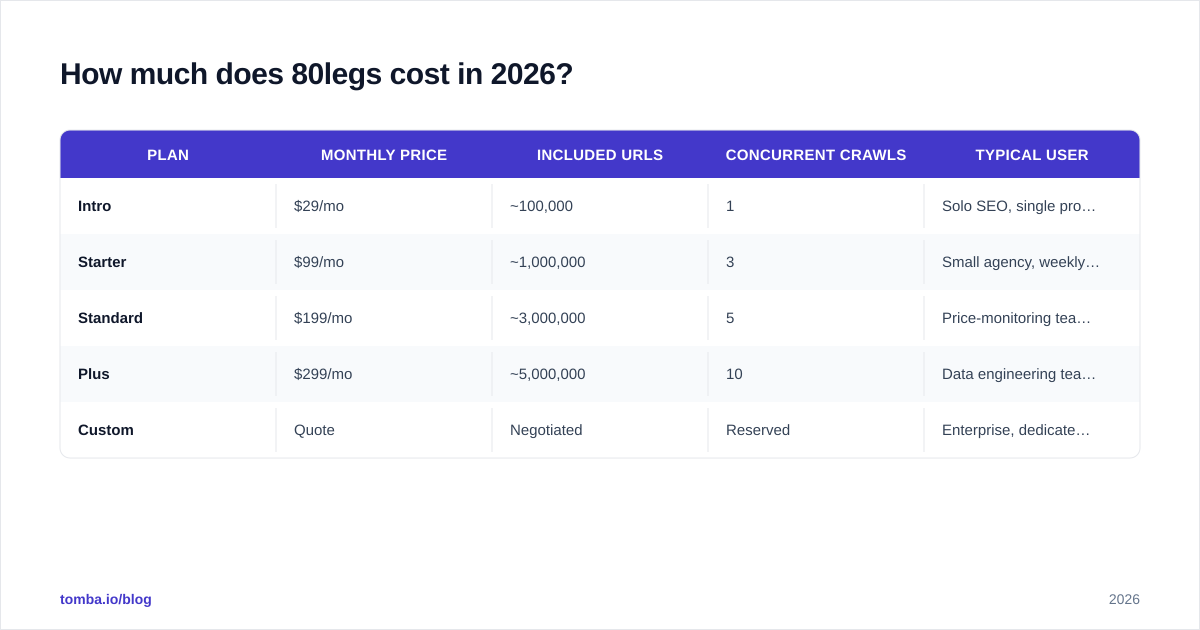
80legs uses a tiered subscription model with a per-URL allotment. Plans roll over to higher tiers as you scale. Overage URLs are billed at a per-thousand rate. Numbers below reflect the public pricing page as of early 2026 and the historical pattern on G2.
| Plan | Monthly price | Included URLs | Concurrent crawls | Typical user |
|---|---|---|---|---|
| Intro | $29/mo | ~100,000 | 1 | Solo SEO, single project |
| Starter | $99/mo | ~1,000,000 | 3 | Small agency, weekly crawls |
| Standard | $199/mo | ~3,000,000 | 5 | Price-monitoring teams |
| Plus | $299/mo | ~5,000,000 | 10 | Data engineering teams |
| Custom | Quote | Negotiated | Reserved | Enterprise, dedicated infra |
A few cost details that bite in practice:
- You pay per URL crawled, not per usable result. A 404, a redirect chain, or a page that fails your parser still burns your budget. Realistic completion ratios in production are 70–85% for well-tuned crawls, lower for JavaScript-heavy sites.
- Custom apps are sandboxed JavaScript. You write them, you test them, you debug them. There is no visual scraper, so a non-engineer cannot run 80legs end-to-end alone.
- Data egress is included at the base tier, but storage on the 80legs side is short — pull results promptly or write them to your own S3/R2 bucket.
Compare that to a structured B2B tool. Tomba pricing charges per credit at $49/mo Starter, $99/mo Growth, and $249/mo Pro. Every credit returns a verified email or phone with metadata — no parser to maintain.
What do 80legs reviews on G2 and Capterra actually say?#
Pulled from public review pages on G2 and Capterra, the sentiment splits along technical-skill lines.
What reviewers consistently like:
- Price per URL is dramatically lower than building and operating your own Scrapy + proxy stack at the same scale.
- The "80app" model is flexible — once you learn it, you can extract almost anything that's in the rendered DOM.
- JavaScript rendering is included by default, which the cheaper crawl APIs charge extra for.
- Crawls can be scheduled and re-run, useful for delta monitoring.
What reviewers consistently complain about:
- The dashboard looks and feels like 2014. Multiple G2 reviews call it "functional but dated."
- Custom-app development has a steep learning curve compared to no-code scrapers like Apify actors or Octoparse templates.
- Support response times are reported as slow on the lower tiers — often 24–48 hours.
- Crawl reliability degrades on sites with aggressive bot detection (Cloudflare, PerimeterX, DataDome). You can hit your URL quota with a high failure rate and no automatic retry credit.
- Documentation gaps — older blog posts and forum threads outrank the official docs in Google, which makes troubleshooting frustrating.
The aggregate G2 rating sits around 3.8/5 in 2026. The bell curve favors 4-and-5-star reviews from engineers and 2-and-3-star reviews from non-technical buyers who expected a no-code tool.
What are the real pros of 80legs?#
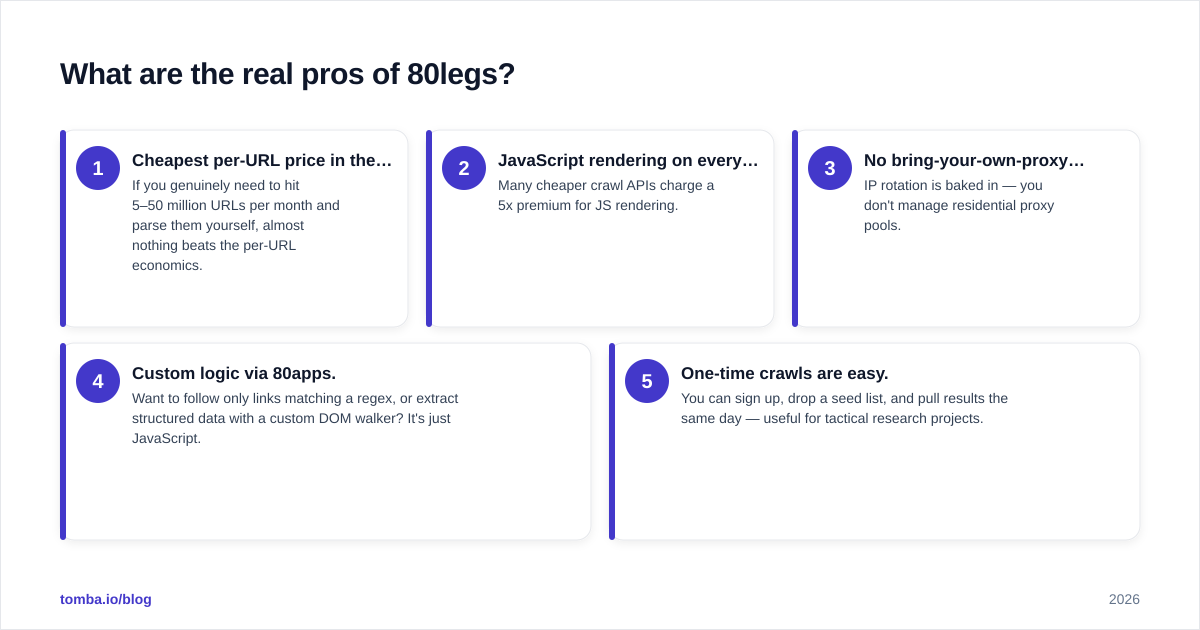
- Cheapest per-URL price in the market for distributed crawling. If you genuinely need to hit 5–50 million URLs per month and parse them yourself, almost nothing beats the per-URL economics.
- JavaScript rendering on every plan. Many cheaper crawl APIs charge a 5x premium for JS rendering.
- No bring-your-own-proxy headache. IP rotation is baked in — you don't manage residential proxy pools.
- Custom logic via 80apps. Want to follow only links matching a regex, or extract structured data with a custom DOM walker? It's just JavaScript.
- One-time crawls are easy. You can sign up, drop a seed list, and pull results the same day — useful for tactical research projects.
What are the cons and dealbreakers?#
The product cons most reviewers hit first:
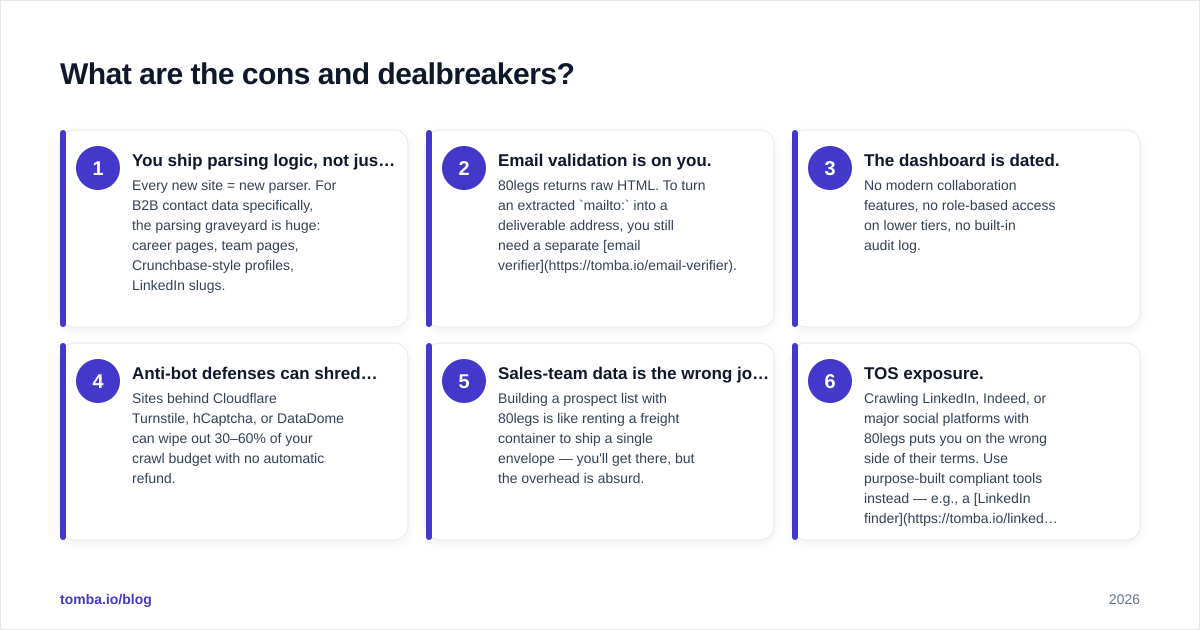
- You ship parsing logic, not just queries. Every new site means a new parser. For B2B contact data, the parsing graveyard is huge: career pages, team pages, Crunchbase profiles, LinkedIn slugs.
- Email validation is on you. 80legs returns raw HTML. To turn a
mailto:into a deliverable address, you still need a separate email verifier. - The dashboard is dated. No modern collaboration, no role-based access on lower tiers, no built-in audit log.
The harder dealbreakers are situational, not product-level:
- Anti-bot defenses can shred completion rates. Sites behind Cloudflare Turnstile, hCaptcha, or DataDome can wipe out 30–60% of your crawl budget. There is no automatic refund.
- Sales-team data is the wrong job for it. Building a prospect list with 80legs is like renting a freight container to ship one envelope. The overhead is absurd.
- TOS exposure. Crawling LinkedIn, Indeed, or major social platforms puts you on the wrong side of their terms. Use purpose-built compliant tools — like a LinkedIn finder that uses public sources.
80legs vs alternatives: which crawler fits which job?#
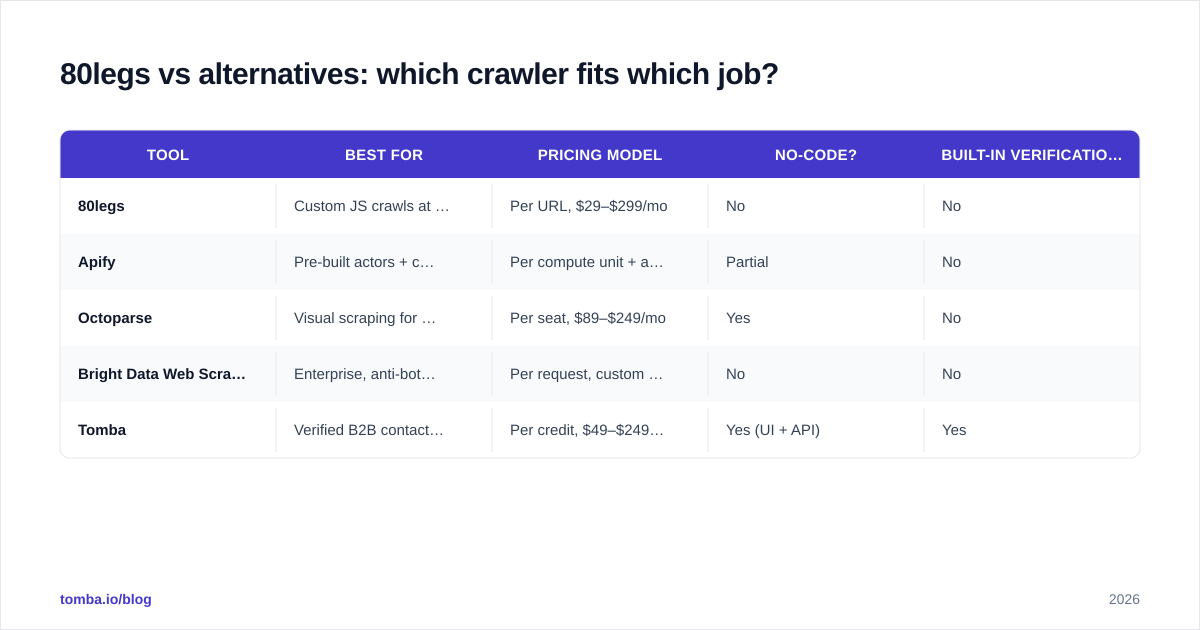
If you've already decided you want a crawler (and not a structured data API), here's how 80legs lines up against the common alternatives.
| Tool | Best for | Pricing model | No-code? | Built-in verification? |
|---|---|---|---|---|
| 80legs | Custom JS crawls at 1M+ URLs/mo | Per URL, $29–$299/mo | No | No |
| Apify | Pre-built actors + custom code | Per compute unit + actor fees | Partial | No |
| Octoparse | Visual scraping for non-engineers | Per seat, $89–$249/mo | Yes | No |
| Bright Data Web Scraper IDE | Enterprise, anti-bot heavy targets | Per request, custom quote | No | No |
| Tomba | Verified B2B contact data (no crawl) | Per credit, $49–$249/mo | Yes (UI + API) | Yes |
The right question isn't "is 80legs cheap?" It's "what's the total cost of ownership, including engineering time and downstream cleanup?"
When should you pick 80legs and when should you skip it?#
Pick 80legs if:
- You have at least one engineer who has shipped a Scrapy or Puppeteer project before.
- Your target output is raw structured data you'll feed into a downstream pipeline (e.g., price intelligence, SEO link graph, product catalog diffs).
- Your monthly volume is in the millions of URLs — small jobs aren't worth the setup tax.
- You're crawling sites where the data isn't already packaged as a SaaS dataset.
Skip 80legs if:
- You want verified work emails, phone numbers, or LinkedIn data — that's solved by purpose-built tools.
- Your team is sales or marketing rather than engineering.
- You need GDPR/CCPA-clean B2B contacts with documented provenance.
- You're crawling sites that are explicitly off-limits via their TOS (LinkedIn, ZoomInfo, etc.).
For the second column — sales and marketing teams chasing leads — the fastest path is a domain search that returns all known emails on a company in one call. Pair it with data enrichment to fill in titles and seniority.
How does 80legs compare to a structured B2B data API?#
This is the comparison most buyers actually care about, even if they searched for 80legs pricing reviews pros and cons. The honest answer: they solve different problems. Using a crawler for B2B prospecting is almost always a false economy.
A structured B2B data API gives you:
- A single endpoint that returns
{ first_name, last_name, email, position, confidence }instead of HTML. - Built-in email verification so the addresses you write to your CRM are deliverable.
- Compliance trail — see exactly where the data came from and which sources contributed.
- Integrations into HubSpot, Salesforce, Pipedrive, and Zapier without an engineering project.
A crawler like 80legs gives you the raw material to build that pipeline yourself. If you're a 10-person sales team, building it yourself is the wrong unit of work. If you're a data-engineering org with a 5-person crawl team, building it yourself might be cheaper at scale — but you'll still bolt a verification layer on top.
What about reliability and uptime?#
80legs historically has had reasonable uptime on the crawl grid itself. Two failure modes catch users off guard:
- Job queue stalling. Large jobs can sit pending if the grid is busy. The platform doesn't aggressively notify you, so check the dashboard.
- Silent low completion. A job can finish "successfully" with a 40% completion rate because the rest hit anti-bot challenges. Always inspect the completion report, not just the "done" status.
Compare with an API: a 4xx response is a 4xx response. You know immediately whether you got data or not, per call.
Frequently asked questions#
Is 80legs legal to use? The platform itself is legal. Whether your specific crawl is legal depends on the target site's TOS, applicable copyright/database rights, and data-protection law in your jurisdiction. Crawling public pricing pages is generally fine. Scraping personal data from gated platforms is generally not. Consult the Wikipedia overview of web scraping legality, then talk to your legal team.
Can I use 80legs for free? There's no permanent free tier as of 2026, only the $29/mo Intro plan. For one-off small jobs, that's the entry point.
Does 80legs handle JavaScript-rendered sites? Yes, JavaScript rendering is included on all plans. That's one of its better differentiators against per-request crawl APIs that surcharge for JS.
Can 80legs replace an email finder? No, and trying to make it one is a common mistake. 80legs returns raw page content. Turning that into deliverable B2B emails requires extraction, pattern matching, MX validation, and SMTP-level checks. That's exactly the stack a dedicated email finder replaces with a single API call.
What about support? Mid-tier support is email-based with 24–48h response times in reviewer reports. Enterprise/custom plans include faster channels. If support response time matters, ask for SLA specifics in writing before you sign.
The 80legs pricing reviews pros and cons verdict#
80legs is a sharp tool for a narrow job. It is cheap, JavaScript-capable, distributed crawling at million-URL scale, controlled by engineers who can write their own parsers. The pricing is genuinely competitive per URL. The reviews skew positive among technical users. The cons are mostly variants of "this is a developer product, not a no-code one."
If that profile matches your team and your project, 80legs earns its place in the stack. If you're a sales, marketing, or RevOps team trying to build prospect lists, it's the wrong layer of abstraction. You'll spend ten times the crawl cost on engineering and verification before you ever email a lead.
Get verified B2B contacts without writing a crawler#
If your real goal is reaching decision-makers — not building a scraping pipeline — start with a tool that gives you verified data on day one. The Tomba Email Finder returns deliverable work emails by domain, name, or company, with built-in verification and a free tier of 25 searches per month. Pair it with the Chrome extension for one-click lookups while you browse. Or use the bulk email finder when you have a CSV of companies waiting. You skip the crawl, skip the parsers, skip the verification stack — and start booking meetings the same day.
// get started
Find, verify and enrich your first contacts today
Start on the free plan with 25 searches a month, then scale when your team is ready.
Free plan · No credit card required · GDPR & CCPA
// about the author