ABM Framework 2026: Build an Account-Based Engine That Closes
A practical ABM framework for 2026: how to pick target accounts, align sales and marketing, sequence channels, and measure pipeline impact without drowning in vanity metrics.
TL;DR#
- An ABM framework is the operating system that ties ICP, tiering, plays, channels, and measurement into one repeatable motion — not a list of "personalized" emails.
- The 2026 version is leaner: fewer accounts, sharper signals, tighter sales-marketing handoffs, and pipeline-weighted scoring instead of MQL counts.
- Start with three tiers (1:1, 1:few, 1:many), assign a play to each, and only scale a tier once the prior one shows real meeting-to-pipeline conversion.
- Data quality is the wall most programs hit. Plan for enrichment, verification, and intent layering before you hire the SDRs.
- Measure pipeline created, pipeline velocity, and account engagement score — not opens, not clicks, not impressions.
What is an ABM framework, really?#
An ABM framework is the structured way you decide which accounts to chase, what to say to them, who reaches them, and how you score whether it's working. Think of it like the kitchen line at a restaurant: the menu is your offer, the recipes are your plays, the stations are your channels, and the expediter is RevOps making sure no plate goes out cold. Without that structure, "account-based" just means "we wrote the company name in the subject line."
The classic ITSMA definition splits ABM into three flavors — 1:1 (strategic), 1:few (cluster), and 1:many (programmatic). That split still holds in 2026, but the weight has shifted. Programmatic ABM has eaten most "marketing-led" demand gen because intent data and AI personalization made it cheap to run hundreds of micro-plays. Strategic 1:1 ABM, meanwhile, looks more like a deal pursuit than a marketing program. The framework you build has to handle both ends of the spectrum without collapsing into chaos.
If you're new to the underlying concepts, HubSpot's ABM hub and Gartner's ABM research are the cleanest free starting points before you commit to a vendor stack.
What are the components of a modern ABM framework?#
A workable framework has six layers. Skip any one of them and the others stop compounding.
- ICP and target account list (TAL). Who fits, who doesn't, why.
- Tiering. How much you'll spend per account and what level of personalization they get.
- Plays. Repeatable sequences of touches mapped to a trigger.
- Channels. Email, LinkedIn, paid, direct mail, events, calls — in what order.
- Data and tech stack. Enrichment, intent, CRM, orchestration, measurement.
- Measurement and governance. Account engagement, pipeline created, velocity, and the weekly review that adjusts the plan.
The mistake most teams make is treating these as a checklist instead of a loop. The measurement layer has to feed back into tiering and plays every two weeks, or you'll keep running last quarter's hypothesis.
How do you build the ICP and target account list?#
Your ICP is a written, falsifiable statement — not a vibe. A useful ICP includes firmographics (industry, employee count, revenue band, region), technographics (the tools they already run), and trigger conditions (hiring patterns, funding events, leadership changes). If a rep can't tell within 30 seconds whether an account fits, the ICP is too vague.
From the ICP you derive the TAL. For most B2B SaaS companies in 2026, a healthy TAL sits between 500 and 2,500 accounts. Bigger than that and your "account-based" program is just a worse version of inbound. Smaller and you starve the funnel.
Three steps to get there:
- Mine the win data. Pull every closed-won from the last 18 months. Find the firmographic median and the top three technographic patterns.
- Score against fit and intent. Combine a fit score (how well the account matches the ICP) with an intent score (active research signals). The product gives you a priority rank, not a binary in/out.
- Verify before you load. Enrich and verify contact data before the list ever touches your sequencer. Use a bulk email finder to resolve buying-committee contacts and an email verifier to strip bounces before they damage your sender reputation.
How should you tier accounts inside an ABM framework?#
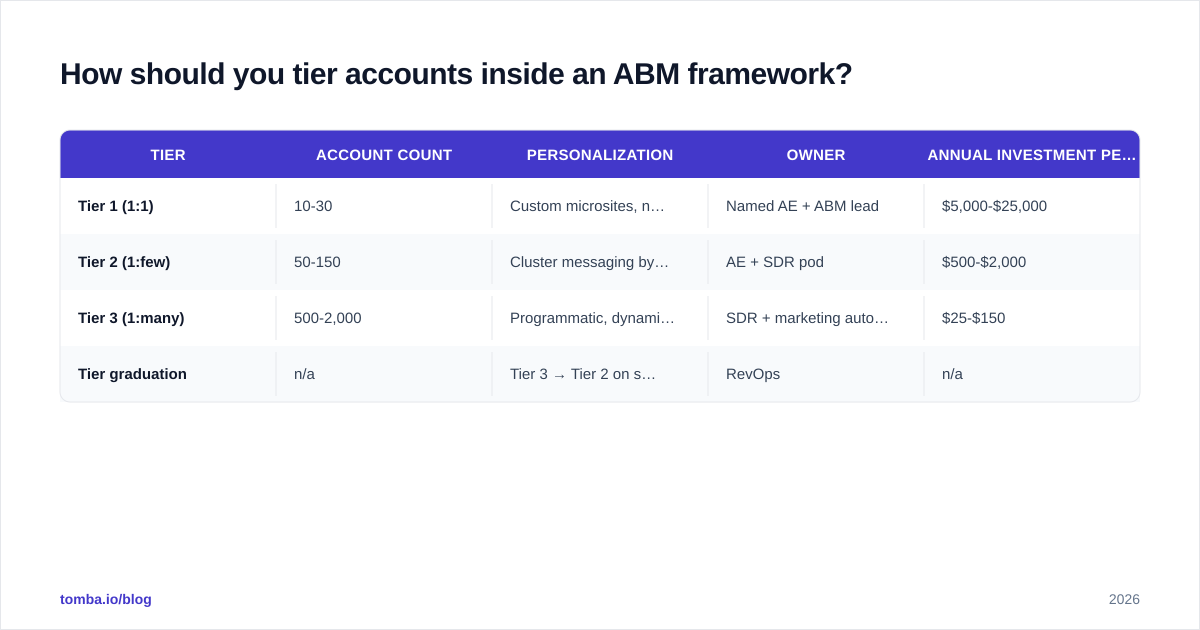
Three tiers is the sweet spot. More than three and your team won't remember which playbook applies; fewer than three and you can't tell strategic pursuits apart from programmatic plays.
| Tier | Account count | Personalization | Owner | Annual investment per account |
|---|---|---|---|---|
| Tier 1 (1:1) | 10-30 | Custom microsites, named exec sponsor, bespoke research | Named AE + ABM lead | $5,000-$25,000 |
| Tier 2 (1:few) | 50-150 | Cluster messaging by industry/persona, semi-custom assets | AE + SDR pod | $500-$2,000 |
| Tier 3 (1:many) | 500-2,000 | Programmatic, dynamic content, intent-triggered | SDR + marketing automation | $25-$150 |
| Tier graduation | n/a | Tier 3 → Tier 2 on sustained intent + meeting; Tier 2 → Tier 1 on opp creation | RevOps | n/a |
Two governance rules make this tiering actually work. First, the count caps are hard — you can't add a Tier 1 account without removing one. Second, tier movement is a documented event with a trigger, not a hallway conversation. Tier inflation kills more ABM programs than bad copy ever has.
What does an ABM play actually look like?#
A play is a trigger plus a sequence plus an exit condition. Without all three it's just a campaign.
A useful Tier 2 play for a new funding announcement:
- Trigger: Account on TAL raises Series B+ in the last 14 days.
- Day 0: Marketing turns on LinkedIn ad set targeting the buying committee with a CFO-angle creative.
- Day 1: SDR sends a relevance email referencing the round and a peer's outcome.
- Day 3: AE sends a LinkedIn voice note to the economic buyer.
- Day 5: SDR follow-up email with a one-pager built for that vertical.
- Day 7: Call attempt from SDR if engagement score ≥ 40.
- Day 12: Exit if no engagement; loop into nurture and re-trigger on the next signal.
Note what's missing: a 14-step "personalized" email cadence that's actually copy-paste. The 2026 play is shorter, multi-channel, and gated on engagement instead of grinding to a fixed end-date.
For Tier 1, the same shape applies but the cadence is hand-built per account with the AE's research baked in. For Tier 3, the same shape runs entirely on automation with dynamic content.
Which channels should an ABM framework use, and in what order?#
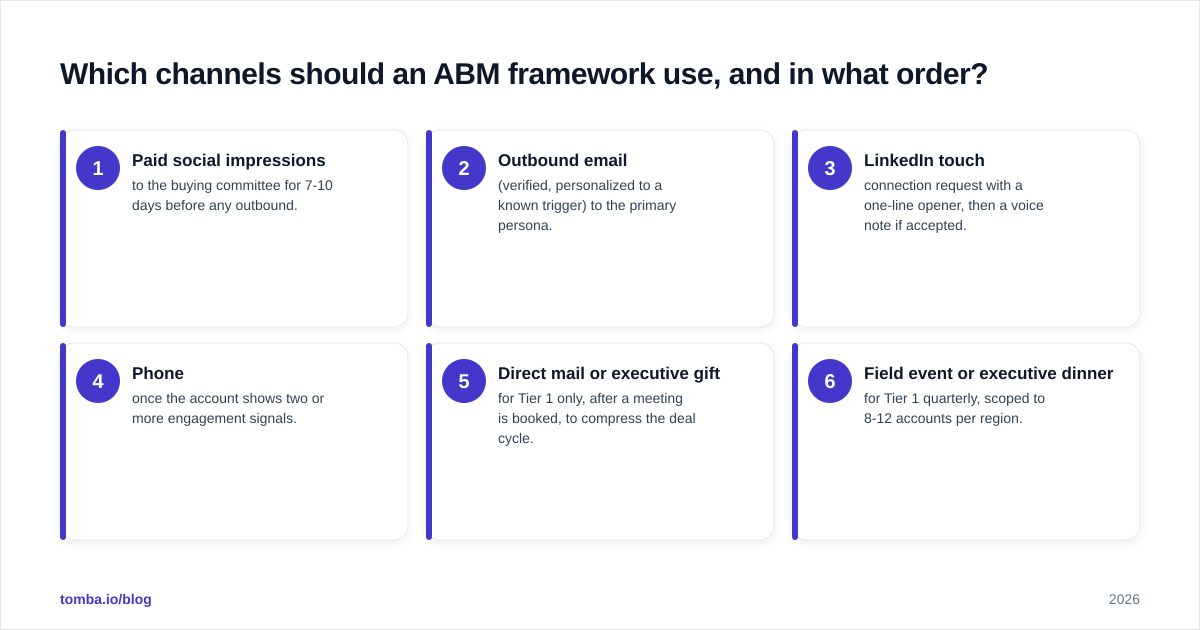
Channel mix depends on tier, but the sequencing logic is consistent: warm the account before you ask for a meeting. A cold call as touch one converts at roughly a third of a cold call placed after three brand impressions, per recent Forrester research on multi-touch B2B journeys.
A defensible default order:
- Paid social impressions to the buying committee for 7-10 days before any outbound.
- Outbound email (verified, personalized to a known trigger) to the primary persona.
- LinkedIn touch — connection request with a one-line opener, then a voice note if accepted.
- Phone once the account shows two or more engagement signals.
- Direct mail or executive gift for Tier 1 only, after a meeting is booked, to compress the deal cycle.
- Field event or executive dinner for Tier 1 quarterly, scoped to 8-12 accounts per region.
Email remains the workhorse, which is why deliverability sits underneath every play. If you haven't audited email deliverability and sender reputation in the last quarter, your ABM framework is leaking pipeline before it even gets to messaging.
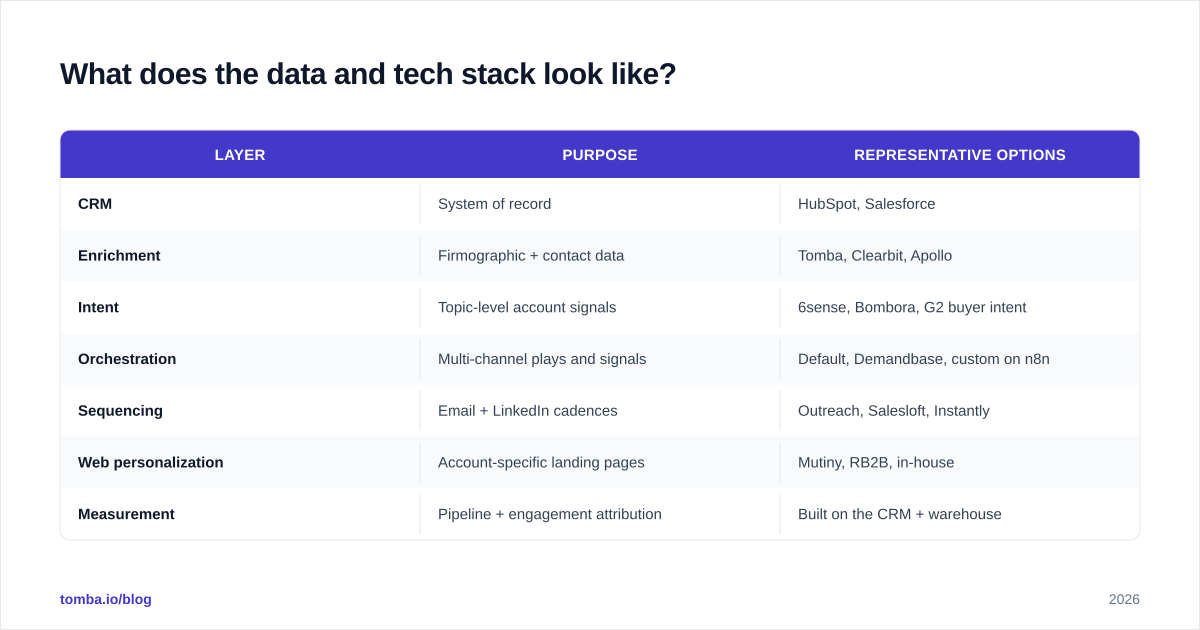
What does the data and tech stack look like?#
There's no single "ABM platform" anymore — there's an assembled stack. The categories you actually need:
| Layer | Purpose | Representative options |
|---|---|---|
| CRM | System of record | HubSpot, Salesforce |
| Enrichment | Firmographic + contact data | Tomba, Clearbit, Apollo |
| Intent | Topic-level account signals | 6sense, Bombora, G2 buyer intent |
| Orchestration | Multi-channel plays and signals | Default, Demandbase, custom on n8n |
| Sequencing | Email + LinkedIn cadences | Outreach, Salesloft, Instantly |
| Web personalization | Account-specific landing pages | Mutiny, RB2B, in-house |
| Measurement | Pipeline + engagement attribution | Built on the CRM + warehouse |
A pragmatic 2026 setup skips the "all-in-one ABM platform" tier and assembles a tighter stack: CRM + enrichment + intent + orchestration + sequencer. The savings fund better data, which is where ABM programs actually fail. If you want a faster way to stand up the enrichment layer, the Tomba API plugs into both Salesforce and HubSpot natively and handles bulk verification before contacts ever touch your sequencer.
How do you measure ABM in 2026?#
Drop MQL as the primary KPI. The metric set that matters now:
- Account engagement score (AES). Weighted activity across the buying committee, decayed weekly.
- Pipeline created from TAL. Dollar value of new opportunities sourced from named accounts.
- Pipeline velocity on ABM accounts. Days from opp created to closed-won, compared to non-ABM.
- Meeting-to-opportunity rate. Quality check on SDR meetings.
- Win rate on ABM accounts. The ultimate fit signal; should beat non-ABM by 15-30%.
- Cost per opportunity sourced. Sanity check on programmatic Tier 3 spend.
A weekly RevOps review reads these six numbers in this order, flags any tier whose meeting-to-opp rate fell below threshold, and pulls the play apart. No deck, no narrative — the numbers either justify the spend or they don't.
Is ABM better than demand gen? (Hint: that's the wrong question)#
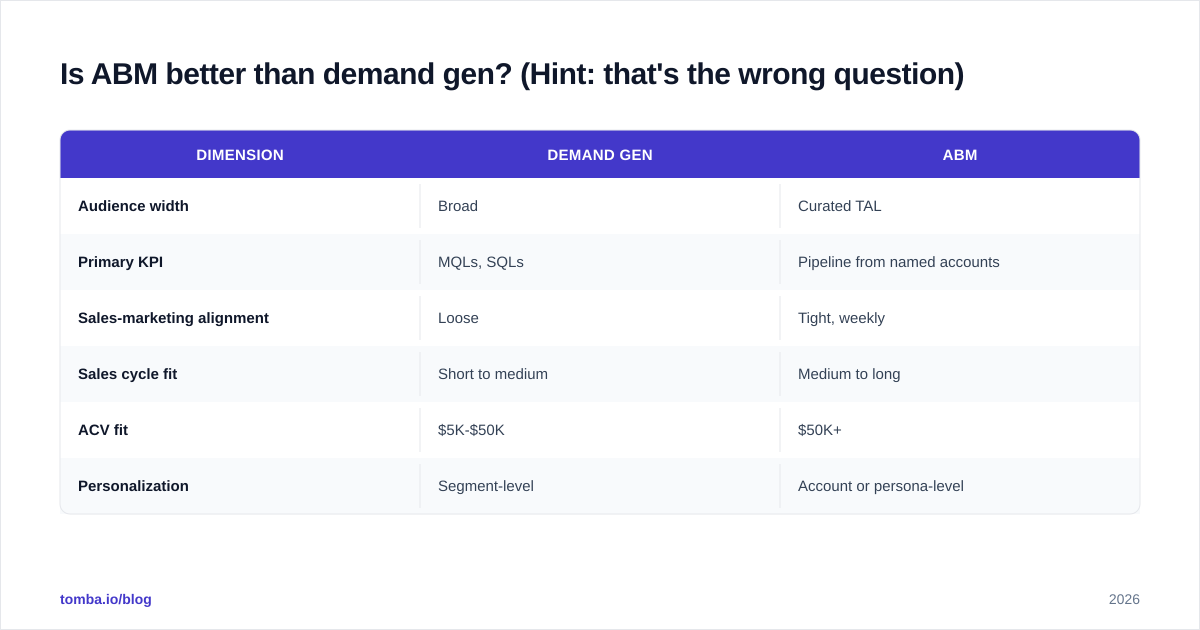
ABM and demand gen aren't competitors; they're different settings on the same dial. Demand gen casts wide and accepts long sales cycles in exchange for volume. ABM narrows the aperture and trades volume for win rate and ACV. Most healthy GTM motions run both: demand gen feeds the top of the marketing qualified lead funnel for SMB and mid-market while ABM pursues a curated TAL for enterprise.
| Dimension | Demand gen | ABM |
|---|---|---|
| Audience width | Broad | Curated TAL |
| Primary KPI | MQLs, SQLs | Pipeline from named accounts |
| Sales-marketing alignment | Loose | Tight, weekly |
| Sales cycle fit | Short to medium | Medium to long |
| ACV fit | $5K-$50K | $50K+ |
| Personalization | Segment-level | Account or persona-level |
The framework above is built for the ABM column. If your average ACV is under $20K and your sales cycle is under 45 days, you probably don't need this much machinery — run programmatic ABM as a Tier 3 layer on top of demand gen instead.
What are the common ABM framework mistakes?#
Five mistakes account for most failed programs:
- Treating ABM as a marketing project. It dies the moment sales isn't co-owning the TAL.
- Skipping data hygiene. A 30% bounce rate kills sender reputation and the program with it. Verify, enrich, then sequence.
- Confusing personalization with relevance. Mentioning the prospect's dog isn't relevance. Tying a message to a documented trigger is.
- Tier inflation. Everyone's a Tier 1 until no one is.
- Measuring activity instead of pipeline. Touches, opens, and impressions are inputs. Pipeline and velocity are outputs.
For a deeper dive on the operating side, revenue operations practices anchor the governance layer that prevents most of these.
How do you launch an ABM framework in 90 days?#
A realistic 90-day rollout, assuming a small team and an existing CRM:
- Days 1-15: Define ICP, mine win data, build TAL v1 (500 accounts). Enrich the buying committee, verify emails.
- Days 16-30: Assign tiers, draft three plays (one per tier), wire the tech stack, set the measurement dashboard.
- Days 31-60: Run programmatic Tier 3 plays. Layer Tier 2 plays for accounts with intent. Hold weekly reviews.
- Days 61-90: Launch Tier 1 pursuits on the 15 best-fit accounts. Cut the worst-performing Tier 3 play. Lock in tier graduation rules.
By day 90 you should have at least 10 ABM-sourced opportunities, a documented playbook, and a defensible cost-per-opportunity number. If you don't, the next decision isn't "more activity" — it's a data audit.
Bring the data layer that makes the framework actually work#
An ABM framework only compounds if the contacts inside it are real, current, and reachable. That's where most programs quietly bleed budget. Tomba Email Finder builds the buying-committee contact list with verified business emails, pipes into HubSpot and Salesforce, and pairs with the Tomba API for the bulk enrichment your Tier 3 plays need. The Free tier (25 searches/month) is enough to validate the workflow before you commit; Starter at $49/month covers a small SDR pod, and Growth at $99/month handles a full mid-market program. Build the framework on data you trust — the plays are easier when the list isn't fighting you.
// get started
Find, verify and enrich your first contacts today
Start on the free plan with 25 searches a month, then scale when your team is ready.
Free plan · No credit card required · GDPR & CCPA
// about the author