ABM Landing Pages in 2026: A Conversion Playbook
ABM landing pages convert target accounts at 3-5x the rate of generic demand-gen pages — if you build them right. Here is the 2026 playbook with frameworks, examples, and benchmarks.
ABM Landing Pages in 2026: A Conversion Playbook
TL;DR
- ABM landing pages convert named accounts 3-5x better than generic demand-gen pages — but only when the personalization layer is meaningful, not cosmetic.
- The 2026 standard is tiered personalization: 1:1 pages for strategic accounts, 1:few pages for clusters, 1:many for industry segments.
- Reveal who is visiting before you ask for a form fill — visitor identification and intent data drive page logic, not the other way around.
- The fastest-growing teams treat ABM pages as a system: a template, a data layer, a personalization engine, and a measurement stack.
- Stop measuring ABM pages by raw conversion rate. Measure account engagement, pipeline influence, and meetings booked from named accounts.
Most B2B teams still send their highest-value target accounts to the same homepage as a cold subscriber. That is the gap this post fixes. ABM landing pages — when designed around a specific account, industry cluster, or persona — outperform demand-gen pages by a wide margin because they remove the cognitive load of "is this for me?" Visitors arrive and immediately see their logo, their use case, their industry's numbers.
This guide walks through what an ABM landing page actually is in 2026, how to tier them, what to put on the page, how to measure them, and which tools to pair them with.
What is an ABM landing page?#
An ABM landing page is a destination URL designed for a specific account, account cluster, or persona — not for the general market. Where a typical demand-gen page asks "what does the visitor care about?" an ABM page already knows. The visitor's company name, industry, tech stack, or job title is baked into the headline, social proof, and CTA before the page renders.
Three layers of personalization define an ABM page:
- Static personalization — the page is hard-coded for one account ("Built for Acme Corp's procurement team"). Used for 1:1 ABM.
- Dynamic personalization — the page reads URL parameters, reverse-IP lookup, or visitor reveal data and swaps in the company name, industry, or logo on the fly.
- Behavioral personalization — the page changes content based on whether the visitor has viewed a pricing page, watched a demo, or opened a sequence.
The shift in 2026 is that layer 2 is now table stakes. Reverse-IP and website visitor reveal tools have made it trivial to know which company is browsing — and visitors expect pages that respond to that signal.
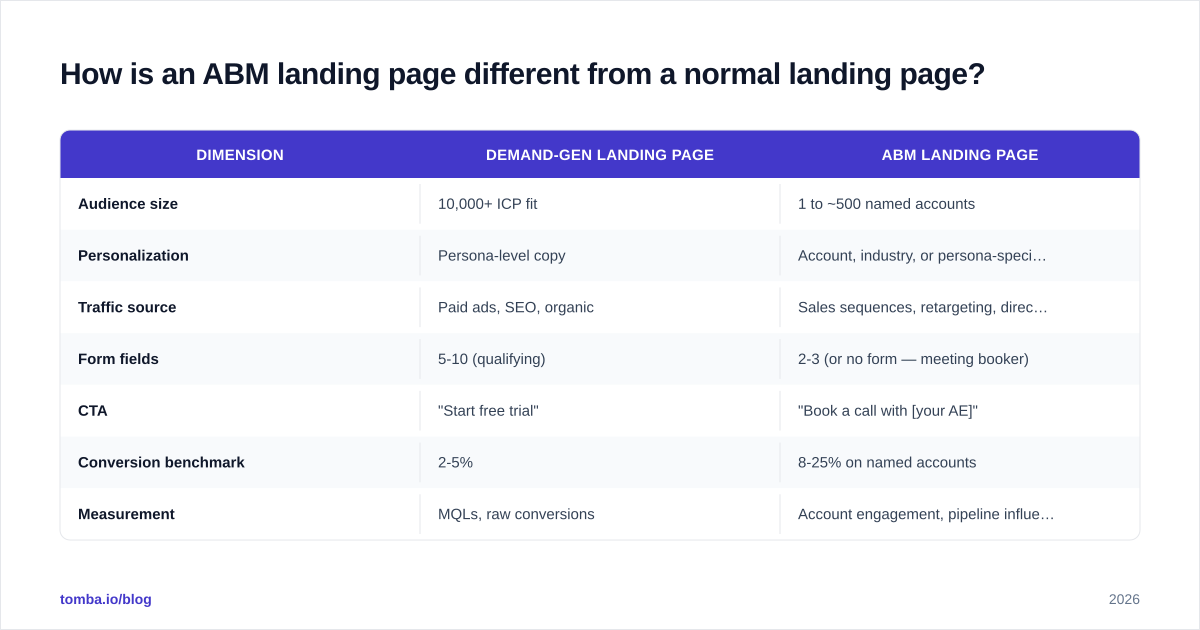
How is an ABM landing page different from a normal landing page?#
The difference is audience size and intent assumption. A normal landing page is built for a broad ICP segment — "marketing managers at SaaS companies under 500 employees." An ABM page is built for a tier, cluster, or single named account, and assumes the visitor is already on your target list.
| Dimension | Demand-gen landing page | ABM landing page |
|---|---|---|
| Audience size | 10,000+ ICP fit | 1 to ~500 named accounts |
| Personalization | Persona-level copy | Account, industry, or persona-specific |
| Traffic source | Paid ads, SEO, organic | Sales sequences, retargeting, direct links |
| Form fields | 5-10 (qualifying) | 2-3 (or no form — meeting booker) |
| CTA | "Start free trial" | "Book a call with [your AE]" |
| Conversion benchmark | 2-5% | 8-25% on named accounts |
| Measurement | MQLs, raw conversions | Account engagement, pipeline influence |
The conversion benchmark gap is the headline number. A demand-gen page that hits 5% is considered excellent. An ABM page that hits 5% is broken — the audience is supposed to be pre-qualified.
When should you build an ABM landing page?#
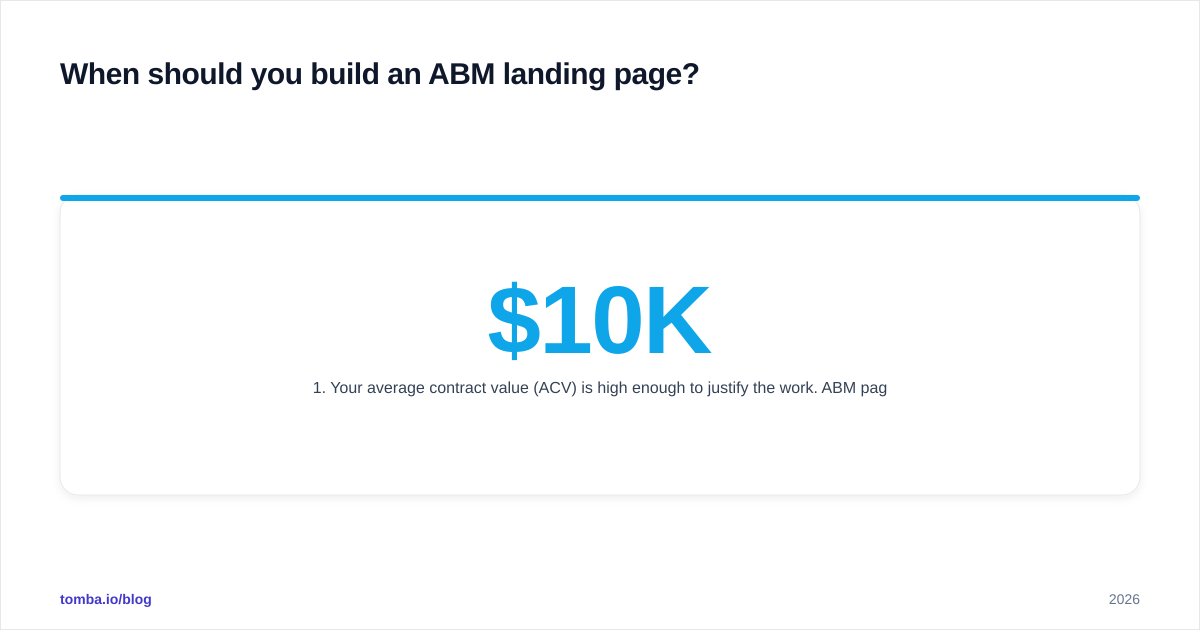
You should build an ABM landing page when three conditions are true:
- Your average contract value (ACV) is high enough to justify the work. ABM pages take 5-20 hours per account at the 1:1 tier. If your ACV is under $10K, that math rarely works. The threshold most teams use is $25K+ ACV for 1:1 and $10K+ for 1:few.
- You have a named account list. ABM without a list is just bad demand gen. The list should come from sales + marketing alignment, not a vendor's database dump.
- You have a way to drive named accounts to the page. Cold outbound, retargeting ads filtered by company, sales sequences, and ABM ad platforms (6sense, Demandbase, Terminus, RollWorks) are the four main channels.
If any of these is missing, fix it first. An ABM page with no targeted traffic source is just an expensive subdirectory.
What are the three tiers of ABM landing pages?#
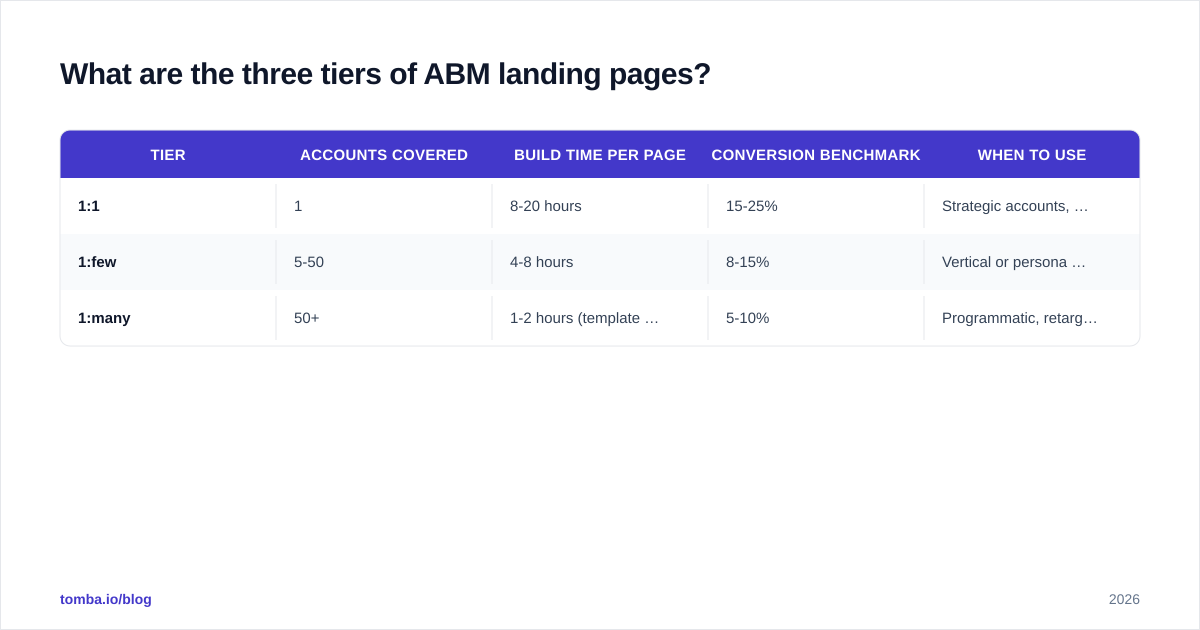
The standard ABM framework — 1:1, 1:few, 1:many — maps cleanly to landing page strategy. Each tier has a different cost-per-page, build time, and expected outcome.
Tier 1: 1:1 pages (strategic accounts)#
One page per account, hand-crafted. Includes the account's logo, the account's competitor logos with check marks, the account's industry stats, and often the name of the AE who owns the relationship. Best for the 10-50 accounts that represent half your pipeline.
Tier 2: 1:few pages (cluster pages)#
One page per cluster of 5-50 accounts. Usually segmented by industry vertical (e.g., "Fintech procurement teams"), tech stack (e.g., "Snowflake customers"), or buying committee (e.g., "VP Engineering at Series B startups"). The template is shared; the variable inputs are the cluster's specific pain points and proof.
Tier 3: 1:many pages (programmatic)#
Industry- or persona-level pages with dynamic personalization. The visitor's company logo and name swap in via reverse-IP. Best for the long tail of your TAM — accounts you cannot afford to hand-craft for, but who deserve more than a homepage.
| Tier | Accounts covered | Build time per page | Conversion benchmark | When to use |
|---|---|---|---|---|
| 1:1 | 1 | 8-20 hours | 15-25% | Strategic accounts, $100K+ ACV |
| 1:few | 5-50 | 4-8 hours | 8-15% | Vertical or persona clusters |
| 1:many | 50+ | 1-2 hours (template + data) | 5-10% | Programmatic, retargeting |
What goes on an ABM landing page?#
The anatomy below is what high-performing ABM pages in 2026 look like. Treat it as a checklist, not a rigid layout.
- Account-specific headline. "How [Acme Corp] can cut close cycles by 32%." Not "How fintech companies can grow faster."
- Subhead with the use case in their language. Pulled from their 10-K, job posts, or recent press.
- Their logo, prominently. Reverse-IP makes this trivial at 1:many tier.
- Industry-specific social proof. Three logos from their direct industry — not your "as featured in" bar.
- Persona-fit case study. A 60-second video or 200-word write-up of a customer with the same buyer profile.
- Competitor comparison. A short table showing how you stack against the tool they currently use (pulled from their tech stack via tools like BuiltWith or Wappalyzer).
- Pricing transparency or a "starts at" anchor. ABM visitors are deeper in the funnel — hiding price reads as evasive.
- A single CTA. A Calendly link to their assigned AE, not a generic "Contact sales" form.
- Owner attribution. "Your account is owned by Sarah Chen. Book directly →" — turns a faceless form into a one-on-one ask.
The most-skipped element from the list above is #9. It is also the cheapest to add and the one that lifts meeting bookings the most in our experience.
How do you personalize an ABM landing page at scale?#
The personalization stack has three layers. Each one feeds the layer above it.
Data layer. This is where you store who each account is. Your CRM, a B2B database, and your enrichment provider all feed this. Account name, industry, tech stack, employee count, intent signals, and last-touched-by-sales date all live here.
Reveal layer. Reverse-IP and de-anonymization tools tell you which named account is on the page right now. This is the trigger that fires personalization. Without reveal, the visitor is anonymous and your dynamic content has nothing to swap.
Rendering layer. The actual page. Built in your CMS or a dedicated ABM platform (Mutiny, RightMessage, PathFactory, or rolled in-house with Next.js + a feature flag service). Pulls from the data layer when the reveal layer fires.
In 2026, the bottleneck is no longer the rendering layer — everyone can swap a logo. The bottleneck is data quality. If your CRM lists "Acme Corp" but your enrichment provider lists "Acme Corporation Inc." and your reveal tool lists "acme.com", the personalization breaks silently. Invest in contact enrichment and dedupe before you invest in a fancy ABM platform.
What does an ABM landing page tech stack look like?#
The minimum viable stack:
- CMS or page builder — Webflow, Framer, or your existing marketing site
- Reveal tool — Clearbit Reveal, RB2B, or Tomba's reveal for visitor identification
- Enrichment / database — for filling in firmographics on the fly
- Email finder + verifier — to populate the assigned-AE flow and pre-fill known contacts. The email finder and email verifier are the standard combo
- Meeting booker — Chili Piper, Calendly, or Default for instant routing
- Analytics — Google Analytics 4 with custom dimensions for account name + tier; complement with an ABM platform if budget allows
The expensive stack adds: an ABM ad platform (6sense, Demandbase), a dedicated personalization engine (Mutiny), and an intent data feed (Bombora, G2 Buyer Intent). Build the minimum stack first and prove ROI before you upgrade.
How do you measure ABM landing page performance?#
Forget conversion rate as the headline metric. ABM pages are measured on account-level outcomes, not page-level ones.
The four metrics that matter:
- Account engagement rate — what percentage of named accounts on your target list have visited the page, by tier
- Multi-thread coverage — how many distinct people from a single target account engaged
- Pipeline influenced — dollars of opportunity created in the 90 days after a target account visited the page
- Meetings booked from named accounts — the truest leading indicator, since it represents intent backed by calendar action
Page conversion rate is still useful for QA — if it drops below 5% on a 1:1 page, something is broken — but it is a diagnostic, not a goal.
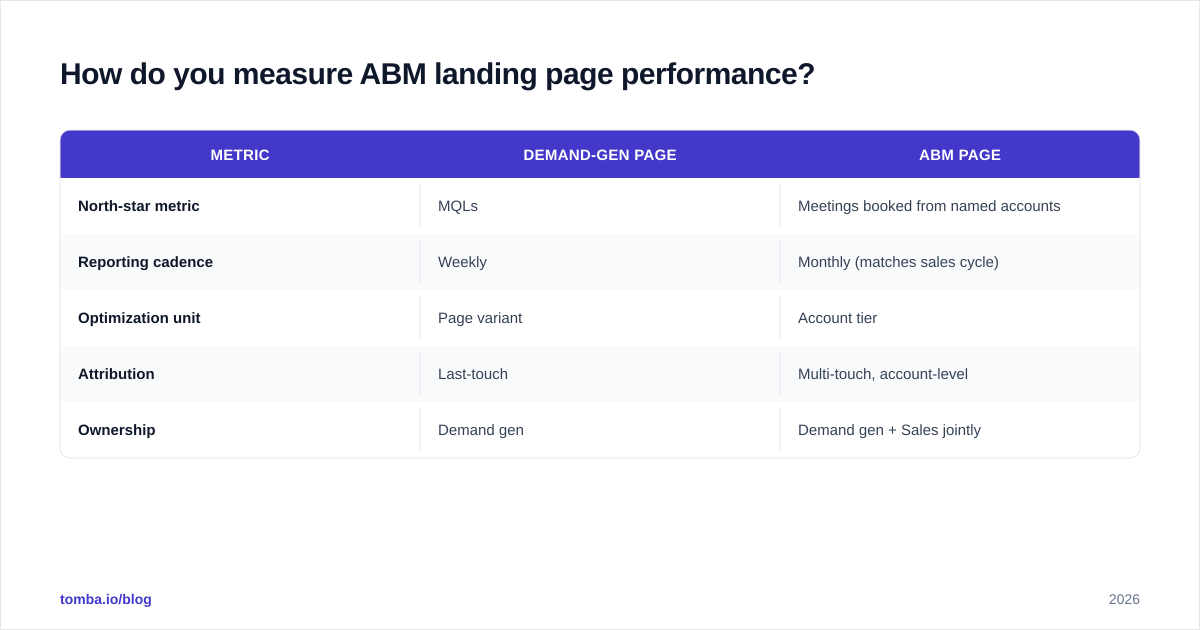
| Metric | Demand-gen page | ABM page |
|---|---|---|
| North-star metric | MQLs | Meetings booked from named accounts |
| Reporting cadence | Weekly | Monthly (matches sales cycle) |
| Optimization unit | Page variant | Account tier |
| Attribution | Last-touch | Multi-touch, account-level |
| Ownership | Demand gen | Demand gen + Sales jointly |
The shift to joint ownership matters more than the metric change. ABM pages fail when marketing builds them in isolation. The AE has to know the page exists, has to use it in their sequences, and has to give feedback on what is and is not landing with the account.
What are common ABM landing page mistakes?#
Five mistakes show up in nearly every audit:
- Cosmetic-only personalization. Swapping a logo without changing a single line of body copy. Visitors notice. It signals laziness more than effort.
- Form fields that ignore what you already know. If you have the visitor's company from reveal, do not ask for it again. Pre-fill or hide the field.
- Treating the page as the campaign. The page is one asset. The sequence, the ad, the LinkedIn message, and the SDR call all need to point to and reinforce it.
- No clear next step. "Learn more" is not a CTA. "Book a 20-minute call with [AE name]" is.
- Not retiring stale pages. A 1:1 page for an account that has been closed-lost for 18 months still gets indexed. Set a sunset date when you build it.
For more on cold-outbound mechanics that drive named accounts to these pages, see our coverage of sales prospecting workflows and how to find verified contacts at the find email addresses stage.
How does ABM landing page strategy fit into the broader GTM motion?#
ABM landing pages are a fulfillment surface for the rest of your ABM motion. They do not generate demand on their own — they convert demand that your ads, outbound, and content programs have already created.
The motion looks like this:
- Identify target accounts (account list)
- Drive awareness via ABM ads, content syndication, intent data triggers
- Trigger outbound from SDRs/AEs using verified contact data
- Send named accounts to the matching ABM landing page
- Convert via the page's CTA (meeting booker, demo request)
- Multi-thread across the buying committee
- Measure account-level engagement, not page-level conversion
Each step has its own tools. For the contact data step — getting verified email addresses and phone numbers for the buying committee at each target account — the standard pairing is an email finder for the email layer and a phone finder for the dialing layer. For broader context on B2B targeting, Gartner's account-based marketing research and HubSpot's ABM guide are good external starting points.
What does a 2026 ABM landing page look like in practice?#
The next-generation pages share five characteristics:
- AI-rendered content blocks — entire sections (headline, hero subhead, social proof) generated per account based on their public footprint
- Embedded video personalization — Loom-style intros generated per account using AI avatars
- Real-time intent signals — the page shows different content if the account has been on G2 or Capterra in the last 7 days
- Frictionless meeting booking — Chili Piper-style instant routing to the right AE based on territory and tier
- Server-side rendering for SEO + privacy — no third-party scripts that block on a slow connection
The teams getting this right treat the ABM landing page as the most expensive square meter of their website. They iterate on it monthly. They review the bottom-quartile pages and either fix or sunset them. They tie every page to a named opportunity in CRM.
For supporting reading, G2's account-based marketing category is a useful place to benchmark tooling.
Final take and next step#
ABM landing pages reward investment in the data layer more than the design layer. A beautiful page with stale account data converts worse than an ugly page with fresh data and a real AE name on it. Start with one tier, get the data right, prove pipeline influence, and then expand.
If your bottleneck is the contact layer — finding verified emails and phone numbers for the buying committee at each named account — start with Tomba's Email Finder. It plugs into the ABM stack at the data-enrichment step, gives you verified emails for your target accounts, and pairs with our phone finder for full buying-committee coverage. The Starter plan is $49/month with a free tier of 25 searches if you want to test it against your target account list before committing. See Tomba pricing for the full breakdown.
// get started
Find, verify and enrich your first contacts today
Start on the free plan with 25 searches a month, then scale when your team is ready.
Free plan · No credit card required · GDPR & CCPA
// about the author