ABM Maturity Model 2026: 5 Stages to Scale Account-Based Revenue
Most ABM programs stall at stage 2. Here's the 5-stage ABM maturity model that separates pilot teams from $100M account-based revenue engines in 2026.
TL;DR#
- An ABM maturity model maps how account-based programs evolve from one-off pilots to fully orchestrated GTM motions across sales, marketing, and customer success.
- Most B2B teams plateau at Stage 2 (Programmatic) — they have target account lists but lack intent data, contact-level enrichment, or sales-marketing service-level agreements.
- The five stages are: Nascent → Programmatic → Strategic → Orchestrated → Predictive. Each stage has measurable benchmarks for account coverage, pipeline velocity, and contribution to revenue.
- Tooling alone does not push you up the model. The gating factor is data quality — accurate contact records, firmographic enrichment, and behavioral signals tied to the right buying committee.
- Use the self-assessment in this guide to find your current stage and the two concrete moves that unlock the next one.
What is the ABM maturity model?#
The ABM maturity model is a five-stage framework that describes how account-based marketing programs scale — from a single sales rep running named-account outreach to a fully integrated revenue engine where every channel, campaign, and rep activity is scored against target accounts.
It exists because "doing ABM" means radically different things at different companies. A founder sending personalized Looms to 30 prospects is doing ABM. A 500-person GTM org running tiered 1:1, 1:few, and 1:many programs across Salesforce, 6sense, and an SDR team is also doing ABM. The maturity model gives leadership a shared language to diagnose where they are, what's missing, and where to invest next.
The version most teams reference originated with ITSMA (now part of Gartner) and Forrester's SiriusDecisions research. The five-stage shape used in this guide is the synthesis that practitioners actually run programs against in 2026.
What are the 5 stages of ABM maturity?#
Each stage builds on the one before. You cannot skip — a team trying to jump from Nascent straight to Orchestrated will burn budget on tooling its data model cannot support.
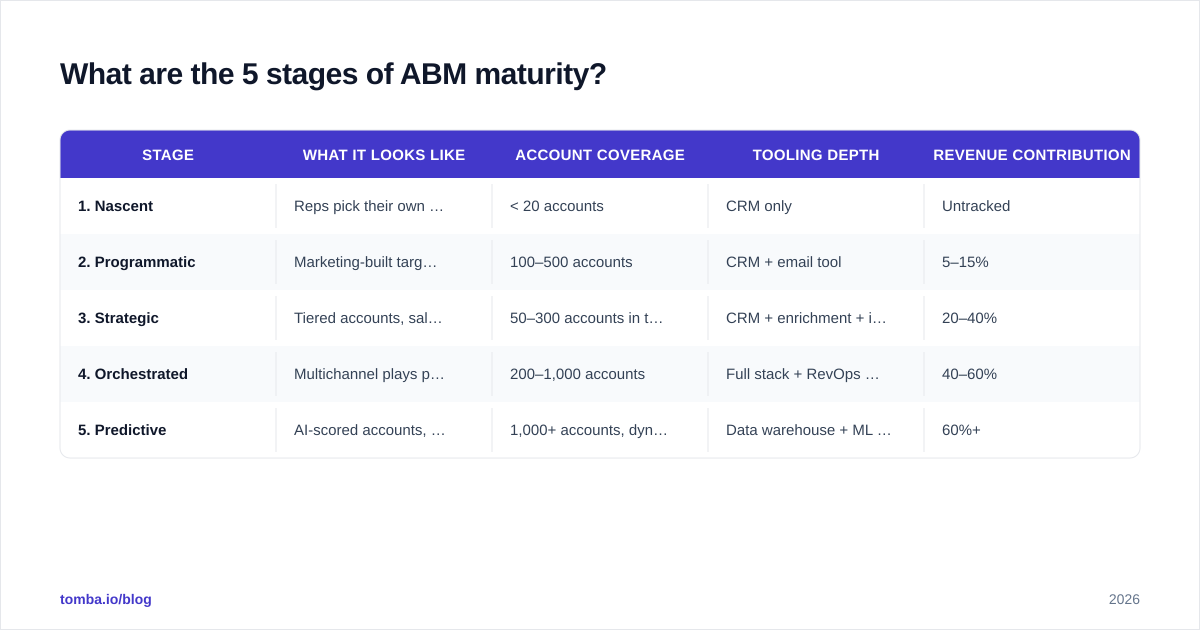
| Stage | What it looks like | Account coverage | Tooling depth | Revenue contribution |
|---|---|---|---|---|
| 1. Nascent | Reps pick their own accounts. No central list. | < 20 accounts | CRM only | Untracked |
| 2. Programmatic | Marketing-built target list. Generic campaigns. | 100–500 accounts | CRM + email tool | 5–15% |
| 3. Strategic | Tiered accounts, sales-marketing SLA, named buyer roles | 50–300 accounts in tiers | CRM + enrichment + intent | 20–40% |
| 4. Orchestrated | Multichannel plays per account, BDR + AE + CS aligned | 200–1,000 accounts | Full stack + RevOps team | 40–60% |
| 5. Predictive | AI-scored accounts, autonomous play triggering, attribution closed loop | 1,000+ accounts, dynamic | Data warehouse + ML models | 60%+ |
Stage 1 — Nascent#
You're here if reps source their own target accounts, ABM lives in a single rep's head or a spreadsheet, and marketing campaigns are still product-led broadcasts. There's no shared definition of an Ideal Customer Profile. Pipeline reporting cannot tell you which deals came from target accounts because nobody agreed on the list.
Exit criteria: an ICP definition signed off by the CRO, a target account list of 100+ accounts, and a CRM field that flags every opportunity as "target / non-target."
Stage 2 — Programmatic#
Most B2B companies live here. Marketing has built a target account list. There are some account-based email nurtures. The website does not yet personalize. Sales and marketing meet weekly but argue about lead handoff. You are sending generic content to a curated list and calling it ABM.
The signature problem at Stage 2 is contact gaps — your CRM has a great list of companies but no clean way to reach the actual buying committee. Filling those gaps with bulk contact enrichment is how teams unlock Stage 3. Tools like the Tomba Email Finder and bulk email finder workflows are designed for exactly this gap.
Stage 3 — Strategic#
You have account tiers — 1:1 (named, < 30 accounts), 1:few (clusters of 5–10 similar accounts), 1:many (everyone else in the ICP). Sales and marketing share a written SLA on response times, meeting handoff, and what counts as engaged. Intent data influences which accounts surface this week. The website personalizes hero copy by industry. Pipeline reporting can answer "what percentage of pipeline came from target accounts?" in under five minutes.
Tooling at this stage: CRM (HubSpot or Salesforce), an enrichment layer with verified contact data, an intent signal source (G2, Bombora, or 6sense), a data enrichment workflow that runs on every new lead, and a domain-level outbound motion using domain search to surface entire buying committees at once.
Stage 4 — Orchestrated#
Every named account has a documented play: which channels touch it, in what order, with what content, owned by which rep. BDRs, AEs, marketing, and customer success share a single account view. Customer success surfaces expansion intent the same way marketing surfaces net-new intent. There is a RevOps function that owns the account scoring model.
This is where attribution stops being a vanity exercise and starts driving budget. Teams at Stage 4 routinely cut 30–40% of marketing spend that touches non-target accounts and redirect it into the orchestrated plays.
Stage 5 — Predictive#
The frontier. Account scores are recomputed daily by a machine learning model trained on closed-won data. Plays trigger autonomously — a spike in technographic install signals routes the account to a specific BDR with a specific Loom template pre-loaded. Attribution is closed-loop: every touch is stitched back to revenue in a warehouse like Snowflake or BigQuery.
Less than 5% of B2B companies are honestly at Stage 5. Most who claim to be are actually well-tooled Stage 4 organizations.
How do you assess your current ABM maturity stage?#
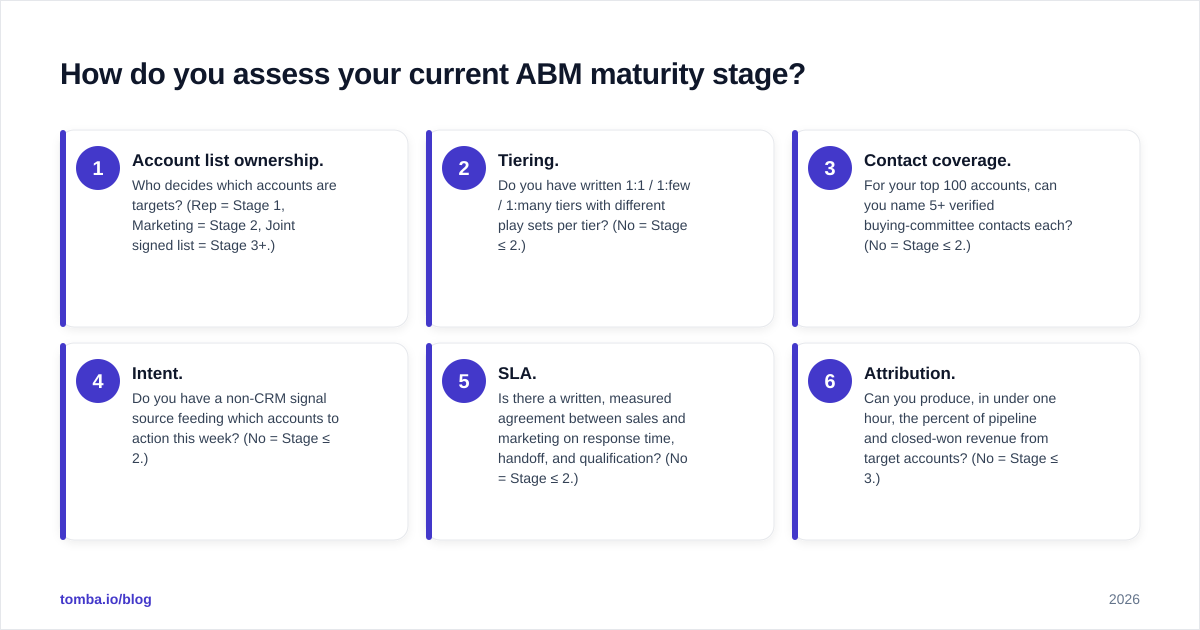
Run this six-question diagnostic with your CRO, CMO, and head of RevOps in the room. Answer honestly — the value is in the diagnosis, not the score.
- Account list ownership. Who decides which accounts are targets? (Rep = Stage 1, Marketing = Stage 2, Joint signed list = Stage 3+.)
- Tiering. Do you have written 1:1 / 1:few / 1:many tiers with different play sets per tier? (No = Stage ≤ 2.)
- Contact coverage. For your top 100 accounts, can you name 5+ verified buying-committee contacts each? (No = Stage ≤ 2.)
- Intent. Do you have a non-CRM signal source feeding which accounts to action this week? (No = Stage ≤ 2.)
- SLA. Is there a written, measured agreement between sales and marketing on response time, handoff, and qualification? (No = Stage ≤ 2.)
- Attribution. Can you produce, in under one hour, the percent of pipeline and closed-won revenue from target accounts? (No = Stage ≤ 3.)
A "no" anywhere caps your maturity at the stage above it. Most teams who self-rate Stage 4 actually fail questions 3 or 6 and are honestly Stage 2.5.
Why do most ABM programs stall at Stage 2?#
Three reasons, in order of frequency:
1. The contact data problem. You can build a perfect target account list and still have no way to start a conversation with the buying committee. LinkedIn alone is not enough — connection requests get rate-limited and the actual decision-makers ignore InMails. Teams stall because the cost of manually finding and verifying 8–12 contacts per account across 300 accounts is prohibitive. This is the single most common blocker, and it's solvable with a bulk email finder workflow plus a catch-all verifier to keep bounce rates under 2%.
2. The org chart problem. ABM at Stage 3+ requires sales and marketing to share goals, not just dashboards. If your CMO is measured on MQL volume and your CRO is measured on pipeline from target accounts, the incentives are in active conflict. Stage 2 organizations typically have not done this org redesign yet.
3. The attribution problem. Without closed-loop attribution, executives cannot tell whether ABM is working. Without that visibility, ABM stays a marketing experiment instead of becoming the GTM operating model.
What tools support each ABM maturity stage?#
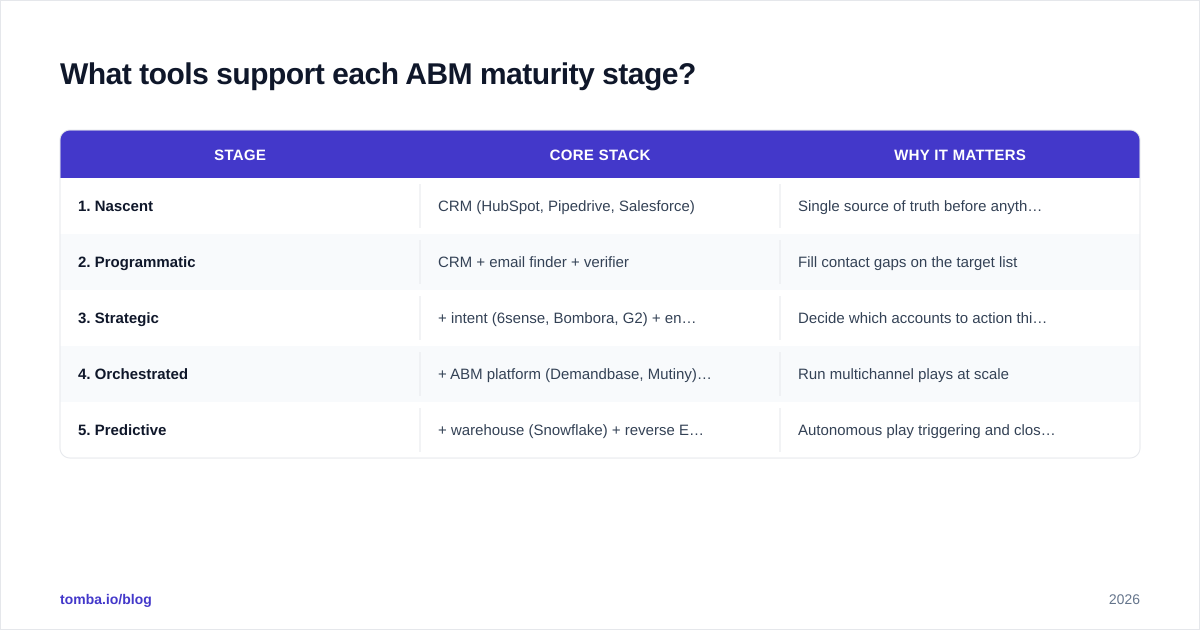
| Stage | Core stack | Why it matters |
|---|---|---|
| 1. Nascent | CRM (HubSpot, Pipedrive, Salesforce) | Single source of truth before anything else |
| 2. Programmatic | CRM + email finder + verifier | Fill contact gaps on the target list |
| 3. Strategic | + intent (6sense, Bombora, G2) + enrichment | Decide which accounts to action this week |
| 4. Orchestrated | + ABM platform (Demandbase, Mutiny) + RevOps tooling | Run multichannel plays at scale |
| 5. Predictive | + warehouse (Snowflake) + reverse ETL (Hightouch) + ML scoring | Autonomous play triggering and closed-loop attribution |
A frequent mistake is buying Stage 4 tooling while operating at Stage 2 data quality. A six-figure Demandbase contract on a target account list with 40% missing contacts is set on fire. Fix the foundation first: clean the CRM, enrich missing contacts via domain search, and verify deliverability with an email verifier before any ABM platform is signed.
For technical teams scaling enrichment programmatically, the Tomba API handles bulk lookups, verification, and webhook-driven enrichment jobs without forcing a manual export-import loop.
How do you move from one stage to the next?#
The transitions are concrete. Here is what unlocks each one.
Nascent → Programmatic. Get the CRO and CMO in a room. Define ICP using three filters (industry, size band, technographic signal). Build the first target account list — 100 to 250 accounts. Tag every CRM opportunity as target or non-target from this point forward.
Programmatic → Strategic. Two moves. First, close the contact gap: enrich every target account to 5+ verified buying-committee contacts. Second, write the sales-marketing SLA — response times, qualification criteria, handoff rules — and have both teams sign it.
Strategic → Orchestrated. Hire (or carve out) a RevOps owner whose job is end-to-end attribution. Build a single account view that combines marketing engagement, sales activity, intent signal, and CS health. Move from generic campaigns to documented plays per tier.
Orchestrated → Predictive. Stand up the data warehouse. Build a machine learning model on closed-won data to score accounts daily. Reverse-ETL the score back into Salesforce so plays trigger automatically. This is a 12–18 month investment for most companies.
What does an ABM maturity audit actually look like?#
A useful audit produces three deliverables:
- Current-stage report. Where you are on each of the six diagnostic dimensions (list, tiering, contacts, intent, SLA, attribution), with evidence. Not opinions — screenshots from the CRM, the actual SLA document, a sample account record showing contact coverage.
- Gap map. The specific blockers between your current stage and the next one, ranked by cost to fix versus impact on pipeline.
- 90-day plan. Three to five initiatives that close the highest-impact gaps. Each one has an owner, a budget, and a measurable outcome.
The audit takes a focused team about three weeks. Trying to do it faster usually produces a deck that looks good and changes nothing.
For a deeper benchmark of how peer companies are progressing, Forrester's annual B2B Summit research and G2's account-based marketing category reports are worth the read.
What's the role of data quality in ABM maturity?#
Data quality is the gating factor. Every stage transition in the model depends on cleaner, more complete, more behaviorally enriched account and contact data than the previous stage.
A target account list is useless without verified contacts. Intent data is noisy without firmographic context. Account scoring is junk without historical closed-won training data. The teams that move fastest up the maturity model are the ones that treat data hygiene as a continuous program, not a one-time cleanup project.
Practical baseline: every record in the CRM should have a verified email, a job title parsed against a standard taxonomy, a company size band, and an industry code. If you cannot produce that today for 95% of your target accounts, that's the first project — not a new ABM platform.
Frequently asked questions#
Is the ABM maturity model the same as the SiriusDecisions framework? The five-stage shape used here is derived from SiriusDecisions (now Forrester) and ITSMA (now Gartner) research, adapted for what 2026 GTM stacks actually look like. The vocabulary varies by vendor; the underlying progression is consistent.
How long does it take to move up one stage? Realistic timelines: Nascent → Programmatic, 3–6 months. Programmatic → Strategic, 6–12 months. Strategic → Orchestrated, 12–18 months. Orchestrated → Predictive, 18+ months, often longer.
Does ABM maturity require an ABM platform like Demandbase or 6sense? Not until Stage 4. Companies routinely reach Strategic-level execution with a CRM, an enrichment provider, an intent source, and disciplined RevOps process. Buying a platform before reaching Stage 3 typically wastes spend.
What's the ROI of moving up the model? Forrester's research consistently shows that mature ABM programs see 1.5–2× higher win rates and 30–50% larger average deal sizes on target accounts versus non-target. The compounding effect makes the investment pay back inside 18 months for most B2B SaaS companies above $10M ARR.
Start with the foundation: clean contact data#
The pattern across every stalled ABM program is the same — the strategy is sound, the tooling is bought, but the underlying contact data cannot support the plays. Before you sign the next ABM platform contract, fix the foundation.
Tomba's Email Finder gives you the verified buying-committee contacts you need to make any ABM motion work — from a first-tier list of 100 accounts to a fully orchestrated 1,000-account program. Start on the free tier (25 searches a month) to test coverage on your top accounts, then scale into Tomba pricing plans as your maturity grows. Pair it with the email verifier to keep bounce rates under 2% and deliverability where ABM plays actually convert.
The companies that win at ABM in 2026 are not the ones with the biggest platform contracts. They're the ones with the cleanest data underneath them.
// get started
Find, verify and enrich your first contacts today
Start on the free plan with 25 searches a month, then scale when your team is ready.
Free plan · No credit card required · GDPR & CCPA
// about the author