ABM Nurturing in 2026: The Complete Playbook for Account-Based Revenue
ABM nurturing is where most account-based programs quietly die. Here's the 2026 playbook for keeping target accounts warm, engaged, and moving toward revenue.
ABM Nurturing in 2026: The Complete Playbook for Account-Based Revenue
TL;DR
- ABM nurturing is the multi-channel, multi-stakeholder cadence that keeps named target accounts engaged between buying windows — not a drip sequence with personalization tokens.
- The best 2026 programs run 9-15 coordinated touches per account per quarter across email, LinkedIn, ads, direct mail, and sales-led plays.
- Pipeline velocity, not MQLs, is the right scoreboard. Track account engagement score, meeting rate per account, and pipeline-to-target ratio.
- Tooling stack splits into three layers: data and contact discovery, orchestration, and signal intelligence. Most teams overspend on layer two and underspend on layer one.
- Tomba sits in layer one — supplying verified contact data for every stakeholder on a target account, so your nurturing reaches inboxes instead of bouncing.
ABM nurturing is the work that happens after you've picked your target accounts and before they're ready to buy. It is also the phase most account-based programs get wrong, because they recycle MQL-era tactics — generic newsletters, "just checking in" emails, retargeting ads — and call it personalization.
This guide is a working playbook for nurturing named accounts in 2026: what it is, how it differs from lead nurturing, the cadences that get replies, the tools that earn their seat in the stack, and the metrics that tell you whether any of it is working.
What is ABM nurturing, exactly?#
ABM nurturing is the systematic engagement of every relevant stakeholder inside a named target account through coordinated channels and messaging, with the goal of expanding awareness, building trust, and creating sales-ready opportunities on your timeline rather than theirs.
Three words do most of the work in that definition:
- Named — you decided this account matters before they raised a hand. The list is finite (50, 250, 1000 accounts depending on tier) and changes slowly.
- Stakeholders — you nurture the buying committee, not a lead. Gartner pegs the average B2B buying group at 6-10 people. You need every name.
- Coordinated — email, ads, social, sales, events, and direct mail all reference the same account-specific narrative. A nurturing program where marketing runs ads about "digital transformation" while sales pitches "vendor consolidation" is not ABM.
How is ABM nurturing different from lead nurturing?#
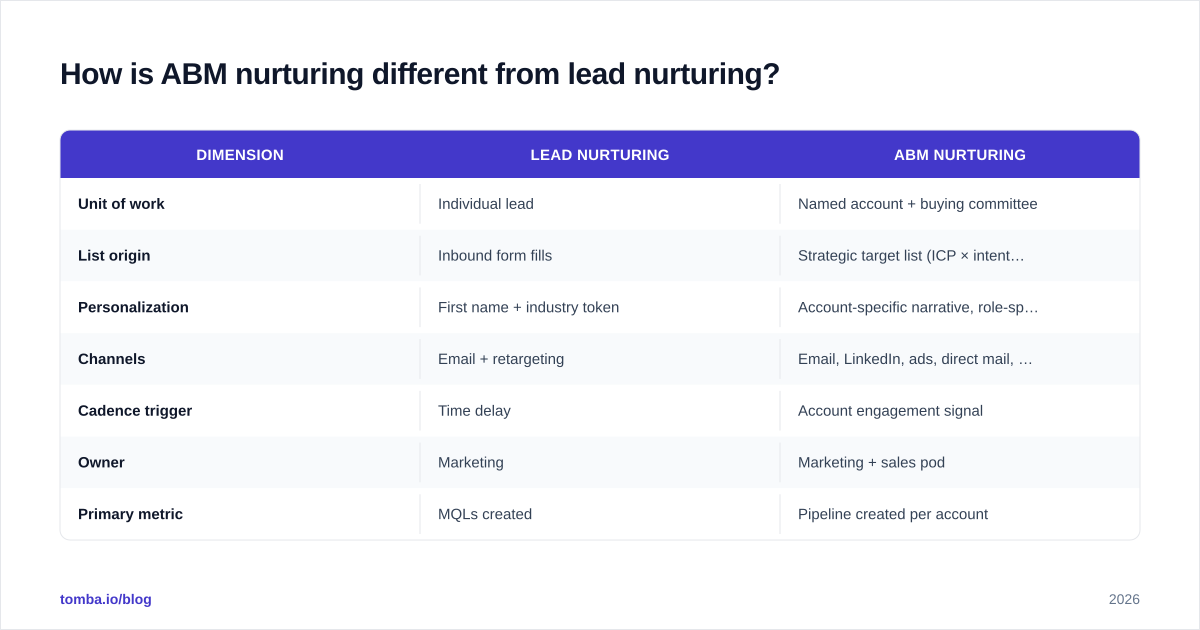
Lead nurturing is built around an individual contact who self-identified through a content download. ABM nurturing flips both halves: you target accounts you chose, and you engage groups of stakeholders together.
| Dimension | Lead Nurturing | ABM Nurturing |
|---|---|---|
| Unit of work | Individual lead | Named account + buying committee |
| List origin | Inbound form fills | Strategic target list (ICP × intent × fit) |
| Personalization | First name + industry token | Account-specific narrative, role-specific angle |
| Channels | Email + retargeting | Email, LinkedIn, ads, direct mail, sales, events |
| Cadence trigger | Time delay | Account engagement signal |
| Owner | Marketing | Marketing + sales pod |
| Primary metric | MQLs created | Pipeline created per account |
| Failure mode | Lead leaks before SQL | Account goes dark mid-cycle |
The practical implication: every tool, metric, and process you used for lead nurturing needs to be re-pointed at the account as the unit of measurement.
What does a 2026 ABM nurturing cadence look like?#
A working cadence is 9-15 touches per account per quarter, weighted toward the first three weeks and tapering thereafter. The touches are not all from the same person, not all the same channel, and not all "nurturing" in the soft sense — some are direct asks.
Here is a tier-1 cadence we've seen consistently produce meetings:
Week 1 — Awareness wedge
- LinkedIn ad campaign targeting account domain, 5-day burst
- Sales rep follows 4-6 stakeholders on LinkedIn
- Marketing sends an account-specific case study email to the economic buyer
- SDR sends a research-led email to a champion candidate
Week 2 — Multi-thread
- LinkedIn DM from AE to the economic buyer referencing a recent post
- Personalized video Loom from SDR to the champion
- Direct mail to the economic buyer (book, custom report, or branded item)
Week 3 — Demonstrate value
- Email with a custom mini-audit (4-6 hours of analyst time)
- Invite to a small executive roundtable or private event
Weeks 4-12 — Sustain
- Bi-weekly email with proprietary data or insight relevant to their stack
- LinkedIn engagement on stakeholder posts (real comments, not likes)
- Retargeting ads keep the brand visible
- Quarterly check-in with a new angle (new product, new case study, new research)
The work that makes this expensive is the inputs: knowing the stack, the buying committee, the recent triggers. None of that is generated by a sequencing tool — it's gathered by a sales researcher and verified contact data.
How do you build the target account list?#
The list is the program. A weak list cannot be rescued by clever creative.
The standard formula in 2026 is ICP fit × intent signal × strategic value. Each account gets a score on all three axes, and the top N go on the list.
- ICP fit — firmographic match: industry, size, geography, tech stack. Tools like Clearbit, ZoomInfo, and Apollo all score this.
- Intent signal — third-party intent (Bombora, G2, 6sense) plus first-party signals (website visits, content engagement, hiring patterns, funding rounds).
- Strategic value — pure judgment: would this logo unlock a vertical? Does the CEO have a network we want? Is this a competitive replacement?
Most teams should hold 50-100 accounts per AE per quarter for one-to-one nurturing, 250-500 for one-to-few, and up to 1000+ for one-to-many programmatic. The buying-committee discovery work scales differently per tier — for tier-1 accounts you map every relevant stakeholder by hand, using a domain search to surface every email at the company and then filtering by role.
How do you find every stakeholder in the buying committee?#
You start with the company domain and work outward. The job is to identify 6-10 people per account: economic buyer, technical buyer, end user, champion candidate, blocker, and any peripheral influencers.
The mechanics:
- Pull the company's full email roster via domain search
- Filter by job title patterns (VP / Director / Manager of [your buyer functions])
- Cross-reference LinkedIn for tenure, reporting lines, and recent posts
- Verify each email before sending — bouncing on a CFO at a target account is a self-inflicted wound
- Enrich each contact with phone, LinkedIn URL, and social handles using data enrichment
For a 250-account program, you're building and maintaining a 1500-2500-person contact set. Doing this in spreadsheets is possible for one quarter and impossible for two. Either build a CRM-native workflow or use a bulk email finder that hands back verified contacts ready to import.
Which channels actually move ABM accounts?#
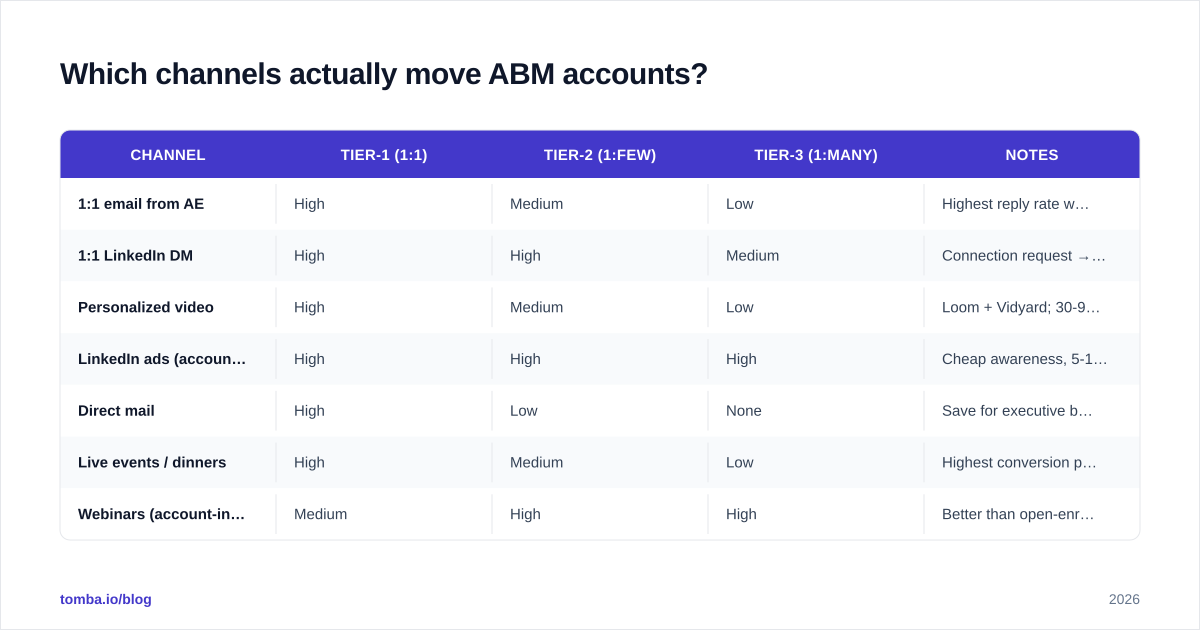
Channel mix should be a function of account tier, deal size, and where your buying committee actually spends time. Here's what 2026 data and operator experience suggests:
| Channel | Tier-1 (1:1) | Tier-2 (1:few) | Tier-3 (1:many) | Notes |
|---|---|---|---|---|
| 1:1 email from AE | High | Medium | Low | Highest reply rate when researched |
| 1:1 LinkedIn DM | High | High | Medium | Connection request → value → ask cadence |
| Personalized video | High | Medium | Low | Loom + Vidyard; 30-90 seconds |
| LinkedIn ads (account-targeted) | High | High | High | Cheap awareness, 5-15% lift in cold-email response |
| Direct mail | High | Low | None | Save for executive buyers, ~$50-200/touch |
| Live events / dinners | High | Medium | Low | Highest conversion per touch, lowest scale |
| Webinars (account-invited) | Medium | High | High | Better than open-enrollment |
| Programmatic display | Low | Medium | High | Air cover, not driver |
| Cold call | Medium | Medium | Low | Bookmark for tier-1 follow-up |
The mistake to avoid: treating LinkedIn ads as the program. They are air cover. The replies come from research-led, multi-channel sequences run by named humans.
How should your team be structured?#
ABM nurturing fails when it sits inside marketing without sales accountability, or inside sales without marketing infrastructure. The functional answer in 2026 is a pod model:
- 1 AE
- 1 SDR (or BDR)
- 0.5 ABM marketer
- 0.25 sales engineer / analyst (for custom mini-audits)
- Shared access to a researcher / ops support
Each pod owns 40-80 tier-1 accounts. Weekly pod standups, monthly account reviews, quarterly target-list refresh. This structure is endorsed in the revenue operations literature from Forrester and 6sense, both of which publish detailed RevOps benchmarks.
The pod structure also clarifies the buy-vs-build question for tooling. Pods need:
- Shared account dashboard (Salesforce/HubSpot account view)
- Engagement signal feed (intent + first-party)
- Contact data on tap (any pod member can pull a stakeholder list in 60 seconds)
- Sequencing tool that respects account-level coordination, not just individual cadence
What does the ABM nurturing tech stack look like?#
Three layers, in priority order:
Layer 1 — Data and contact discovery
The foundation. Bad data here pollutes everything above it. Tools include Tomba, Apollo, ZoomInfo, Clearbit, and Cognism. The differentiators are coverage (does it have the contacts you need), verification accuracy (bounce rate when you actually send), enrichment depth (phone, LinkedIn, intent), and pricing model.
For benchmarks on how email-finder tools compare on accuracy and coverage, see independent reviews on G2 and our own data sources documentation.
Layer 2 — Orchestration
Where the cadence runs. Outreach, Salesloft, Apollo sequences, HubSpot Sequences, Smartlead, Instantly. Newer ABM-specific orchestration (Demandbase, 6sense, ZoomInfo's Engage) adds account-level coordination.
Layer 3 — Signal intelligence
What triggers the play. Intent data (Bombora, 6sense, G2), website visitor reveal (Tomba Reveal, RB2B, Warmly), CRM signals (Pocus, Common Room), social signals (Trigify, Champify).
Spend roughly 30/40/30 across the three layers. The common mistake — 10/70/20 — leaves you with the world's most elegant sequencing engine running on garbage data.
Which metrics actually matter?#
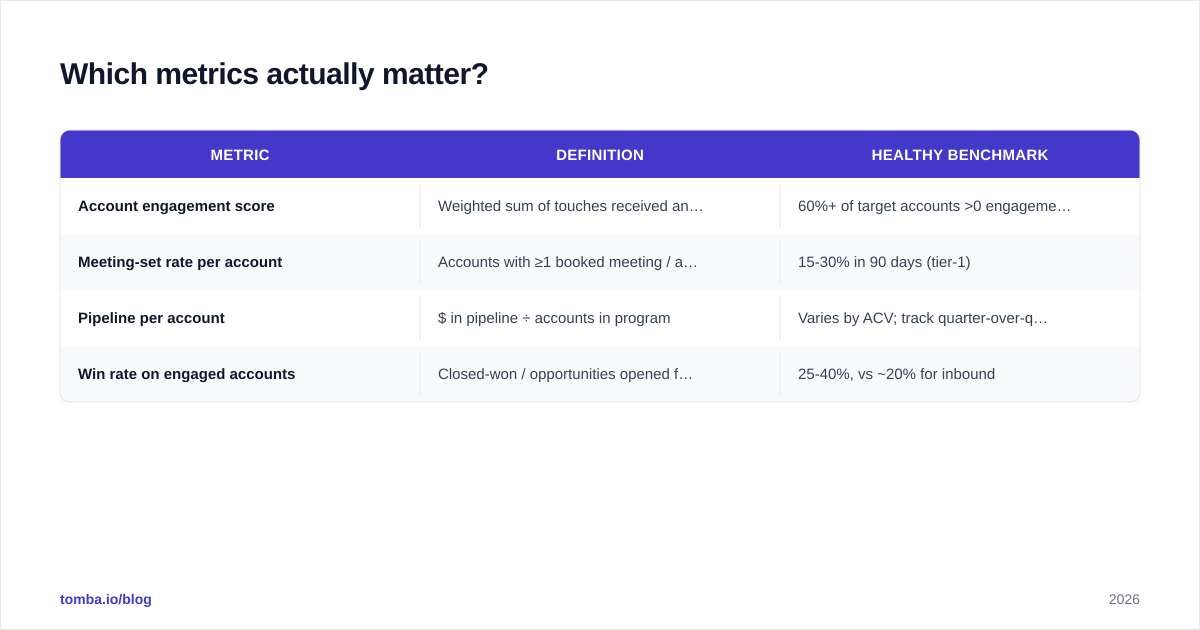
Not MQLs. The honest scoreboard for ABM nurturing has four numbers:
| Metric | Definition | Healthy benchmark |
|---|---|---|
| Account engagement score | Weighted sum of touches received and replied to per account | 60%+ of target accounts >0 engagement in 90 days |
| Meeting-set rate per account | Accounts with ≥1 booked meeting / accounts in program | 15-30% in 90 days (tier-1) |
| Pipeline per account | $ in pipeline ÷ accounts in program | Varies by ACV; track quarter-over-quarter trend |
| Win rate on engaged accounts | Closed-won / opportunities opened from program | 25-40%, vs ~20% for inbound |
Secondary metrics worth tracking: time-from-first-touch-to-meeting, multi-thread coverage (% of accounts where ≥3 stakeholders engaged), and content consumption by account.
The metric trap to avoid: optimizing for velocity of touches instead of quality of replies. A pod that sends 1000 touches with a 0.5% reply rate is losing to a pod that sends 200 touches with a 4% reply rate. Forrester's 2024 B2B Buying Study confirmed that buyers now ignore 80% of vendor outreach by default — quality is the only lever left.
What are the most common ABM nurturing mistakes?#
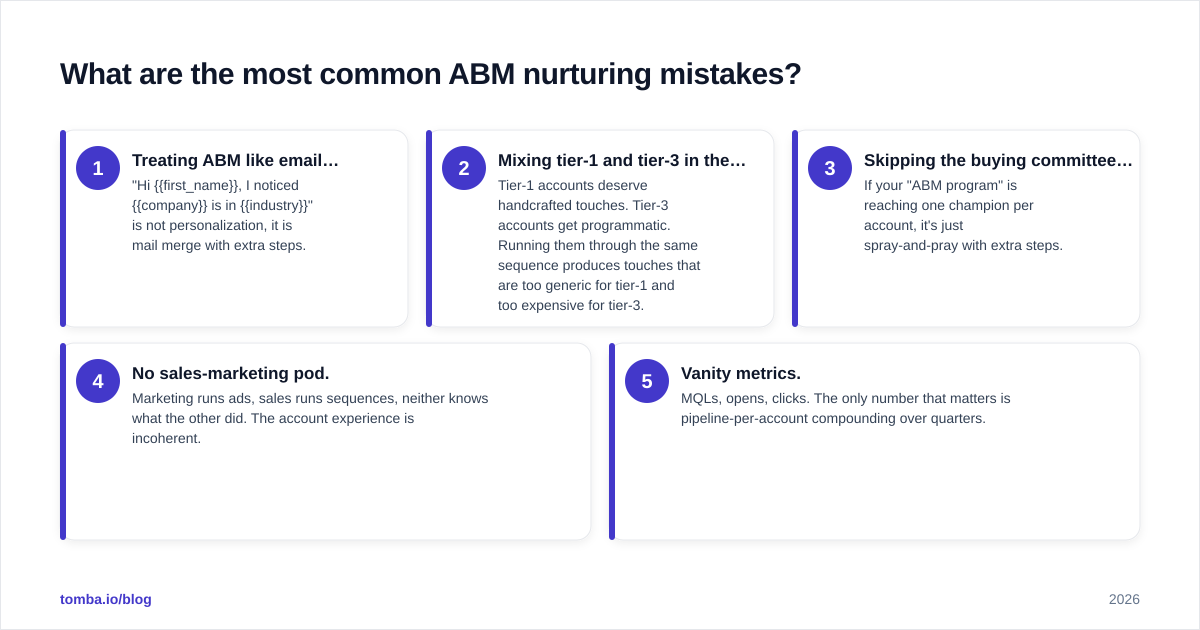
Five mistakes account for most program failures:
- Treating ABM like email marketing with bigger tokens. "Hi {{first_name}}, I noticed {{company}} is in {{industry}}" is not personalization, it is mail merge with extra steps.
- Mixing tier-1 and tier-3 in the same cadence. Tier-1 accounts deserve handcrafted touches. Tier-3 accounts get programmatic. Running them through the same sequence produces touches that are too generic for tier-1 and too expensive for tier-3.
- Skipping the buying committee mapping. If your "ABM program" is reaching one champion per account, it's just spray-and-pray with extra steps.
- No sales-marketing pod. Marketing runs ads, sales runs sequences, neither knows what the other did. The account experience is incoherent.
- Vanity metrics. MQLs, opens, clicks. The only number that matters is pipeline-per-account compounding over quarters.
How long until ABM nurturing produces pipeline?#
Plan for 90 days to first meaningful pipeline, 180 days to a predictable rhythm, 12 months before you trust the numbers enough to scale spend. ABM is a flywheel — it pays off quarterly, not weekly.
Quarter 1 is mostly infrastructure: list, contacts, content, cadences, dashboards. Quarter 2 you start to see meetings convert. Quarter 3 the first deals close. Quarter 4 you have enough data to refine the target list and double down on what works.
If your CFO needs faster proof, run a 60-day pilot with 30 accounts, a single pod, and one tightly scoped offer (a custom audit, a small executive event). Document the meetings, the pipeline, and the cost per opportunity. Then scale.
What's the simplest way to start ABM nurturing today?#
Start small enough to actually finish:
- Pick 30 accounts. Real names, real reasons.
- Map the buying committee — 6-10 people each, using a domain search and email verifier so you don't burn the program on bounces.
- Write one good asset — a custom mini-audit template, a research report, a teardown.
- Build a 6-touch sequence across email + LinkedIn + a direct-mail moment.
- Run it for 60 days. Track meetings, pipeline, and which touches drove replies.
- Review honestly, then expand or kill.
The teams that win at ABM in 2026 aren't the ones with the biggest tech stack. They're the ones that do the unglamorous work — accurate contact data, real research, multi-threaded outreach, patient measurement — and refuse to call MQL drip campaigns "account-based."
Get your contact foundation right#
Every layer of ABM nurturing sits on the assumption that your emails reach inboxes and your contact data is current. Tomba's Email Finder and data enrichment give you verified contacts for every stakeholder on every target account — across Salesforce, HubSpot, Pipedrive, and your existing workflow. Start with the free tier (25 searches/mo) and scale to Growth or Pro when your account list grows. Your ABM program is only as good as the inboxes it reaches — make sure those inboxes are real.
// get started
Find, verify and enrich your first contacts today
Start on the free plan with 25 searches a month, then scale when your team is ready.
Free plan · No credit card required · GDPR & CCPA
// about the author