ABM Platform Comparison 2026: Demandbase vs 6sense vs RollWorks
A direct, no-fluff ABM platform comparison covering Demandbase, 6sense, RollWorks, Terminus, and HubSpot ABM — pricing, intent data, fit, and where each one breaks.
ABM Platform Comparison 2026: Demandbase vs 6sense vs RollWorks
TL;DR
- The 2026 ABM platform market splits into three tiers: enterprise (Demandbase, 6sense), mid-market (RollWorks, Terminus), and CRM-native (HubSpot ABM, Salesforce/Pardot).
- Intent data quality is the single biggest differentiator — Bombora-fed platforms behave very differently from first-party signal engines like 6sense.
- Pricing ranges from $1,000/mo (RollWorks starter) to $120,000+/yr (Demandbase enterprise). Most teams overbuy.
- An ABM platform without clean contact data is a $60k browser tab. Pair any of these with a serious email finder before you sign.
- This comparison gives you the honest break-down: where each platform wins, where it stalls, and how to pick without getting trapped in a 24-month contract.
What is an ABM platform and why does the comparison matter in 2026?#
An account-based marketing (ABM) platform identifies in-market accounts, surfaces buying-committee contacts, orchestrates multi-channel plays, and reports on account-level engagement. It replaces the lead-by-lead funnel with an account-by-account one.
The market matured fast between 2023 and 2026. Vendors that started as display-ad networks (RollWorks, Terminus) added intent and orchestration. Pure-play intent vendors (6sense, Demandbase) added advertising and personalization. And CRMs (HubSpot, Salesforce) bolted on lighter ABM modules to keep mid-market customers from churning.
The result: a confusing landscape where five tools claim to do the same thing for prices that vary by 100x. A serious ABM platform comparison has to look past the marketing pages.
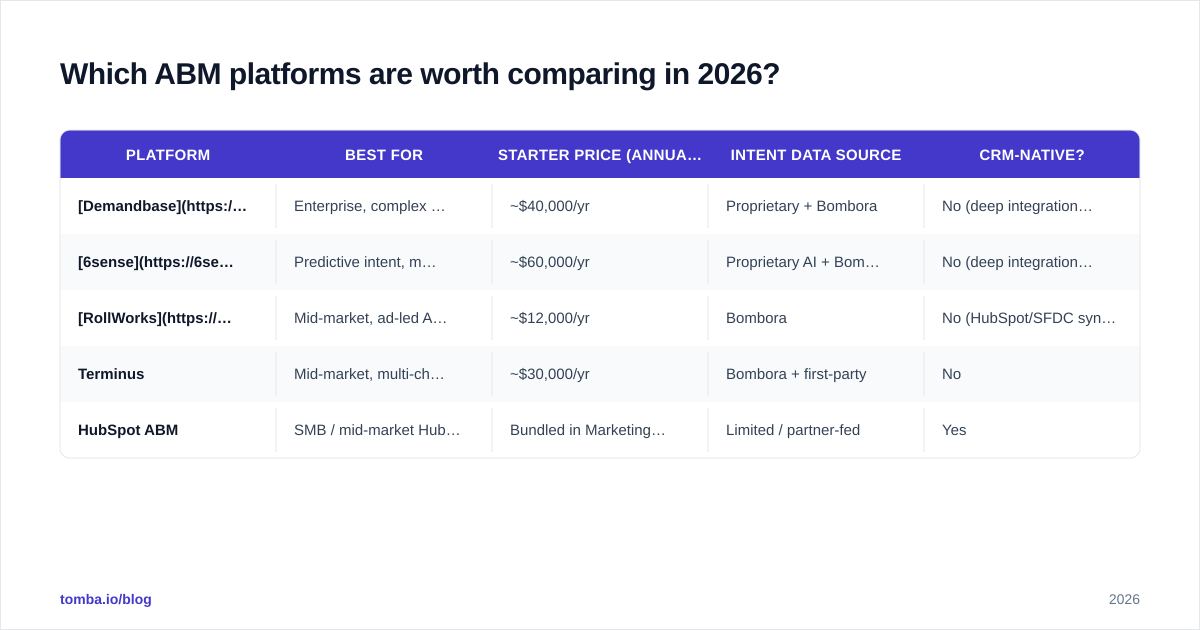
Which ABM platforms are worth comparing in 2026?#
We narrowed the field to five that buyers actually evaluate against each other. Niche tools (Madison Logic, N.Rich, Influ2) exist but rarely show up in head-to-head decisions outside their specialty.
| Platform | Best for | Starter price (annual) | Intent data source | CRM-native? |
|---|---|---|---|---|
| Demandbase | Enterprise, complex GTM | ~$40,000/yr | Proprietary + Bombora | No (deep integrations) |
| 6sense | Predictive intent, mid-to-enterprise | ~$60,000/yr | Proprietary AI + Bombora | No (deep integrations) |
| RollWorks | Mid-market, ad-led ABM | ~$12,000/yr | Bombora | No (HubSpot/SFDC sync) |
| Terminus | Mid-market, multi-channel orchestration | ~$30,000/yr | Bombora + first-party | No |
| HubSpot ABM | SMB / mid-market HubSpot customers | Bundled in Marketing Hub Pro ($890/mo+) | Limited / partner-fed | Yes |
Prices are 2026 list ranges from G2 reviewer submissions and public RFP data — your number will move with seat count, ad spend, and how hard you negotiate.
How do the top ABM platforms compare on intent data quality?#
This is where the marketing pages lie hardest. Every vendor says "we have the best intent data." Three things actually matter: signal source, deduplication, and how the signal maps to your accounts.
Demandbase uses a hybrid: its own Demandbase Insights (built on the old DemandMatrix and InsideView data) plus Bombora keyword intent. The strength is the company graph — they know that Acme NA, Acme EU, and Acme.io are the same logo. The weakness is keyword-based intent, which has noise problems at scale.
6sense runs a proprietary AI model that fuses anonymous first-party site behavior, third-party signals, and a predictive scoring layer. Buyers consistently rate it the best at predicting in-market behavior, which is why it commands a price premium. The trade-off: the "Sense" black box is hard to debug when scores look wrong.
RollWorks is Bombora-licensed intent with their own engagement layer on top. It's fine. It's not magic. For mid-market teams who don't have an analyst to tune a 6sense model, that's an honest match.
Terminus licenses Bombora plus their own anonymous first-party detection. Mid-pack — usable, not predictive.
HubSpot ABM has no native intent engine. You either pipe in third-party data (Clearbit Reveal, Bombora via partner) or use the built-in scoring on first-party signals only.

What does ABM platform pricing actually look like in 2026?#
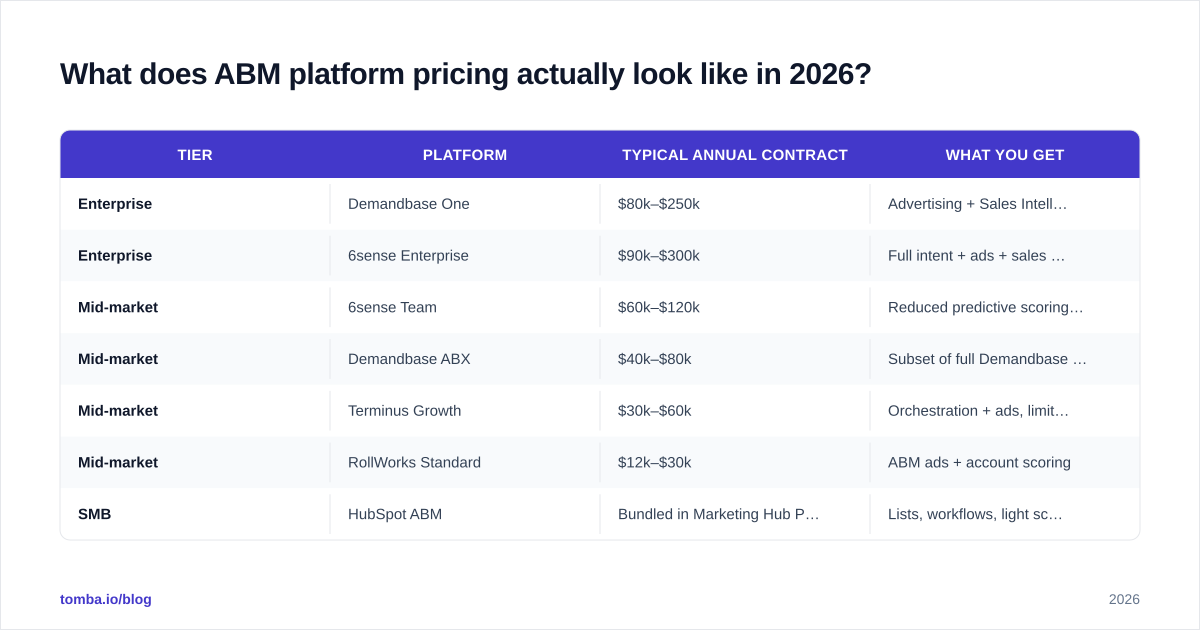
Public list pricing for enterprise ABM is mostly fiction. Here's what real 2026 deals look like, based on G2, RFP data, and confirmed reviewer screenshots:
| Tier | Platform | Typical annual contract | What you get |
|---|---|---|---|
| Enterprise | Demandbase One | $80k–$250k | Advertising + Sales Intelligence + Orchestration + Data |
| Enterprise | 6sense Enterprise | $90k–$300k | Full intent + ads + sales intel + predictive scoring |
| Mid-market | 6sense Team | $60k–$120k | Reduced predictive scoring + capped account list |
| Mid-market | Demandbase ABX | $40k–$80k | Subset of full Demandbase One |
| Mid-market | Terminus Growth | $30k–$60k | Orchestration + ads, limited intent |
| Mid-market | RollWorks Standard | $12k–$30k | ABM ads + account scoring |
| SMB | HubSpot ABM | Bundled in Marketing Hub Pro/Enterprise | Lists, workflows, light scoring |
A second number nobody talks about: minimum ad spend. Both Demandbase and 6sense effectively require $30k–$60k/yr of programmatic ad spend on top of platform fees to use the display channel meaningfully. Budget for the total.
For a deeper dive into how vendors structure these contracts, the Forrester Wave for ABM platforms is a useful starting point, even if you have to read between the lines.
How does each ABM platform handle the buying-committee data problem?#
This is where most ABM projects quietly fail. The platform tells you Acme is in-market. Then someone has to find the actual 8 humans on the buying committee, find their work emails, and route them to sales or sequence.
Demandbase and 6sense both have sales intelligence modules with contact data — but coverage is uneven. Demandbase's contact data leans U.S. mid/large enterprise. 6sense's is broader but reviewers consistently flag stale records in EMEA and APAC. Both expect you to keep a contact-data vendor on the side.
RollWorks and Terminus don't pretend — they rely on you bringing your own contacts or buying them from a partner.
HubSpot ABM uses whatever's already in your HubSpot CRM, which means if your CRM is thin, your ABM is thin.
This is the single most common failure mode: teams sign a $90k 6sense contract, then discover their CRM has 1.2 contacts per target account when they need 6–8. The fix is either an enrichment vendor or an email finder that lets you pull the missing buying-committee contacts on demand, then push them to the ABM platform.
You can also use bulk lead generation workflows to seed an ICP-matched account list with full buying committees before you ever turn the ABM platform on. That sequencing matters more than the platform you pick.

Is 6sense better than Demandbase?#
It depends on what you're solving for, and the honest answer is they win different deals.
6sense wins when:
- Your buyer journey is long and you need predictive (not reactive) intent
- You have analyst capacity to interrogate the AI scoring
- You're mid-to-enterprise B2B SaaS with global accounts
- You care more about pipeline acceleration than ad reach
Demandbase wins when:
- You have a complex account hierarchy (parent/child, global subsidiaries)
- You need tight orchestration across web personalization + ads + sales plays
- Your marketing team is bigger than your data team
- You want a single contract instead of stitching point tools
Both are real platforms, and either one outperforms doing nothing. The wrong question is "which is best." The right question is "which one does my team actually have the operational maturity to run." A 6sense license without a marketing operations lead is a six-figure dashboard.
G2's ABM grid tracks the head-to-head on roughly 4,000 reviews — it's worth filtering by company size before reading any rating.
What about RollWorks, Terminus, and the mid-market tier?#
Below the enterprise line, the comparison gets more interesting because the platforms are honestly priced.
RollWorks is the easiest mid-market starting point. The ABM grid is built around three jobs (identify, engage, measure) and the UI shows you exactly what's happening on each. The HubSpot integration is best-in-class because RollWorks was built around it. The ceiling: at $30k+/yr you outgrow the predictive features and look at 6sense.
Terminus has the strongest multi-channel orchestration in this tier — chat, ads, email, web personalization, direct mail. If you run plays across more than two channels, Terminus reduces tool sprawl. The weakness is the data layer; intent feels thinner than 6sense or Demandbase.
For HubSpot-native shops, the question is usually "do we even need a third-party ABM platform?" If your TAM is small (<2,000 target accounts), HubSpot's built-in target accounts and ABM workflows plus an enrichment layer can cover 80% of what RollWorks does. Above 2,000 accounts, you'll hit the ceiling fast.
What CRM and martech integrations should you actually verify?#
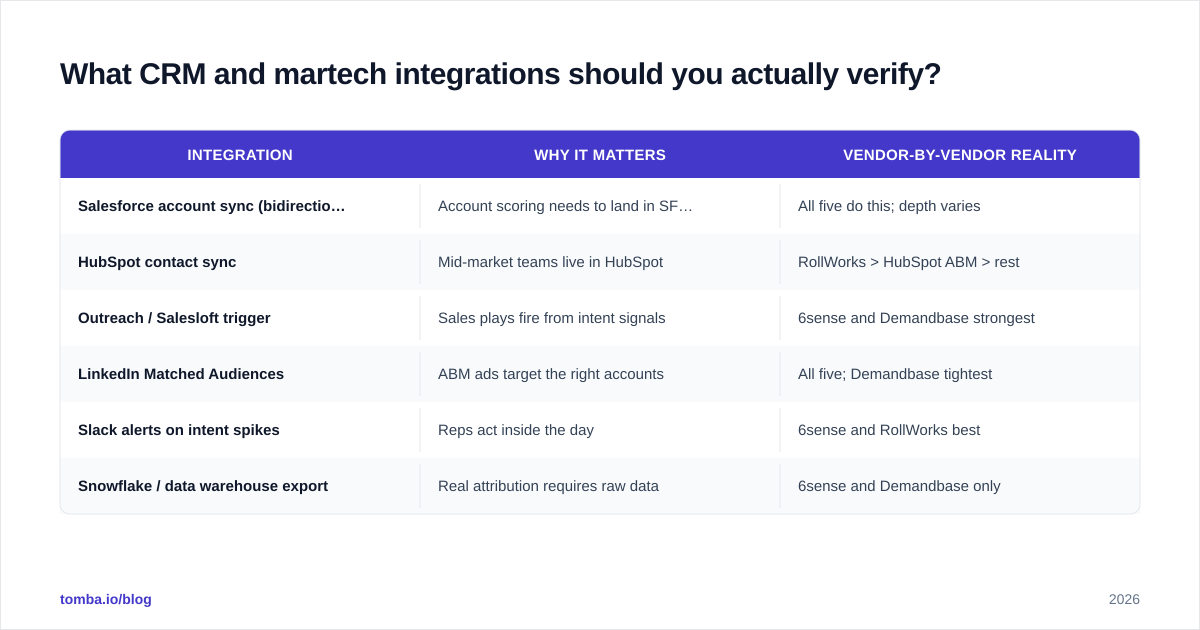
Don't take "we integrate with everything" at face value. The integrations that actually move pipeline:
| Integration | Why it matters | Vendor-by-vendor reality |
|---|---|---|
| Salesforce account sync (bidirectional) | Account scoring needs to land in SFDC for reps | All five do this; depth varies |
| HubSpot contact sync | Mid-market teams live in HubSpot | RollWorks > HubSpot ABM > rest |
| Outreach / Salesloft trigger | Sales plays fire from intent signals | 6sense and Demandbase strongest |
| LinkedIn Matched Audiences | ABM ads target the right accounts | All five; Demandbase tightest |
| Slack alerts on intent spikes | Reps act inside the day | 6sense and RollWorks best |
| Snowflake / data warehouse export | Real attribution requires raw data | 6sense and Demandbase only |
The data warehouse export is the test most buyers skip. If you can't pipe raw account-level engagement to Snowflake or BigQuery, you can't tie ABM activity to closed-won revenue six months later. That's a buying criterion, not a nice-to-have.
If you're stitching ABM signals into existing prospecting workflows, the Tomba HubSpot integration and Salesforce integration cover the contact-data side of that pipe.
How do you evaluate ABM platforms without getting stuck in a 24-month contract?#
Five hard rules from buyers who've been burned:
- Demand a month-to-month pilot. Enterprise reps will resist. Push back. A 90-day pilot on a subset of accounts proves intent quality faster than any demo.
- Run their intent data against a known account. Pick a deal you closed last quarter. Ask the vendor to show their data from 90 days before close. If they can't, the data isn't predictive.
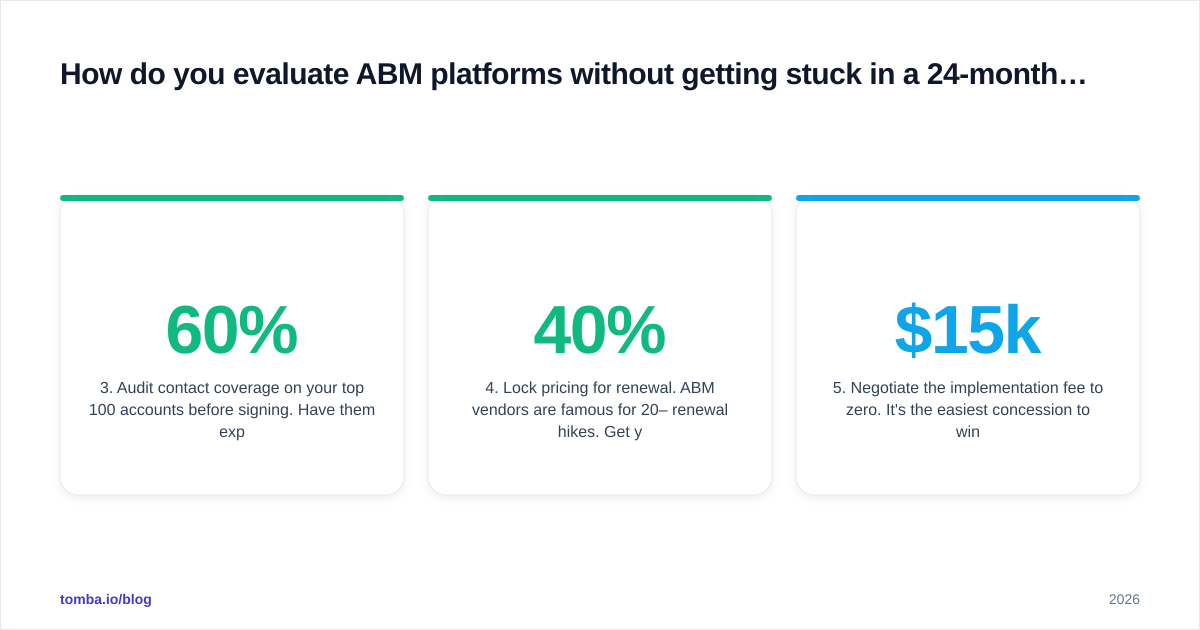
- Audit contact coverage on your top 100 accounts before signing. Have them export every contact they have for those companies. Then compare to your CRM. Most platforms cover 30–60% of the buying committee — the rest you'll need to fill with an email finder or LinkedIn finder.
- Lock pricing for renewal. ABM vendors are famous for 20–40% renewal hikes. Get year-two and year-three price caps in writing.
- Negotiate the implementation fee to zero. It's the easiest concession to win and usually saves $15k–$40k.
Which ABM platform should you actually pick?#
A short decision tree:
- <$5M ARR, lean team, HubSpot stack: Start with HubSpot ABM + an enrichment layer. Don't pay for an enterprise platform you can't operate.
- $5M–$50M ARR, mid-market B2B: RollWorks or Terminus. Pick RollWorks if you're ad-heavy, Terminus if you're channel-diverse.
- $50M+ ARR, complex GTM, analyst capacity: 6sense if you prioritize predictive intent, Demandbase if you prioritize orchestration and account hierarchy.
- Enterprise with global subsidiaries: Demandbase, almost always — the company graph is unmatched.
Whichever way you go, the platform is only as good as the contact data flowing through it. Buying committee coverage is the silent killer of ABM ROI.
Where Tomba fits into your ABM stack#
ABM platforms are great at telling you which accounts are in-market. They are average at telling you which 8 humans inside that account you need to reach. That's where most projects stall.
Tomba's email finder plugs that gap: feed it a list of target accounts from 6sense, Demandbase, or RollWorks, and pull verified, deliverable contacts for the entire buying committee in minutes — not the 30–60% coverage your ABM vendor ships with. Plans start at the Tomba Free tier (25 searches/mo) so you can validate the workflow against a real account list before you commit. When you're ready to scale, the Starter plan is $49/mo and the Growth plan is $99/mo — a rounding error next to a $60k ABM contract that fails because the contact data was thin.
Pick the ABM platform that matches your scale. Then make sure the contacts inside it are real.
// get started
Find, verify and enrich your first contacts today
Start on the free plan with 25 searches a month, then scale when your team is ready.
Free plan · No credit card required · GDPR & CCPA
Get the Tomba newsletter
Product and data updates
// about the author