ABM ROI in 2026: How to Measure Account-Based Returns
ABM ROI is the only metric that decides whether your account-based program survives the next budget cycle. Here is how to measure it without lying to yourself.
ABM ROI in 2026: How to Measure Account-Based Returns
TL;DR
- ABM ROI is
(Revenue Influenced by ABM − Program Cost) / Program Cost, but the honest version requires you to define "influenced" before you start, not after the deal closes. - The 2026 benchmark from ITSMA/Momentum is a 3:1 to 10:1 return on ABM spend within 18 months, with one-to-one programs landing on the higher end.
- Pipeline velocity, account engagement, and deal size are leading indicators. Closed-won revenue is the lagging one. Track all four or you will optimize the wrong thing.
- The biggest ROI killer is not bad targeting — it is dirty contact data inside your tier-1 account list. Garbage in, garbage tracked.
- Build a measurement model before you spend a dollar on intent data. Backfilling attribution six months in never works.
What does ABM ROI actually mean?#
ABM ROI measures whether your account-based marketing program returns more revenue than it costs. The formula is unambiguous on paper:
ABM ROI = (Revenue Influenced − Program Cost) / Program Cost × 100
The fight is over the word "influenced." Your CMO wants every closed-won deal from any targeted account to count. Your CFO wants only deals where ABM was the first or primary touch. Both are wrong if you do not pick a definition and freeze it before the program starts.
A clean working definition: revenue from a target-list account where at least one ABM-attributed touch occurred in the 90 days before the opportunity was created, and the deal closed within the program measurement window. That is conservative, defensible, and survives audit.
This matters because ABM is expensive. A typical one-to-one program costs $5,000 to $25,000 per account per year when you load in ad spend, content production, BDR time, and tooling. If you target 50 accounts, that is up to $1.25M in committed spend. The board will ask for the return number. You need the number ready.
How do you calculate ABM ROI in 2026?#
Start with five inputs. Pull each from a system of record, not a slide.
- Total program cost — tooling, ad spend, content, headcount allocation, agency fees, data and enrichment subscriptions
- Revenue from target accounts — closed-won ARR or TCV from your defined account list during the measurement window
- Attribution rule — first-touch, last-touch, multi-touch, or "ABM-influenced" tag
- Measurement window — typically 12 to 18 months from program start
- Baseline — what these same accounts would have produced without ABM (use a control cohort or prior-year same-quarter)
The formula in practice:
ABM ROI = (Target Account Revenue − Baseline Revenue − Program Cost) / Program Cost
Subtracting the baseline is the step most teams skip. Without it, you are crediting ABM for revenue that would have closed anyway. Forrester's 2025 research on account-based programs found that teams who failed to set a baseline overstated ROI by an average of 2.4x. That gap is what gets programs cut when a new CFO arrives.
What are realistic ABM ROI benchmarks in 2026?#
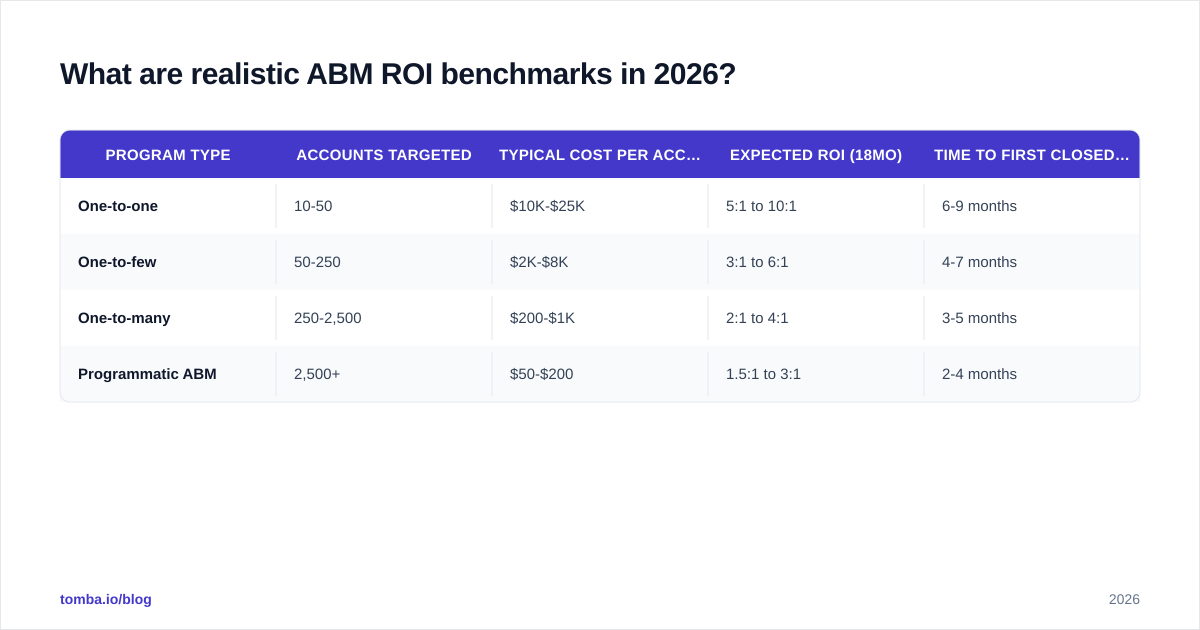
There is no universal benchmark, but the 2026 data converges around a few ranges.
| Program type | Accounts targeted | Typical cost per account/year | Expected ROI (18mo) | Time to first closed-won |
|---|---|---|---|---|
| One-to-one | 10-50 | $10K-$25K | 5:1 to 10:1 | 6-9 months |
| One-to-few | 50-250 | $2K-$8K | 3:1 to 6:1 | 4-7 months |
| One-to-many | 250-2,500 | $200-$1K | 2:1 to 4:1 | 3-5 months |
| Programmatic ABM | 2,500+ | $50-$200 | 1.5:1 to 3:1 | 2-4 months |
Three things shift these numbers. ACV is the biggest lever — a $500K ACV program tolerates much higher per-account cost than a $20K ACV program. Sales cycle length is the second; long enterprise cycles mean your 12-month ROI looks bad even when the program is working. Data quality is the third, and the one most teams underweight.
Why does data quality break ABM ROI math?#
Because your target account list is only as good as the contacts inside it. A 100-account tier-1 list with stale director and VP emails is not a target list — it is a wish list.
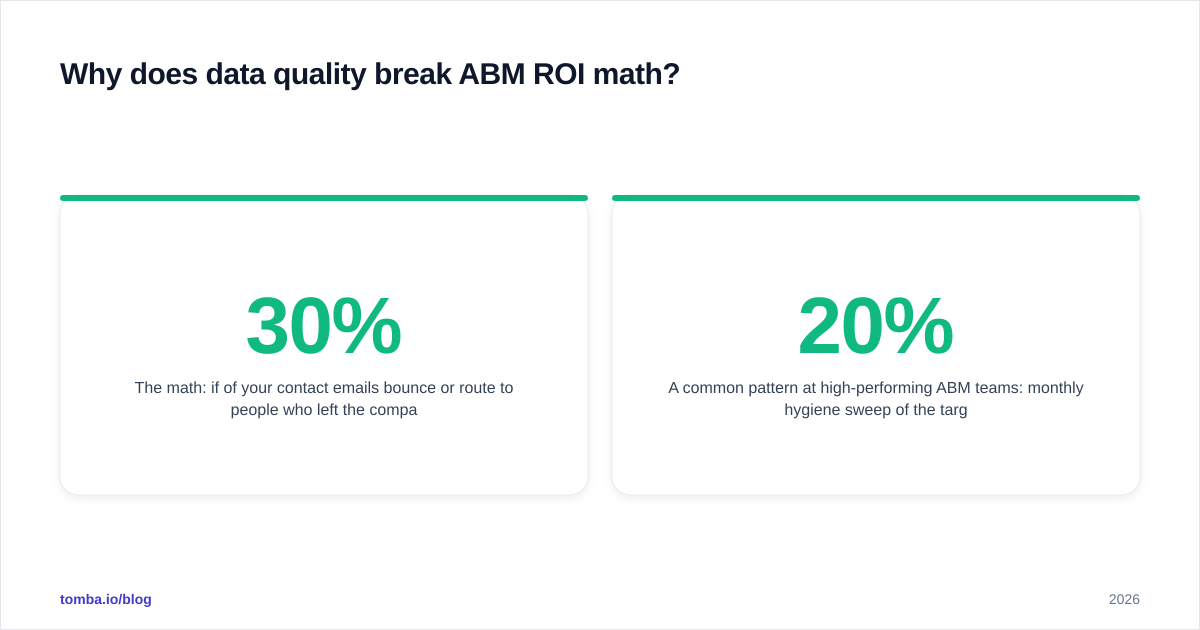
The math: if 30% of your contact emails bounce or route to people who left the company, you have effectively reduced your reachable account count by 30% while still paying the full program cost. Your denominator stays the same. Your numerator shrinks. ROI craters.
This is where contact-level hygiene determines program-level returns. Before you launch any ABM motion, every contact at every target account needs to be verified, role-mapped, and refreshed quarterly. Use an email verifier to catch decay before your BDR team burns sequences on dead inboxes, and pair it with a domain search to find the buying-committee members you are missing entirely.
A common pattern at high-performing ABM teams: monthly hygiene sweep of the target list, quarterly buying-committee re-mapping, and a hard rule that no ad spend or sequence runs against an unverified contact. That single rule typically lifts program ROI 20% to 40% in the first two quarters.
What metrics should you track beyond ROI?#
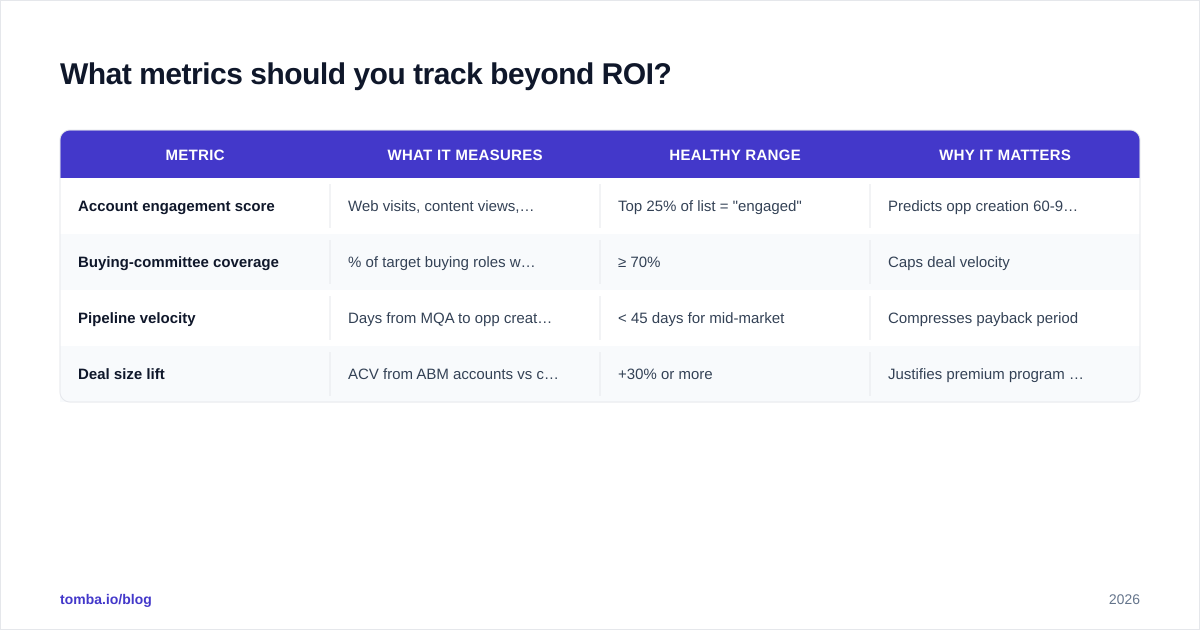
ROI is lagging. By the time the number is bad, the budget cycle is over. Track four leading indicators alongside it.
| Metric | What it measures | Healthy range | Why it matters |
|---|---|---|---|
| Account engagement score | Web visits, content views, ad impressions per account | Top 25% of list = "engaged" | Predicts opp creation 60-90 days out |
| Buying-committee coverage | % of target buying roles with verified contacts | ≥ 70% | Caps deal velocity |
| Pipeline velocity | Days from MQA to opp created | < 45 days for mid-market | Compresses payback period |
| Deal size lift | ACV from ABM accounts vs control | +30% or more | Justifies premium program cost |
Engagement score is the one most teams get wrong. They count any touchpoint as engagement. The honest version weights touches by intent value: a pricing page visit by a VP is worth 50x a blog visit by an unknown contact. Build the weights once, lock them in, and let the score drive prioritization.
How do one-to-one, one-to-few, and one-to-many ROI compare?#
The instinct is to assume one-to-one programs always return more. They do per account. They do not always return more per dollar.
A one-to-one program on 25 strategic accounts at $20K/account costs $500K per year. If three accounts close at $400K ACV each, you booked $1.2M against $500K cost — a 2.4:1 first-year return that compounds as those accounts renew and expand. Good.
A one-to-many programmatic motion on 2,500 accounts at $150/account costs $375K per year. If 1.2% close at $40K ACV, you booked $1.44M against $375K — a 3.8:1 first-year return. Also good, but with different cash-flow shape.
The right structure depends on your ACV distribution, sales capacity, and how much board patience you have for a 9-month payback. Most mature programs run all three tiers concurrently, with the budget split roughly 40/40/20 across one-to-one, one-to-few, and one-to-many.
What tools and inputs actually move ABM ROI?#
The vendor map for ABM is crowded. Strip it down to four functional categories and the picture clears up.
| Category | What it does | Examples | ROI contribution |
|---|---|---|---|
| Intent data | Surfaces in-market accounts | 6sense, Bombora, Demandbase | 15-25% (better targeting) |
| Contact data + verification | Finds and validates buyer emails/phones | Tomba,ZoomInfo, Apollo | 20-40% (reachability) |
| Engagement orchestration | Coordinates touches across channels | HubSpot, Salesloft, Outreach | 10-20% (consistency) |
| Measurement + attribution | Tracks influence and revenue | Bizible, HockeyStack, Dreamdata | Enables the rest |
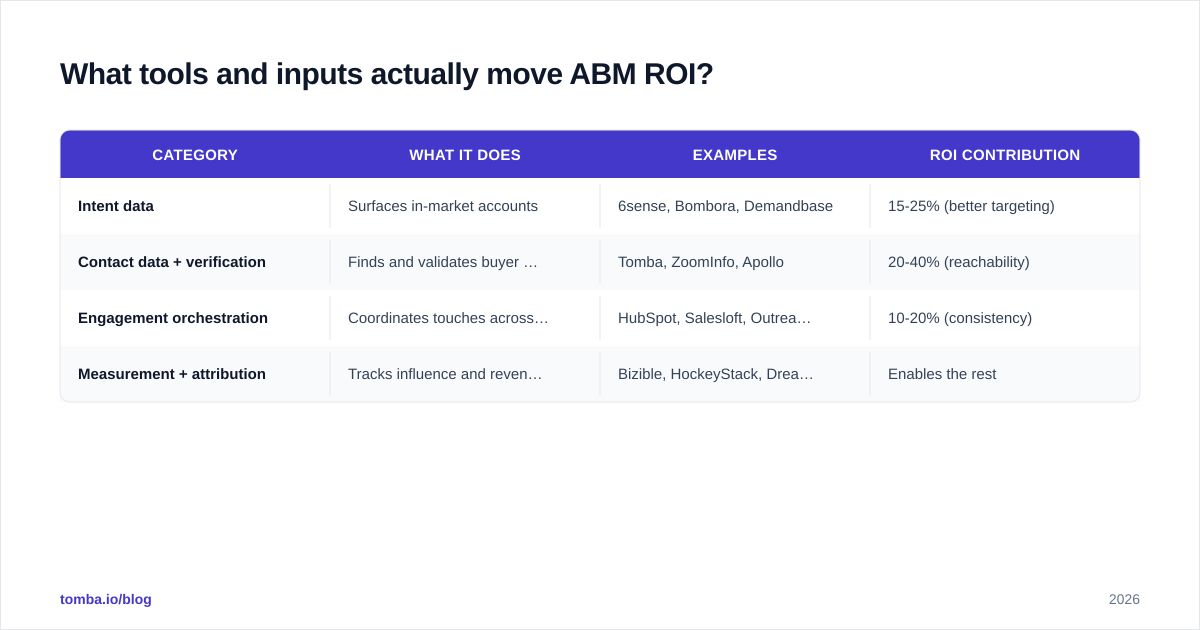
Notice contact data is the single biggest contributor in most teardown analyses. The reason is mechanical: even the best intent signal is worthless if you cannot reach the human attached to it. A bulk email finder for committee mapping plus ongoing verification is the cheapest leverage point in the entire stack.
For phone outreach against tier-1 accounts, layer in a phone finder so your BDRs can mix channels. Mixed-channel ABM sequences out-perform single-channel by 2.1x on connect rate, per Salesloft's 2025 benchmark.
What is a measurement framework that survives the CFO?#
Three layers, locked before the program starts.
Layer 1: Definitions. What counts as a target account. What counts as a touch. What counts as influenced revenue. What the measurement window is. Get sales, marketing, and finance to sign these definitions in a shared doc. The doc is the contract.
Layer 2: Baseline. Either a matched control cohort (similar accounts not in the program) or a same-quarter prior-year comparison. The baseline is the floor. ABM ROI is everything above the floor.
Layer 3: Reporting cadence. Monthly review of leading indicators (engagement, coverage, velocity). Quarterly review of lagging indicators (pipeline, closed-won, ROI). Annual program reset with budget rebalancing across tiers.
The reason this works is it makes the math falsifiable. If engagement climbs but pipeline does not, the targeting is wrong. If pipeline climbs but close rate does not, the sales motion is wrong. If close rate is fine but deal size is flat, the value prop is wrong. Each diagnosis has a different fix.
For more on the upstream metrics that feed this — marketing qualified leads, pipeline definitions, and conversion benchmarks — see the surrounding glossary entries. A solid grounding in revenue operations terminology prevents the most common attribution disputes.
How long until you see ABM ROI?#
The honest answer is 9 to 18 months for the first credible read, depending on sales cycle length.
Months 0-3: program build, target list lock, data hygiene, content production. No revenue impact. Cost is going out.
Months 3-6: first engagement signals. Pipeline starts to build. You should see lifted meeting acceptance rates and account engagement scores climbing. Still no closed-won contribution worth reporting.
Months 6-12: first deals close. Early ROI reads are noisy because the sample is small. Do not present a 12-month ROI number to the board as final — present it as directional with confidence intervals.
Months 12-18: the program either works or it does not. By month 18 you should have enough closed-won data to compute ROI against your baseline with reasonable confidence. This is when you decide to scale, restructure, or kill.
Teams that cancel ABM at month 9 because "ROI isn't proven" are usually right that ROI isn't proven and wrong about what that means. ABM is a long-cycle investment. You cannot judge a 14-month sales cycle on a 9-month timeline.
Vendor sources like HubSpot's ABM guidance and Gartner's account-based research reinforce this — most reported "ABM failures" are timeline mismatches, not program failures.
What is the fastest way to lift ABM ROI right now?#
If your program is already running and the numbers are soft, three moves outperform every other intervention in the first 60 days.
First, audit and rebuild your target account contact data. Run every email through verification. Re-map the buying committee at each account. Find the 2-3 contacts per account you are currently missing. This alone usually moves engagement metrics 25%+ within a quarter.
Second, tighten the target list. Cut the bottom 20% of accounts that have shown zero engagement signal in 90 days. Redeploy that spend onto your top 20% where engagement is climbing. ROI math is brutal — concentrate spend where conversion probability is highest.
Third, kill the channels that are not pulling weight. Most ABM programs have one or two channels driving 70% of engagement. Find them, double down, and stop funding the rest until you have data showing they work.
Bringing it together#
ABM ROI is not a mysterious number. It is (influenced revenue − cost) / cost, with honest definitions, a baseline, and a long enough measurement window. The teams that win at ABM ROI are not the ones with the fanciest intent stack — they are the ones who define their math before they spend, keep their contact data clean, and stay disciplined about the 18-month timeline.
Before you commit your next ABM budget, fix the cheapest leverage point first: your contact data. Try the Tomba Email Finder on your tier-1 account list to map buying committees, verify every email before it hits a sequence, and stop watching ABM ROI leak out through bounced inboxes. The free tier covers 25 searches a month — enough to audit your top accounts this week and see what you have been missing.
// get started
Find, verify and enrich your first contacts today
Start on the free plan with 25 searches a month, then scale when your team is ready.
Free plan · No credit card required · GDPR & CCPA
// about the author