ABM Without Expensive Tools: A 2026 Playbook on a Budget
You don't need a $60K platform to run account-based marketing. Here's how to build a working ABM motion in 2026 using lean tools, smart data, and disciplined targeting.
ABM Without Expensive Tools: A 2026 Playbook on a Budget
TL;DR
- You can run a credible account-based motion in 2026 for under $300/month if you're disciplined about target list, data, and orchestration.
- The expensive platforms (6sense, Demandbase, Terminus) buy you intent data, ad orchestration, and reporting — not the strategy itself.
- A lean stack of CRM + email finder + LinkedIn Sales Navigator + a sequencer can replicate 80% of the value for under 5% of the cost.
- The hard parts of ABM — ICP definition, account selection, multi-threaded messaging — are free. The tools are the easy part.
- Skip the platform until you've closed at least 10 ABM deals manually and know what to automate.
Most "ABM tooling" conversations skip the only question that matters: do you have enough revenue motion to justify a $60K-$200K platform? For 90% of B2B teams, the honest answer is no. You can still run account-based marketing — and run it well — without the line item. This post shows how.
What is ABM, really, when you strip the software away?#
Account-based marketing is a sales-led strategy where marketing and sales agree on a finite list of target accounts and orchestrate personalized outreach against them. That's it. Everything else — intent scoring, ad retargeting, journey orchestration — is a workflow enhancement, not the strategy.
The strategy has four moving parts:
- ICP definition — which companies match your best customers
- Account selection — which 50, 200, or 1,000 of those you'll target this quarter
- Contact mapping — which 4-7 humans inside each account influence the buying decision
- Orchestrated outreach — coordinated touches across email, LinkedIn, ads, and phone
None of those require a platform. They require focus, a CRM, and contact data. Gartner's own account-based marketing research consistently lands on the same finding: program maturity, not tooling spend, predicts ABM success.
Why do most ABM platforms cost so much?#
Enterprise ABM platforms bundle four things you can buy separately for far less:
- Intent data — third-party signals about which companies are researching your category
- Account-level ad targeting — display ads served only to IPs at your target accounts
- Engagement orchestration — multi-channel sequences with branching logic
- Reporting — dashboards showing account-level engagement scores
The bundle is convenient. It's also expensive because the intent data feeds (Bombora, G2, TrustRadius) are licensed in bulk and resold with a margin. If you buy intent directly from a single source, target ads through LinkedIn's account list feature, sequence in Instantly or Smartlead, and report in your CRM, you reassemble the bundle for a fraction of the cost.
The trade-off is integration work. You glue the pieces together yourself with Zapier, n8n, or Make. For a team running fewer than 500 target accounts, that glue work takes a few hours a quarter — well below the break-even point for a platform license.
How much do the "real" ABM platforms cost in 2026?#
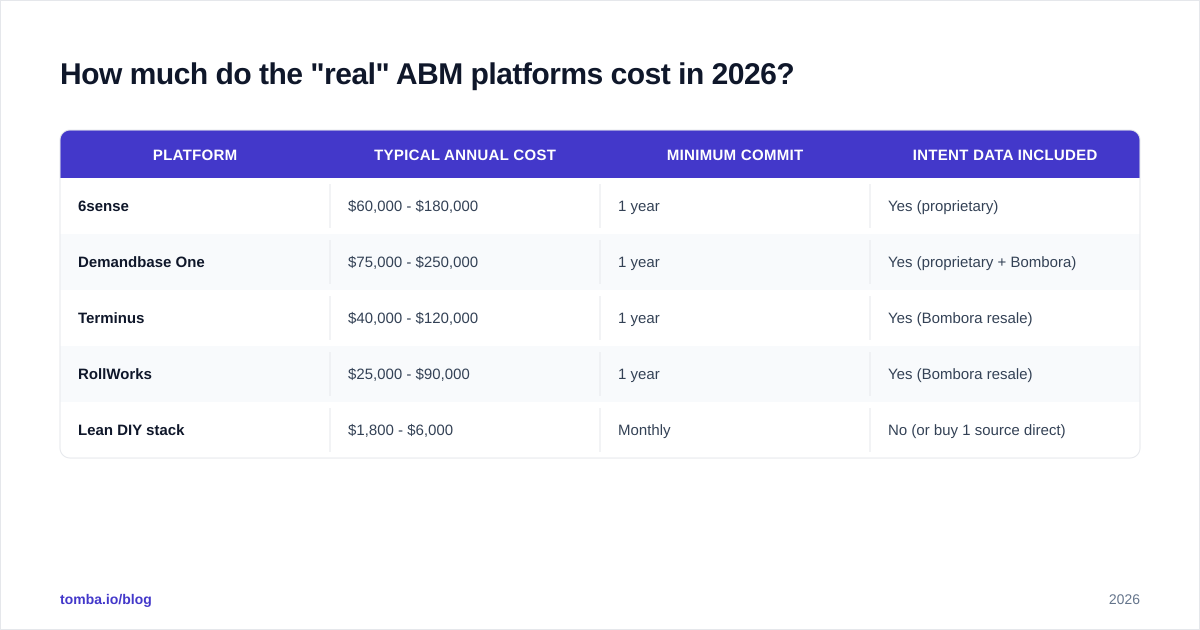
Public pricing is rare in this category, but here's what reliable buyer-side data on G2 and Capterra reports for typical mid-market deals:
| Platform | Typical annual cost | Minimum commit | Intent data included |
|---|---|---|---|
| 6sense | $60,000 - $180,000 | 1 year | Yes (proprietary) |
| Demandbase One | $75,000 - $250,000 | 1 year | Yes (proprietary + Bombora) |
| Terminus | $40,000 - $120,000 | 1 year | Yes (Bombora resale) |
| RollWorks | $25,000 - $90,000 | 1 year | Yes (Bombora resale) |
| Lean DIY stack | $1,800 - $6,000 | Monthly | No (or buy 1 source direct) |
Source: G2 user-submitted pricing ranges as of Q1 2026, plus published vendor case studies. Custom enterprise contracts vary.
The cost gap isn't just sticker price. It's commitment. Every platform on that list requires an annual contract paid upfront. A lean stack runs month-to-month, which means you can kill it the moment it stops working.
What does a lean ABM stack actually look like?#
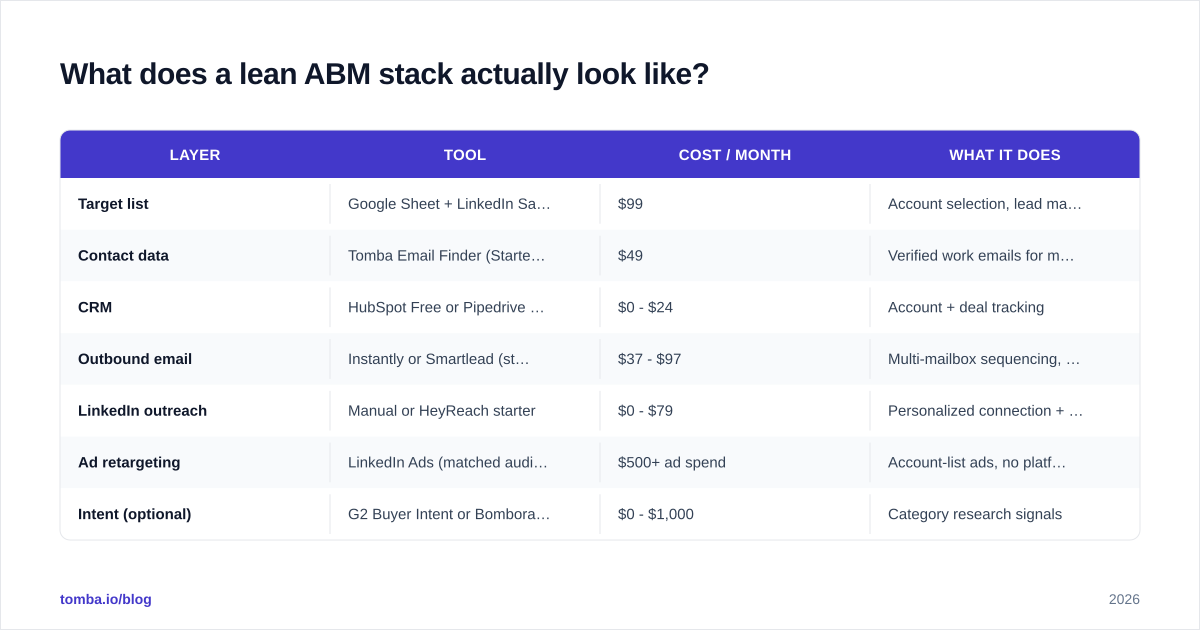
Here's the stack I'd build for a Series A or bootstrapped B2B company running 100-300 target accounts:
| Layer | Tool | Cost / month | What it does |
|---|---|---|---|
| Target list | Google Sheet + LinkedIn Sales Navigator Core | $99 | Account selection, lead mapping |
| Contact data | Tomba Email Finder (Starter) | $49 | Verified work emails for mapped contacts |
| CRM | HubSpot Free or Pipedrive Essential | $0 - $24 | Account + deal tracking |
| Outbound email | Instantly or Smartlead (starter) | $37 - $97 | Multi-mailbox sequencing, warmup |
| LinkedIn outreach | Manual or HeyReach starter | $0 - $79 | Personalized connection + DM cadence |
| Ad retargeting | LinkedIn Ads (matched audience) | $500+ ad spend | Account-list ads, no platform fee |
| Intent (optional) | G2 Buyer Intent or Bombora direct | $0 - $1,000 | Category research signals |
| Reporting | Native CRM dashboards | $0 | Account engagement, pipeline by tier |
Total platform cost: roughly $185 to $400 per month before ad spend. Compare to the floor of $60,000 / year ($5,000+/month) for an enterprise ABM platform.
The piece that surprises people is how much value sits in the email finder. Once you have a confirmed account list, you don't need an intent vendor to tell you who to reach — you need accurate work emails for the 5-7 people inside each company who matter. That's a $49/month problem, not a $60K/year problem.
How do you build the target account list without an ABM tool?#
The platform vendors will tell you they're indispensable here. They aren't. The process is:
- Pull your top 20 closed-won accounts from the CRM. Look at industry, employee count, tech stack, geo, revenue. The pattern is usually obvious by account 10.
- Build firmographic filters in LinkedIn Sales Navigator that match the pattern. Save the search.
- Export accounts to a sheet. Sales Nav doesn't allow native export, but you can copy rows or use a scraping helper. Add columns for tier (1/2/3) and stage.
- Run a domain search on each company to pull email patterns and key roles. This is where Tomba's domain search beats a manual approach — you get the email format and a list of identified people in one call.
- Score each account on fit (1-5) and signal (1-5). Multiply for priority. Anything below 10 drops to tier 3 or off the list.
The whole exercise for 200 accounts takes a strategic ops person about two days. An ABM platform would not make it meaningfully faster — it would just give you more accounts you can't act on.
What about intent data — can you really skip it?#
You can skip it for now, and most teams should. Here's why.
Intent data tells you which accounts are researching your category. It's a sorting signal. But sorting signals only matter when you have more accounts than you can pursue. If your list is 200 accounts and your SDR can hit 40 per week, intent ranking matters less than account fit and account warmth (existing relationships, past meetings, mutual connections).
If you genuinely have an over-large list (1,000+ accounts) and need a triage mechanism, buy intent directly from one source rather than paying a platform that resells it:
- G2 Buyer Intent — visitors researching you and competitors on G2. Starts around $1,200/month standalone.
- Bombora Company Surge — sold direct, but minimum contracts are high. Worth it only at scale.
- LinkedIn Sales Navigator — its "Account IQ" and posted-job signals are free intent if you already have a Nav seat.
For most lean teams, the LinkedIn signals plus your own website visitor identification cover 80% of what paid intent provides. Forrester's B2B buyer journey research shows the average B2B buyer self-educates through 17+ touches before contacting sales — most of those leave traces you can pick up free.
How do you orchestrate touches without an ABM platform?#
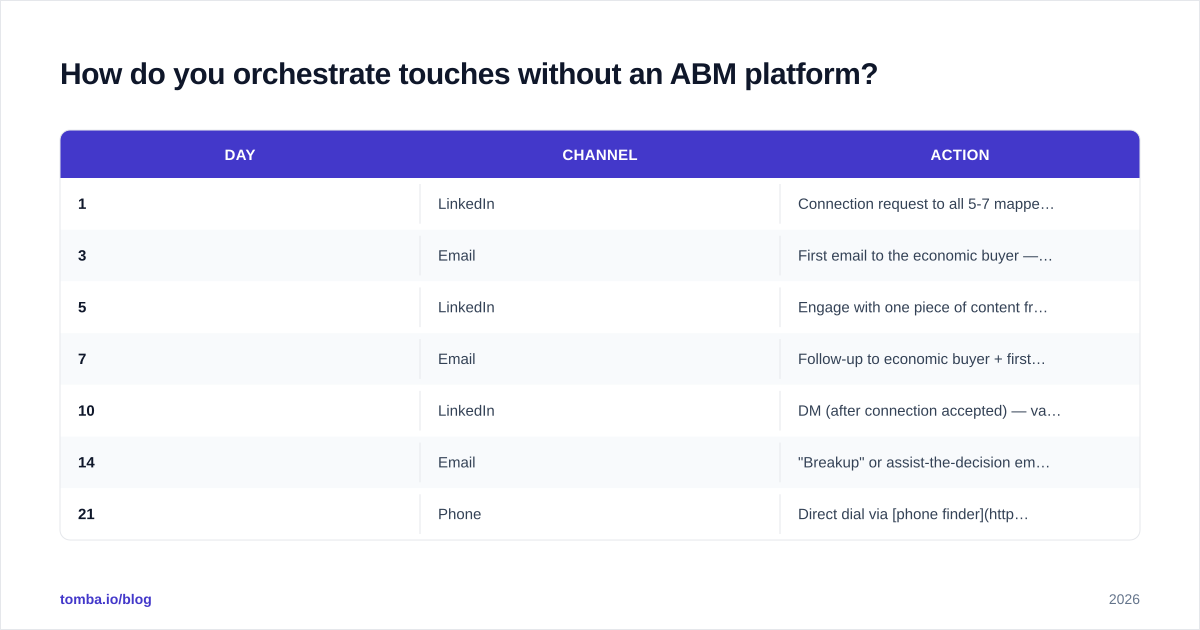
This is the part teams overthink. Orchestration in lean ABM = a sequence + a CRM task + a calendar.
A workable cadence for a tier-1 account (10-15 named contacts):
| Day | Channel | Action |
|---|---|---|
| 1 | Connection request to all 5-7 mapped contacts, no pitch | |
| 3 | First email to the economic buyer — short, account-specific | |
| 5 | Engage with one piece of content from each contact | |
| 7 | Follow-up to economic buyer + first email to power user | |
| 10 | DM (after connection accepted) — value-led | |
| 14 | "Breakup" or assist-the-decision email | |
| 21 | Phone | Direct dial via phone finder |
| 30 | LinkedIn ads | Add account to matched-audience retargeting list |
| 45 | Refresh angle — new content, new trigger |
The sequencing tool (Instantly, Smartlead, Saleshandy) handles steps 3, 7, 14, and 45. LinkedIn handles 1, 5, 10. Your SDR or AE handles step 21 manually. Step 30 is one campaign in LinkedIn Ads Manager that you maintain in 15 minutes a week.
You don't need a platform to "orchestrate" this. You need a shared spreadsheet, a CRM task queue, and discipline.
How do you measure ABM without enterprise-grade reporting?#
Three metrics, all native to your CRM:
- Account engagement score — sum of touches received + touches given per account. A custom HubSpot property or Pipedrive field that increments per email open, reply, call, meeting, ad impression (manually batch-imported weekly from LinkedIn Ads).
- Pipeline-by-tier — total opportunity value generated by tier-1, tier-2, tier-3 accounts. Tier-1 should produce disproportionate pipeline. If it doesn't, your tiering is wrong.
- Velocity by tier — average days from first-touch to closed-won. ABM should compress the cycle on tier-1 accounts versus inbound or unstructured outbound. If it doesn't, your sales process is the bottleneck, not your tooling.
That's the reporting layer. No platform required. You can stand it up in HubSpot Free in an afternoon.
When does it actually make sense to buy an ABM platform?#
Buy a platform when at least three of these are true:
- You have 500+ target accounts you actively pursue at once
- You have 4+ SDRs working those accounts
- You spend more than $20K/month on display retargeting and want account-level attribution
- You have dedicated ABM ops headcount (not a half-time RevOps person)
- You're closing 10+ ABM deals per quarter and the unit economics support a $5K-$15K monthly tool spend
- Sales and marketing already agree on the target account list (this matters more than the tool)
Anything less, and the platform will sit unused. I've seen too many startups burn $80K on a Demandbase contract their team never logged into after onboarding. The tool didn't fail — the team didn't have the ABM motion ready for it.
What are the common mistakes when going lean on ABM?#
After watching dozens of teams attempt this, the failure modes cluster:
- Target list too big. 1,000 accounts isn't ABM — it's outbound with extra steps. Start at 50-200 for tier-1.
- Single-thread outreach. Mailing only the CEO is not ABM. Map 5-7 contacts per account and touch them all.
- No sales-marketing agreement. Marketing's "tier-1 list" and sales' "real targets" diverge within a quarter. Lock the list quarterly and review it in joint pipeline meetings.
- Skipping data verification. Bad emails kill deliverability, which kills your sender reputation, which kills inbound too. Run every list through an email verifier before sending.
- No content for the tier. ABM without tier-specific content is just personalized cold email. Build at least one piece of mid-funnel content per ICP segment.
- Confusing intent with interest. A G2 visit is a hint, not a signal of buying intent. Treat it as a tiebreaker, not a trigger.
How does this compare to the expensive way?#
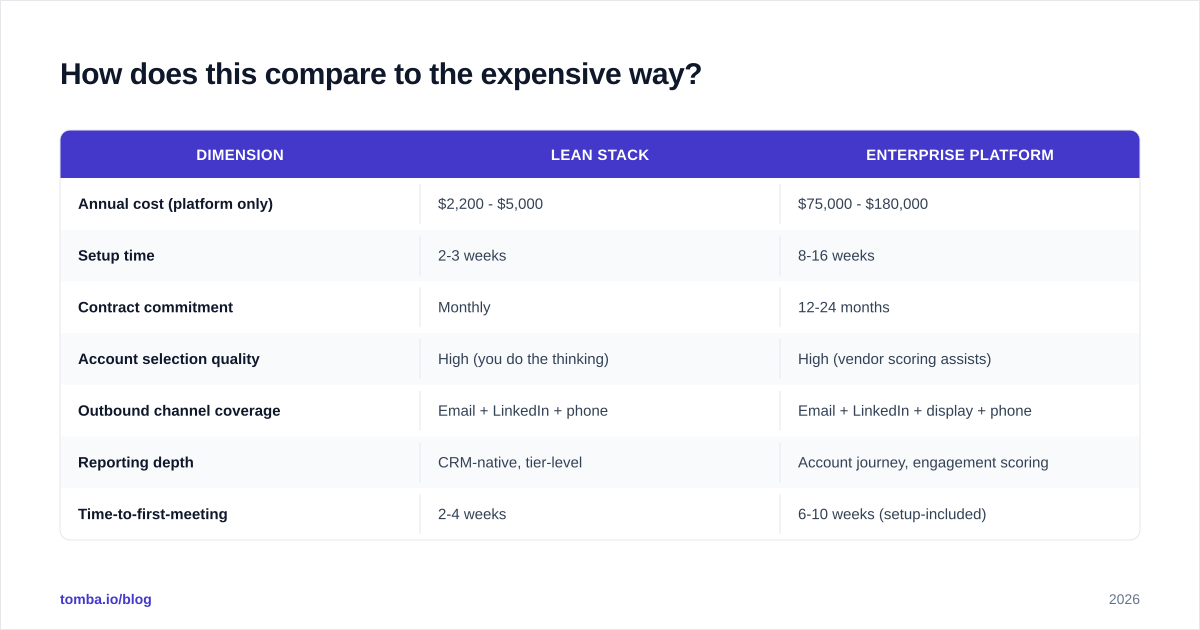
A side-by-side over a 12-month run for a team targeting 200 accounts:
| Dimension | Lean stack | Enterprise platform |
|---|---|---|
| Annual cost (platform only) | $2,200 - $5,000 | $75,000 - $180,000 |
| Setup time | 2-3 weeks | 8-16 weeks |
| Contract commitment | Monthly | 12-24 months |
| Account selection quality | High (you do the thinking) | High (vendor scoring assists) |
| Outbound channel coverage | Email + LinkedIn + phone | Email + LinkedIn + display + phone |
| Reporting depth | CRM-native, tier-level | Account journey, engagement scoring |
| Time-to-first-meeting | 2-4 weeks | 6-10 weeks (setup-included) |
| Best for | <500 accounts, <4 reps | 500+ accounts, dedicated team |
The platform wins on display retargeting depth and journey analytics. The lean stack wins on everything else for small teams: cost, speed, flexibility, and the discipline forced by doing the strategic work yourself.
What's the minimum viable lean ABM stack today?#
If you only had $200 a month, here's what I'd spend it on:
- CRM: HubSpot Free or Pipedrive Essential ($0 - $24)
- Contact data: Tomba pricing Starter at $49/month gets you enough credits to map 200-300 accounts in a quarter
- LinkedIn Sales Navigator Core: $99/month — non-negotiable for account research
- Email sequencer: Saleshandy or Smartlead starter, $30 - $40/month
- Optional ad layer: $500+/month direct in LinkedIn Ads when budget allows
That's roughly $230 - $260/month. It will run an ABM motion for a 4-person sales team targeting 150-250 accounts. Anything more is a nice-to-have until you've proven the motion converts.
For context, HubSpot's own ABM resources lay out the same conclusion in different language: the strategy matters more than the software, and you can start small and scale tooling later.
The honest take#
Running ABM without expensive tools isn't a hack — it's how most successful ABM programs actually started. The platforms get bought after the motion is proven, not before. If you can't run a credible account-based motion with a sheet, a CRM, an email finder, and discipline, the platform won't fix it. The platform just amplifies whatever motion you already have.
Start lean. Prove the motion. Earn the platform later, when the math justifies it.
Ready to map your target accounts? Start with verified work emails for every decision-maker on your list. Tomba's Email Finder gives you accurate, source-cited contact data starting at $49/month — enough to power a real account-based motion without committing to a six-figure platform contract. Find every buying-committee email by company domain, role, or name in seconds.
Ready to find emails that actually work?
Join 150,000+ professionals who stopped guessing and started sending. Free credits on signup — no credit card required.
Get the Tomba newsletter
Practical outbound tactics and product updates — once every two weeks.
About the author