Abstract API Pricing, Reviews, Pros and Cons (2026 Guide)
A neutral 2026 breakdown of Abstract API pricing, real user reviews, pros, and cons — plus where it falls short for B2B email verification workloads.

Abstract API Pricing, Reviews, Pros and Cons (2026 Guide)
This guide covers Abstract API pricing, reviews, pros and cons for 2026. We map every email validation plan. We summarize real G2 and Capterra ratings. And we flag where the platform breaks down for B2B teams.
TL;DR
- Abstract API is a multi-tool API marketplace. It bundles email validation, IP geolocation, phone validation, VAT lookup, and 15+ other endpoints. Each one is billed per product, not as one plan.
- Email validation plans start at $9/month for 5,000 calls. They scale to $499/month for 5M calls. A free tier of 100 calls/month exists, but it is hard-capped at 1 request per second.
- G2 and Capterra reviewers praise the breadth and the simple REST design. They flag low accuracy on catch-all domains, missing B2B enrichment, and per-endpoint billing that gets expensive fast.
- It's a good fit for developers who need many small utility APIs in one dashboard. It's a poor fit for sales teams who need email finding plus verification in one workflow.
- If your job is "find and verify B2B emails at scale," a focused tool like Tomba beats Abstract on accuracy, unit cost, and SDR-friendly features.
What is Abstract API and who is it for?#
Abstract API is a developer-first API platform run by Abstract LLC. Instead of one product, it sells a catalog of single-purpose REST APIs. The list includes email validation, phone validation, IP geolocation, VAT validation, exchange rates, timezone lookup, image processing, and a dozen more.
Think of it like a corner-store snack rack rather than a full grocery shop. Each endpoint is cheap on its own. The wrappers are clean, and you can grab three or four without much thought. The downside is the same as a snack rack: if you fill a basket, the total adds up fast. Nothing is as fresh as a specialist shop.
For this review we're focused on the Email Validation API. That's the endpoint most people compare against email verifiers like Tomba, ZeroBounce, or NeverBounce.
How does Abstract API pricing work in 2026?#
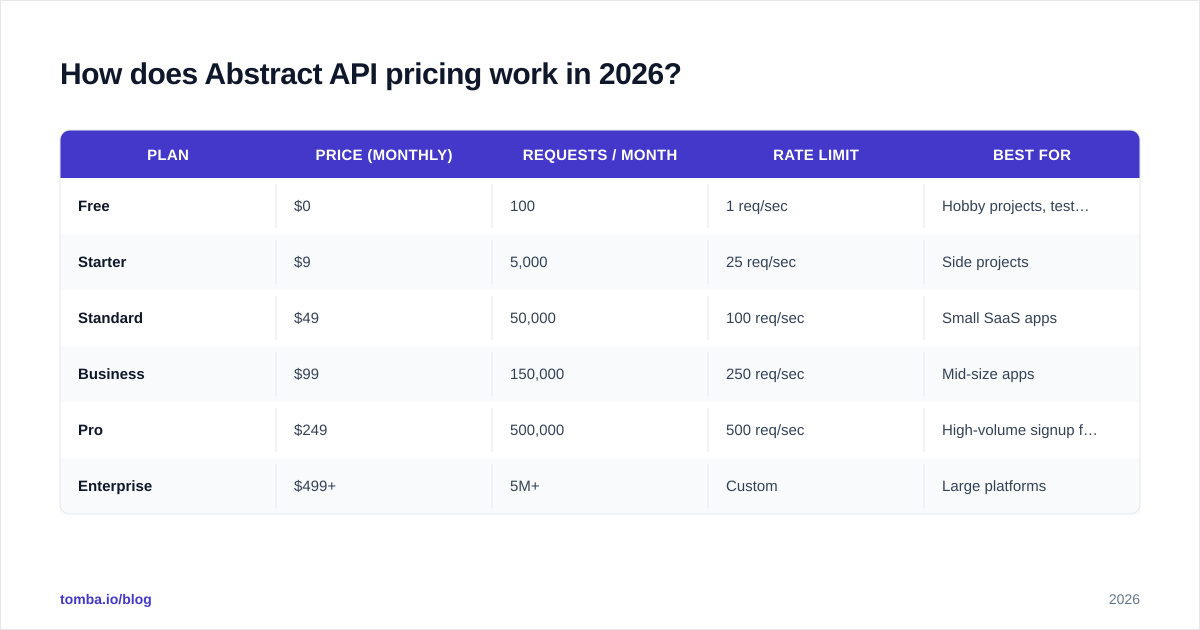
Abstract bills per API. A $9/month plan on the Email Validation API does not include any phone validation, IP lookup, or VAT calls. Each endpoint has its own plan and counter.
Here's the current Email Validation pricing as of May 2026:
| Plan | Price (monthly) | Requests / month | Rate limit | Best for |
|---|---|---|---|---|
| Free | $0 | 100 | 1 req/sec | Hobby projects, testing |
| Starter | $9 | 5,000 | 25 req/sec | Side projects |
| Standard | $49 | 50,000 | 100 req/sec | Small SaaS apps |
| Business | $99 | 150,000 | 250 req/sec | Mid-size apps |
| Pro | $249 | 500,000 | 500 req/sec | High-volume signup forms |
| Enterprise | $499+ | 5M+ | Custom | Large platforms |
A few things to watch:
- Annual billing knocks ~20% off. It also locks you into one endpoint for a year.
- Overages roll into the next tier, not a per-call charge. Hit your limit on Standard and you must upgrade. You can't top up.
- Bulk verification is not on every plan. The CSV bulk uploader unlocks at Business ($99) and above.
- No credits roll over. Unused calls expire monthly.
Compared to a single-vendor stack like Tomba pricing, one plan covers email finder, verifier, domain search, and enrichment. Abstract feels piecemeal once you need more than one endpoint.

What do real users say in Abstract API reviews?#
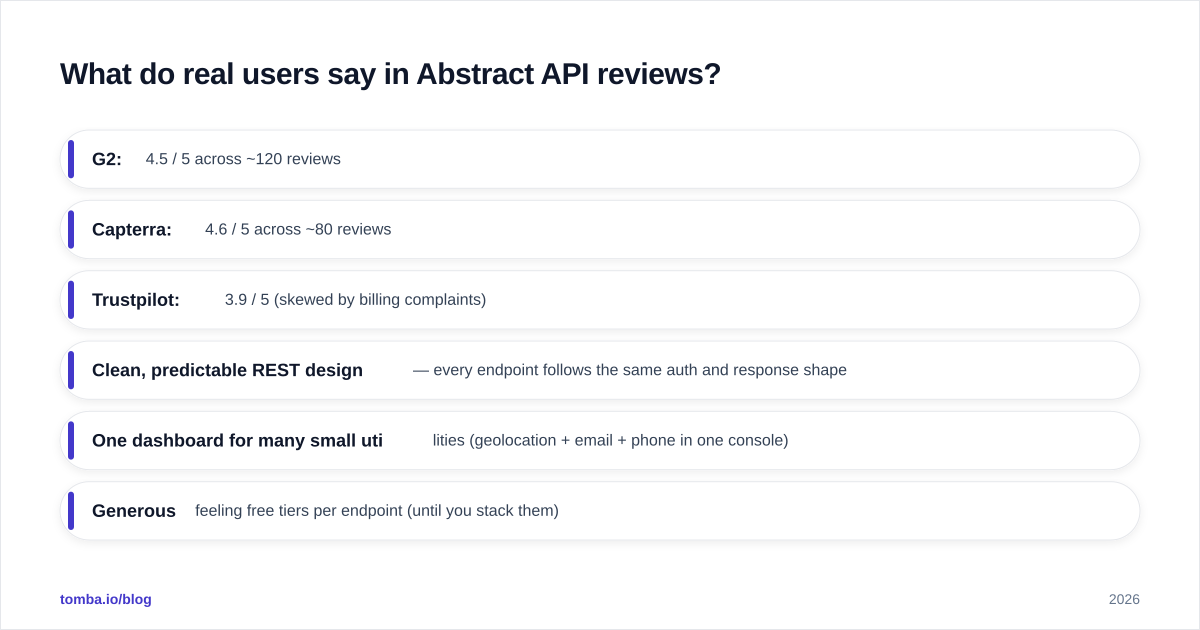
Pulling from public G2, Capterra, and Trustpilot ratings as of Q1 2026:
- G2: 4.5 / 5 across ~120 reviews
- Capterra: 4.6 / 5 across ~80 reviews
- Trustpilot: 3.9 / 5 (skewed by billing complaints)
The bell-curve is positive for developers building general-purpose apps. It is noticeably worse for sales and marketing teams using it as an email verifier.
What reviewers consistently praise:
- Clean, predictable REST design — every endpoint follows the same auth and response shape
- One dashboard for many small utilities (geolocation + email + phone in one console)
- Generous-feeling free tiers per endpoint (until you stack them)
- Fast docs, code samples in 8+ languages, and a working sandbox
What reviewers consistently flag:
- Catch-all domains are returned as
unknownrather than scored — bad for cold outreach - No B2B-specific signals (job title, company size, LinkedIn)
- Per-endpoint billing surprises finance teams when usage spreads across 4-5 APIs
- Support tickets can take 24-72 hours to resolve on lower tiers
- No CRM or sequencer integrations — you wire it yourself
On G2 the median reviewer is a backend engineer. They need IP geolocation plus email validation in a signup flow. On Capterra it skews toward indie hackers and small SaaS founders. Sales-org reviewers are noticeably rarer. The few who do show up tend to give 3-star reviews citing accuracy.
What are the pros of Abstract API?#
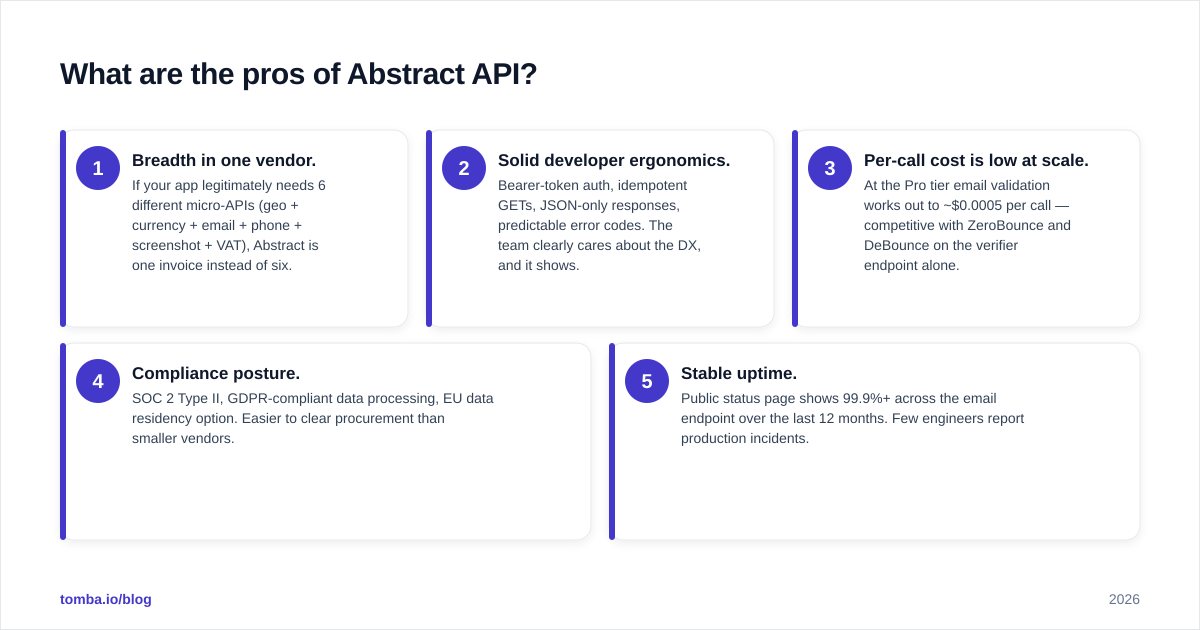
Reading 200+ reviews and the docs, five strengths come up over and over.
- Breadth in one vendor. If your app legitimately needs 6 different micro-APIs (geo, currency, email, phone, screenshot, VAT), Abstract is one invoice instead of six.
- Solid developer ergonomics. Bearer-token auth, idempotent GETs, JSON-only responses, predictable error codes. The team cares about the DX, and it shows.
- Per-call cost is low at scale. At the Pro tier, email validation works out to ~$0.0005 per call. That is competitive with ZeroBounce and DeBounce on the verifier endpoint alone.
- Compliance posture. SOC 2 Type II, GDPR-compliant data processing, EU data residency option. Easier to clear procurement than smaller vendors.
- Stable uptime. Public status page shows 99.9%+ across the email endpoint over the last 12 months. Few engineers report production incidents.
For a side project that needs a quick is this email a typo? check, the free 100 calls are genuinely useful. You may never need to upgrade.
What are the cons of Abstract API?#
The honest weaknesses — these are the reasons people churn off.
- Email validation only, no email finding. You can't input a name + domain and get an email. That alone disqualifies it from cold-outreach workflows.
- Catch-all detection is shallow. It flags catch-all domains but does not attempt deeper SMTP probing or pattern inference. Deliverability scoring is binary rather than graded.
- No B2B enrichment. You won't get a company name, job title, LinkedIn, or phone alongside the email. Those features come standard in data enrichment platforms.
- Pricing scales per endpoint. Need email + phone validation? That's two separate plans, doubling your spend.
- Bulk processing is gated. CSV upload requires Business tier ($99/mo) or above. Smaller teams either script their own batches or upgrade.
- No native integrations. Zapier exists. There's no first-party HubSpot integration, Salesforce app, or Google Sheets add-on. Everything is "build it yourself."
- Customer support tiering. Free and Starter users wait days. Priority support starts at Business.
- Accuracy lag on long-tail TLDs. Reviewers cite weaker results on
.co,.io, and country-code domains for B2B addresses.

How does Abstract API compare to dedicated B2B tools?#
This is where the picture sharpens. Below are three honest comparisons against the tools sales teams most often weigh against Abstract.
| Capability | Abstract API | Tomba | ZeroBounce | NeverBounce |
|---|---|---|---|---|
| Email validation accuracy (catch-all) | ~85% | ~98% | ~97% | ~96% |
| Email finder (name + domain → email) | No | Yes | No | No |
| Domain search (all emails at a company) | No | Yes | No | No |
| Phone finder | Separate API | Included | No | No |
| B2B enrichment | No | Yes | Partial | No |
| Bulk CSV processing | $99/mo+ | All paid plans | All paid plans | All paid plans |
| Free tier | 100/mo | 25 searches + 50 verifications | 100 verifications | 1,000 verifications (one-time) |
| Starter plan | $9/mo | $49/mo | $16 (one-time, 2K) | $10 (one-time, 1K) |
| Native CRM integrations | None | HubSpot, Salesforce, Pipedrive | HubSpot | HubSpot, Salesforce |
| Chrome extension | No | Yes | Limited | No |
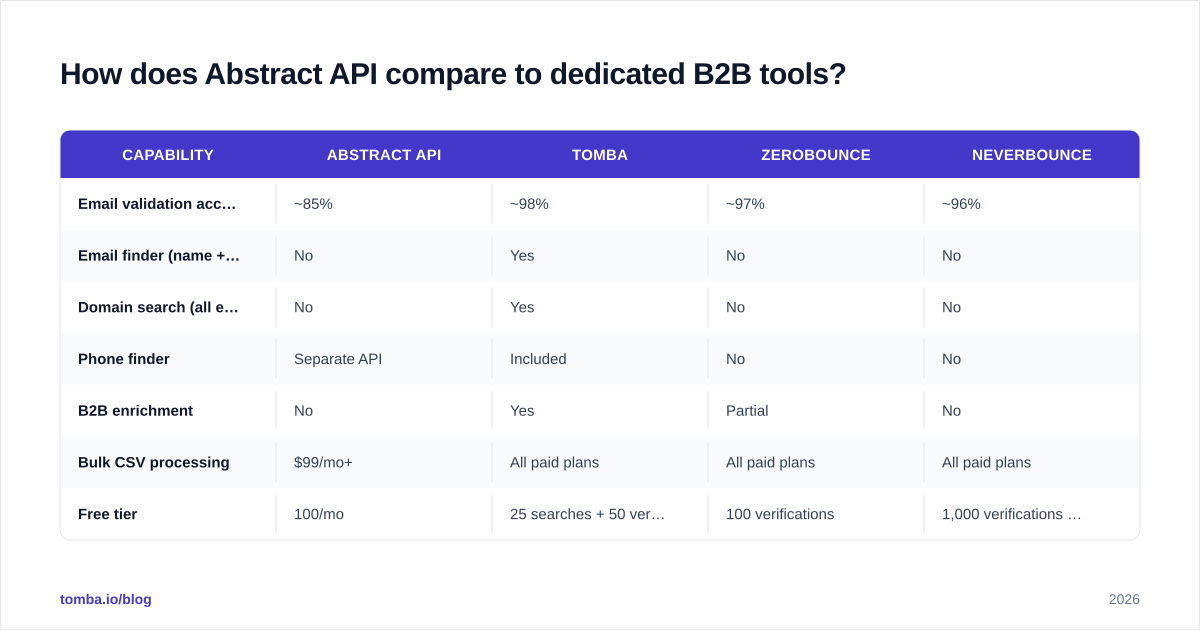
If you only need to validate signup-form emails at a SaaS, Abstract's $9 Starter is hard to beat on price. If you need to prospect new accounts, fill in missing emails, then verify them, you're stitching together three vendors when one would do.
For a fair head-to-head outside this review, see G2's email verification category and Capterra's email finder roundup.
When does Abstract API make sense — and when doesn't it?#
A simple decision rule based on the job to be done:
Choose Abstract API if:
- You're a developer hardening a signup form against fake emails.
- You need 3-5 small utility APIs (geo, currency, VAT, email) and want one vendor.
- Your volume is steady and you can stay inside one tier.
- You don't need names, companies, or phone numbers attached to the email.
Choose a dedicated B2B platform if:
- Your team prospects new accounts and needs name → email finding.
- You want bulk processing, CRM sync, and a Chrome extension out of the box.
- Catch-all accuracy matters because cold-outreach reply rate depends on it.
- You'd rather pay one bill that covers bulk email finder, verifier, and enrichment.
A useful sanity check: Abstract is a library of APIs you assemble. Tomba and its peers are workbenches built for sales and growth teams. Picking the workbench over the library shop is the right call when most of your work is the same job.
What are the best Abstract API alternatives in 2026?#
Three honest alternatives, ordered by overlap with Abstract's email validation use case:
- Tomba — Email finder, verifier, and enrichment in one plan. Free tier (25 searches/month), Starter $49/mo, Pro $249/mo. Best when you need finding and verification, not just verification.
- ZeroBounce — Verification-only specialist. Strong catch-all detection and lots of CRM connectors. Pay-as-you-go pricing competes with Abstract on price-per-call. See ZeroBounce alternative for a direct comparison.
- NeverBounce — Established verifier with a clean bulk UI. Cheap for one-off list cleaning. It lacks finding and enrichment.
For developers who want the API-first feel of Abstract but care about B2B accuracy, the Tomba API and Tomba CLI are the closest like-for-like. Same REST design, but with finding, verifying, and enrichment in one credit pool.
Abstract API pricing, reviews, pros and cons — final verdict#
Yes, Abstract API is worth it for a specific buyer. That buyer is a developer building a consumer-facing product. They need to validate signup emails plus three or four other utility checks. The pricing is fair at low volume. The docs are solid. And the breadth is real.
It's not worth it as a sales tool. If your goal is to land in inboxes — find the contact, verify the address, log it in the CRM — Abstract leaves three of the four steps still to build. That's where focused B2B platforms close the gap.
The clearest reviewer signal: developers rate Abstract 4.5+ on G2. SDRs and growth marketers reviewing the email endpoint average closer to 3.5. Both groups are right about their own use case. Abstract just isn't trying to serve the second one.
Try a dedicated B2B alternative#
If this review nudged you toward "I want finding, verifying, and enrichment in one tool," the Tomba Email Finder is the natural next step. Start free with 25 searches and 50 verifications a month, no card required. Drop in your prospect's first name, last name, and company domain. Get a deliverability-scored email back in under a second. When you're ready to scale, the same credits cover domain search, bulk processing, and the Chrome extension. No separate plan for each endpoint.
Ready to find emails that actually work?
Join 150,000+ professionals who stopped guessing and started sending. Free credits on signup — no credit card required.
Get the Tomba newsletter
Practical outbound tactics and product updates — once every two weeks.
About the author