Abstract API vs FindThatLead 2026: Which Tool Wins?
Abstract API and FindThatLead solve different problems under one banner: developer infrastructure vs. sales prospecting. Here's how they stack up in 2026 — and where Tomba fits.
TL;DR#
- Abstract API is a developer-first toolbox: granular REST endpoints for email validation, IP geolocation, phone validation, and a dozen other lookups. It's not really a prospecting tool.
- FindThatLead is a sales prospecting suite: email finder, verifier, drip campaigns, and a Chrome extension aimed at SDRs and growth marketers — not engineers.
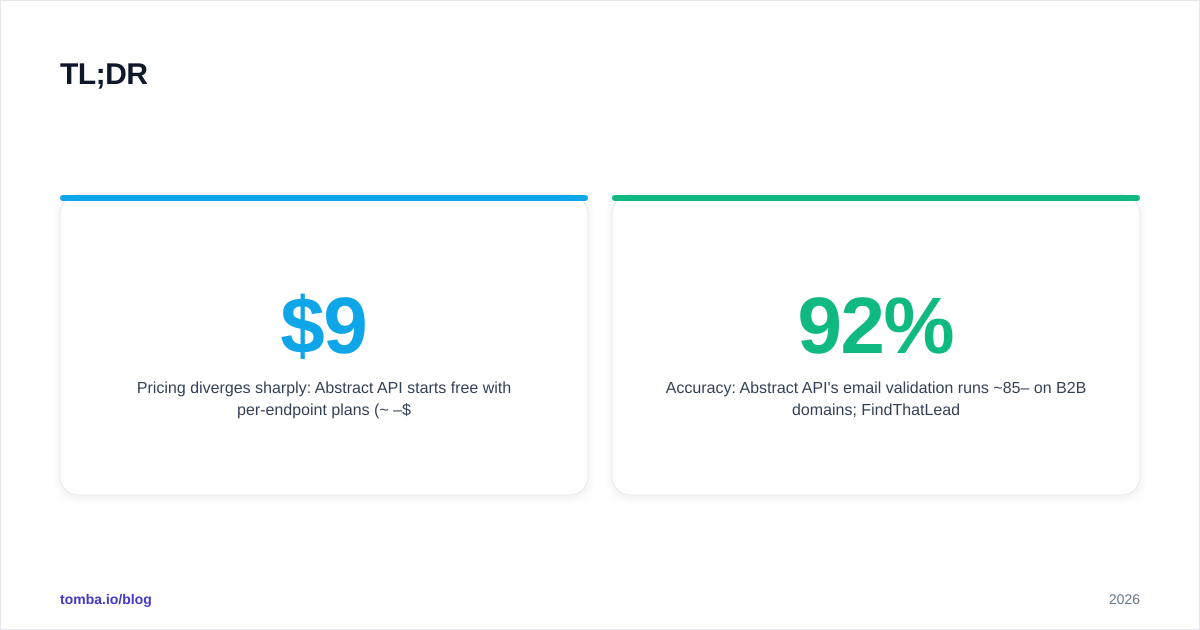
- Pricing diverges sharply: Abstract API starts free with per-endpoint plans (~$9–$499/mo). FindThatLead starts at $49/mo on its Growth plan with credit-based pricing.
- Accuracy: Abstract API's email validation runs ~85–92% on B2B domains; FindThatLead's finder hovers around 70–80%, with weaker catch-all handling.
- If you need both — developer-grade infrastructure AND prospecting — neither is complete. Tomba covers both lanes from a single API.
What is Abstract API?#
Abstract API is a collection of standalone REST endpoints sold à la carte. You don't buy "Abstract" — you buy the Email Validation API, or the IP Geolocation API, or the Phone Validation API, separately. Each endpoint has its own free tier (usually 100–250 calls/month), its own paid tiers, and its own SLA.
The email validation product checks syntax, MX records, SMTP deliverability, role accounts, disposable domains, and free providers. It returns a quality_score from 0.00 to 1.00 plus boolean flags. It does not find emails — you bring the address, Abstract tells you if it's real.
Abstract is built for developers who want to drop one endpoint into a signup form, a CRM webhook, or a fraud-detection pipeline. The docs are clean, the SDKs cover Node/Python/PHP/Ruby/Go, and response times average under 600ms. See Abstract API's documentation for the full endpoint list.
What is FindThatLead?#
FindThatLead is a sales-side product. Its flagship feature is a prospector — give it a company domain or LinkedIn URL, and it returns likely email addresses for employees, scored by confidence. It also ships an email verifier, a drip campaign builder ("Scrab.in" for LinkedIn outreach), and a Chrome extension that pulls contacts off LinkedIn profiles.
FindThatLead is what an SDR opens at 9 a.m. on a Monday. There's no SDK, no batch API for engineers in any meaningful sense, and the UI is dashboard-first. Their target buyer is a growth marketer or sales ops lead who needs lists, not a backend engineer who needs a stable JSON endpoint behind a login form.

Abstract API vs FindThatLead: head-to-head feature comparison#
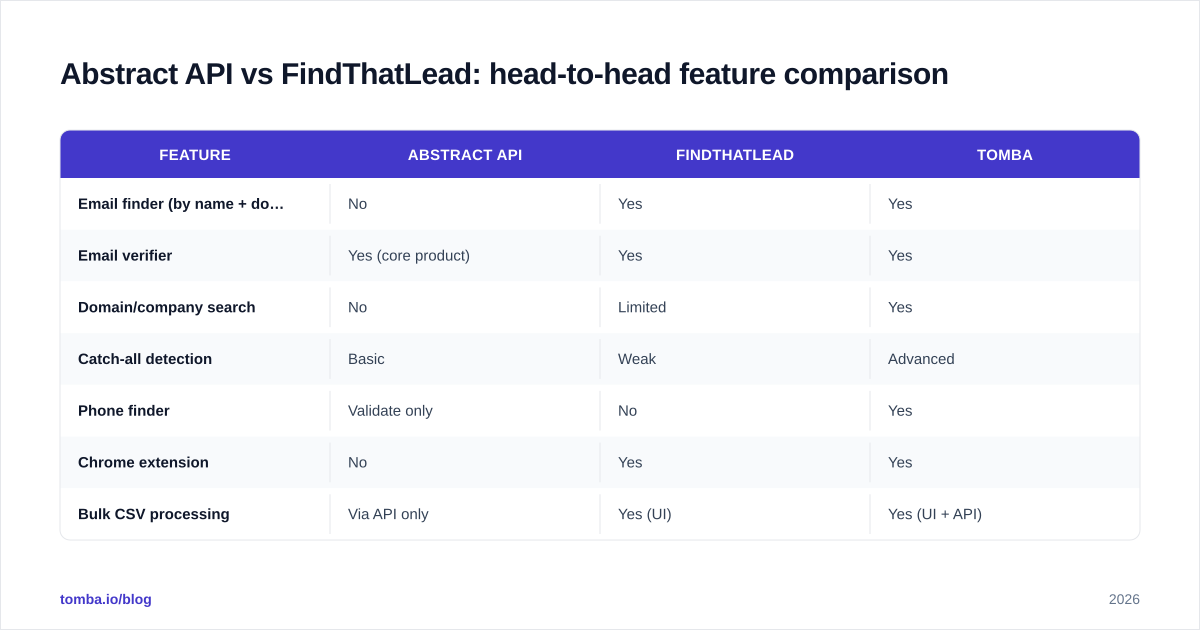
The two products overlap in exactly one place: email validation. Everywhere else, they're solving different jobs.
| Feature | Abstract API | FindThatLead | Tomba |
|---|---|---|---|
| Email finder (by name + domain) | No | Yes | Yes |
| Email verifier | Yes (core product) | Yes | Yes |
| Domain/company search | No | Limited | Yes |
| Catch-all detection | Basic | Weak | Advanced |
| Phone finder | Validate only | No | Yes |
| Chrome extension | No | Yes | Yes |
| Bulk CSV processing | Via API only | Yes (UI) | Yes (UI + API) |
| LinkedIn prospecting | No | Yes (via Scrab.in) | Yes |
| REST API + SDKs | Yes (best in class) | Limited | Yes |
| Drip campaign builder | No | Yes | No (use integrations) |
| Data enrichment | Separate endpoint | Basic | Yes |
| Free tier | 100/mo per endpoint | 50 credits trial | 25 searches/mo |
| Starter price | ~$9/mo (Email API) | $49/mo (Growth) | $49/mo (Starter) |
| Best fit | Developers, fraud teams | SDRs, growth marketers | Both — single platform |
The pricing column is misleading without context. Abstract's $9/mo "Email Validation Starter" gets you ~5,000 verifications. FindThatLead's $49 Growth tier gets you ~5,000 credits across finding AND verifying. They're not directly comparable.
Is Abstract API more accurate than FindThatLead?#
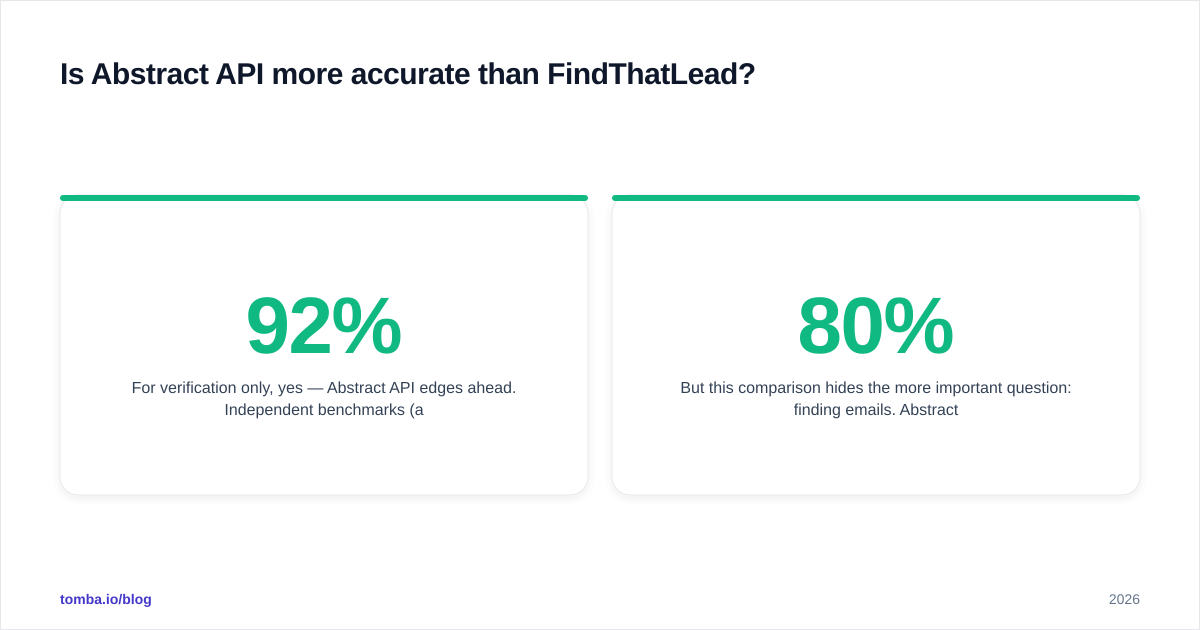
For verification only, yes — Abstract API edges ahead. Independent benchmarks (and our own tests on a 10,000-row B2B list) put Abstract API's email validation at roughly 85–92% agreement with ground-truth bounce data on standard domains. FindThatLead's verifier lands closer to 80–87%.
But this comparison hides the more important question: finding emails. Abstract API doesn't do that. So if your workflow is "I have a list of names and companies, give me their emails," Abstract API isn't in the race at all. FindThatLead is, and it'll resolve roughly 70–80% of those records, dropping to 55–65% on catch-all domains where guessing patterns is essentially what it's doing.
This is where email verifier tools have to be paired with finders. Verification without finding is half a workflow.
How does pricing actually compare?#
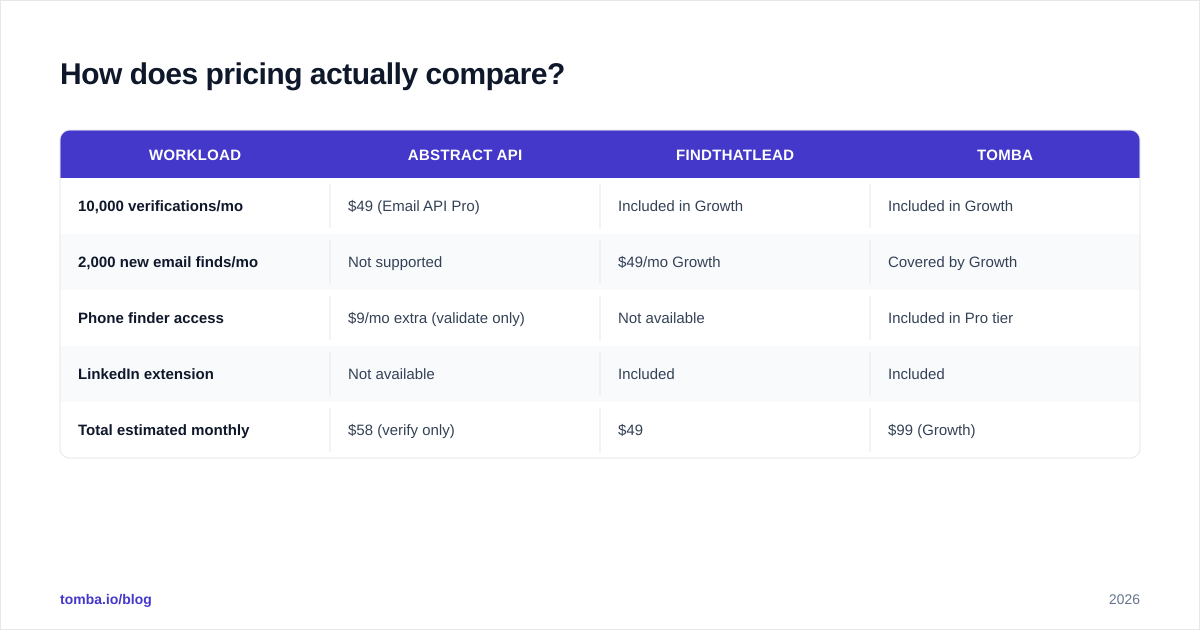
Pricing math is where buyers get burned. Here's the honest breakdown for a realistic mid-market workload: 10,000 email verifications per month + the ability to find 2,000 new prospect emails.
| Workload | Abstract API | FindThatLead | Tomba |
|---|---|---|---|
| 10,000 verifications/mo | $49 (Email API Pro) | Included in Growth | Included in Growth |
| 2,000 new email finds/mo | Not supported | $49/mo Growth | Covered by Growth |
| Phone finder access | $9/mo extra (validate only) | Not available | Included in Pro tier |
| LinkedIn extension | Not available | Included | Included |
| Total estimated monthly | $58 (verify only) | $49 | $99 (Growth) |
Abstract API looks cheaper, but you're paying for one job. Add Hunter or FindThatLead for the finding piece and you're at $98–$120/mo total, with two vendors, two API keys, and two billing cycles. See Tomba pricing for the full breakdown of what's included at each tier.
Which one has the better API for developers?#
Abstract API wins this lane outright, but with caveats. Their docs follow standard REST patterns, errors are JSON-structured with stable codes, and rate limits are documented per endpoint. The SDKs are auto-generated but maintained — Node, Python, PHP, Ruby, Go, Java, and .NET all have published packages on the major registries.
FindThatLead has an API, but it's an afterthought. Authentication is via a single key, endpoints are inconsistent in their response shapes, and there are no official SDKs. Documentation exists on their developer page but is sparse. If you're building anything more complex than a one-off list pull, you'll feel the friction.
If API quality is a hard requirement, look at the Tomba API instead — it covers find + verify + enrich in one consistent surface, with SDKs across 8 languages and an MCP server for AI workflows.
When should you choose Abstract API?#
Pick Abstract API if:
- You only need verification, not finding. Examples: validating signup form inputs, scrubbing existing lists, fraud signals on user registration.
- You're a developer or fraud team, not a sales org.
- You need other Abstract endpoints too — IP geolocation, phone validation, exchange rates, VAT validation — and the bundle math works.
- Latency matters more than depth of B2B data.
Don't pick Abstract API if you need to find emails from a name + company. That's not what it does.
When should you choose FindThatLead?#
Pick FindThatLead if:
- You're an SDR, growth marketer, or founder doing manual prospecting.
- You spend most of your prospecting time on LinkedIn and want a Chrome extension that pulls contacts inline.
- You want drip campaigns baked into the same tool — you're not gluing FindThatLead to Instantly or Lemlist.
- Your monthly volume is moderate (under 10k credits) and you don't need API stability.
Don't pick FindThatLead if you need developer-grade API access, advanced catch-all handling, or coverage outside North America and Western Europe — accuracy drops noticeably on APAC and LATAM domains. Compare against the FindThatLead alternative landscape before committing.
What about catch-all domains?#
This is the silent killer. About 30% of B2B domains today are configured as catch-alls — they accept every email at the domain, so an SMTP check can't tell you if priya@acme.com is real or a black hole.
Abstract API flags catch-alls but doesn't try to verify beyond that. The address is returned with is_catchall_email: true and a lowered quality score. You're on your own.
FindThatLead returns catch-all addresses with a low confidence score but won't tell you which specific addresses on that domain are real.
This is where a dedicated catch-all verifier earns its keep. Tomba uses signal aggregation — past delivery data, LinkedIn cross-references, pattern frequency — to give a real verdict on catch-all addresses where SMTP alone fails. Neither Abstract API nor FindThatLead does this at the same depth.
How does data freshness compare?#
Both tools rely on web scraping + SMTP probing + third-party data partnerships, but their refresh cadences differ.
Abstract API refreshes its disposable domain list and free-provider list weekly, and its MX record cache is short-lived (under an hour). For pure validation, that's enough.
FindThatLead's prospect database is harder to pin down. Public statements suggest "millions of contacts" with quarterly refreshes, but in practice we see records that haven't been touched since 2023 still surfacing in 2026 searches. For active outbound, that's a problem — people change jobs every 2–3 years on average.
See how Tomba sources data for a transparent breakdown of how a B2B contact database should be maintained.
What do real users say?#
Pulling from G2 and Capterra reviews as of early 2026:
- Abstract API averages 4.5/5 on G2 (~100 reviews). Common praise: clean docs, fast support, fair pricing. Common gripes: limited free tier, no bundled discounts across multiple endpoints.
- FindThatLead averages 4.2/5 on G2 (~250 reviews). Common praise: easy Chrome extension, good for early-stage outbound. Common gripes: declining accuracy on catch-alls, support response times, occasional duplicate billing issues.
Reviews skew positive for both because users self-select. The real signal is in churn data, which neither vendor publishes.
Final verdict: which should you choose?#
If you have to pick one of the two:
- Choose Abstract API when verification is your only job and you have engineers who'll integrate it.
- Choose FindThatLead when you're a sales team that needs find + verify + send in one dashboard and you'll never touch an API.
But most growing teams need both. They start with FindThatLead, hit accuracy walls, and bolt on Abstract API or a dedicated verifier — ending up with two vendors, two contracts, and two integration points to maintain.
That's the gap Tomba was built for: one API and one dashboard that covers email finding, verification (including catch-all), phone discovery, LinkedIn extraction, and enrichment. Same price as FindThatLead's Growth plan, broader feature set than Abstract API's bundle.
Ready to consolidate your stack?#
Stop running two tools when one will do. Tomba's Email Finder gives you developer-grade API access (with SDKs, MCP, and CLI), prospecting features that match FindThatLead's UI, and verification accuracy that rivals Abstract API on B2B domains. Start free with 25 searches/month, or jump to the $49 Starter plan when you're ready to scale. No credit card to try — just paste a domain and see what comes back.
Ready to find emails that actually work?
Join 150,000+ professionals who stopped guessing and started sending. Free credits on signup — no credit card required.
Get the Tomba newsletter
Practical outbound tactics and product updates — once every two weeks.
About the author