Abstract API vs Lead411 (2026): Which B2B Data Tool Wins?
Abstract API and Lead411 solve different problems under the same 'data' umbrella. Here's the honest 2026 breakdown of pricing, accuracy, and the right use case for each.
Abstract API vs Lead411 (2026): Which B2B Data Tool Wins?
TL;DR
- Abstract API is a developer-first toolkit of micro-APIs (email validation, IP geolocation, phone validation, company enrichment). It is cheap, modular, and pay-as-you-go.
- Lead411 is a full sales intelligence database with verified emails, direct-dial phones, intent signals, and a Bombora-powered trigger feed. It is priced per seat and built for SDR teams.
- These are not really competitors — they sit at opposite ends of the B2B data stack. Picking one over the other should be a function of who's using it: engineers or sellers.
- Abstract API wins on price-per-call and developer experience. Lead411 wins on contact depth, intent data, and CRM workflows.
- If your real need is finding and verifying B2B emails at scale, a dedicated tool like Tomba Email Finder sits between them in price and beats both on email-finder accuracy.
What is Abstract API?#
Abstract API is a collection of standalone REST APIs aimed at developers who need to drop small data utilities into an application. Each endpoint is sold separately and metered by request volume.
The most relevant endpoints for B2B teams:
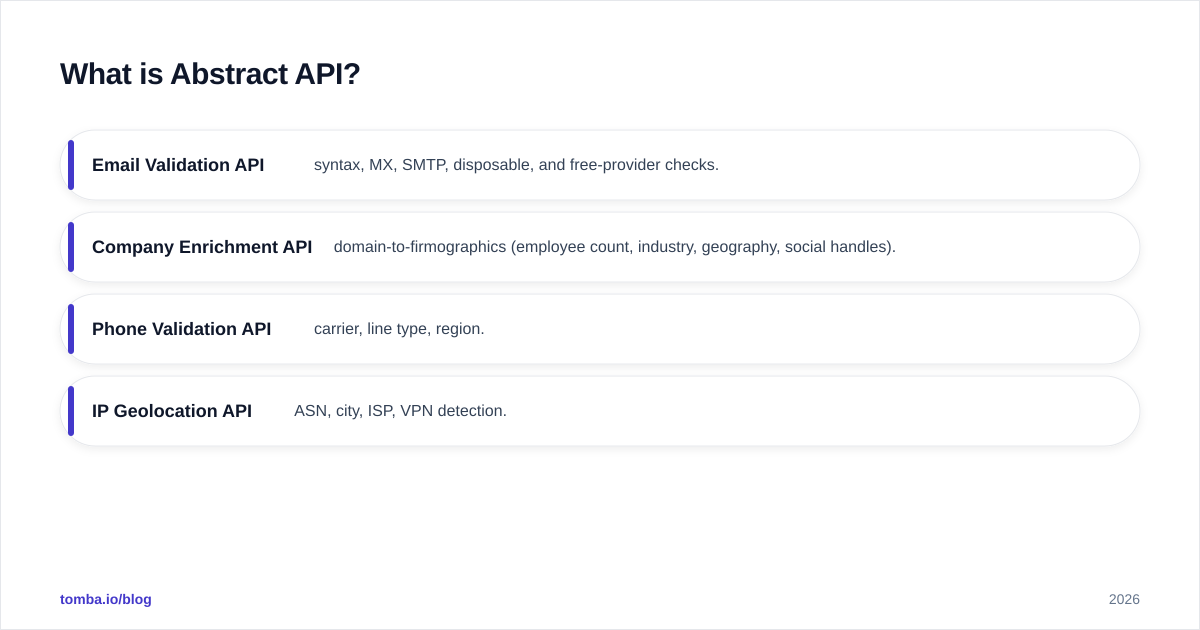
- Email Validation API — syntax, MX, SMTP, disposable, and free-provider checks.
- Company Enrichment API — domain-to-firmographics (employee count, industry, geography, social handles).
- Phone Validation API — carrier, line type, region.
- IP Geolocation API — ASN, city, ISP, VPN detection.
Abstract is built for engineers. Documentation is clean, SDKs cover the obvious languages, and free tiers let you prototype without a credit card. What it is not: a UI, a CRM connector, or a workflow tool. There is no "list of prospects to call today" — just JSON responses.
What is Lead411?#
Lead411 is a B2B sales intelligence platform that has been in market since 2001. It sells access to a contact and company database with three things that engineering-first APIs typically lack:
- Triple-verified emails plus direct-dial mobile numbers — bought, scraped, and human-verified.
- Bombora-powered intent data — buyer-stage signals for ~7,000 topics.
- Sales trigger alerts — new hires, funding rounds, IPOs, executive changes.
The product ships as a web app plus a Chrome extension and pushes data into HubSpot, Salesforce, Outreach, and Salesloft. It also has a "Reach" cadence module so reps can email from inside the same UI.
Lead411 prices by user, not by record. That tells you everything about who it is for: SDR teams running outbound, not engineers building features.
How is Abstract API different from Lead411?#
The honest answer: they barely overlap. Abstract sells functions. Lead411 sells a database of people.
You can call Abstract's Company Enrichment endpoint with tomba.io and get firmographics back. You cannot ask Abstract for "all marketing VPs at Series B SaaS companies in California who showed intent on email deliverability topics last week." Lead411 answers that in a saved search.
Conversely, you cannot ask Lead411 to validate 100,000 inbound webform emails in 200ms each via a stateless API. That is Abstract's job.

Abstract API vs Lead411: feature comparison#
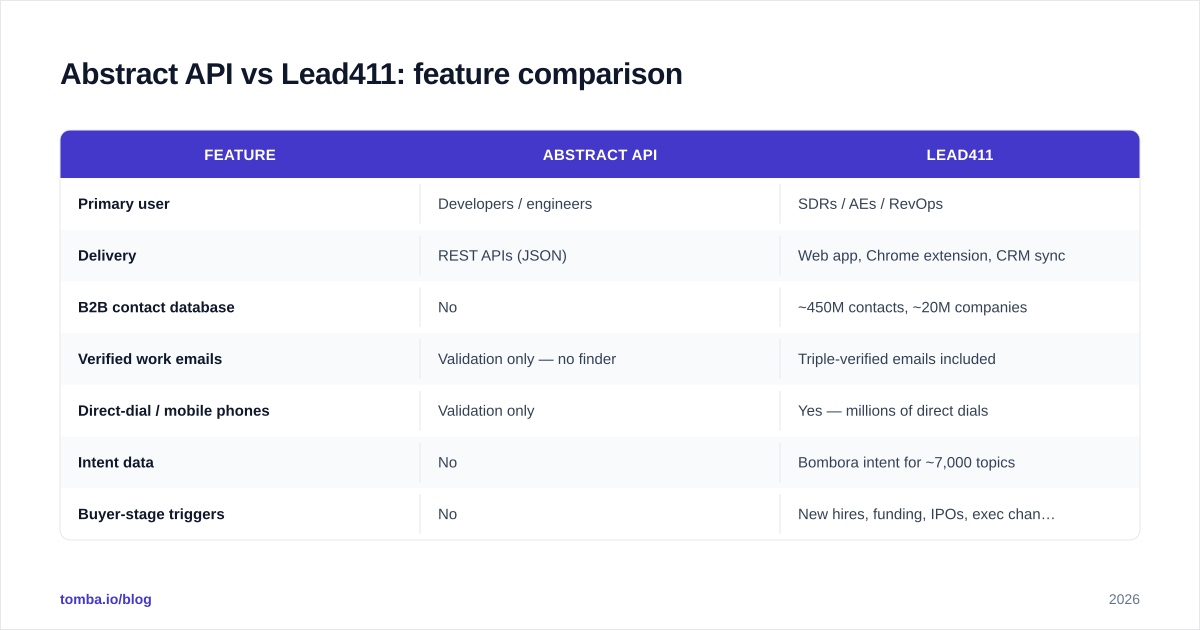
| Feature | Abstract API | Lead411 |
|---|---|---|
| Primary user | Developers / engineers | SDRs / AEs / RevOps |
| Delivery | REST APIs (JSON) | Web app, Chrome extension, CRM sync |
| B2B contact database | No | ~450M contacts, ~20M companies |
| Verified work emails | Validation only — no finder | Triple-verified emails included |
| Direct-dial / mobile phones | Validation only | Yes — millions of direct dials |
| Intent data | No | Bombora intent for ~7,000 topics |
| Buyer-stage triggers | No | New hires, funding, IPOs, exec changes |
| Company enrichment | Yes, by domain | Yes, deeper firmographics + technographics |
| CRM integrations | DIY via API | HubSpot, Salesforce, Outreach, Salesloft, Pipedrive |
| Built-in cadence / sequencer | No | Yes (Reach) |
| Pricing model | Pay-as-you-go per endpoint | Per seat, annual |
| Entry price (2026) | Free tier; ~$9/mo per API for paid | ~$99/user/mo (Basic Plus Unlimited) |
| Best fit | Form validation, app features | Outbound sales teams |
How does pricing compare?#
Abstract API uses a per-endpoint, request-metered model. Each API has its own pricing page, but the pattern is roughly:
- Free: 250–500 requests/month, rate-limited.
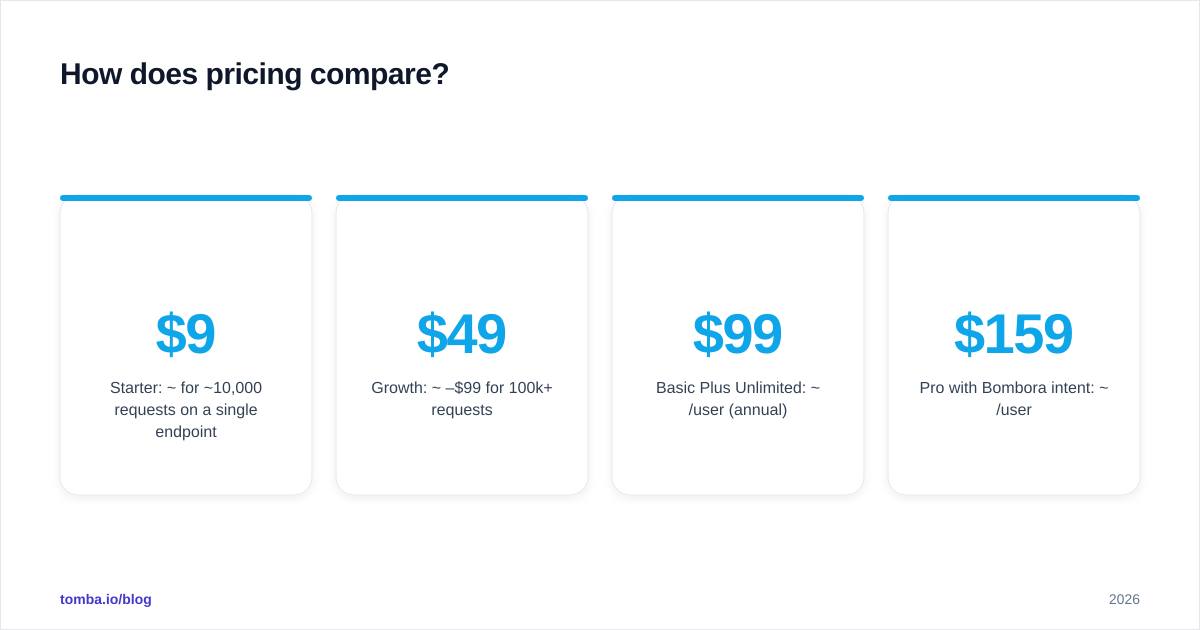
- Starter: ~$9/month for ~10,000 requests on a single endpoint.
- Growth: ~$49–$99/month for 100k+ requests.
- Enterprise: custom volume + SLA.
If you use four endpoints, you stack four subscriptions. Costs scale with traffic, not headcount.
Lead411 prices per seat with unlimited views on most tiers:
- Basic Plus Unlimited: ~$99/user/month (annual).
- Pro with Bombora intent: ~$159/user/month.
- Enterprise Limited and Unlimited: custom.
For a 5-rep SDR team, expect $500–$800/month all-in. For a single developer adding email validation to a signup form, Lead411 makes no sense at any price.
For context on where dedicated finders sit, see Tomba pricing — the Starter plan is $49/mo with 500 searches and 1,000 verifications, which is in the same neighborhood as Abstract's paid email tier but with finder coverage Abstract does not offer.
Which has better data accuracy?#
Different question for each tool, because they expose accuracy differently.
Abstract API's Email Validation publishes a "deliverability" score (DELIVERABLE / UNDELIVERABLE / RISKY / UNKNOWN). Independent benchmarks put its raw catch rate around 88–91% — solid but not best-in-class for catch-all-heavy lists. It does not "find" emails, only judges them.
Lead411's contacts are triple-verified: scraped → vendor cross-check → human-reviewed sample. Reported bounce rates from G2 reviewers cluster around 5–8%, with intent-data triggered records usually fresher. The weakness is coverage depth outside North America — EMEA and APAC data quality is noticeably thinner.
If your core need is finding work emails (not just judging the ones you have), neither tool leads the category. A purpose-built email finder plus a strong email verifier typically beats both on cost-per-valid-lead. We covered the math in our internal benchmark below.

When should you pick Abstract API?#
Pick Abstract when the work is inside a product, not inside a CRM.
Concrete fits:
- Signup form validation — kill disposable/role/typo emails before they enter your DB.
- Account-fraud signals — IP + phone + email cross-check during onboarding.
- Lightweight enrichment in-app — show users "we found you work at X, is that right?" via a Company Enrichment call.
- Internal data pipelines — append firmographic fields to records in a warehouse.
The mental model: Abstract is a Lego brick. You wire it into something you're already building. Skip it if you wanted a finished house.
When should you pick Lead411?#
Pick Lead411 when the work is outbound prospecting by humans.
Concrete fits:
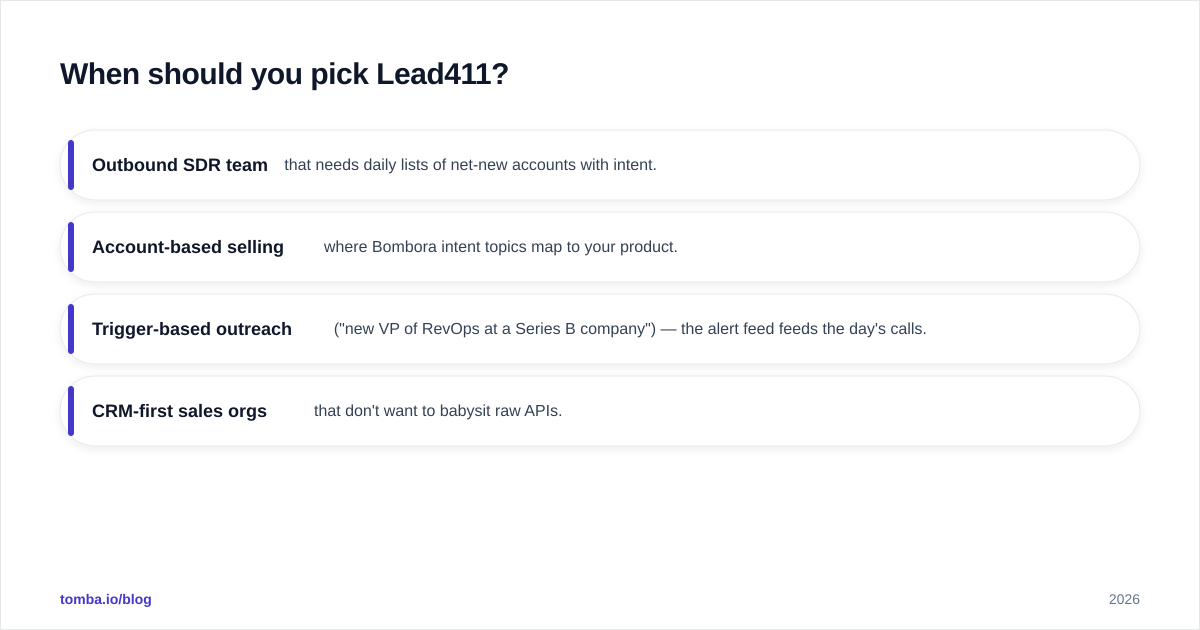
- Outbound SDR team that needs daily lists of net-new accounts with intent.
- Account-based selling where Bombora intent topics map to your product.
- Trigger-based outreach ("new VP of RevOps at a Series B company") — the alert feed feeds the day's calls.
- CRM-first sales orgs that don't want to babysit raw APIs.
Skip Lead411 if your buyers are mostly outside North America, if your contracts can't absorb per-seat billing, or if you only need email verification on web traffic.
What about the missing middle? (Finding emails)#
Neither Abstract nor Lead411 is built primarily to find an email when you have a person + company. Abstract validates what you give it. Lead411 hands you contacts from a pre-built database, but only people already in their list.
The gap is what dedicated email-finder tools fill: given a name and a domain, return a verified work email with a confidence score, drawing on real-time web sources, not just a closed database.
That is the core job Tomba Email Finder does — and where it differs from both Abstract's stateless validation and Lead411's pre-indexed contact list. Tomba's domain search returns every public email on a domain plus pattern detection; the email verifier sits in front for SMTP + catch-all checks; and bulk email finder handles batches without seat-based billing.
For teams in between — too engineer-heavy for a SDR platform, too sales-heavy for raw micro-APIs — that's the slot dedicated finders sit in.

How do they handle integrations?#
Abstract API has no native integrations — by design. You get REST endpoints, official SDKs (Node, Python, PHP, Ruby, .NET, Java, Go), and OpenAPI specs. If you want it in your CRM, you build the connector (or use Zapier integration-style middleware).
Lead411 ships native two-way sync with HubSpot, Salesforce, Outreach, Salesloft, Pipedrive, Zoho, Bullhorn, and a few ATSs for recruiting use cases. Push contact, push intent, push triggers — all without code. There is also a Chrome extension for LinkedIn scraping.
If you measure "integrations" by zero-config, Lead411 wins. If you measure by "I can wire it into anything that speaks HTTPS," Abstract wins.
How does each treat data sources?#
This matters more than the marketing pages suggest. Bad sourcing means stale records, GDPR risk, or both.
- Abstract API does not maintain a contact graph at all — it queries live signals (DNS, SMTP, IP registries) at request time. There is essentially no "stale data" problem because the question is asked fresh on every call.
- Lead411 maintains an indexed database refreshed continuously, with claims of human verification on a rolling cycle. Like every database vendor, freshness varies by segment — North American tech is well-covered, European mid-market less so.
For comparison, here's how Tomba sources its data: see data sources for the transparency breakdown.
Verdict: Abstract API vs Lead411#
These tools are not in the same fight. Choose this way:
- Building product features → Abstract API.
- Running an outbound sales team → Lead411.
- Finding and verifying B2B emails at scale → a dedicated finder. Neither Abstract's validators nor Lead411's pre-indexed contacts cover this well on their own.
The mistake teams make is buying Lead411 hoping it will solve developer use cases (it won't — there's no real-time API for arbitrary lookups), or buying Abstract hoping it will solve sales prospecting (it won't — there's no contact graph).
If the actual job-to-be-done is "find and validate work emails for outreach," try Tomba Email Finder. The free tier covers 25 searches/month with no card required; paid plans start at $49/mo on the Starter tier. For developers, the Tomba API gives you the same endpoint surface Abstract offers, but on a database actually built for finding people, not just judging them.
Spend the API budget where it pays back: on verified contacts your reps can actually email.
// get started
Find, verify and enrich your first contacts today
Start on the free plan with 25 searches a month, then scale when your team is ready.
Free plan · No credit card required · GDPR & CCPA
// about the author