Abstract API vs Saleshandy (2026): Which Tool Actually Fits Your Stack?
Abstract API and Saleshandy solve different problems — one is a developer toolbox of microservices, the other is a cold-email sequencer. Here's how to pick the right one in 2026.
TL;DR#
- Abstract API is a catalog of single-purpose REST endpoints (email validation, IP geolocation, phone validation, company enrichment). You wire it into your own product.
- Saleshandy is a cold-email and LinkedIn sequencer with built-in lead finding, sender rotation, and unified inbox for reply handling.
- They overlap on exactly one thing — email verification — and disagree everywhere else.
- Pick Abstract API if you're a developer adding data quality to an app. Pick Saleshandy if you're a sales team sending outbound campaigns.
- If you need both prospecting accuracy and a developer-friendly API, neither is a complete answer — you'll combine one with a dedicated email-finder.
What is Abstract API?#
Abstract API is a portfolio of standalone REST APIs sold as separate microservices. Each endpoint does one thing: validate an email, look up an IP's geolocation, check a VAT number, scrape a webpage, convert currency. There is no UI, no campaign manager, no inbox. You authenticate with a key, hit /v1/, and parse JSON.
The product appeals to engineers who need a piece of data infrastructure without standing up their own scraper or validator. It's the same category as ZeroBounce's API, Twilio's lookup services, or ipify — small, focused, and priced per call.
For our comparison, the relevant Abstract endpoint is Email Validation & Verification API, which returns deliverability scoring, MX checks, role-detection, free-mail flagging, and disposable-domain detection.
What is Saleshandy?#
Saleshandy is an outbound sales platform. The core flow:
- You pull a lead list (Saleshandy now bundles a B2B contact database).
- You write a multi-step email sequence with conditional branches.
- You connect 5–50 sender mailboxes for rotation and warmup.
- The platform sends, tracks opens/replies, and routes responses into a unified inbox.
It competes head-to-head with Instantly, Smartlead, and Lemlist — not with Abstract. Saleshandy does include email verification on imported lists, which is the only feature it shares with Abstract API.
Is Abstract API better than Saleshandy?#
The question is malformed. They're tools for different jobs.
- If your job is "I need to validate 500k emails inside my SaaS signup flow" → Abstract API wins because Saleshandy has no API for that.
- If your job is "I need to run a 12-touch outbound campaign across 8 inboxes" → Saleshandy wins because Abstract API has no sender, sequencer, or inbox.
The honest answer most people are looking for: "I have a list of prospects and want to email them" → Saleshandy. "I'm building a product and need data plumbing" → Abstract API.
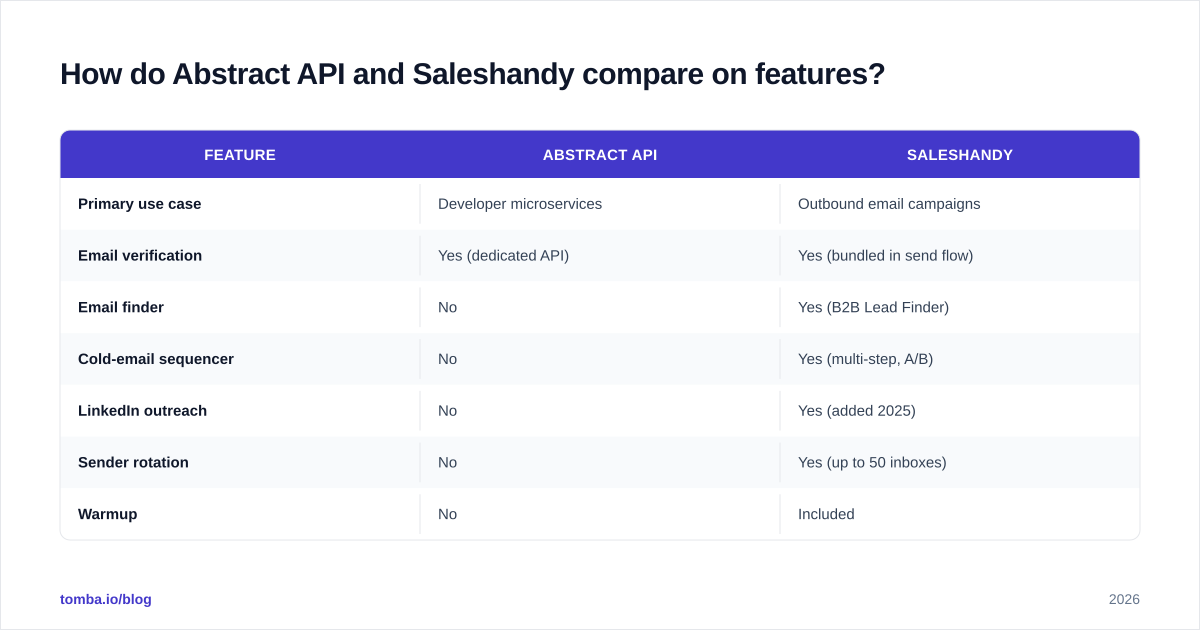
How do Abstract API and Saleshandy compare on features?#
| Feature | Abstract API | Saleshandy |
|---|---|---|
| Primary use case | Developer microservices | Outbound email campaigns |
| Email verification | Yes (dedicated API) | Yes (bundled in send flow) |
| Email finder | No | Yes (B2B Lead Finder) |
| Cold-email sequencer | No | Yes (multi-step, A/B) |
| LinkedIn outreach | No | Yes (added 2025) |
| Sender rotation | No | Yes (up to 50 inboxes) |
| Warmup | No | Included |
| Unified reply inbox | No | Yes |
| CRM/Zapier integrations | Limited | Native HubSpot, Salesforce, Pipedrive, Zapier |
| Free tier | 100 requests/mo per API | 25 emails/day, limited features |
| Starter price | $9/mo (email API) | $36/mo (Outreach Starter) |
| API for developers | Core product | Available but secondary |
| Best fit | Engineers, SaaS apps | SDRs, agencies, founders |
How do their pricing models stack up?#
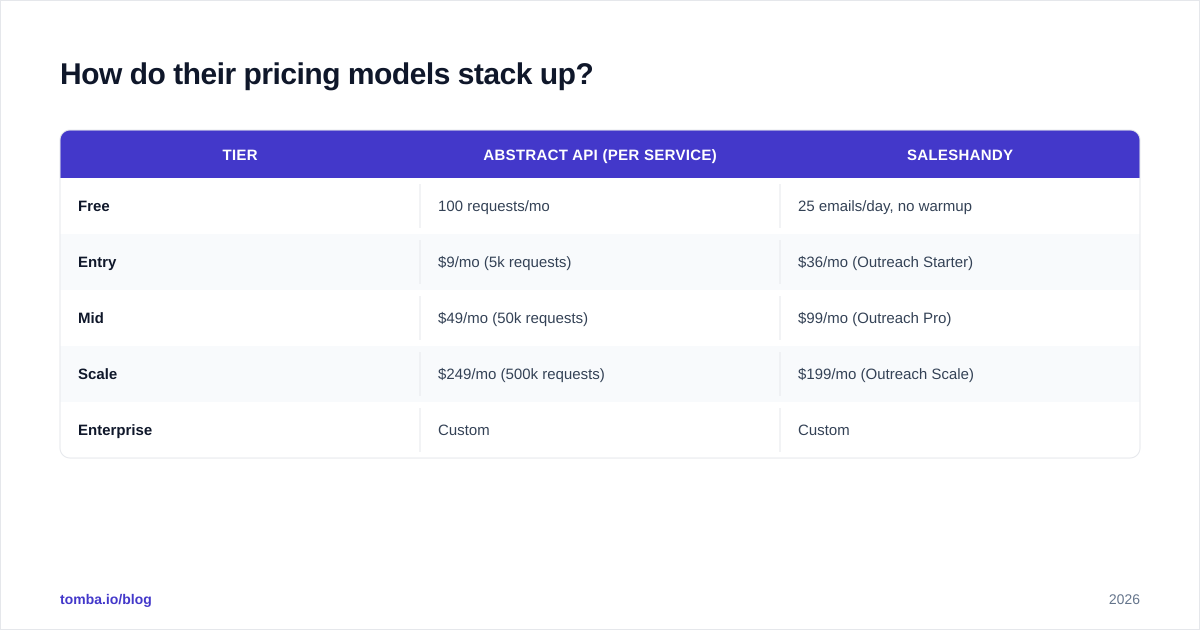
Abstract sells each API as a separate subscription. If you want email validation and IP geolocation and phone validation, you pay three times.
| Tier | Abstract API (per service) | Saleshandy |
|---|---|---|
| Free | 100 requests/mo | 25 emails/day, no warmup |
| Entry | $9/mo (5k requests) | $36/mo (Outreach Starter) |
| Mid | $49/mo (50k requests) | $99/mo (Outreach Pro) |
| Scale | $249/mo (500k requests) | $199/mo (Outreach Scale) |
| Enterprise | Custom | Custom |
Saleshandy's pricing scales by send volume, sender slots, and contact-finder credits. Abstract scales linearly by API calls. Neither is "cheaper" in absolute terms — it depends on what you're measuring.
If you only need email verification, Abstract is cheaper at low volume. If you need a full outbound stack, Saleshandy is dramatically cheaper than buying a sequencer, a verifier, a warmup tool, and a lead database separately.

How accurate is each tool's email verification?#
This is the one place they directly compete. Verification accuracy depends on three things:
- SMTP probing quality — how the tool talks to mail servers without triggering blocks.
- Catch-all handling — can it distinguish a real inbox from a domain that accepts everything?
- Disposable / role / free-mail detection — does it return useful metadata, not just a green light?
Independent tests (G2, third-party benchmark posts, and vendor self-reports) put Abstract's email validation in the 92–95% accuracy band for non-catch-all domains. Saleshandy's bundled verifier sits around the same range — it's good enough for outbound list cleaning, but it's not a specialist product.
Neither tool clears the 97%+ bar that dedicated verifiers like Tomba's email verifier or ZeroBounce hit on catch-all domains. If verification accuracy is mission-critical (transactional signup gates, regulated industries, paid lead lists), use a specialist on top.
A few practical points:
- Abstract returns a numeric
quality_score(0.00–1.00). Saleshandy returns categorical statuses (valid / risky / invalid). - Abstract's API is faster per-call (~150ms median). Saleshandy is bulk-oriented — you import a CSV, it churns through the list.
- Neither offers transparent retry logic on greylisting; both quietly mark slow responders as "risky."
When should you use Abstract API?#
Use Abstract API when:
- You're building a SaaS product and need to validate signup emails server-side.
- You need IP geolocation, VAT validation, or another microservice alongside email checks.
- You want pay-per-call pricing rather than seat-based.
- Your team is engineering-led and doesn't run outbound campaigns.
A common stack: Abstract API for signup validation + a dedicated email finder for sales prospecting + a CRM. Three tools, three jobs.
When should you use Saleshandy?#
Use Saleshandy when:
- You run cold email or LinkedIn outreach as a primary channel.
- You need to rotate across 5+ sender inboxes to scale volume safely.
- You want one tool for finding, verifying, sequencing, and replying.
- You don't want to write code or stitch APIs together.
Saleshandy's B2B contact database is competent but not as deep as Apollo's or as accurate as best-in-class email finders. If your win rate depends on accurate phone numbers or specialist-role emails, augment Saleshandy with a dedicated B2B database or phone finder.
What about deliverability — does either help?#
Saleshandy is the clearer winner here because deliverability is part of its core product:
- Built-in warmup across all connected senders.
- Sender rotation reduces per-mailbox volume.
- Spintax and conditional steps reduce signature-based pattern matching.
- Bounce-protection pause if a mailbox exceeds threshold.
Abstract API doesn't touch sending. It only tells you whether an address is likely deliverable before you send. You still need an SMTP layer, SPF records, DKIM, DMARC, and a warmup strategy on top.
For most outbound teams in 2026, email deliverability is decided more by sender reputation and content patterns than by pre-send validation accuracy. Saleshandy handles 80% of that work for you.
What are the main weaknesses of each?#
Abstract API weaknesses:
- No bulk UI — you need engineering work to use it.
- Documentation is correct but thin compared to Stripe or Twilio.
- Per-API billing gets expensive if you adopt multiple endpoints.
- Support is ticket-only on lower tiers.
- No prospecting features — you bring your own leads.
Saleshandy weaknesses:
- Lead-finder coverage is weaker outside North America and Western Europe.
- The unified inbox UX is improving but still trails Missive or Front for power users.
- LinkedIn automation is new (2025) and less mature than Waalaxy or Dripify.
- No native developer API for the sequencer — you can pull reports via Zapier but can't programmatically build sequences.
- Heavier learning curve than Instantly for first-time users.
How do they compare for ROI?#
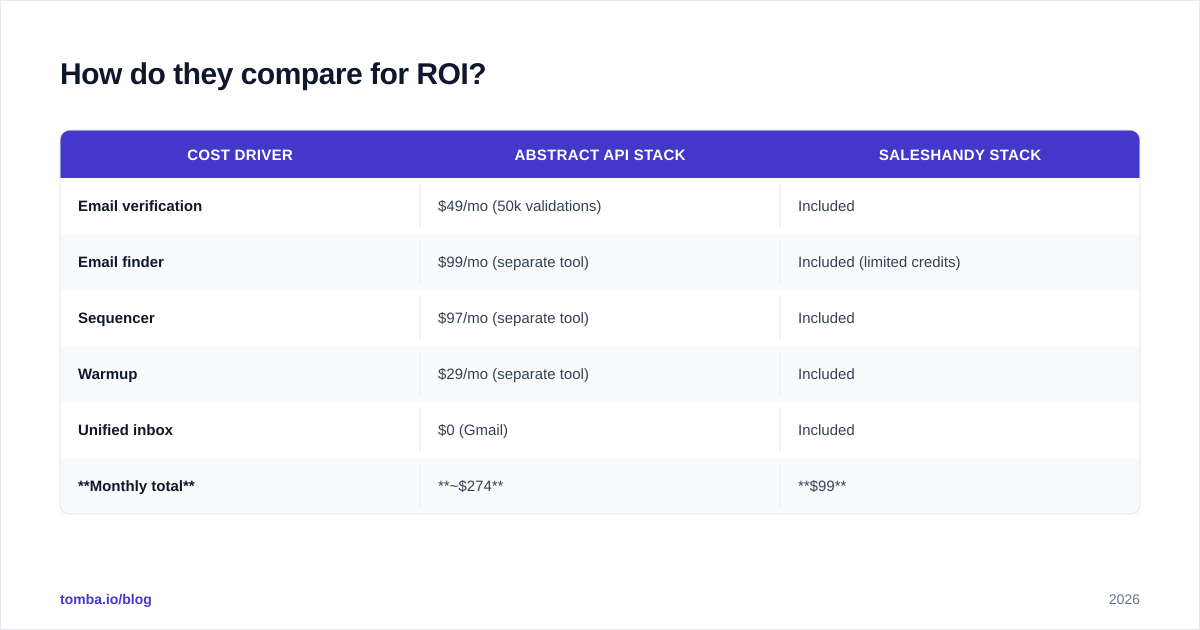
Here's a simplified scenario for a 5-person sales team sending 10,000 cold emails/month:
| Cost driver | Abstract API stack | Saleshandy stack |
|---|---|---|
| Email verification | $49/mo (50k validations) | Included |
| Email finder | $99/mo (separate tool) | Included (limited credits) |
| Sequencer | $97/mo (separate tool) | Included |
| Warmup | $29/mo (separate tool) | Included |
| Unified inbox | $0 (Gmail) | Included |
| Monthly total | ~$274 | $99 |
Saleshandy wins on bundled cost. Abstract API wins on flexibility — you can swap any component out. For most SMB sales teams, the bundle is the right call. For product companies and agencies running custom workflows, the unbundled stack pays off.
Can you use both together?#
Yes, and it's a sensible pattern.
- Use Saleshandy for the outbound sequencer + sender rotation + warmup.
- Use Abstract API inside your signup flow, lead-form gating, or CRM webhook to validate emails before they hit your DB.
- Push validated contacts to Saleshandy via Zapier or HubSpot.
This is common for B2B SaaS companies that both sell and self-serve. The two tools never step on each other because their surfaces don't overlap beyond verification — and you can route verification jobs to whichever tool is closer to the data source.
What's the better alternative if neither fits?#
If you want email-finder accuracy on par with specialists plus developer-grade APIs, Abstract and Saleshandy both fall short. The sweet spot is a tool that exposes:
- A web UI for non-technical users.
- A documented REST API for engineers.
- High-accuracy email finding and verification, including catch-all handling.
- Bulk processing, CRM integrations, and Sheets/Excel add-ons.
That's the niche Tomba fills — accuracy that competes with ZeroBounce and Apollo, with a developer surface area that competes with Abstract. It doesn't replace Saleshandy's sequencer (Tomba is not a sender), but it slots upstream of any sequencer cleanly.
Final recommendation#
Pick Abstract API if you're an engineer adding data validation to an app and don't care about sending email.
Pick Saleshandy if you're running outbound campaigns and want one tool to handle finding, verifying, sequencing, and replying.
Neither is "better" — they're tools for different jobs that happen to share one feature. Choose based on the job you're actually doing, not on the marketing pages.
Need accurate lead data before either tool touches it? Try the Tomba Email Finder — find verified professional emails by domain, name, or company, then push results straight into Saleshandy via Zapier or pull them through the Tomba API into your own stack. Free tier includes 25 searches/month, no credit card required. See full Tomba pricing for higher-volume plans.
Ready to find emails that actually work?
Join 150,000+ professionals who stopped guessing and started sending. Free credits on signup — no credit card required.
Get the Tomba newsletter
Practical outbound tactics and product updates — once every two weeks.
About the author