Abstract API vs Smartereach: Which Email Tool Wins in 2026?
Abstract API ships developer-first email verification while Smartereach bundles outreach automation. Here's which one actually fits your 2026 stack — and where Tomba quietly wins.
Abstract API vs Smartereach: Which Email Tool Actually Wins in 2026?
TL;DR
- Abstract API is a developer-first verification API — fast, cheap per call, but it only validates emails. It does not find them.
- Smartereach (often searched as "Smarte") is an outreach automation suite — sequencing, warmup, inbox rotation. It verifies emails as a side feature, not its core.
- The two products barely overlap. Choosing between them is really a question of "do I need a verification endpoint or a sending platform?"
- For teams that need BOTH finding and verifying in one API, Tomba is the cleaner choice — 99% accuracy, $49/mo starter, and an SDK in every major language.
- Skip both if you only need 50–500 verifications a month. A free checker handles that without a contract.
What problem are we actually solving?#
Search traffic for "abstract api vs smarte" mixes two very different jobs. One camp wants to know whether [someone]@[domain].com will bounce before they push it to SendGrid. The other camp wants a turnkey outbound platform that handles sequencing, warmup, and reply detection.
If you treat these as the same product, you'll buy the wrong thing.
This post sorts the two by what they actually do, where each falls apart, and what to pick when neither fits. We'll lean on independent reviews from G2 and vendor documentation rather than marketing copy.
What is Abstract API?#
Abstract API is a collection of small, single-purpose REST APIs. Their email verification endpoint takes one email address and returns deliverability, MX, SMTP, disposable, free-provider, and role flags. It's documented at abstractapi.com and used heavily by indie SaaS founders because of its free tier and pay-as-you-go pricing.
It is not an email finder. You give it an email; it tells you whether the email is real. If you don't already have a list, Abstract won't help you build one.
Strengths:
- Sub-second response times on single-lookup calls
- Generous free tier (100 requests/mo)
- Per-endpoint pricing, so you only pay for what you use
- Clean OpenAPI docs and SDKs in Node, Python, PHP, Ruby
Weak spots:
- No discovery — can't search a domain for emails
- Catch-all handling is binary (flagged, not scored)
- No enrichment, no phone, no LinkedIn, no firmographics
- Bulk processing requires self-built queuing
What is Smartereach (Smarte)?#
Smartereach is a cold email sending platform. Think Instantly, Smartlead, or Saleshandy class of tool. It bundles inbox connection, warmup, sequence builder, A/B testing, reply detection, and a verification step inside its sending pipeline. Its verification is built to gate sends, not to be exposed as a developer API.
You pay per slot (inbox + leads) not per verification credit.
Strengths:
- Multi-inbox rotation built in
- Warmup runs continuously without an add-on
- Sequence + reply detection in one UI
- Reasonable starter pricing for solo sellers
Weak spots:
- Verification is internal and not a standalone API
- No public REST endpoint for
verify(email)calls - Locked to the sending workflow — you can't easily plug it into a signup form
- Reporting is decent but not as deep as Outreach.io or Salesloft
Independent breakdowns on Capterra consistently note that Smartereach is best when your job-to-be-done is "send 5,000 cold emails this month" rather than "stop fake signups on my SaaS."
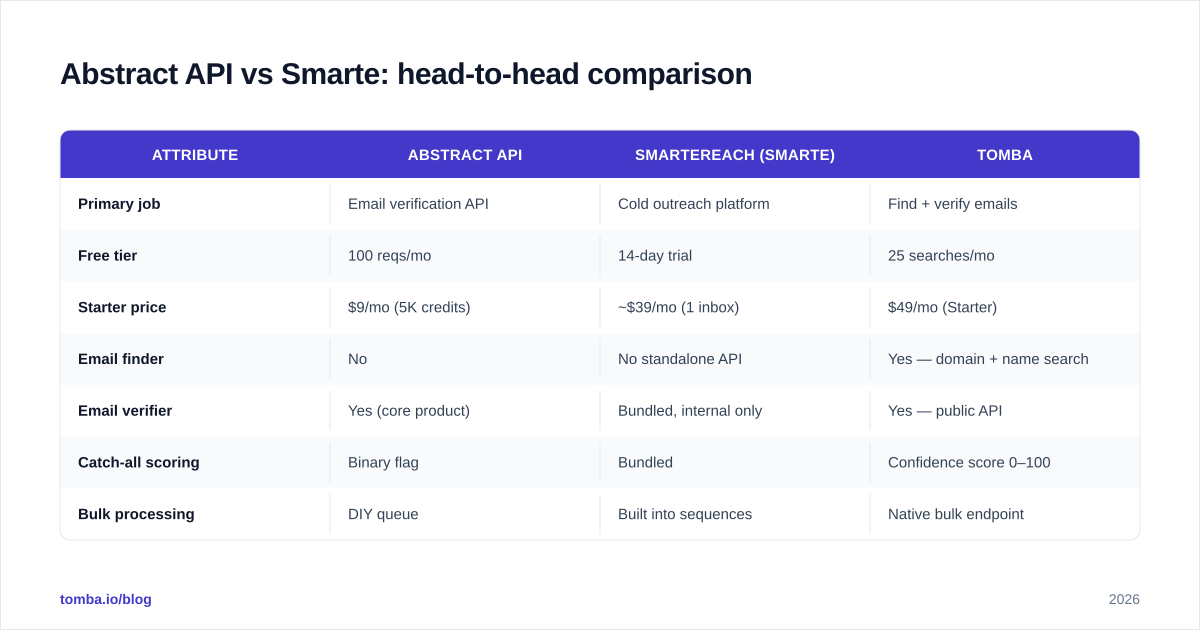
Abstract API vs Smarte: head-to-head comparison#
| Attribute | Abstract API | Smartereach (Smarte) | Tomba |
|---|---|---|---|
| Primary job | Email verification API | Cold outreach platform | Find + verify emails |
| Free tier | 100 reqs/mo | 14-day trial | 25 searches/mo |
| Starter price | $9/mo (5K credits) | ~$39/mo (1 inbox) | $49/mo (Starter) |
| Email finder | No | No standalone API | Yes — domain + name search |
| Email verifier | Yes (core product) | Bundled, internal only | Yes — public API |
| Catch-all scoring | Binary flag | Bundled | Confidence score 0–100 |
| Bulk processing | DIY queue | Built into sequences | Native bulk endpoint |
| Sending engine | No | Yes (multi-inbox + warmup) | No (integrates with sender) |
| SDKs | Node, Python, PHP, Ruby | None (UI-first) | Node, Python, PHP, Go, Ruby, Java |
| Best for | Signup-form validation | Outbound sequencing | Prospecting + list cleaning |
The pricing column is the real tell. Abstract sells credits. Smartereach sells inbox slots. They aren't the same currency, and you can't compare them line for line unless you know which job you're hiring the tool for.

When should you pick Abstract API?#
Pick Abstract API when:
- You're a developer dropping verification into a signup or checkout form
- Your volume is unpredictable (some weeks 50 calls, some weeks 50,000)
- You don't need to find emails — only validate the ones users type
- You want a no-contract, prepaid, per-call billing model
A typical Abstract use case looks like this: a B2B SaaS adds the verification endpoint to its registration page. Before allowing signup, it checks if the email is deliverable, non-disposable, and non-role. Fake signups drop 80%. Cost runs around $30/month.
Abstract is not the right pick when you need to build a prospect list. It has no domain search, no name-to-email lookup, no enrichment. For that, you need a different class of tool — like a proper email finder.
When should you pick Smartereach?#
Pick Smartereach when:
- You're a sales team or agency running cold outbound
- You need multiple sending inboxes with warmup and rotation
- You want sequences, replies, and analytics in one product
- You're comparing against Instantly, Smartlead, or Saleshandy
If you're an SDR planning to send 200 cold emails per day from five different inboxes, Smartereach handles the orchestration. Verification is included in the workflow so your bounce rate stays under 2%.
Smartereach is the wrong pick when you only want a verification endpoint. You'd be paying for a sending engine you don't use.
Where does Tomba fit?#
Tomba sits between the two. It's a developer-grade API like Abstract but does both finding AND verifying. It's used by sales teams like Smartereach is, but exposes everything as a REST endpoint so engineers can build their own workflows.
For example, a common Tomba flow:
- Hit the domain search endpoint with
stripe.com→ get back 47 verified contacts - Pipe results into your CRM via the HubSpot integration
- Push approved contacts into Smartereach (or Instantly, or Apollo) for sending
- Use the email verifier API on inbound form submissions
You get Abstract's developer ergonomics with Smartereach's data depth, minus the lock-in to a single sending pipeline.
According to Tomba's own accuracy benchmarks, pattern-matched emails verify at over 99%, with catch-all confidence scored on a 0–100 scale rather than a binary flag.

Is Abstract API better than Smartereach?#
Neither is better. They solve different problems.
If we're scoring on a single dimension — verification quality — Abstract wins because it's the actual product. Smartereach's verification is a side check designed to keep its own sending engine clean. Abstract's is exposed, tested, and documented as a public API.
If we're scoring on outbound output — emails sent that get replies — Smartereach wins. Abstract has no sending capability.
The reason this comparison shows up in search results is that buyers conflate "I need to clean my list" with "I need to send to my list." Those are sequential steps, not substitutes.
| Buyer intent | Right tool |
|---|---|
| "I need to validate signups" | Abstract API |
| "I need to send 10K cold emails" | Smartereach |
| "I need to find emails for a target account list" | Tomba |
| "I need both finding and verifying in one API" | Tomba |
| "I need verification + enrichment + phone" | Tomba |
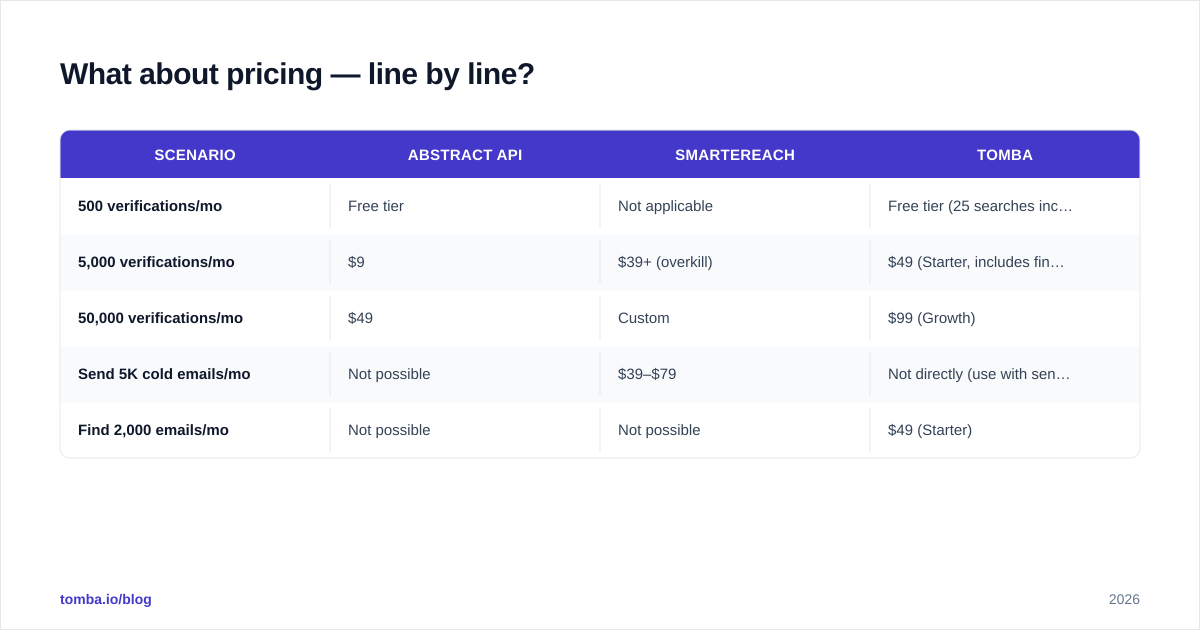
What about pricing — line by line?#
Here's where contracts get sneaky. Abstract bills per credit. Smartereach bills per inbox slot. If you're comparing total cost of ownership, you have to model your usage.
| Scenario | Abstract API | Smartereach | Tomba |
|---|---|---|---|
| 500 verifications/mo | Free tier | Not applicable | Free tier (25 searches included) |
| 5,000 verifications/mo | $9 | $39+ (overkill) | $49 (Starter, includes find) |
| 50,000 verifications/mo | $49 | Custom | $99 (Growth) |
| Send 5K cold emails/mo | Not possible | $39–$79 | Not directly (use with sender) |
| Find 2,000 emails/mo | Not possible | Not possible | $49 (Starter) |
See full Tomba pricing for the per-credit breakdown across plans.
What features actually matter in 2026?#
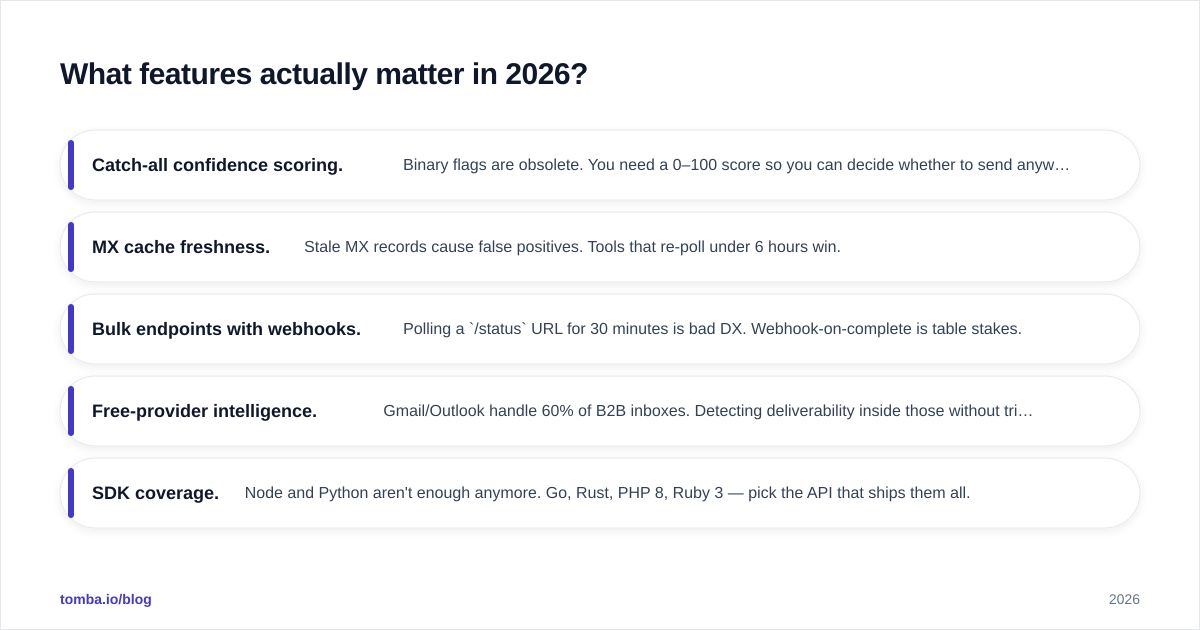
The verification space moved on from "real or fake?" three years ago. The features that move the needle now:
- Catch-all confidence scoring. Binary flags are obsolete. You need a 0–100 score so you can decide whether to send anyway.
- MX cache freshness. Stale MX records cause false positives. Tools that re-poll under 6 hours win.
- Bulk endpoints with webhooks. Polling a
/statusURL for 30 minutes is bad DX. Webhook-on-complete is table stakes. - Free-provider intelligence. Gmail/Outlook handle 60% of B2B inboxes. Detecting deliverability inside those without triggering rate limits matters.
- SDK coverage. Node and Python aren't enough anymore. Go, Rust, PHP 8, Ruby 3 — pick the API that ships them all.
Abstract API covers most of these for verification. Smartereach doesn't really compete because verification isn't its product. Tomba's API docs cover the lot, plus finding endpoints Abstract lacks entirely.
For deeper background on what "verified" actually means, the Tomba glossary entry on email deliverability walks through SMTP handshake, soft vs hard bounces, and sender reputation impact.
What do reviewers say on G2 and Capterra?#
Independent reviews on G2 place Abstract API in the upper-mid tier for verification accuracy, praised for DX but knocked for limited reporting. Smartereach lands in the cold-email-platform category, sitting alongside Instantly and Smartlead, where reviewers praise its warmup but criticize its verification as "good enough, not best in class."
If you cross-reference G2 ratings against Capterra, the pattern repeats: Abstract is a niche verifier, Smartereach is a generalist sender. Neither is a list-builder.
That gap — list building — is exactly where a dedicated email finder plays.
What's the honest recommendation?#
Three scenarios, three answers:
- You're a developer protecting a signup form. Use Abstract API. The free tier covers most indie SaaS. Upgrade only when you cross 5K calls/month.
- You're running cold outbound at volume. Use Smartereach (or Instantly, or Smartlead — they're interchangeable). Verification is a side feature; you're paying for the sending engine.
- You're building a prospecting workflow that needs both find AND verify. Use Tomba. The API does both, the SDKs cover six languages, and the pricing doesn't lock you into a sending platform you don't want.
The honest answer is that "Abstract API vs Smartereach" is the wrong fight. They aren't competitors. The right comparison is "verification API vs sending platform vs prospecting platform," and the answer depends on which job you're actually hiring software to do.
Final word#
If you came here trying to pick between two tools that do different things, walk away with this: identify the job first, then pick the tool. Verification API jobs go to Abstract. Sending jobs go to Smartereach. Finding + verifying jobs go to Tomba.
Ready to try the third option? Spin up a free Tomba account, hit the email finder endpoint, and see how 99% accuracy with a $49/mo entry plan compares to stitching two single-purpose tools together. The free tier gives you 25 searches — enough to test it against your real target list before you commit.
Ready to find emails that actually work?
Join 150,000+ professionals who stopped guessing and started sending. Free credits on signup — no credit card required.
Get the Tomba newsletter
Practical outbound tactics and product updates — once every two weeks.
About the author