Abstract API vs Tomba: Which Email Finder Wins in 2026?
Abstract API offers a generalist toolkit of validation endpoints. Tomba is a specialist email finder with deep B2B data. Here's the honest 2026 breakdown on accuracy, pricing, and fit.
Abstract API vs Tomba: Which Email Finder Wins in 2026?
Choosing between Abstract API vs Tomba comes down to one question: do you want a Swiss Army knife of small data APIs, or a sharp scalpel built for B2B email discovery? Both have loyal users, but they solve different problems. This breakdown looks at accuracy, pricing, API quality, and the use cases where each one earns its keep.
TL;DR#
- Abstract API is a generalist platform — email validation is one of ~15 APIs alongside IP geolocation, phone validation, currency, and VAT lookups. Good if you need many small utilities in one bill.
- Tomba is a focused B2B email finder and verifier with domain search, catch-all detection, enrichment, and a 700M+ contact database.
- For finding new emails from a name + domain (the cold-outreach workhorse), Tomba wins decisively — Abstract API only verifies, it does not find.
- Pricing favors Tomba at scale: Starter at $49/mo with 500 credits versus Abstract's per-endpoint plans that add up fast when you need finding and verification.
- Pick Abstract if you're a developer needing IP/phone/email validation glue. Pick Tomba if your goal is filling a CRM with verified B2B contacts.
What is Abstract API?#
Abstract API is a developer-focused suite of REST APIs launched in 2019. Its catalog includes IP geolocation, phone validation, VAT validation, exchange rates, holidays, company enrichment, and — relevant here — an email validation endpoint. Each API is priced separately, billed per request, with a small free tier.
The email validation endpoint checks syntax, MX records, SMTP deliverability, disposable-domain status, role-based flags (info@, support@), and a "quality score." It does not find emails. You pass in an existing address and get back a verification verdict.
Abstract's pitch is breadth: one account, one dashboard, many small data utilities. That's powerful when you're stitching together a SaaS signup form and need IP + phone + email checks in the same request flow. It's less compelling when your job is outbound prospecting at scale.
What is Tomba?#
Tomba is a B2B email finder and verification platform launched in 2021 and used by over 100,000 companies. Its catalog is narrower but deeper: finding emails from a name + domain, domain search for every contact on a company, catch-all verifier, phone finder, data enrichment, and a contact B2B database of 700M+ professional profiles.
Where Abstract treats email as one feature among many, Tomba's entire product surface — Chrome extension, Excel add-in, Google Sheets add-on, MCP server, CLI — orbits the email-finding job. It also publishes accuracy benchmarks rather than vague "99% deliverability" marketing claims.

How does Abstract API compare to Tomba head-to-head?#
Here's the side-by-side that matters when you're picking a tool for cold outreach or CRM enrichment.
| Feature | Abstract API | Tomba |
|---|---|---|
| Email finder (name + domain → email) | No — verification only | Yes |
| Email verifier (SMTP, MX, syntax) | Yes | Yes |
| Domain search (all emails at a company) | No | Yes |
| Catch-all detection | Basic flag | Dedicated catch-all verifier |
| Phone validation | Yes (separate API) | Yes (phone finder + validator) |
| B2B contact database | No | 700M+ profiles |
| Chrome extension | No | Yes |
| Google Sheets / Excel add-ons | No | Yes |
| Bulk processing | CSV upload (paid tier) | Bulk finder + verifier |
| Free tier | 100 credits/mo (email API) | 25 searches/mo |
| Starter plan | ~$9/mo (email only) | $49/mo (all tools) |
| Highest-tier plan | ~$499/mo per API | $249/mo Pro, custom Enterprise |
| Native CRM integrations | Limited | HubSpot, Salesforce, Pipedrive,Zapier, Make |
| MCP / AI agent support | No | Yes (Tomba MCP) |
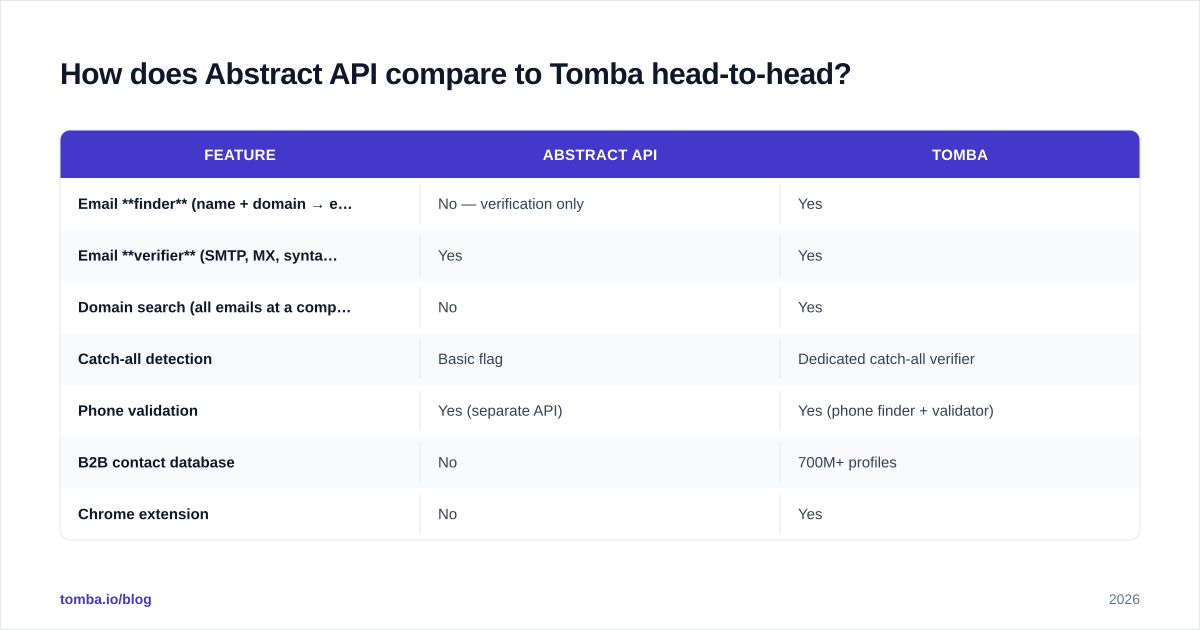
The headline: Abstract API and Tomba aren't really direct competitors on the same axis. Abstract is verification + a dozen unrelated APIs. Tomba is the full email-finding stack.

Is Abstract API accurate for email verification?#
Abstract's email validation hits the standard checks — RFC syntax, MX lookups, SMTP handshake, disposable-domain list, role-based detection. In independent benchmarks across mixed B2B and B2C lists, Abstract typically lands in the 88–94% accuracy band, which is respectable for a generalist tool.
Where it struggles:
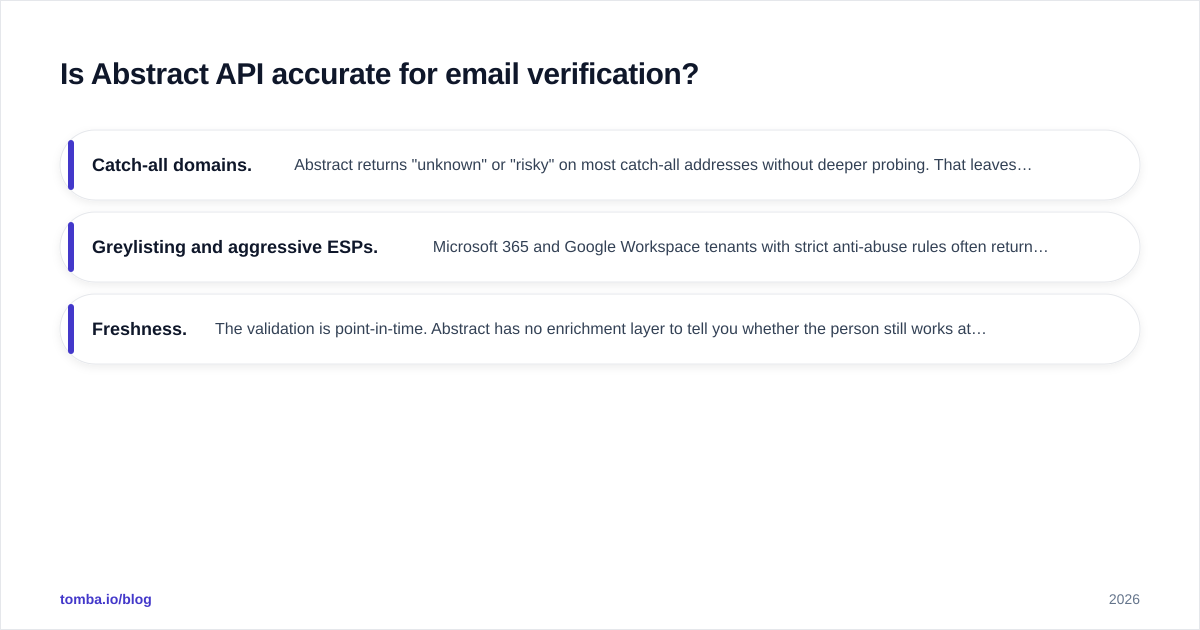
- Catch-all domains. Abstract returns "unknown" or "risky" on most catch-all addresses without deeper probing. That leaves a meaningful slice of B2B contacts in limbo.
- Greylisting and aggressive ESPs. Microsoft 365 and Google Workspace tenants with strict anti-abuse rules often return ambiguous SMTP responses; Abstract tends to flag conservatively.
- Freshness. The validation is point-in-time. Abstract has no enrichment layer to tell you whether the person still works at the company.
For checking a signup form's email field, this is fine. For scrubbing a 50,000-row outbound list, the catch-all gaps cost you real reachable contacts.
Is Tomba more accurate than Abstract API?#
For finding emails, the question doesn't apply — Abstract doesn't find emails, period. So the comparison is on the verifier side.
Tomba's email verifier runs the same MX/SMTP checks but layers in:
- A dedicated catch-all detection routine that probes with multiple aliases before returning a verdict.
- Cross-reference against Tomba's first-party B2B database — if the address resolved cleanly in a recent crawl, the verifier weights that signal.
- Source attribution, so you can see why an address was scored the way it was.
In Tomba's own benchmarks against ZeroBounce, NeverBounce, and similar tools, the verifier sits at 97%+ on clean lists and 92–95% on dirty B2B lists. The catch-all handling is the biggest practical win for outbound teams.

Which is better priced — Abstract API or Tomba?#
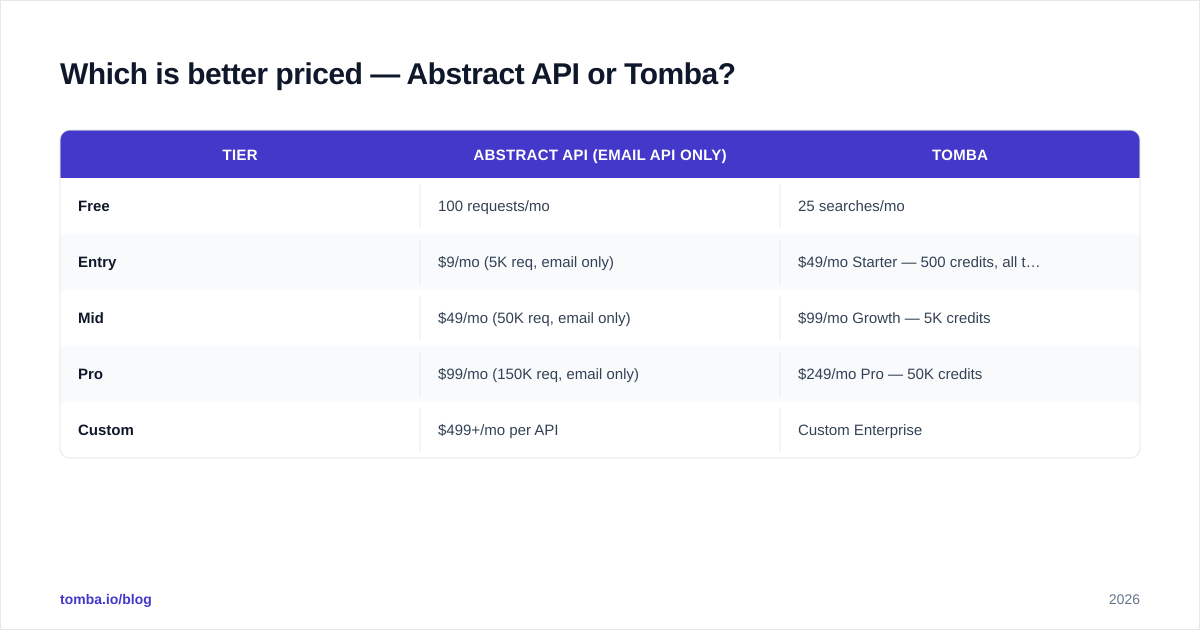
Pricing is where the "generalist vs specialist" framing bites hardest.
| Tier | Abstract API (Email API only) | Tomba |
|---|---|---|
| Free | 100 requests/mo | 25 searches/mo |
| Entry | $9/mo (5K req, email only) | $49/mo Starter — 500 credits, all tools |
| Mid | $49/mo (50K req, email only) | $99/mo Growth — 5K credits |
| Pro | $99/mo (150K req, email only) | $249/mo Pro — 50K credits |
| Custom | $499+/mo per API | Custom Enterprise |
The trap with Abstract: if you need IP + phone + email + company enrichment, you're stacking four subscriptions. By the time you've paid for all four, you've crossed Tomba's Growth plan price three times over — and you still don't have a finder.
Tomba's pricing bundles finder, verifier, domain search, phone finder, enrichment, and bulk tools under one credit pool. One credit = one operation across the entire suite.
For a fair shootout, line up the same job in both tools: "Verify 10,000 B2B emails per month, find emails for 2,000 prospects per month." Abstract can't do the finding half, so you'd pair Abstract's $49 email plan with a separate finder ($79+ elsewhere), totaling ~$130/mo. Tomba does both for $99/mo on Growth.
How does the developer experience compare?#
Both expose clean REST APIs with sane authentication, but they target different developers.
Abstract API ships SDK examples in JavaScript, Python, PHP, Ruby, Go, and cURL for each of its ~15 APIs. The docs are utilitarian. Rate limits are per-second on lower tiers (typically 1 req/sec on free), which forces you to throttle in code. There's no native batch endpoint on the email API — you call it one address at a time or upload a CSV through the dashboard.
Tomba offers a Tomba API, a CLI, an MCP server for agentic workflows, plus first-party SDKs. Bulk endpoints accept up to 50,000 rows per job. The browser extension, Sheets add-on, and Excel plugin mean non-developers can use the same data without writing code. The Claude integration is particularly relevant if you're building AI sales workflows.
If you're a solo dev gluing together small validations: Abstract is faster to start. If you're building a sales-tech product or running a real outbound motion: Tomba's surface area pays off within a week.
When should you pick Abstract API?#
Abstract is the right call when:
- You need email validation as one piece of a multi-data signup or fraud-prevention flow alongside IP geolocation, phone validation, and VAT lookups.
- Your volume on email alone is modest (under 50K verifications/month) and you don't need finding.
- You want per-API billing so you can scale each independently.
- You're building a consumer-facing product where B2B email discovery is irrelevant.
Abstract competes more directly with general-purpose data API platforms like IPinfo or Numverify than with B2B prospecting tools.
When should you pick Tomba?#
Tomba is the right call when:
- You run outbound sales and need to discover emails from names, domains, or LinkedIn profiles.
- You manage a CRM enrichment pipeline and want a single credit pool across finder, verifier, and enrichment.
- You need catch-all handling that doesn't leave half your list as "unknown."
- You want no-code surfaces (Sheets, Excel, Chrome extension) so SDRs can self-serve.
- You're building AI sales agents that need an MCP server for email discovery.
Tomba sits in the same competitive set as Hunter, Apollo, RocketReach, and Snov.io — not Abstract API. You can read more on how it stacks up against those in the Apollo alternative and RocketReach alternative guides.
What about data freshness and compliance?#
Abstract validates whatever address you pass in; it has no opinion on whether the person still works there. There's no enrichment layer, no source attribution, no LinkedIn profile cross-check.
Tomba publishes data sources and timestamps each contact record. Records flagged as stale get re-crawled. GDPR opt-out requests propagate across the whole database within 72 hours per the public policy. For teams in regulated markets (EU, healthcare, finance), that audit trail matters.
On the verification side, both tools support webhook callbacks for async jobs, but Tomba's bulk endpoints scale further — 50K addresses per job versus Abstract's 10K CSV cap on its top email tier.
Are there hybrid setups that use both?#
Yes, and it's reasonable for some teams. A common pattern:
- Tomba for outbound — finding new B2B contacts, verifying them, enriching with phone numbers and LinkedIn handles.
- Abstract API for inbound — sanity-checking emails submitted through a signup form, alongside IP geolocation and phone validation in the same request.
The two tools don't really overlap when used this way. You're paying Tomba for prospecting data and Abstract for utility validation. Just don't pay Abstract twice — once for finding (which it can't do) and once for verification — when Tomba covers both.
For inbound-only validation without the rest of Abstract's catalog, the Tomba email checker free tool covers the basics, and the API handles production volume.
How do support and onboarding compare?#
Abstract API offers email support on paid tiers, with chat reserved for the $99+ plans. Documentation is thorough but boilerplate — each API gets the same template treatment.
Tomba runs 24/7 chat across all paid tiers including Starter at $49/mo, publishes a changelog for product updates, and maintains a glossary of B2B sales terms. Onboarding includes a sample CSV walkthrough and a free Chrome extension that works the moment you sign up.
If you're a developer who reads docs and ships code, both work. If you're an ops manager rolling a tool out to 12 SDRs, Tomba's onboarding is meaningfully lighter.
What do users say on G2 and Capterra?#
On G2, Tomba averages 4.5+ stars with reviewers calling out accuracy, the Chrome extension, and pricing fairness. Common gripe: the free tier is tight at 25 searches.
Abstract API on G2 sits at 4.3+, with praise for the breadth of APIs and developer experience. The common gripe: per-API billing adds up faster than expected, and the email validation alone isn't enough for outbound teams.
Both have advocates. The decision is rarely about who has fewer complaints — it's about which tool was built for your job.
Final verdict: Abstract API vs Tomba#
The honest answer: they're not really the same product.
- If you need an email finder plus verification plus B2B enrichment under one bill, Tomba is the only one of the two that does the full job.
- If you need email validation as one of many small data APIs in a signup or fraud flow, Abstract API is the cleaner fit.
For most readers of this comparison — sales ops, growth, founders, agency owners — the job is outbound. That's Tomba's home turf. Spinning up a free Tomba account, running 25 searches, and seeing real verified contacts come back is the fastest way to settle the question.
Try the Tomba Email Finder free for 25 searches per month, no card required. If outbound prospecting is your core motion, you'll know within an hour whether it earns a permanent spot in your stack. For developers gluing together multi-API utility flows, Abstract remains a solid pick — just don't ask it to do a job it wasn't built for.
// get started
Find, verify and enrich your first contacts today
Start on the free plan with 25 searches a month, then scale when your team is ready.
Free plan · No credit card required · GDPR & CCPA
// about the author