Account Based GTM in 2026: The Complete Playbook
Account based GTM aligns marketing, sales, and customer success around a shared target account list. Here's how to build the motion in 2026.
Account Based GTM in 2026: The Complete Playbook
TL;DR
- Account based GTM (ABGTM) is the operating model where marketing, sales, customer success, and RevOps all orient around the same ranked list of target accounts — not around channels, MQLs, or quotas in isolation.
- It is not "ABM with a new acronym." ABM is a marketing tactic. ABGTM is the whole revenue engine: ICP, intent, plays, ownership, and measurement.
- The winning teams in 2026 run a three-tier model (1:1, 1:few, 1:many) on top of a clean account list, with intent data from at least one source and a documented play library.
- Tooling matters less than orchestration. A $99/mo stack run by a disciplined team will beat a $5,000/mo stack run by a fragmented one.
- Pipeline-to-target-account ratio and account penetration depth are the two metrics that separate ABGTM theatre from ABGTM revenue.
What is account based GTM?#
Account based GTM is a revenue model where every go-to-market team — demand gen, SDRs, AEs, CSMs, partner managers — works from a single ranked list of target accounts and a shared definition of "engaged." Instead of marketing chasing MQL volume while sales chases their own list, both functions converge on the same 200, 500, or 2,000 companies and run coordinated plays against them.
Think of it like a film production. ABM (account-based marketing) is the marketing department. ABGTM is the entire crew — director, cast, lighting, sound — making one movie together. If marketing's "great campaign" lights up accounts your AEs aren't ready to call, you've spent money to confuse your buyers.
The model started as enterprise SaaS gospel from companies like Demandbase and 6sense around 2017, but the 2026 version looks different. Outbound volume restrictions, AI-generated noise, and the collapse of MQL-to-revenue conversion rates have pushed mid-market teams into ABGTM territory too. You don't need a 50-person revenue org to run it — you need an ICP, a list, and the discipline to say no to accounts that don't fit.
Why has account based GTM eaten traditional demand gen?#
Three forces pushed the shift, and none of them are reversing.
MQL math broke. In 2018, a mid-market SaaS could expect 3-5% MQL-to-closed-won. By 2024, HubSpot's State of Marketing data and parallel reports from Forrester were showing that number cut roughly in half. The cost of generating an MQL went up because ad CPMs rose; the value of each MQL went down because buyers research anonymously for months before raising a hand. You can't fix that with more lead magnets.
Buying committees got bigger. Gartner's research on B2B buying has pegged the average enterprise committee at 6-10 people. If your motion is "capture one form fill and pass to sales," you are talking to 10-20% of the actual deal. ABGTM bakes multi-threading into the model from day one.
AI made spam free. Cold outbound at scale is now table stakes for every competitor in your space. Volume no longer differentiates. Precision — the right message, to the right account, at the right moment — does.
What's the difference between ABM, ABS, and account based GTM?#
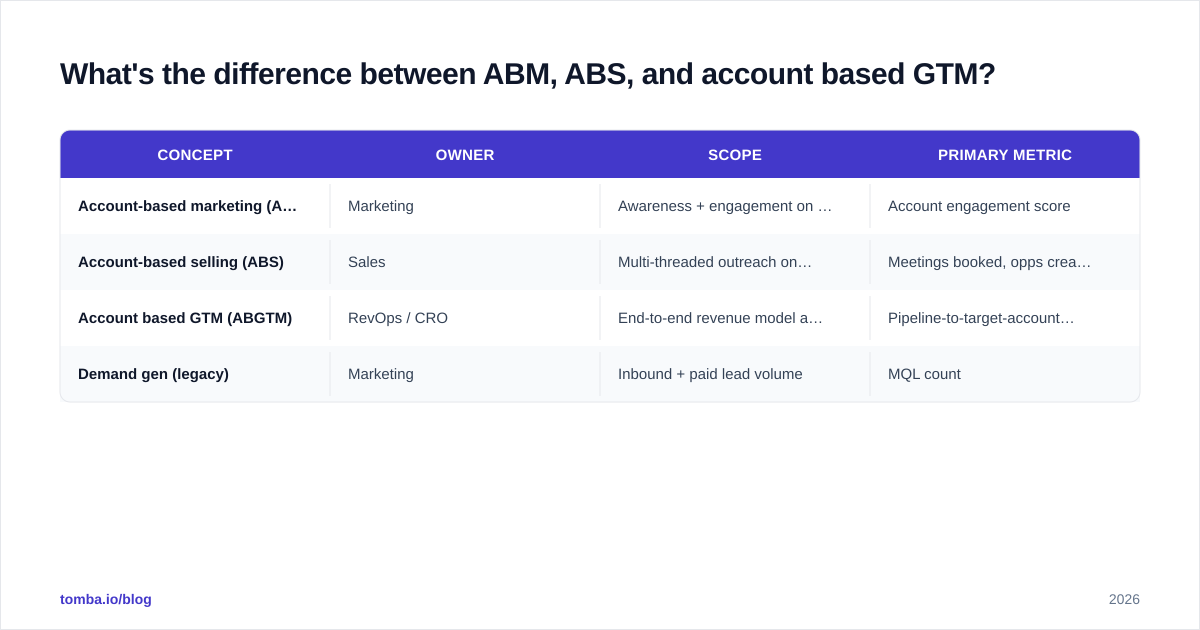
These three get used interchangeably and they shouldn't be. Here is the practical distinction.
| Concept | Owner | Scope | Primary metric |
|---|---|---|---|
| Account-based marketing (ABM) | Marketing | Awareness + engagement on target accounts | Account engagement score |
| Account-based selling (ABS) | Sales | Multi-threaded outreach on a named list | Meetings booked, opps created |
| Account based GTM (ABGTM) | RevOps / CRO | End-to-end revenue model across marketing, sales, CS, partners | Pipeline-to-target-account ratio, win rate, NRR |
| Demand gen (legacy) | Marketing | Inbound + paid lead volume | MQL count |
If your "ABM program" is a marketing director running display ads to a list while sales runs their own outbound off a separate list, that's not ABGTM. That's ABM and ABS happening in the same building.
How do you build a target account list that actually works?#
The list is the foundation. Everything downstream — message, channel, spend — depends on it being right. Here is the sequence that works.
1. Lock the ICP first. Not the persona — the ICP, the company-level fit. Industry, employee count, revenue, tech stack, geo, funding stage. The ICP should be tight enough that you can name 20 accounts off the top of your head that fit and 20 that don't.
2. Pull a universe. Use a B2B database or a data provider like G2 intent feeds to get every company on earth that matches the ICP. Most mid-market teams will end up with a universe of 3,000-15,000 accounts.
3. Score for fit. Layer firmographic and technographic data — anything that predicts deal size or win rate. A simple weighted model in a spreadsheet beats no model.
4. Layer intent. Bombora, 6sense, G2 Buyer Intent, or web-visitor reveal data tells you which accounts are actively researching. Intent is not a forecast — it's a signal that the next 60 days are warmer than the previous 60.
5. Tier the result. Bucket the scored list into three tiers — we cover the model below — and assign coverage.
Expect to throw away 70-80% of the universe. That's the point. The discipline is in what you say no to.
What does the 1:1, 1:few, 1:many tier model look like?#
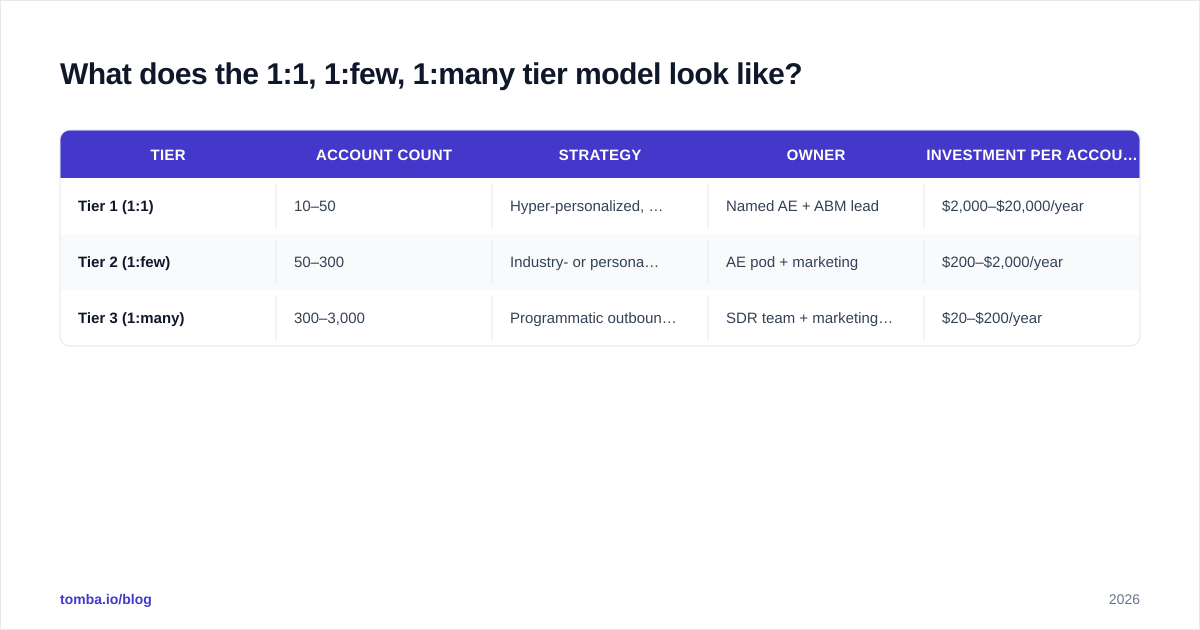
The tier model is how you allocate finite human attention across an infinite-looking list.
| Tier | Account count | Strategy | Owner | Investment per account |
|---|---|---|---|---|
| Tier 1 (1:1) | 10–50 | Hyper-personalized, multi-channel, custom content, exec sponsorship | Named AE + ABM lead | $2,000–$20,000/year |
| Tier 2 (1:few) | 50–300 | Industry- or persona-tailored plays, light personalization | AE pod + marketing | $200–$2,000/year |
| Tier 3 (1:many) | 300–3,000 | Programmatic outbound, paid social, intent-triggered nurture | SDR team + marketing automation | $20–$200/year |
Tier 1 is where you build custom landing pages, send physical mail, and have your CEO write a one-paragraph note. Tier 3 is where you let automation do the work — sequences, retargeting, intent-triggered emails — with humans only touching when a buying signal fires.
The mistake teams make is running Tier 1 effort on Tier 3 accounts. You don't write a custom one-pager for a company doing 100 employees in a non-priority vertical. You let your sequence find the warm ones and then escalate.
How do you orchestrate plays across marketing and sales?#
This is the hard part. The list is mechanical. Plays are cultural.
A "play" is a coordinated, multi-touch sequence triggered by a signal, with defined ownership at every step. Example: when a Tier 2 account shows three intent signals on "email deliverability" in a 14-day window, the play is:
- Day 0 (marketing): Add account to retargeting audience. Push contacts to LinkedIn matched audience.
- Day 1 (SDR): Pull all senior marketing and ops contacts from a LinkedIn finder and enrich with verified emails.
- Day 2 (SDR): Personalized email referencing the intent topic. Connect on LinkedIn with the buying-committee leads.
- Day 4 (AE): AE breaks in with an exec-to-exec note if the account is in their top 20.
- Day 7 (marketing): Direct mail to top contact for top-tier intent accounts.
- Day 10 (SDR): Phone call with a voicemail referencing the previous email.
- Day 14: Review. If no meeting, downgrade to nurture.
That's one play. A mature ABGTM team has 8-15 plays — by signal type, by tier, by segment. Document them in a play library. Train every new hire on it. Measure conversion at every step.
Which signals actually predict pipeline?#
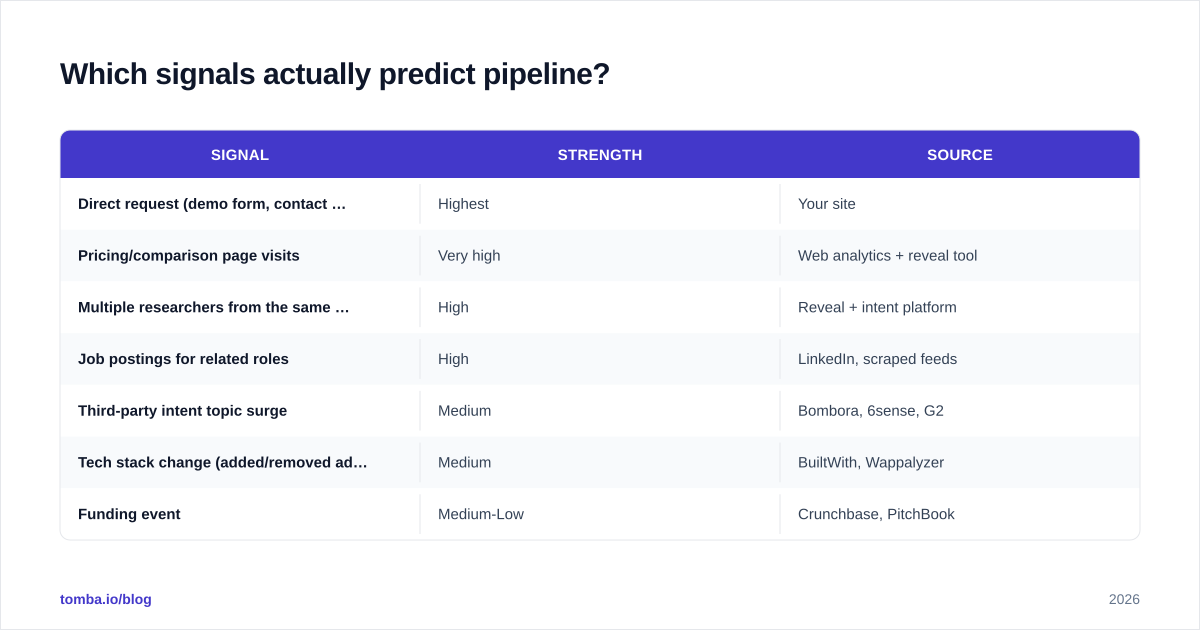
Not all intent is equal. After running this motion across hundreds of companies, the signal hierarchy roughly looks like this, strongest to weakest.
| Signal | Strength | Source |
|---|---|---|
| Direct request (demo form, contact us) | Highest | Your site |
| Pricing/comparison page visits | Very high | Web analytics + reveal tool |
| Multiple researchers from the same account | High | Reveal + intent platform |
| Job postings for related roles | High | LinkedIn, scraped feeds |
| Third-party intent topic surge | Medium | Bombora, 6sense, G2 |
| Tech stack change (added/removed adjacent tool) | Medium | BuiltWith, Wappalyzer |
| Funding event | Medium-Low | Crunchbase, PitchBook |
| Social engagement (likes/comments on your content) | Low | |
| Generic display ad impressions | Lowest | Ad platforms |
The combination is what matters. One signal is noise. Three signals from different sources inside two weeks is a deal trying to start.
What does the 2026 ABGTM tool stack look like?#
You need five layers. You do not need a separate vendor for each one.
| Layer | What it does | Example tools |
|---|---|---|
| Account/contact data | Build and enrich the list | Tomba, Apollo,ZoomInfo, Cognism |
| Intent + reveal | Surface buying signals and de-anonymize traffic | 6sense, Demandbase, Tomba Reveal, RB2B |
| Engagement (outbound) | Run sequences across email and LinkedIn | Outreach, Salesloft, Instantly, Smartlead |
| CRM + orchestration | Single source of truth, route plays | HubSpot, Salesforce |
| Measurement | Tie touches to revenue | Native CRM reporting, Bizible, HockeyStack |
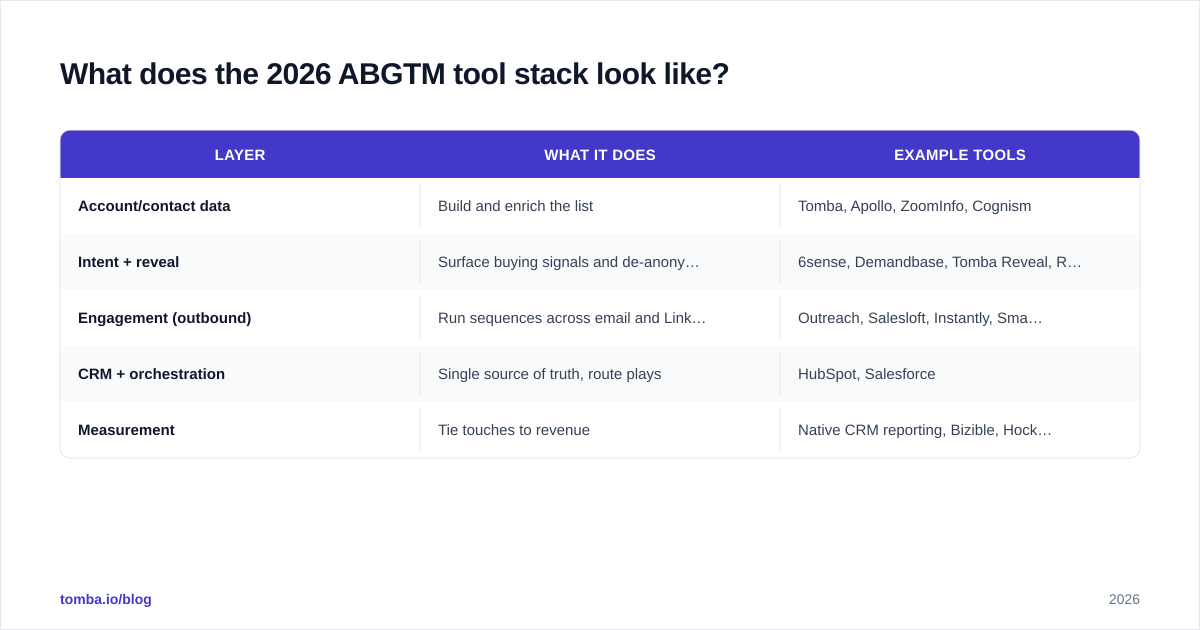
A scrappy mid-market team can run this on Tomba + HubSpot + Smartlead + an intent feed and be more effective than a competitor on a $200K/year Demandbase alternative stack that no one knows how to use. Tomba's Tomba pricing starts at $49/mo for the Starter plan, which is enough to power list enrichment for a team of three SDRs. The data sources behind it are documented at where Tomba gets data.
How do you measure ABGTM (without lying to yourself)?#
Ditch MQL volume as your North Star. It does not survive the ABGTM transition. Measure these instead.
Account penetration depth. Average number of engaged contacts per target account. Target: 3+ for Tier 2, 5+ for Tier 1. If you have one contact engaged at a 10-person buying committee, the deal is fragile.
Pipeline-to-target-account ratio. Pipeline generated divided by number of target accounts. Lets you compare Q over Q without account-list inflation skewing things.
Win rate on engaged vs unengaged accounts. This is the ABGTM proof. If accounts that hit "engaged" status close at 25% and unengaged accounts close at 5%, your motion is working. If they close at the same rate, you are doing expensive theatre.
Velocity to first meeting. Days from "account on the list" to "first qualified meeting." Should compress quarter over quarter as plays improve.
Cost per opportunity, by tier. Compare Tier 1 CPO to Tier 3 CPO. Tier 1 should cost more per opp but the deal value and win rate should justify it.
What are the most common ABGTM failure modes?#
Five recurring ones, in order of damage.
- Misaligned ownership. Marketing builds the list, sales ignores it, both blame each other when pipeline misses. Fix: one owner (usually the CRO or VP RevOps) signs off on the list and the play library. Quarterly.
- List too big. "Strategic" lists of 5,000 accounts are not strategic. They are everything dressed up. Cut by half and watch quality jump.
- No play library. Plays live in one rep's head. When they leave, the motion dies. Document everything in Notion or your CRM.
- Vanity engagement metrics. Display impressions and email opens are not engagement. A pricing-page visit, a demo request, a reply, or a meeting are engagement.
- Buying the platform before the playbook. A 6sense contract without a play library is a $100K/year invoice for unread dashboards. Build the playbook on a $99/mo stack first.
How does ABGTM differ for mid-market vs enterprise?#
The model scales down, but the levers change.
| Dimension | Enterprise ABGTM | Mid-market ABGTM |
|---|---|---|
| Account list size | 100–500 | 500–3,000 |
| Avg deal size | $100K+ | $5K–$50K |
| Sales cycle | 6–18 months | 30–90 days |
| Tier 1 effort | Custom microsites, events, exec gifting | Personalized video + handwritten note |
| Primary signal | Intent surge + committee mapping | Reveal + pricing-page visits |
| Stack cost | $200K+/year | $1K–$10K/month |
Mid-market wins ABGTM through speed. You don't have the budget for a five-person ABM team, so your edge is reacting to a signal within 24 hours instead of two weeks. The teams that get this right treat their bulk email finder workflow and their CRM as one motion — pull, enrich, sequence — measured in hours, not days.
What does a 90-day ABGTM rollout look like?#
If you are starting from scratch, here is the realistic sequence.
Days 1–30: foundation.
- Lock the ICP in a one-page doc, signed off by CRO and CMO.
- Build the universe and score it. Land on 300–500 Tier 1+2 accounts and 1,000–3,000 Tier 3.
- Pick one intent source and connect it.
- Document three plays — one per tier.
Days 31–60: pilot.
- Run the three plays against a 50-account pilot list. AE + SDR pair, weekly sync.
- Instrument the funnel. Engagement, meetings, opps, by play.
- Find the broken steps. Almost always: weak data, weak first-touch message, or no SDR-to-AE handoff.
Days 61–90: scale.
- Roll the plays out to the full list.
- Add two new plays based on what the pilot taught you.
- Build a weekly ABGTM standup: marketing, SDR, AE, CS in one room (or Slack thread). Review accounts, not pipeline numbers.
Most teams skip the pilot. Most teams then spend a year explaining to the board why "ABM didn't work for us." The pilot is non-negotiable.
Closing thoughts and where to start#
Account based GTM is not a campaign you launch. It is an operating model you commit to. The teams that win in 2026 will not be the ones with the biggest intent contracts or the most expensive ad budgets. They will be the ones that built a clean list, wrote down their plays, and showed up every week to review accounts together.
If you are about to run your first ABGTM motion and need the list-building piece sorted before you spend on intent platforms, start with the email and contact data. Tomba's Tomba Email Finder gives you verified emails for any company on your target list, the domain search pulls every contact at an account in one query, and the HubSpot integration drops it straight into your CRM. Free tier covers 25 searches a month — enough to test the list quality before you spend a dollar. Build the playbook first. Buy the platform second.
// get started
Find, verify and enrich your first contacts today
Start on the free plan with 25 searches a month, then scale when your team is ready.
Free plan · No credit card required · GDPR & CCPA
Get the Tomba newsletter
Product and data updates
// about the author